Showing posts with label John Saxon. Show all posts

Wednesday, 8 June 2022

The Girl Who Knew Too Much


Román Holiday

The Girl Who Knew Too Much
aka La ragazza che sapeva troppo
Italy 1963
Directed by Mario Bava
Arrow Blu Ray Zone B
As part of Arrow’s
Macabre Visions Blu Ray Set


First of all, I’d like to point out that for this re-watch of the classic giallo, I watched the Italian version of The Girl Who Knew Too Much and not the version re-dubbed and re-cut for the American market as The Evil Eye. The main reason being that there aren’t enough hours in the day to cover everything I want to cover on this blog but I mention this because the American cut is very different from the Italian version. Both have scenes exclusive of the others and additional differences, like the identity of the voice over narrative, give each film a slightly different feel, as does the extra emphasis on humour in the US version but, possibly, also a more organic version in The Evil Eye with regards to how the characters relate and bond. Both have slightly different endings too but I honestly can’t remember the last time I watched these... it was well over a decade ago so forgive me for not remembering more thoroughly.

And, I will get around to revisiting the US cut one day and, when I do, I’ll probably tack it onto the end of this review and republish it. I’m not sure I’d advise that the US version is better (as some people do) but, anyway, I’ve plumped for the version which would have been shown in Italian cinemas. This transfer of the film is from the barely released Arrow Blu Ray box set from a couple of years ago called Macabre Visions - The Films Of Mario Bava. I say barely released because this was so limited it sold out before it hit physical shops, just before Arrow’s licence for the films in it expired (from what I can tell, please enlighten me further if you know differently) and the shop I’d pre-ordered it from and paid a significant deposit with, informed me on the day that they couldn’t get it in after all and could only offer me a refund. I quickly jumped on the internet and grabbed what I believed was one of the very last copies on Amazon, which sold out later in the same release day, if memory serves. For people who missed out on this set, all I can say is that it’s probably not the last time we’ll see these on Blu and my gut tells me there will be a much more comprehensive (and costly) Blu Ray edition of Bava films from somewhere else at some point, possibly from one of the ‘usual suspects’ labels in the US like Severin or Vinegar Syndrome.

The Girl Who Knew Too Much is considered by many to be the first Italian giallo and, well, there’s certainly an argument to be made for it being the first famously remembered one at any rate. It’s shot in black and white by the late, very great Mario Bava who continues to prove, along with his earlier black and white movies (I think this was his last monochrome film where he was actually credited as the director rather than cinematographer), that he was just as much of a visual genius with a chiaroscuro tonal palette as he was with his amazing colour films. The claim that he more or less invented (not quite I think) the Italian giallo would be further enhanced when he released the brilliant movie Blood And Black Lace a year later (reviewed by me here) which really strengthens the claim although, of course, it was Dario Argento’s borrowing of the format in The Bird With The Crystal Plumage (reviewed here) in 1969 which really opened the floodgates of the genre from that point on.

The plot of the film is very simple but proceeds with a very convoluted unravelling to get to the resolution of what is, to all intents and purposes, a standard whodunnit. The film started out as trying to be a simple, romantic comedy in the Roman Holiday vein but Bava wanted to take the slight thriller aspects of the earlier script and push them full on. I don’t know when famous director Sergio Corbucci jumped on to write one of the screenplays but I’m guessing he was at least partially responsible for the way the material changed.

Either way, the plot deals with an American girl, Nora Davis, played by the extraordinary beautiful and interesting... and subsequently somewhat wasted in her short movie career... Letícia Román. She flies in to stay with an older lady friend in Rome for a vacation but, when the old lady dies and she tries to get to the hospital, in a sequence I’ll detail a little later, she witnesses a murder which is covered up the next day. The old lady’s doctor, Marcello Bassi, played by the dependable John Saxon, then tries to help her solve the puzzle as the killer appears to be honing in on Nora to be the next victim in the ‘Alphabet Murders’, the last of which happened ten years prior. She goes to stay in a new but absent friend’s apartment  (played by Valentina Cortese) that looks out onto where she saw the murder and she uses that as her base for the rest of the movie. And that’s pretty much all the plot details I want to give as I don’t want to spoil this for you. Although I will say that this is so early in the giallo cycle that the portrayal of the police as either ridiculous or incompetent is not yet a thing here. Instead, while they’re just as ineffective in terms of coming up with a credible investigation, they’re not portrayed as being bad at their job, as they would often be shown in various gialli as the years went by.

Bava’s shot compositions are, as usual, extremely beautiful and a constant all the way through this good looking movie. He will often do things like pitch a figure in one half of the screen in close up and then have the depth of the shot a lot greater on the opposite side of the screen (say where the corner of a wall gives way into a bigger space) to show a background which ensures your eye is focused on the figure in the frame. Another nice piece of directing the audience eye occurs when Nora is lured to a room in an apartment and the view from an open door as we look out at her from within, has the doorway showing the only details of the shot placed in an upright vertical slat of the screen representing the door, with all the rest of the frame either side as just black space... with Bava effectively shrinking the frame for that one shot.

There are also some great and quite long camera movements in the piece. Sometimes he’ll start off on a detail of a shot which doesn’t mean much and then move the camera to focus on a person or group moving through a space and then start following them before suddenly stopping as the character(s) move on, as he takes note of another detail in the background of the shot, for instance. Asides from the gothic tinged atmosphere he manages to achieve in the well lit streets of Rome at night, he also makes good use of the interiors, especially in a sequence where Nora sets a trap for the killer by sprinkling the floor with talcum powder and running a cats cradle of interconnecting string all around the house... it’s almost like Bava came up with the string just so he could photograph it, as it doesn’t really add anything to the plot in this scene.

The film is quite fast paced and Bava uses a lot of short, visual stings (almost) in the sequence which starts off with the death of the old lady. While Nora is putting some drops into a glass for her, not realising she’s passed away as she’s doing this, we get the reveal of the death as a sequence of four beautiful shots when she goes to give the old girl her medicine as... a close up shot of Nora’s face, a close up shot of the old lady’s face, a close up shot of a cat against a mirror signalling fright and then a beautiful shot of Nora’s hand dropping the glass in profile.

As the sequence carries on after Nora can’t raise the nearby hospital on a telephone, Bava really piles on the assault on Nora’s senses with another little sequence of short shots (something I don’t usually think of in association with Bava). So we see her get mugged for her handbag and knocked unconscious, then she wakes up and sees a woman who has been stabbed with her possible murderer pulling the knife from the lady before dragging the body away... causing Nora to faint again, then someone trying to revive her the next morning by pouring alcohol down her throat before he runs off when a policeman finds her and she wakes up again. The next sequence begins with an amazing shot of white nuns’ hats pressed together and looking like the petals of a flower before the nun’s heads depart from their close huddle, like petals peeling away and revealing the shot of Nora in a hospital bed (and only then do you realise what the ‘giant petals’ were when we see the nuns in a reverse shot). It’s all good stuff and the pace is certainly dazzling.

The acting and chemistry between Román and Saxon is great too (much more so than in real life, from what I understand) and there are certainly some hangovers, even in the Italian version, where the comedy of what must have been the original script is seeping through and invading the thriller element (such as the slapstick conclusion to the ‘talcum powder and string’ sequence). Bava manages to pull it off and make the elements work together even when, in some cases, Roberto Nicolosi's wonderful score is perhaps playing to the comedy a little too much (I can’t remember what Les Baxter’s score for the US version is like). In short, the ‘first screen giallo’, The Girl Who Knew Too Much, is an absolutely brilliant and entertaining movie and is up there with the director’s best. Any fan of giallo or, indeed, Italian cinema in general, should definitely take a look at this one. An essential film among many essentials in the director’s body of work, for sure.

Monday, 17 January 2022

Wonder Woman


Bullets & Bracelets

Wonder Woman/
The New Adventures
Of Wonder Woman

USA 1975 - 1979
Three Seasons
Blu Ray Zone B


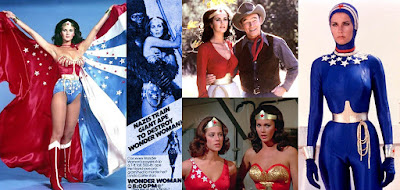
Following a somewhat muted attempt at a Wonder Woman TV show with a pilot starring Cathy Lee Crosby, in a much toned down version of the role (similar to a run on the DC comics around that time, when the character had lost her powers and become a kind of secret agent, I suspect) a new attempt was made to capture the lightning of the character (DCs top female superhero character, pretty much since her first appearances in Sensation Comics in 1942). A new pilot starring Miss World 1972, the great Lynda Carter, was commissioned... along with a couple of episodes. Then a gap as this first series proved good with the ratings and another load of episodes were commissioned, giving a total of 14 episodes in total made by Warner Brothers for ABC. Despite the popularity, ABC didn’t renew the contract but two more seasons were created for CBS, under the slightly revised title The New Adventures Of Wonder Woman.

Now, I didn’t really watch these as a kid. I saw a few episodes and liked what I saw at the time but couldn’t get over the fact that I’d managed to miss the Cathy Lee Crosby TV movie from the year before (it aired on the week I was away on holiday) and I found it hard to get invested in something if I couldn’t see all the episodes (even when I was six). By the time I was eight, though, I was very much interested in her as a pin up girl and I treasured any issues of Starburst, Starlog and the like which had photos of Lynda in her sexy costume.

However, visiting them properly now for the first time on Blu Ray (I’ll get to the 1974 TV movie when I finally get around to purchasing it), I can see just how great this must have been for young female viewers in the 1970s. Shows like Wonder Woman, The Bionic Woman and Charlie’s Angels, all of which had relatively strong female characters (while still operating with highly sexist values, it has to be said) must have had a considerable impact on women of the time and I’m so glad these were made. I came to Wonder Woman as an interesting character very late (asides from seeing her regularly on the old Super Friends cartoon show), when I grudgingly went to the first Gal Gadot movie... which completely blew me away and forced me to re-examine this character.

All I can say is, wow, this was a really great show. Especially the first series where you had Lynda as Diana Prince/Wonder Woman, Lyle Waggoner (who was just pipped at the post by Adam West for the role of Batman in 1966) as Steve Trevor and Beatrice Colen as Etta Candy (all characters from the comic books). These first season episodes were set in the 1940s during the war (as were the original comics penned by William Moulton Marston, although the TV show continues using his literary pen name, Charles Moulton, on the credits). This debut season was amazing in that it used a brilliant series of animated comic book panels for the opening credits (pitched against a rollicking song which was toned down more and more each season) and the comic book style would continue into the story so you’d have comic book drawings become photos and the constant use of captions superimposed on the live action footage such as ‘Meanwhile’ and so on. One minor problem in the writing, perhaps, was that the villains were always the ‘Nazi of the week’ during the first year but, heck, the entertainment value was high and she also had her ‘invisible jet’ in this season. I don’t recall if it was used more than maybe only once more from Season 2 onwards... which is strange because I can remember that invisible jet being a hugely popular thing when I was a kid and the recent Wonder Woman 84 movie (reviewed here) also features an homage to it.

Like later seasons, the show was peppered with guest stars, many of them big names and one of the fun things about watching the various incarnations of the show now is spotting the various people who were either nearing the end of their careers or just starting out. There were people like Frank Gorshin, Roddy McDowell, John Saxon, Ron Ely and Ann Francis turning up in various shows. Even Roy Rogers was in one, although he refused to work with Carter until they got her some Western style clothes... so Wonder Woman has a new cowboy themed look to her costume for that episode (which actually works quite well, it has to be said). Also, a young Debra Winger was in a few episodes as Diana’s sister, Wonder Girl for the first season, although she bought herself out of the contract and turned down offers for episodes in a future season and her own spin off series (I’m currently reading Elvira’s wonderful autobiography and I now know why that particular piece of casting came to be).

For the second season, the show was updated to contemporary times... which was fine with the Wonder Woman character, as she’s not supposed to age. However, Lyle Waggoner also returned, this time playing the son of the character he'd played in the first season, also called Steve Trevor. This version of Trevor works for the Inter-Agency Defence Command (IADC) and, following an opening episode which half plays as a repeat of the first season pilot, Diana becomes an agent working under him. However, the revamped show lost its ‘comic book’ visual connections and, although the villains in the stories were more varied in their motivations, it did kind of lose a little in the updating. Especially when a ‘funny computer’ and a ‘funny robot’ were thrown into the mix.

In the third from last episode of Season 3, the show’s producers went for another reboot and Diana moves to LA, to work for a different branch of the IADC... introducing a whole host of new regular characters including a streetwise, Gary Colemanesque kid, a chimpanzee and an invincible man. This must have been made after the last two episodes (which were aired a little later as specials) because, in those two (which make up a single story), Diana is back in Washington and working for Steve Trevor Jr again. So yeah... I would have liked to have seen it continue but, honestly, not in the new format they were steering towards for an LA version of the show so... perhaps it’s best it ended when it did, with 60 episodes under its belt.

Still it’s a really interesting series but I did notice it always kept reinventing itself a little more than I would have liked... which is my polite way of saying it kept changing the rules. For example, the famous spin created for the TV show, where Diana Prince transforms into Wonder Woman, is shown as it should be for the first three episodes. It’s slowed down and shows Diana moving at super speed and throwing off her outer clothes to change costume. But it was time consuming (and therefore expensive) to keep doing that and locking off the camera before a 45 minute make-up and costume change so... pretty soon they developed a magical woosh superimposed over the two parts of the spin to bridge the footage and, it looks fine and is a staple of TV nostalgia now (again, there are even a couple of very subtle references to them in the Gal Gadot movies) but it’s also problematic. And the reason it’s problematic and the reason I say it’s reinventing itself is because the rules of Diana’s powers change over time due to this. When she’s tied up or imprisoned as Diana, she no longer has her powers unless she’s completed her spin in later episodes. So she becomes more like a Billy Batson changing to Captain Marvel style character, when he used to have to shout SHAZAM! to change and gain his powers. She is vulnerable when she’s Diana Prince which, obviously, is total rubbish and not the way the character is supposed to work at all. Not how she did work in the earlier episodes, where she had various other powers such as the ability to mimic any voice, many of which were dropped for the post-season one incarnations of the show. There seems to be a definite lack of consistency as the show develops as to what she can and can’t do and, if you’re watching them back to back in a compressed time slot as I just did, you’ll notice these little changes more.

And there’s a heck of a lot more I could write about this show, actually. I wrote a lot of notes as I watched but, honestly, I don’t want to write a book on the subject (although, if anyone wants to commission me to write a book on the first of the Gal Gadot movies, I’d be happy to oblige). Unless you want to read about me getting annoyed about how every corporation depicted in Season Three having exactly the same bizarrely shaped coffee mugs and things like that. Suffice it to say that Lynda Carter totally nails it in the role and is an amazing hero who, I guess, happened to hit at the right time when she was needed by an audience that appreciated her. The only thing which occasionally grates is the big, cheesy, freeze frame grin she gives at the end of pretty much every story but, honestly, she’s absolutely brilliant in this and I’m surprised she didn’t go on to do more higher profile things in Hollywood once the show had ended. 

 If you are interested in the character then this show, despite its differences to the comic, does not let the character down too much and the title role is a strong, positive role model for people, as far as I’m concerned. Or if you don’t want to go the long haul, maybe give Season One a spin, where the visual style of the comic book source material is played up  in a really nice way... something which should never have been dropped in my opinion. Anyway, the recent Warner Brother Blu Ray set of the entire three seasons of Wonder Woman is definitely worth a twirl, whichever way you look at it.

Sunday, 12 June 2016

Tenebre (aka Tenebrae)


Giallo Dolly

Tenebre (aka Tenebrae)
Italy 1982 Directed by Dario Argento
Synapse Dual Blu Ray DVD Zone A/Region 1 Steelbook


1982 was a really great year for movies. We got Star Trek II - The Wrath Of Khan (reviewed here), John Milius’ original Conan The Barbarian, John Carpenter’s The Thing adaptation and, my personal all-time favourite, Blade Runner (reviewed here). We also got what I think is one of director Dario Argento’s absolutely best movies... Tenebre (aka Tenebrae).

It’s been a while since I’ve watched the movie but it’s one of the two Argento films I saw back to back on TV a couple of decades ago and, notably, Tenebrae was still stupidly censored in our country. I’ll get to the ridiculousness of that particular cut a little later on but what it did, of course, was made me pursue all of Argento’s films on DVD, with the release of various uncut, good quality releases in their correct aspect ratios available in different countries and easily playable once I was armed with a low priced multi-region player from my local Tesco (the fact that you could also buy the original Buster Crabbe Flash Gordon serials on US DVD at the time was another big incentive to get myself multi-regioned up).

Now, with the appearance of Blu Ray, I can’t really re-buy all the 3000 plus movies I have on DVD again... especially when there are so many other previously unreleased movies still being unearthed around the globe. Argento, however, is one of the directors whose films I would at least be happy to upgrade ten or more of. So I leapt at the chance when I heard of this new US Synapse three disc dual format version of one of my favourites... primarily because the third disc is a remastered edition of Goblin’s classic score for the movie. That being said, they’re not allowed to be credited as Goblin on this film because the line up had slightly changed and there were some legal issues, I believe... so, to this day, the music is still credited to Simonetti-Morante-Pignatelli. It’s one of their greatest, however, and if you want to know what a “disco slasher” sounds like... this score is it. I’ll always remember those old vinyl soundtrack adverts on the back of Starlog magazine as a kid in the 1980s, with the lurid Tenebre cover of the girl’s head hanging down and the broken glass panel going through the back of her neck. It pretty much became an iconic image... once seen, never forgotten.

The film starts off with the fictional thriller novel of the title being read from (by Argento himself, if you choose to watch it with the Italian language track on) and the book is then thrown on a fire to be devoured by flames as Goblin’s (sorry... pseudo Goblin’s) score kicks in. We then follow a shoplifter played by Ania Pieroni, who had made an unforgettable appearance in a cameo as the third mother (The Mother Of Tears) in Argento’s previous film, the Suspiria sequel Inferno. Here she is pursued by her killer, represented voyeuristically with a following camera eye which is, possibly, overused as a visual prop in this movie but, frankly, is so stylishly done that I really don’t mind it here. There’s some absolutely beautiful moments in this early sequence with the camera stalking her with Argento’s keen eye watching her from behind a rack of goods in a shop, stopping and starting the movement in time as she is framed perfectly at every stop by a gap in the display shelf packaging. It’s just these kinds of sequences which keep me interested in Argento and the giallo format in general.

After getting herself into various bits of trouble with antagonistic forces of one kind or another, Pieroni is attacked by the black gloved killer, force fed pages of the fictional book Tenebrae (written by the lead character, Peter Neal) and then slashed to death with a straight razor. When we finally meet Peter Neal, played by Anthony Franciosa, who is visiting Italy to do a tour for his book, he is already being included in the investigation of this and other similar murders. Heading up the investigation is Detective Germani, played by the extraordinary Spaghetti Western star Giuliano Gemma and, in typical giallo fashion, he checks back in with the main protagonist, in this case Neal, who starts to get involved with his own investigation. As you would expect from this genre, the bodies start piling up and it’s not long before everyone you expected to be the killer is gradually murdered, leaving us with few people left in the cast who the antagonist could be.

Tenebre is somewhat overshadowed, I think, by the Bava drenched colours of the two Argento films that came before this one (Suspiria and Inferno) but I think it’s a much maligned movie in that respect, in that it’s easily one of the greatest of the gialli ever committed to celluloid. Contrary to the title of the piece, the film is all bright light with shiny, reflective surfaces and architectural details. Although the big city landscapes are quite blatantly modernistic, I think it’s often forgotten, or mostly completely overlooked, that the film was intended to be set in the near future. But whether people take that away from this or not... one thing for sure is that it’s one of the most hyper-real and typically outstanding giallo movies that Argento ever made.

For example, on a visual level, similar to the sequence I described with the tracking camera in the shop, Argento uses a lot of vertical lines to split up and separate different people into specific, multi-layered spaces... challenging or creating perspective as he captures his performers doing their thing. There’s a brilliant shot, for example, towards the end of the movie with Anthony Franciosa and Argento’s early muse Daria Nicolodi (the mother of their daughter, the actress and director Asia Argento) standing back to back, with Nicolodi in the foreground and Franciosa a little further away, where the two planes are artificially split by the vertical of the middle of the frame of a set of windows they are standing in front of. Absolutely incredible stuff.

Another celebrated shot is the one which starts off outside the window of a lady's apartment looking in, travels in close up around the building a bit, enters her lover’s room upstairs through another window, comes back out again and goes “around the houses”, so to speak, before ending up back down in the original woman’s room. This is a prelude to a brilliant double murder, committed against the two lesbian lovers, with some breathtaking shots including a razor blade slicing a big hole in a t-shirt to reveal the face of the girl who is in the process of putting it on... and the celebrated ‘head through the glass panel’ shot I mentioned from the old vinyl album cover earlier on. And there’s an exceptional shot of a straight razor striking the side of a lightbulb to shatter and extinguish it which really does stick in your mind long after the film is over.

There's a truly great visual flourish at the end of the movie which certainly shows Argento's influence on his contemporaries and the rich visual legacy the next generation of film-makers have in their arsenal. A character in the centre of the shot bends down to inspect a possible clue and the killer is revealed behind him taking up the exact same visual space. When the character stands up again, his head replaces the head of the kiler in the shot exactly, once more. I think you'll find that this exact same shot set up is recreated by Brian De Palma in, I think, Raising Cain, if my memory is working properly.  So clearly an influential director... of that there can be no doubt.

In typical genre fashion, any number of characters are built up as possibly being the murderer but, like all good gialli, your suspicions are shifted constantly the more you watch (and, as I said before, the more your suspects end up as just another gory death for the killer’s roving, camera eye). However, Argento also does something quite clever in terms of the final solution of the puzzle of just who the killer is in this one but... I really don’t want to spoil the chance that you might figure it out for yourself, if you’ve never seen this movie before. But, yeah, it’s a typical example of the genre in that Argento manages to subtly, and often not so subtly, set up pretty much almost everyone in the film to possibly be the killer.

It’s also a film where Argento gets to poke fun at his critics too, which is kinda nice. He took a lot of flack in the 70s and 80s for being a misogynistic director but the arguments for that have always seemed quite false to me. For instance, there are almost as many men being killed off in imaginatively gory ways in his films as their are women. Also, giallo movies are abundant with both female killers and strong women who survive to the end of the movie as the ‘final girl’ trope of many horror movies. I don’t think you can call that particularly disempowering or hateful, to be honest.

This also has, as far as I’m concerned, the best script of any of Argento’s movies in terms of credible dialogue and Argento uses it quite well in one particular line, where he argues exactly in opposition to the myth that somebody who makes violent art is a violent person. The line comes from the Peter Neal character in the movie, whose books are being used by the killer as a justification for his own actions... at least in the first half of the film. Frankly, we are all living in a real life world where a notorious serial killer was inspired in his killing by the George Lucas movie Star Wars Episode VI - Return Of The Jedi... so any argument that giallo or horror films are a catalyst due to their content dies with that reality, as far as I’m concerned. The line itself, spoken to the police inspector is “If you find someone killed with a Smith and Wesson revolver, do you go and interview the president of Smith and Wesson?” This is a fair point, I think, and definitely raises the question of whether the manufacturer, or the artist in this analogy, should be held responsible for the way people choose to respond or react to their product or art.

There’s also a particularly comical moment in this one where John Saxon, who has hilariously demonstrated in an earlier scene that his new hat doesn’t fall off, finally gets caught up in a particular incident where his headwear heads to the floor and this involves the death of one of the male characters (I’m being cagey here about the identity of that character because I really don’t want to give anything away to people who haven’t seen this movie yet). But these kinds of little details and clues in the script are what help make Tenebre one of the absolutely greatest and credible of the films made in the giallo genre and for me. It stands the test of time with other classic Argento gialli such as Deep Red (aka Profondo Rosso, reviewed here), The Bird With The Crystal Plumage and Four Flies On Grey Velvet.

The film is presented uncut and the UK version is also uncut, nowadays. This main censored scene in previous UK versions featured the actress Veronica Lario, who went on to notoriously marry Silvio Berlusconi at one point in her life. Here, she is waiting with a gun in her hand when an axe comes through the window and severs her arm halfway up, above the wrist. She then gets up and paints the clinically white walls red with the arterial spray of her blood. The comical thing about some of the previous, censored versions, is that the BBFC in our country (for example) decided that the actual axe going down into the arm, which is relatively tame compared to the aftermath, was excised from prints but... the truly ostentatious goriness of the moments following, were always left completely in tact. How insane is that? Just another odd thing to show that censors were really bizarre when it came to doing what they saw as their job.

The disc itself sports a lovely transfer of the film and includes several extras including a feature length documentary on the history of the screen giallo, with maybe just a little over emphasis on Argento’s huge contribution towards popularising the format himself. The documentary includes comments from a number of genre experts (one of whom I wish wasn’t included in this film as an expert of this particular subject, for reasons I won’t go into here) and it’s great to see such brilliant testimony from such cool people as Alan Jones, Maitland McDonagh, Kim Newman and a variety of writers and directors of these kinds of films too. I do wish, though, that people would stop holding up Michelangelo Antonioni’s Blow Up as an example of a giallo film in order to somehow legitimise the genre to people unfamiliar with it, to be honest. I really can’t see how Blow Up, wonderful as it is, could ever be considered a giallo, bearing in mind how many of the genres tropes and intents it fails to demonstrate. Also, the music that plays throughout the majority of the documentary is also from the main feature presented here. Not particularly surprising, given the expense of music rights, but still something which might have been better served with a decent mixture of Morricone and Cipriani mixed in with the Goblin, methinks. But this is a minor criticism of a great little US Blu Ray set of this film.

If you’ve never seen Tenebre and you are a fan of the genre then this is a near perfect giallo and, also, an absolutely brilliant jumping on point if you’ve never seen one of these movies before. An incredibly beautiful film to look at with traditionally clunky but ‘still much more credible dialogue than most gialli and with some just jaw droppingly stunning set pieces in places. Definitely something everyone into Italian film should see at some point. No wonder Dario Argento is still thought, rightly so, as the master of his craft.

Wednesday, 24 September 2014

Battle Beyond The Stars


The Seventh Steal

Battle Beyond The Stars
1980 USA 
Directed by Jimmy T. Murakami and Roger Corman (uncredited)
Shout Factory US DVD Region 1

I guess readers below a certain age won’t understand why a film like Battle Beyond The Stars was a big deal with its target audience back when it was released in 1980. It is, after all, a notoriously cheap (although not by Roger Corman’s standards, since the film cost $2 million to make) remake of a classic which is 100 times better than either this or its more famous remake from 1960. Let me give the baffled among you a little bit of context though.

The “space opera” arm of sci-fi had just re-emerged at cinemas again, three years earlier, with the release of George Lucas’ classic Star Wars. There were a fair few bandwagon films like the theatrical release prints of the Battlestar Galactica TV show, Disney’s The Black Hole and the big movie budget version of Star Trek - The Motion Picture coming out around this time to cash in on the success, not to mention much smaller vehicles like Star Crash and The Humanoid. However, sci-fi films were still relatively scarce occurrences at the local cinema so any excuse to go and see the latest extravaganza was always taken. Some of the special effects may look a little ropey today (not as ropey as some of John Sayle’s dialogue in this one, for sure) but in those days it was state-of-the-art and every kid fresh from being reminded of the joys of science fiction from the release of Star Wars: Episode V: The Empire Strikes Back (reviewed here), earlier the same year, would have rushed their parents out of the house straight into the cinema to see this one.

I loved it just as much as everyone else, of course. I think I ended up seeing it three times at my local ABC cinema (now a Tesco car park) and I even remember one of my cousin’s rare visits to Enfield to see it with me, one afternoon. I knew that Shout Factory had produced this deluxe edition DVD and snapped it up when it came out (in hindsight I should have waited for the Blu Ray) but it’s taken this long for me to make some time to watch it and, as you can imagine, I was curious to see how it held up nowadays.

The film starts off with the planet Akir (named after director Akira Kurosawa, for reasons which will quickly become apparent), home of Shad... as played by Richard Thomas (John Boy Walton himself), being threatened with destruction if the planet doesn’t give up its crops and resources to evil Sador (played with villanous relish by John Saxon with a “Donald Pleasance as Blofeld” style scar/make up enhancement on one of his eyes) on his imminent return to their star system after a small time period. All the residents of Akir know is dusting crops and lounging about in simple clothes but they dig out their technological relic of a starship, from decades gone by, and send John Boy, sorry, I mean Shad, out into the galaxy to rustle up a cheap, rag tag team of space mercenaries to return in their spaceships and help defend the planet from the evil Sador.

And if this is all starting to sound just a little bit familiar with you by now, you’ve probably recognised that this is a remake of Akira Kurosawa’s original Seven Samurai. And the film very much follows the main, basic plot points of that movie but condensed into a much shorter running time and with some quite nice and often quite solid sci-fi decoration. I was surprised to see, as I watched this, that the film holds up a lot better than I expected it to after all this time and there are some nice little, well thought out details in this which are worth the price of admission.

Scenes, for example, such as those of one of the main female characters repairing a robot as she plays music by inserting a tape (or advanced technology equivalent of a tape) into a slot into the androids torso... so it can sing the contents to her as she works. Or Shad’s ship whose argumentative female personality talks to him and banters with him throughout the whole film... even going so far as to take matters into her own hands by destroying an enemy ship. When Shad points out to her that she just broke this movies conceptual steal of the first of Isaac Asimov’s Three Laws Of Robotics (yeah, funny how everyone uses those... for good reason) she retorts something along the lines of , “Yeah. It’s a stupid law!”... which was quite a refreshing attitude at the time.

That ship, Nell, by the way, has got to be one of the most beautiful spaceships ever designed for a movie. Resembling, quite deliberately, a giant pair of boobs to rival those of one of the lead actresses (yeah, don’t worry, I’ll get to her in a minute) it’s like a giant, flying, sea ship’s figurehead with the arms, legs and head cut off to just leave a beautiful torso that flies and swoops through space. One of the most unique and spectacular designs of 1980s science fiction by my reckoning. Corman must have liked it too because he recycled all the footage of it and used it as the main spaceship in at least two of his other science fiction movies subsequent to this... which is about right when you think about Corman’s notoriously groovy cost cutting measures on his movies.

There are some pretty interesting actors in here too, with George Peppard playing the Earthman “Space Cowboy” and hamming it up with the best of them like there’s no cheque in the post after this gig. Also, we have the addition of Robert Vaughn playing Gelt, a very similar character to the one he plays in John Sturges well loved 1960 Seven Samurai remake, The Magnificent Seven... asides from the “lost my nerves, cowardice” aspect of the character, which gets ditched here. In fact, some of the dialogue in Battle Beyond The Stars, and with Robert Vaughn’s character in particular, seems to have been lifted pretty much intact from The Magnificent Seven, it has to be said, There’s also a vague attempt to have Gelt inherit this movies equivalent of the Mexican kids who follow around Charles Bronson’s character at one point but, this is only a token reference and I’m not quite sure, to be honest, why they decide to use it here without following it up later in an appropriate sequence.

And, of course, no look at this movie would be complete without a mention of every young boy’s dream made celluloid flesh in the presence of Sybil Danning as St. Exmin of the Valkyrie. They manage to pop one of the most buxom and boobage blessed Austrian actresses of all time, give her some of the skimpiest outfits which make you feel like she’s going to just pop out by accident any minute, give her some specific lines about sexuality (which wasn’t that normal for something which was being sold as sci-fi space opera to kids) as well as giving her the most memorable and oft quoted mantra of the movie... “ Live fast, fight well, and have a beautiful ending.” I’ll bet a lot of young, adolescent teens went home and thought about a whole lot more than space opera when they left the cinemas after seeing Sybil in this movie (yeah, me included).

There are two other things this movie is quite notable for, that I can remember.

One if that it employed a young James Cameron on the special effects crew (listed as art director but I’m guessing he was doing a lot on this production) and it’s reportedly where he met his future wife and movie making partner Gale Ann Hurd, which led to the directing of his second feature, The Terminator.

The other thing this film has is a terrific score by James Horner. Sure, it’s reused in numerous other Horner scores and also borrows from composers like Prokofiev, but however you view Horner’s rampant borrowings, there’s no denying that he writes entertaining scores and this is one of them. However, it's said he’s never been happy with the performance of the orchestra on this score so nothing other than the original album master has ever been used for score releases over the years... which is a shame because I, and a lot of other people, would love to get their hands on some kind of expanded remaster of this one. However, the obstacle to release on this one seems to be Horner himself so, at the time of writing this, it looks like there’s not going to be any movement on that front for a while (probably not in my lifetime, I expect, which is a shame... for me).

And what more to say about this one. At times it’s cringe inducingly embarrassing and at other times a certain worthiness shines through its small budget. It’s not the best movie in the world and it’s certainly not a good remake of Seven Samurai, but it is one of the better put together of the “ride the Star Wars band wagon” films that came out at the time and I’m sure youngsters, and the much older variety of youngsters, will get something out of it even now. And it’s surely worth it to see Sybil Danning rocking and almost popping out of those groovy costumes. One that should not go forgotten, I think.