
Mother Nature
Inferno
Italy 1980 Directed by Dario Argento
20th Century Fox - Arrow Blu Ray Zone B
Warning: Some spoilers here.
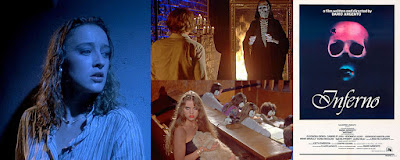
Following on from the success of his phenomenal film Suspiria (reviewed by me here), the great Dario Argento made a movie with mostly American finance which, honestly, shouldn’t be overlooked as, like many of his films, it’s a truly beautiful looking picture. Also, it’s one of the few horror films in his CV (he mostly directed gialli) and it’s a direct sequel to Suspiria, being a second helping of the story of another of the Three Mothers (or Three Witches) who Daria Nicolodi and Dario Argento cribbed/were inspired to create from a few pages in Thomas De Quincey’s sequel essay to Confessions Of An English Opium Eater (and which is often bundled in with that book by publishers).
Now, the directing genius Mario Bava helped out Argento on this one on special effects although, I’m now hearing that while Argento was ill, Bava directed whole sequences and Irene Miracle says, according to a source, that Argento wasn’t on the set during her shoot for the film. Either way, I can’t start pulling this film apart and assigning scenes to who I thought might have directed different portions of it so, for me, this is an Argento film and it surely has some of the key features of Suspiria mixed in with it, such as the strong, vibrant colours pitched against each other in the lighting (which is admittedly a Mario Bava signature but it also very much came to be an Argento fingerprint on a lot of his movies too).
The plot is very thin, as you would expect form an Argento film and it’s just the principle protagonist, Mark played by Leigh McCloskey, wandering around Italy and then, for most of the picture, an apartment building in New York (home to Mater Tenebrarum, the Mother Of Darkness), trying to find his sister Rose, played by Miracle. That beings said, Argento films are never about the story or even the acting and this one is no exception. It’s all about atmosphere and the unbelievable visual feast of eye and ear candy that the director lavished on the senses of the audience.
The film lulls you in with Rose reading from a fictional book by the architect Varelli, talking about DeQuincey’s Three Mothers. Then, all of a sudden, the brilliant Keith Emerson score comes crashing in with the title of the film and then, as the credits continue on an angled shot of Rose from above, in a very slow zoom, the music stays strong and really pulls you in.
This one is very focused on Argento’s obsession with architecture and three quarters of the film are about moving the characters in small adventures around the New York building. The shot design is mesmerising stuff and, as he often does, Argento uses a lot of moving camera where he completely moves around the space without tearing apart the compositions as he goes, framing actors in portions of the screen in areas made by various horizontals and verticals of objects or architectural features of the sets. Indeed, there’s an elaborate sequence where Daria Nicolodi is watching Mark’s unconscious body being dragged across the floor from a window opposite and... it’s a gridded window so, of course, when the killer relaxes his grip on the body, Mark's head is perfectly framed in one of those small squares. This film shows Argento at the top of his game and I think it’s this period of his career, or his slightly earlier phase, that people think of when they recall the ‘golden age’ of this particular director’s output as an artist.
The use of various connections of acoustical egress and access via grills and ventilation shafts in the structure of the New York building does, of course, play to the director’s favourite modus operandi, as he moves the camera around cramped, interior crawlspaces to show the journey of a conversation. But, the real triumph of artifice over nature, which often highlights his work, is seen in a brilliant shot where a man simply gets out of an elevator and walks into a corridor. I remember the very first time I saw this movie, maybe 20 or more years ago, I had to backtrack on the DVD I was watching it on because I couldn’t work out why the man was holding his right leg at a funny angle in a quite unnatural pose as the doors open. However, when you look to the left of screen and see one of various windows which you see more of as the camera backs away from the angled shot to follow the progresss of the man down the corridor, you realise that those windows all have a very thin, black slanted separating line and the man’s leg, held at the same angle for a second or two, was a deliberate visual echo to the environment he finds himself in. Totally artificial, of course but, an interesting detail, none the less.
There are also references to earlier Argento ‘moments’, if that’s the right word, such as one of the killers (the film seems to have a few ‘agents’ of the Three Mothers) being reflected in the broken piece of a glass door handle, something which plays on Argento’s use of reflective surfaces up to that point. There are also things in this which I’m sure are references to other artists, such as the ants crawling on Mark’s hand in a scene which, although they actually do become a slight story point later on, I’m sure are there as a little visual homage to Dali and Bunuel’s Un Chien Andaleau.
Despite the vibrant colours in some of the film recalling Suspiria, this movie seems to have its own atmosphere to it, although the director does go out of his way, it seemed to me, to recall certain moments of the previous ‘installment’ in this as, almost a way of engaging the audience and giving them more of the same. There’s a scene with Sacha Pitoëff as a particularly unpleasant character, for example, where he is being picked off by rats in New York’s Central Park (which I believe was rebuilt in a studio in Italy, if memory serves) and a hot dog vendor who you assume is running to his aid but actually hacks away at his neck with a knife once he gets to him... which almost recalls the unexpected moment when the blind man gets killed by his own dog in Suspiria. Also, a lot of the dialogue in the movie sounds particularly childish, such as the deliberately child-like dialogue in the former film... which does no favours for the actors here, I’d have to say.
The very first time I watched this movie I was particularly unimpressed with Leigh McCloskey’s performance and thought he was a bad actor. Now that I watch it and, taking into consideration the dialogue and atmosphere of the thing, I realise that this must have been a quite deliberately minimal performance and it’s actually perfect for the film. McCloskey does a brilliant job here and, in a scene where he’s overwhelmed by the presence of the Third Mother (Mother Of Tears) in a music lesson in Rome, I realise now that his performance combined with the misé en scene and Ania Pieroni’s performance as Mater Lachrymarum... is a masterpiece of visual film making, no two ways about it. A sequence which absolutely transfers a sense of slow burn, oozing intensity onto the viewer. Really wonderful stuff. And, of course, Mark taking ill and also the exploding, burning building around him as he makes good his escape at the end, also recall similar moments from Suspiria.
Missed opportunities abound, of course, in terms of Ania Pieroni since she did not reprise her absolutely brilliant performance as Mater Lachrymarum in the third part of the trilogy made 27 years later... nor, indeed, in Luigi Cozzi’s closely related movie The Black Cat, nine years later. But she does a good job here in her two small scenes and she really adds to the film, I think.
Emerson’s music is one of those Argento scores which, at first, seems out of place and sometimes inappropriately placed... until you get used to it and realise just how outstanding it is. When his song Mater Tenebrarum kicks in (which is also nicely covered by Claudio Simonetti’s group Daemonia on a couple of their albums), it’s totally unexpected but absolutely fantastic and it feels like, rather than try and fit itself to the on screen action, the visuals are trying to keep up and fit themselves to the music... it’s quite an ear opener of a sequence, for sure.
And that’s me done, for the time being, with Argento’s Inferno, although this really is one of those films which a lover of cinema can never be completely done with... it’s something which I’m sure I’ll revisit many more times over the course of my life. Another Argento masterpiece and as great a contribution to horror cinema as you can get... it just looks so beautiful.


