Showing posts with label Kim Newman. Show all posts

Saturday, 25 October 2025

Anno Dracula


Ripping Yarns

Anno Dracula
by Kim Newman
Titan Books
ISBN: 9781803361864
Signed 30th Anniversary Edition
including new Anno Dracula short, 
The Chances Of Anything 
Coming From Mars


Warning: A kind of spoiler... but not really.

So it’s been about 30 years since I last read Kim Newman’s masterwork Anno Dracula. I only read it the once but it became one of my favourite books, being one of the first I’d read where various literary and real life characters collide in a fictional confection of some substance. A year or two after, remember that this was in the days before the internet really took hold and people couldn’t find out about things like new release books unless they saw them in a bookshop, I stumbled on a second-hand hardback copy of his sequel, The Bloody Red Baron. A year or two later, again, while holidaying in Llandudno, I discovered in a remaindered bookshop his third and, for a good long while ‘final’, Anno Dracula tome - a new hardback copy of Dracula Cha Cha Cha. They were all brilliant and all told tales, set in a different decade, of an alternative history of the world after Dracula had in fact ‘won’ at the end of Bram Stoker’s novel, seduced and married Queen Victoria and created a London... and world... where vampires and ‘warms’* lived in a dubious harmony. 

When Newman started writing new Anno Dracula books, not all that long ago, I decided to buy the new annotated editions with the extras and go through all of them again. But I was stalled until the announcement of his new 30th anniversary edition, signed by the author in hardback with red sprayed page edges and attached cloth bookmark. I certainly couldn’t resist and bought all the Anno Dracula tomes I could find.

This one hooks the reader in straight away. It’s not really a spoiler to say that it deals with Jack The Ripper’s reign of terror in London and that, from the very first chapter, the reader is made aware of the identity of The Ripper... so stop reading now if you really don’t want to know but, honestly, it’s not a whodunnit, so it’s revealed straight away. Revealed, as it happens, in a ‘cover version’ of a famous, fictional murder by Jack The Ripper, that of Lulu Schön in Wedekind’s Pandoras Box (more famously remembered these days as the role which made Louise Brooks a household name... I saw Joanne Whalley play the part on stage in the 1990s and she also did a good job with it). In this alternate riff on the final scene of that play, Lulu is a vampire prostitute and Jack The Ripper, known at this point as Silver Knife, because he is cutting up vampire girls and you can’t do any damage without silver, kills her and goes back to his sanatorium. For it is revealed straight away that this is what has become of Bram Stoker’s character Jack Seward.

The rest of the book is about Charles Beauregard of the famed Diogenes Club (from Sherlock Holmes, the club still being run by brother Mycroft), given the task of finding the killer as Jack takes out his real life victims one by one... as his way of getting back at Dracula for what he did. Aiding him are the Si Fan, lead by Fu Manchu and his daughter from Limehouse and, the long lived ‘captured at 16 year old’ vampire heroine of this and a few of the other Anno Dracula novels, Geneviève Dieudonné. Not to be confused with Kim Newman’s other vampire character of the same description written under a pen name, also called Geneviève Dieudonné, from his Warhammer books (yeah, it gets kinda confusing). 

And it’s great stuff which, despite the number of references to other literary characters and events, is very much its own story... and an extremely well written one at that. As writer Neil Gaiman says in his introduction to this new, deluxe edition (honestly, who’d have thought it would come to a deluxe edition... nobody had heard of it when I first read it and it seemed to almost flounder in obscurity), the window dressing never gets in the way of the story. 

But such brilliant window dressing. Lots of the usual suspects turned up either named as such... like Dr. Jekyll, Mr, Hyde, Dr. Moreau, Colonel Sebastian Moran (accomplice of one Professor Moriarty, if you remember your Conan Doyle), Varney The Vampire and even, Count Orlok, the iconic ‘bootleg Dracula’ from the 1922 movie Nosferatu, who is put in charge of the Tower Of London after certain events take place in this book. Those who aren’t actually named are certainly alluded to, perhaps due to copyright restrictions... so there will be no doubt just who you are reading about when it comes to characters like Dr. Fu Manchu, for example or, in one wonderful moment where the costume and speech of a character makes the reference quite clear, a temporally displaced version of Carl Kolchak. 

There’s also some interesting characters from real life, too numerous to mention but a special shout out to Florence Stoker (husband of Bram... who has himself been sent to the notorious English concentration camp Devil’s Dyke, along with such anti-vampire factions as Sherlock Holmes) and also to John Merrick, The Elephant Man and his own part in the novel’s finale. 

The descriptions of the lifestyle and feeding rituals of the various vampire characters are well done, especially when Charles’ fiance is ‘turned’ and the politics of the piece, witnessed by such people on the street as vampire Inspector Lestrade, are actually quite chilling and do, it seems to me, reflect politics in ‘not so Great anymore Britain’ even more now than they did when the novel was first published, three decades ago. 

However, it’s also filled with a lot of humour and jokes, as you can probably tell from my vague descriptions, not least of which when an armadillo turns up in Dracula’s Buckingham Palace near the end of the novel, mirroring the armadillo seen briefly near the start of Universal’s 1931 version of Dracula (that completely popped me out of the novel and got me chuckling, I can tell you). Also, the great thing about re-reading this 30 years on is... I get more of the references now. Such as Genevieve being pursued by an elder, hopping vampire from the movie Mr. Vampire (a film I still have yet to see but, my understanding is I will become acquainted with it soon, probably before this review goes up even).** 

And, it has to be said, it’s got an absolutely brilliant ending (which has completely thrown me into confusion as I just started reading Mr. Newman’s relatively new comic book sequel to the tale in terms of setting... more on that when that review goes up and I may have more clarity by the end of it) and it’s followed by the author’s annotations on certain ‘spot the reference’ antics throughout the novel (although, as he admits himself, certainly not all of them). 

As if this wasn’t enough, this edition also includes a new story set in 1899... The Chances Of Anything Coming From Mars. This is told first person by the vampire version of Colonel Sebastian Moran and deals with he and various other characters, such as Professor Challenger, as they go to deal with... as you might expect from the title... the arrival of a martian fleet in Woking. In this alternate version of H. G. Wells The War Of The Worlds, the martians certainly don’t die from the common cold as they do in the original novel, but I won’t spoil the twists and turns of this one here. But, once again there are various misplaced pop culture references such as, during a description of speculations about the martians, ones which look like “pygmies wearing roman helmets”... so yeah, Marvin The Martian from the old Warner Brothers cartoons finally gets a look in too. And there’s also an excellent gag which is a literary equivalent of the comically timed ‘excised scenes’ from Grindhouse put into effect. Really wonderful stuff.

As is the whole darned book, which I’ve rattled on about enough for now, I think. Anno Dracula is still one of my favourite novels and an absolutely brilliant read. Definitely give this new edition a go if you’ve not read it before and keep an eye out on the blog in the, relatively, near future as I read and re-read myself through the entire series. 

*Warm blooded, non-vampires.

**That dates when I wrote this somewhat... my review of Mr. Vampire can be found here. 

Monday, 23 December 2024

A Christmas Ghost Story


Somerset Morn

A Christmas Ghost Story
by Kim Newman
Titan Books
ISBN 9781835410691


A short snip of a shout out of a review to the great Kim Newman’s latest, relatively short novel, A Christmas Ghost Story. Heralded on the front cover as “A chilling tale of dark days and long nights”, the story introduces us to Rust (formerly Russell), a teenage-ish boy and his mother Angie, a somewhat successful crime fiction writer. They live at Six Elms in a part of Somerset easily cut off from the rest of civilisation when bad, winter snow hits... which it does throughout the course of the novel, which takes place from the 1st to the 25th of December.

The basic plot is that they, or rather Rust, receives threatening and ultimately supernatural post, one a day for 24 days and, as they carry on over the length of the month, things get decidedly eerie. Is it all related to Angie’s imagined but seemingly fictional broadcast of an edition of Christmas Ghost Stories from the old BBC ones of the 1970s and 1980s, which were often adaptations of the works of M. R. James (amongst others)? Or is something even more sinister taking root in the household (and believe me, that first day advent calendar chocolate is a bitch)? Either way, it makes a good subject for Rust’s paraphenomenon podcast for sure.

The book is playful with shrewd insight and ideas, which is kind of what you expect from a writer with the talent of Kim Newman but, I always forget just how naturally he weaves his words and how his phrases and observations zing off the page. There’s some beautiful stuff in here, such as the idea of the mother using her computer spell check and the young boy’s response that a computer is just a box and it’s a subroutine of software she’s running. And I practically cheered (and quickly highlighted to my friends over whatsapp) when he says, in a scene flashing back to the mother’s earlier years... “Dad and Angie would have already been through the double issues of the Radio and TV Times with highlighter pens, flagging conflicts of interest.” He then goes on to absolutely nail, in the following paragraph, the difference between the golden age of 1970s Christmas TV and the current poor showing these days, when there’s rarely ever anything good on and the chaff hugely outnumbers the wheat, so to speak.

And throwaway lines such as “Supernatural curse delivery isn’t what it was before Brexit.” certainly liven up the prose and helps to build two central protagonists who are completely likeable in every way. People you care about and who the reader wishes to see no harm come to. Subsequently the wit and attitude of the prose blazes away into high gear and, to risk summoning the obvious clichés, makes the book absolutely binge worthy, like a really good TV show.

My only slight criticism is the supernaturally abstract nature of the book’s ultimate denouement. It felt a little less edgier than the rest of the novel but not entirely inappropriate and, to be fair, the good ship Newman did even surprise me with the direction the last part of the book took... which is something so rare that I always respect it in a writer when they are able to take me unawares.

People of my old age will also get something out of the many pop culture references (and even the made up parodies of such things) that litter the pages. References to stuff like Quatermass And The Pit, The Thing, Doctor Who and even The Shining are also all present and correct alongside the company of those old BBC Ghost Stories I mentioned earlier. So there’s a lot crammed into the book’s relatively punchy 150 plus pages, for sure.

So, a quick but also pacey read makes Kim Newman’s A Christmas Ghost Story, bulging at the seams with style and entertaining truths, something of a fulfilling read for the Christmas season, to be sure. This one makes a nice companion to the yuletide meanderings and rituals many of us go through each year and you could do a lot worse than to mark it up on your Christmas list, as far as I’m concerned.

Thursday, 17 August 2023

Kolchak The Night Stalker 50 Year Anniversary Graphic Novel


Monster Of The
Week Turns 50


Kolchak The Night Stalker
50 Year Anniversary
Graphic Novel

edited by James Aquilone
Moonstone ISBN 9781946346179


Last year was the 50th anniversary of the TV movie of the week The Night Stalker (reviewed here) and there’s a reason why I didn’t put these reviews up then and felt forced to stay my hand until 2023. The reason was that, at the start of 2022 I put some money into Kickstarter towards this hardback edition of a Fifty Years Of Kolchak graphic novel, with brand new stories featuring Kolchak in different decades from the 1930s to somewhere in the 2000s.

Now, I was a little sceptical of this collection because it was put out by Moonstone. I tried to read some Moonstone Kolchak comics a few years ago because I thought they’d make a good blog review but I couldn’t get through more than about six issues. They’d tried to update Kolchak to modern times, with mobile phones and internet and, it just wasn’t working. Also, more importantly, the style of writing didn’t really seem like it quite nailed it and... I dunno... it just didn’t feel like anything more than a cash grab, rather than the labour of love I was hoping for. However, there were two things about this new collection that made me sit up and take note...

One was that one of the comic book stories to be included would be written by one of my favourite authors, Kim Newman (who lists, among his many accomplishments, the Anno Dracula novels, one of which had a kind of bizarre displaced cameo by Kolchak). The other was that one of the covers I could have chosen (and did) was by Jerry Ordway, who was doing great things with Captain Marvel a couple of decades back... and by Captain Marvel I mean The Original Captain Marvel, who is nowadays known as SHAZAM!, of course. So yeah I ordered the book and, as a bonus reward, also signed up for an extra one-shot comic signed by one of the creators. 

Alas, there was a lot of fizzle in store for me on this particular Kickstarter... although, I have to say, not so much disappointment that I quite regret buying the book in the first place. I’m glad I made the purchase because it’s at least something which is a souvenir of the year Kolchak turned fifty... well kinda.

So my first disappointment was after I’d reviewed the four other things which preceeded this review, making up Kolchak Week at NUTS4R2, when I found out that the printed hardbacks and comics wouldn’t be ready by the end of the 50th anniversary year after all. Instead, we could download a PDF of the book but, yeah, if I’d wanted a PDF I would have ordered the cheaper option. I’m a print person, I want the real deal, not a bunch of ones and zeros dressed up as coloured pixels on a screen. So I took the decision to hold the reviews and push back Kolchak Week for a year, for when I had the book in its proper form.

My next disappointment, when the book finally did arrive earlier this year, was the beautiful looking signed comic that came with it. Hmm... should I read this before or after the main book? It was while I was trying to decide when I noticed that the comic did not house an extra story at all but, was itself also included in the hardback. So, yeah, I needn’t have bothered grabbing the comic book at all... which is annoying.

Thirdly... the book is a mixed bag, to be honest. After two separate introductions... one by James Rice, the son of Jeff Rice who wrote the original novel and another by R. C. Matheson, the son of Richard Matheson, who wrote the original teleplay... not to mention a dedication to Jeff Rice, Richard Matheson and Darren McGavin... the book is split into two sections comprising 12 comic book stories in the first section, followed by a smaller, second section containing ten text short stories. It reminded me a little of the old hardback Christmas Annuals we used to get over here in the UK in the 60s, 70s and 80s, with a mix between strip and text stories (and occasional ‘activities’) but, yeah, it’s a mixed bag.

Let me state the positive first... all the artwork in the pages is fantastic. A whole bunch of artists, mostly utlising fully painted artwork, all in different styles (although, I think some of them owe a debt of influence from the kind of hyper-real comic artwork that people like Alex Ross used to... and still does... indulge in) and all looking really great. If you are into cool art then you are going to dig this book.

The downside is... the writing on most of the book - comic strips and text stories alike - is really hit and miss about how well they are feeling like a Kolchak tale. There are a few interesting highlights, though. For instance, Kim Newmans Interview With The Night Stalker, which starts off with a wonderful splash page parodying the old ‘Max Von Sydow under a street lamp’ The Exorcist poster, is a retelling and expanded version of the denouement of the original The Night Stalker movie. You know the stuff where Kolchak entered the vampire’s house but, in this version, the vampire Skorzeny gives a kind of interview into Kolchak’s ever present tape recorder.

Another unusual one, although I didn’t love it so much as found it extremely interesting, is the last comic strip in the book. The book starts out with an elderly Ron Updike being left Carl’s notes which make up the stories in this volume. Kind of like a found footage literature, so to speak. He ominously states that Kolchak has ‘gone missing’ but left this stuff to him. Okay... spoiler territory folks. The last comic in the volume, The Last Byline, written by James Chambers, is set in the 2000s and has the vampiric father of Skorzeny returning to bite Kolchak and turn him into a vampire. After this has happened, Kolchak discovers three vampire armies waiting to emerge to take over the city and so, he kills himself just like the lead character did in the vampire movie 30 Days Of Night (and presumably the comic its based on) , by exposing himself to sunlight... but he also deliberately takes the vampire armies up in flames with him at the same time, sacrificing himself for the city. It’s a nice little story because it remembers two characters neglected from most of the stories here... Miss Emily plus the tragic departure of his girlfriend Gail from the end of The Night Stalker but, to me, it felt like a terrible ending for Kolchak. I really wouldn’t have liked to see him go out this way.

The text section has a better hit rate, as far as I’m concerned and I especially noted a werewolf themed tale which had a passage which said... “That’s Henry Rains. He and Claude Hull make up the other pack members.” I immediately twigged that if you transposed those two names you get Claude Rains and Henry Hull, two actors who have large parts to play in famous werewolf movies. So I went back and checked some of the other character names and, sure enough, there were a couple of guys called Michael Chaney and Lonnie Landon... so, yeah, transpose their names and you get Lon Chaney Jr and Michael Landon, two other actors associated with werewolf roles. So that was kinda fun.

My biggest problem with the book is this, though. There are various stories set at different stages of Kolchak’s life, from the 1930s where he’s depicted as a reporter for his High School classes, through some time served during the Second World War, the 1950s and even the Vietnam War. With all of these supposed tales taking place before the character’s debut in 1972. And, in that 1972 movie, it’s made very clear that, until he sees the vampire Skorzeny, he doesn’t have an interest in such things as the supernatural and certainly doesn’t believe in them until he’s suddenly confronted with the evidence. But all the pre-TV movie stories featured here include Kolchak encountering some supernatural forces... a fire flinging magician, a vampire, ghosts etc. So, really, The Night Stalker more than strongly implies that Kolchak has never had a supernatural encounter before but, here, these stories certainly say the opposite. As far as I’m concerned this is kind of a glaring continuity error and I’m kinda surprised that some of the writers bought into it the way they have here... it’s pretty silly.

So, yeah, sorry to conclude my Kolchak Week on a bit of a downer but, heck, like Kolchak, I always seek to tell the truth... at least as far as I understand it. Kolchak The Night Stalker 50th Anniversary graphic novel is a beautifully illustrated and presented book and certainly a nice souvenir for the Kolchak phenomenon but, it doesn’t really have all that much substance, it seems to me.

Wednesday, 9 August 2023

The Man From The Diogenes Club


Action Guru


The Man From
The Diogenes Club

by Kim Newman
Titan Publishing
ISBN 9781781165744


A quick word to the wise about another absolute belter of a classic from Kim Newman, The Man From The Diogenes Club. Those new to Newman should at least recognise The Diogenes Club from its appearances in Sir Arthur Conan Doyles Sherlock Holmes stories, forever associated with his even smarter brother Mycroft Holmes. In the literary world of Mr. Newman, however, the gentleman’s club has been co-opted as the establishment where the more-secret-than-top-secret British intelligence service is run, especially... as in this case... where cases of unusual or supernatural phenomena are concerned.

The Diogenes Club features quite heavily in Newman’s Anno Dracula books too (reviews of those treasures coming very soon to this blog) but this manifestation, while sharing many of the same people, seems to operate in a slightly alternate universe to the Anno Dracula books. Which would explain why characters from those books are mentioned (and even turn up to help) throughout this collection of short stories about Richard Jeperson, the titular man from the Diogenes club. Sometimes this can get a little confusing, for sure...

For instance, in one of the stories in this tome, which has a kind of ‘brand new team of superheroes sent in to rescue the old team’ vibe, none other than the vampire Geneviève Dieudonné turns up to lend her talents. I’m guessing this isn’t the Anno Dracula version of Geneviève or there would be a lot more overt vampires in the text throughout this collection... it may be the Warhammer series version of Geneviève (also written by Newman) or someone else completely, I have no idea. But it was nice she gets an elaborate shout out in this tome.

Now, for these stories we have the central character of Richard Jeperson who Newman freely admits to being inspired by such 1960s TV fayre as The Avengers and Jason King and, yeah, certainly this has the feel of those in places. For me though... and there’s absolutely nothing to back this up... I reckon Jeperson is possibly inspired by Michael Moorcock’s Jerry Cornelius character... with a hefty dose of Sapphire and Steel thrown into the mix. Joining Jeperson for most (but not all) of the stories are the enigmatic Vanessa and, as we see recruited in the first story (although it’s not chronologically the first in this collection), a transferred copper called Fred Regent.

Although one or two tales seem chronologically misplaced (perhaps it’s writing order rather than story order, so to speak), they cover Jeperson’s exploits going from the 1950s (in a flashback from a story which starts off in the 1980s) right through to the 21st Century. And the stories are all fantastic, not a bad one among them as the writer tells tales involving such things as killer robots, living snowmen, a Soho Golem and even a killer TV soap opera, of all things. And being as it’s Mr. Newman, there are all kinds of cultural references littered throughout the stories. One of my favourite tales in the book is the second story, Moon Moon Moon - “It’s all trilogies these days. I blame Johnny Tolkien.” - which involves a bunch of killings which lead to a plot to stop the first moon landing by Armstrong and Co and even features small guest appearances by such notables as Cyrano De Bergerac, Baron Munchaussen, the Selenites, the Cybermen, Captain Haddock and even the Cat Women On The Moon.

The Soho Golem story is another corker, set in the seedy underbelly of London’s Soho and involving all manner of strippers and mob connections. And another firm favourite with me is the last tale, Swellhead, which involves a much older Jeperson in the age of the internet as he investigates, along with a team including the titular Swellhead of the story, Mr. Sewell Head, an underground lair beneath the ice where his coat, the exact same one he is also wearing at the same time as being brought said coat, is found riddled with bullet holes and some of his blood. Is it a time travel thing or is there something even more sinister going on? Either way, Mr. Newman gets away with working one of the best lines from the movie version of Barbarella into the mouth of his main character. He also finds a version of the novel 2001 - A Space Odyssey except, this one is co-authored by both Arthur C. Clark and Ray Bradbury so, yeah, there’s definitely something up.

Other thing I love about these stories is how Newman can just throw in a quick, cultural reference to place the story in a certain time zone by shorthand, rather than trumpet the exact decade each time. So, for instance, in a railway waiting room in the story The Man Who Got Off The Ghost Train, there’s a copy of Guy N. Smith’s The Sucking Pit waiting to be read. I was also very pleased with Newman’s correct usage of the expression ‘imp of the perverse’, after the Poe story. Seems to me I’ve seen that regularly mis-used over the years but Newman obviously totally ‘gets it’ and uses the term admirably. And, in the story which takes place on the sets of a TV soap opera, I was delighted by the term ‘To Darrin’ someone, meaning to replace an actor a long way into a run with someone so like him the audience doesn’t notice... named after the real life occurrence when Dick York, who played Darrin in Bewitched, was replaced after 170 episodes by Dick Sergeant for the remaining 84... with scarcely anyone in the audience noticing. This particular story also introduces a similar variant concept, ‘To Who’ someone... but I’ll let you figure out what that one is.

At the end of the day, I had an absolutely fantastic time with Kim Newman’s The Man From The Diogenes Club and, as usual with this writer, it’s a hard recommend all the way. Certainly add this to your reading list if you’ve not already done so.

Tuesday, 15 March 2022

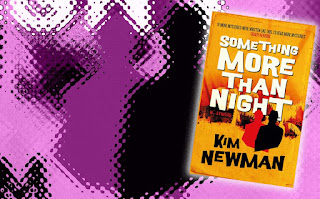
Something More Than Night


Pratt Falls
And Big Sleeps


Something More
Than Night

by Kim Newman
Titan Books
ISBN: 9781789097719


Well this one is utterly brilliant too.

Allow me a brief shout out of a review for the latest mystery thriller from Kim Newman, one of my writing heroes. Well I say that, I’ve only read four of his fictional works and a smattering of his film criticism books but, yeah, still very much a literary hero.

It was in the very early 1990s that I first knowingly came across Mr. Newman’s name, when a friend of mine (please contact me sometime if you’re somehow reading this Rob!) leant me his first edition of Anno Dracula. Well, first paperback edition at any rate... not sure if it made it into a hardback at that time. I was absolutely enthralled with the tome and the absolutely brilliant nods to other cultural characters from myriad sources in abundance, all pulled together and, in the modern parlance,’mashed up’ to weave an alternate version of literary history in which Dracula was successful in his visitation to England (contrary to the ending of Mr. Bram Stoker’s account in Dracula), set up shop with Queen Victoria and paved the way to where various vampires and humans were living together in the same society. That level of post-modernistic melange was new to me then and there weren’t that many people doing it at the time... certainly not as successfully and entertainingly as Mr. Newman and, though I could find no edition for sale in any new book store, a couple of years later I managed to pick up my own copy of the same edition in a second hand bookshop.

Nowadays, of course, the practice of taking various literary characters from different stories is much more common. For example, every year I read the ‘second from latest’ collection of a series of anthologies of new stories called Tales From The Shadowmen from Black Coat Press, which make this cross-fiction character mixing almost the criterion for inclusion (indeed, Mr. Newman has certainly contributed to some of these tomes in previous years) .

Now, remember, there was no internet in those days to find out what, if anything, was going on in the world. CEEFAX was our closest equivalent and, if you’re old enough to remember that, then you know just how useless a dispenser of information that was, back in the day. So I was absolutely thrilled when I found a hardback copy of a sequel to Anno Dracula entitled The Bloody Red Baron (and now set during World War I) which is, from memory, equally as brilliant. And a similar experience happened to me again, a few years later in one of those ‘brand new but remaindered’ style bookshops when I was on holiday in Llandudno... this time a brand new hardback of the third (and at that point final) in the series, Dracula Cha Cha Cha. Now, the books seem to be much more successful currently than they were in the 1990s and Mr. Newman has not only reissued these in expanded versions which I need to pick up and re-read... but also published a whole load more sequels over the last decade. So, yes, I keep promising myself I will get onto those at some point and, yeah, maybe this is the year.

Of course, I’ve seen Mr. Newman in person a fair few times now because he does seem to turn up to a lot of the same kinds of events I go to (not to mention appearing on a lot of DVD and Blu Ray ‘expert interviews’) although I’ve mostly only been in the same room as him rather than actually met him (unless you count that one time where I saw him on his own rushing to a FrightFest and stopped him, really only for 30 seconds or so, to tell him how much his writing meant to me).

And here I am reading his latest, Something More Than Night. The premise is as follows... the majority of the book is set in 1939 and it details the fictional adventures of one William Henry Pratt, better known to the world as Boris Karloff of course... and his friend, the equally famous writer Raymond Chandler (Karloff went to the same Grammar School in Enfield that I, myself, attended in the 1970s and early 1980s and they never once publicised it, which I always thought was a bit of a missed opportunity). The two characters in this iteration of them have had some ‘history’ together from their school days and now their detective friend is found hideously murdered. It’s up to the two of them to take up the reins of the mystery they were embroiled in, slightly earlier in their lives, joining the dots and... oh no, I’m stopping right there with the story content. It’s an incredible book and I’m certainly not going to be wrecking it for people who want to read it.

What I can, I think, say is that it’s certainly not a conventional mystery and it involves... well let’s just say it has some strong ‘weird science’ elements to the tale. Some people might also think it tiptoes from one side of the thin line which sometimes separates mystery tales from horror yarns... to the other but, yeah, that’s not an argument I want to get involved in, for sure.

The book is hugely entertaining and fans of Raymond Chandler’s works will especially love this one because the majority of the tale (apart from a few chapters of third person yarn spinning, where it was obviously necessary to switch to a third person viewpoint) is told by the voice of Chandler himself, Newman adopting the author’s writing style in as credible a manner as I’ve seen done. Well, okay, it’s been a few decades since I last read anything by Chandler but this certainly hit the mark as far as I was concerned. Mr. Newman also does wonders with his descriptions of Karloff and I really could remember certain moments from various films where the mannerisms, gestures and character traits that the writer imbues in him here are gloriously manifest.

The novel is split up into six sections, themselves split irregularly into a number of chapters, including a wonderfully titled, single chapter section called The Man In Chapter 30. And yes, there are a lot of characters from real life history mentioned but also as many made up, parody versions and stereotypes working for, for example, a fake ‘poverty row’ style Hollywoodland studio called Pyramid Pictures. And, yes, it’s full of wonderful appearances including one of the cast of Tod Browning’s Freaks and a nice reference to Margaret Brundage (I reviewed a book about her here). And, honestly, Frankenstein fans will love lines such as... “Cats love Billy. As do women. And small children he hasn’t drowned.” There’s even a nice bit of business where two of the characters get into a discussion about who would win in a fight between Flash Gordon and The Lone Ranger. And fans of Karloff would appreciate, perhaps, one of my favourite jokes in the book, when a mutual friend of Karloff and Chandler gives them the nicknames “Invisible Ray’ and ‘Visible Ray’. Yes, the book is a hoot and well worth the time of anyone who loves the movies and pulps from this particular era.

Now, there were two things that irked me just a little but, since they’re just part of the baggage that I, as a reader, brought along with me to Mr, Newman’s perfect literary venue, these mild criticisms really are my problem alone... but I’ll mention them anyway. One of them lays in Newman’s eliminating a pretty important (to me), real life character and replacing him with an entirely fictional one. Specifically, Kenneth Strickfadden, who invented all those old, sparky machines you see turning up time and time again in Universal monster movies and Flash Gordon serials (I reviewed his biography here...), has been eliminated from the fictional world portrayed here and replaced by someone else fairly important to the plot. Which is kind of a shame but these things happen.

The other thing I was bizarrely upset with, purely because I was expecting him to make an appearance and, during one sequence at the centre of the book, I thought he did... before a character was revealed as someone else.... was the fact that, not once (unless I missed a veiled reference) does Rondo Hatton turn up as a character in this one. Which is a shame but, yeah, that was just my personal wish and expectation of the book and so, boo hoo, I guess I’ll live.

All said and done, Mr. Newman has once more thrilled me with a book like no other, turned to perfection with a well researched look at the milieu of the people he’s writing about and nicely phrased to make the various characters and credibility stretching situations in which they find themselves, dance to life on the page and lodge in your brain in a way which you know will make you miss them later, when the book is done. So, yeah, Something More Than Night is yet another great work by Kim Newman and, yes, I really do have to revisit and explore the Anno Dracula series again sometime soon (not to mention some other compelling novels I’ve seen listed over the last few years which also carry his name). In other words... another great read. Go get this one.

Sunday, 12 June 2016

Tenebre (aka Tenebrae)


Giallo Dolly

Tenebre (aka Tenebrae)
Italy 1982 Directed by Dario Argento
Synapse Dual Blu Ray DVD Zone A/Region 1 Steelbook


1982 was a really great year for movies. We got Star Trek II - The Wrath Of Khan (reviewed here), John Milius’ original Conan The Barbarian, John Carpenter’s The Thing adaptation and, my personal all-time favourite, Blade Runner (reviewed here). We also got what I think is one of director Dario Argento’s absolutely best movies... Tenebre (aka Tenebrae).

It’s been a while since I’ve watched the movie but it’s one of the two Argento films I saw back to back on TV a couple of decades ago and, notably, Tenebrae was still stupidly censored in our country. I’ll get to the ridiculousness of that particular cut a little later on but what it did, of course, was made me pursue all of Argento’s films on DVD, with the release of various uncut, good quality releases in their correct aspect ratios available in different countries and easily playable once I was armed with a low priced multi-region player from my local Tesco (the fact that you could also buy the original Buster Crabbe Flash Gordon serials on US DVD at the time was another big incentive to get myself multi-regioned up).

Now, with the appearance of Blu Ray, I can’t really re-buy all the 3000 plus movies I have on DVD again... especially when there are so many other previously unreleased movies still being unearthed around the globe. Argento, however, is one of the directors whose films I would at least be happy to upgrade ten or more of. So I leapt at the chance when I heard of this new US Synapse three disc dual format version of one of my favourites... primarily because the third disc is a remastered edition of Goblin’s classic score for the movie. That being said, they’re not allowed to be credited as Goblin on this film because the line up had slightly changed and there were some legal issues, I believe... so, to this day, the music is still credited to Simonetti-Morante-Pignatelli. It’s one of their greatest, however, and if you want to know what a “disco slasher” sounds like... this score is it. I’ll always remember those old vinyl soundtrack adverts on the back of Starlog magazine as a kid in the 1980s, with the lurid Tenebre cover of the girl’s head hanging down and the broken glass panel going through the back of her neck. It pretty much became an iconic image... once seen, never forgotten.

The film starts off with the fictional thriller novel of the title being read from (by Argento himself, if you choose to watch it with the Italian language track on) and the book is then thrown on a fire to be devoured by flames as Goblin’s (sorry... pseudo Goblin’s) score kicks in. We then follow a shoplifter played by Ania Pieroni, who had made an unforgettable appearance in a cameo as the third mother (The Mother Of Tears) in Argento’s previous film, the Suspiria sequel Inferno. Here she is pursued by her killer, represented voyeuristically with a following camera eye which is, possibly, overused as a visual prop in this movie but, frankly, is so stylishly done that I really don’t mind it here. There’s some absolutely beautiful moments in this early sequence with the camera stalking her with Argento’s keen eye watching her from behind a rack of goods in a shop, stopping and starting the movement in time as she is framed perfectly at every stop by a gap in the display shelf packaging. It’s just these kinds of sequences which keep me interested in Argento and the giallo format in general.

After getting herself into various bits of trouble with antagonistic forces of one kind or another, Pieroni is attacked by the black gloved killer, force fed pages of the fictional book Tenebrae (written by the lead character, Peter Neal) and then slashed to death with a straight razor. When we finally meet Peter Neal, played by Anthony Franciosa, who is visiting Italy to do a tour for his book, he is already being included in the investigation of this and other similar murders. Heading up the investigation is Detective Germani, played by the extraordinary Spaghetti Western star Giuliano Gemma and, in typical giallo fashion, he checks back in with the main protagonist, in this case Neal, who starts to get involved with his own investigation. As you would expect from this genre, the bodies start piling up and it’s not long before everyone you expected to be the killer is gradually murdered, leaving us with few people left in the cast who the antagonist could be.

Tenebre is somewhat overshadowed, I think, by the Bava drenched colours of the two Argento films that came before this one (Suspiria and Inferno) but I think it’s a much maligned movie in that respect, in that it’s easily one of the greatest of the gialli ever committed to celluloid. Contrary to the title of the piece, the film is all bright light with shiny, reflective surfaces and architectural details. Although the big city landscapes are quite blatantly modernistic, I think it’s often forgotten, or mostly completely overlooked, that the film was intended to be set in the near future. But whether people take that away from this or not... one thing for sure is that it’s one of the most hyper-real and typically outstanding giallo movies that Argento ever made.

For example, on a visual level, similar to the sequence I described with the tracking camera in the shop, Argento uses a lot of vertical lines to split up and separate different people into specific, multi-layered spaces... challenging or creating perspective as he captures his performers doing their thing. There’s a brilliant shot, for example, towards the end of the movie with Anthony Franciosa and Argento’s early muse Daria Nicolodi (the mother of their daughter, the actress and director Asia Argento) standing back to back, with Nicolodi in the foreground and Franciosa a little further away, where the two planes are artificially split by the vertical of the middle of the frame of a set of windows they are standing in front of. Absolutely incredible stuff.

Another celebrated shot is the one which starts off outside the window of a lady's apartment looking in, travels in close up around the building a bit, enters her lover’s room upstairs through another window, comes back out again and goes “around the houses”, so to speak, before ending up back down in the original woman’s room. This is a prelude to a brilliant double murder, committed against the two lesbian lovers, with some breathtaking shots including a razor blade slicing a big hole in a t-shirt to reveal the face of the girl who is in the process of putting it on... and the celebrated ‘head through the glass panel’ shot I mentioned from the old vinyl album cover earlier on. And there’s an exceptional shot of a straight razor striking the side of a lightbulb to shatter and extinguish it which really does stick in your mind long after the film is over.

There's a truly great visual flourish at the end of the movie which certainly shows Argento's influence on his contemporaries and the rich visual legacy the next generation of film-makers have in their arsenal. A character in the centre of the shot bends down to inspect a possible clue and the killer is revealed behind him taking up the exact same visual space. When the character stands up again, his head replaces the head of the kiler in the shot exactly, once more. I think you'll find that this exact same shot set up is recreated by Brian De Palma in, I think, Raising Cain, if my memory is working properly.  So clearly an influential director... of that there can be no doubt.

In typical genre fashion, any number of characters are built up as possibly being the murderer but, like all good gialli, your suspicions are shifted constantly the more you watch (and, as I said before, the more your suspects end up as just another gory death for the killer’s roving, camera eye). However, Argento also does something quite clever in terms of the final solution of the puzzle of just who the killer is in this one but... I really don’t want to spoil the chance that you might figure it out for yourself, if you’ve never seen this movie before. But, yeah, it’s a typical example of the genre in that Argento manages to subtly, and often not so subtly, set up pretty much almost everyone in the film to possibly be the killer.

It’s also a film where Argento gets to poke fun at his critics too, which is kinda nice. He took a lot of flack in the 70s and 80s for being a misogynistic director but the arguments for that have always seemed quite false to me. For instance, there are almost as many men being killed off in imaginatively gory ways in his films as their are women. Also, giallo movies are abundant with both female killers and strong women who survive to the end of the movie as the ‘final girl’ trope of many horror movies. I don’t think you can call that particularly disempowering or hateful, to be honest.

This also has, as far as I’m concerned, the best script of any of Argento’s movies in terms of credible dialogue and Argento uses it quite well in one particular line, where he argues exactly in opposition to the myth that somebody who makes violent art is a violent person. The line comes from the Peter Neal character in the movie, whose books are being used by the killer as a justification for his own actions... at least in the first half of the film. Frankly, we are all living in a real life world where a notorious serial killer was inspired in his killing by the George Lucas movie Star Wars Episode VI - Return Of The Jedi... so any argument that giallo or horror films are a catalyst due to their content dies with that reality, as far as I’m concerned. The line itself, spoken to the police inspector is “If you find someone killed with a Smith and Wesson revolver, do you go and interview the president of Smith and Wesson?” This is a fair point, I think, and definitely raises the question of whether the manufacturer, or the artist in this analogy, should be held responsible for the way people choose to respond or react to their product or art.

There’s also a particularly comical moment in this one where John Saxon, who has hilariously demonstrated in an earlier scene that his new hat doesn’t fall off, finally gets caught up in a particular incident where his headwear heads to the floor and this involves the death of one of the male characters (I’m being cagey here about the identity of that character because I really don’t want to give anything away to people who haven’t seen this movie yet). But these kinds of little details and clues in the script are what help make Tenebre one of the absolutely greatest and credible of the films made in the giallo genre and for me. It stands the test of time with other classic Argento gialli such as Deep Red (aka Profondo Rosso, reviewed here), The Bird With The Crystal Plumage and Four Flies On Grey Velvet.

The film is presented uncut and the UK version is also uncut, nowadays. This main censored scene in previous UK versions featured the actress Veronica Lario, who went on to notoriously marry Silvio Berlusconi at one point in her life. Here, she is waiting with a gun in her hand when an axe comes through the window and severs her arm halfway up, above the wrist. She then gets up and paints the clinically white walls red with the arterial spray of her blood. The comical thing about some of the previous, censored versions, is that the BBFC in our country (for example) decided that the actual axe going down into the arm, which is relatively tame compared to the aftermath, was excised from prints but... the truly ostentatious goriness of the moments following, were always left completely in tact. How insane is that? Just another odd thing to show that censors were really bizarre when it came to doing what they saw as their job.

The disc itself sports a lovely transfer of the film and includes several extras including a feature length documentary on the history of the screen giallo, with maybe just a little over emphasis on Argento’s huge contribution towards popularising the format himself. The documentary includes comments from a number of genre experts (one of whom I wish wasn’t included in this film as an expert of this particular subject, for reasons I won’t go into here) and it’s great to see such brilliant testimony from such cool people as Alan Jones, Maitland McDonagh, Kim Newman and a variety of writers and directors of these kinds of films too. I do wish, though, that people would stop holding up Michelangelo Antonioni’s Blow Up as an example of a giallo film in order to somehow legitimise the genre to people unfamiliar with it, to be honest. I really can’t see how Blow Up, wonderful as it is, could ever be considered a giallo, bearing in mind how many of the genres tropes and intents it fails to demonstrate. Also, the music that plays throughout the majority of the documentary is also from the main feature presented here. Not particularly surprising, given the expense of music rights, but still something which might have been better served with a decent mixture of Morricone and Cipriani mixed in with the Goblin, methinks. But this is a minor criticism of a great little US Blu Ray set of this film.

If you’ve never seen Tenebre and you are a fan of the genre then this is a near perfect giallo and, also, an absolutely brilliant jumping on point if you’ve never seen one of these movies before. An incredibly beautiful film to look at with traditionally clunky but ‘still much more credible dialogue than most gialli and with some just jaw droppingly stunning set pieces in places. Definitely something everyone into Italian film should see at some point. No wonder Dario Argento is still thought, rightly so, as the master of his craft.

Friday, 21 August 2015

VHS Forever - Psychotronic People


Tape Worms

VHS Forever - Psychotronic People
UK 2014
Directed by Mark Williams & Darren J. Perry
Son of Bill Production MultiRegion DVD

So I’d heard about this relatively new documentary film from the tail end of last year via Twitter, got kinda interested in it and then promptly forgot about it, what with all the other digitalised celluloid attractions on offer these days. However, when I realised I’d only been to three film fairs this year, instead of the 13 or so a year I was knocking back a few short years ago (due to varying reasons, mostly budgetary), I realised that I should maybe get myself down to the latest Camden Film Fair and see what was going on... mostly because I’d been hoping to catch up with the stall of the Camden Fair’s organiser at this year’s London Film And Comic Con (reviewed here) and, like a fair few other dealers, he’d not bothered with that one this time around.

Anyway, when I got there I visited a stall run by Tony & Donna Clarke of the Psychotronic Video Store (www.psychotronicstore.com) who were selling a fair few treasures, including the beautiful limited edition (only 300 copies folks) Lucio Fulci playing cards I’d bought a few weeks before and, among the many gems available, was this movie. So I thought, yeah, I still wanted to catch up to this and, once I’d been around all the stalls at the show, I went back to make the purchase. I was further surprised when one of the directors of the movie, Mark Williams, was there to sign copies for people... which was great.

Now, I’ve seen a few of these small, independent low budget documentaries over the last few years, my favourites being the two epic docs on Video Nasties (reviewed by me here and here) and this is probably one of the lowest budgeted I’ve seen. The IMDB entry for VHS Forever lists it as costing approximately £1000 to make and, I have to say, for the small amount of money it cost, the writers/directors have come up with a very entertaining and fairly informative, depending on how much of this stuff you already know, little homage to the early days of VHS collecting.

Now it would probably be remiss of me not to point out that this particular documentary film is about a very specific aspect of early VHS collecting in this country and, sadly for me, it’s an aspect of the scene I missed out on as a teenager because I was more interested in World Cinema at the time than many of the movies covered here, although watching this film has made me realise I might have a couple of cardboard sleeved rarities sitting on a shelf somewhere which may bear further investigation. There’s not much of anything about the early days of UK collecting when the budget arm of the sell through market was established and tapes were coming down in price, for example. You won’t find The Video Collection label and their early hits like Bringing Up Baby and Invasion Of The Bodysnatchers being praised and lionised on here. But you do get another view of the world of the pre-certification, video nasty style horror market and the first hand stories of the people who used to buy these. This makes it very much a companion piece to the two Video Nasty documentaries I mentioned earlier and, although it won’t mean a heck of a lot to a certain section of the VHS buying market, to me this is essential viewing.

The film covers a little bit about the infamous banned list and the stories of the victimisation of the people who used to buy and sell these tapes and, once again, highlights how out of step the UK was, and still is, with the rest of the planet in regards to trying to conform and control what an individual should be allowed to watch on his or her TV set. Another thing which makes it valuable to me is the kind of people the crew interviews for this movie. Along with well known and well loved names like Norman J. Warren, Lloyd Kaufman, Caroline Munro and Kim Newman, they’ve also got some of those less well sung experts like Nigel Burrel who, perhaps, should be better known amongst lovers of film than they are right now. There were a fair few people talking, also, who have taken my money over the last few decades at shows like the Camden and Westminster Film Fairs and it was kinda nice to see them and, also, rewind them to catch what they said again when I realised the locations they were being shot in meant I had been concentrating more on the background to see if I saw either myself or one of my friends wandering around rather than paying attention to what was actually being said.

The film is not going to give you a thoroughly detailed account of the persecution and horror that people were up against at the time... I remember a lot of the kids in my old school playground used to swap copies of tapes that would have given Mary Whitehouse an absolute fit if she’d have known how easy these things were to get a hold of for teenagers or younger, some of which still wouldn’t be allowed in this country or many other countries due to various laws... but the film does give a lot of interesting stories and reminiscences by a few of the hardcore collectors of the time that are vastly entertaining and well worth the £10 I paid for this DVD. This includes stories about visiting the original Psychotronic Video store in Camden in the 1980s and its infamous ‘back room’, where certain highly prized and riskier titles might be purchased in illegal trade.

It also talks to some of the illustrators at the time who were responsible for the fantastic artwork on the sleeves of some of these things and, furthermore, interviews some of the modern poster and sleeve artists who were inspired by them... I now know why we still get the odd, fantastic exploitation sleeve like the one used for Hobo With A Shotgun, for instance (reviewed here). So, yeah, one of the things which sticks in my mind about this film... and it’s something I think I was half aware of before but this certainly drums it home... is that the lurid artwork of the sleeves themselves were as easily responsible, if not more so, for making some of these dubious pleasures targets of an increasingly watchful yet uncomprehending government body. And, yeah, I think it’s good that the filmmakers here have included the graphic design element of the original tapes and it also leads to two scenes where one of my favourite people of all time, the always lovely Caroline Munro, talks about the artwork on a couple of the VHS sleeves of movies she’s been in, namely Dracula AD 1972 and The Last Horror Show.

Now, one of the most noticeable aspects of this film is that the quality is questionable and this might possibly put some people off... however, it should also be pretty obvious to a lot of people who spent a fair amount of the 1980s watching VHS transfers that the footage has been deliberately shot like this, possibly even downgraded, to look a little fuzzy like an old VHS recording. It’s also shot in a 4:3 aspect ratio to emulate the horrible pan and scan look which was a feature of many of those early cassette tapes... and one of the reasons why I stopped buying this stuff until they started releasing widescreen editions. However, it works pretty well here regarding the subject matter and the kinds of people who are going to want this account of years gone by in their library are probably not going to have a problem with it... it’s certainly endearing.

All in all, I’d say this movie isn’t going to exactly appeal to a great amount of people but for individuals like myself, who were around during these days and remember having to go and approach dodgy looking people on the streets of Camden Town if we even wanted to be in with a chance of acquiring withdrawn movies like Kubrick’s A Clockwork Orange... then there are a lot of memories, stories and judgement calls about those days which are quite appealing. Also, it’s edited pretty well and some of the transitions between segments of interviews leading onto other comments by people are intelligently done and their juxtaposition gives all the sides of the story on certain issues without clinging to a specific agenda... which is a good approach to take if you are trying to give an overall picture and capture a specific zeitgeist without trying to gloss over the inherent problems which were made manifest by this area of ‘the VHS scene’.

VHS Forever - Psychotronic People is a charming look at a time which people from younger generations won’t know much about but which is still relevant to the current issues of censorship and film trading going on now... I can’t remember how long ago since I last had to wait outside the Electric Ballroom until the police had finished raiding the Camden Film Fair and confiscating materials... but it can only have ben a couple of years ago at most and some of the questionable (and therefore often the most fun) things you can get at these kind of film oriented events are really not that different to what was going on 30 or so years ago. So this is definitely a film which a specific section of modern cineastes of a certain kind are going to want to get their teeth into, methinks. At any rate, it’s something I’m very pleased I bought and probably a movie I’ll be dipping into again and again for reference purposes over the coming years. So put this one on your list if this specific kind of home video subculture is something you either remember from the time or have an interest in... you should have a fun time with it.

VHS Forever - Psychotronic People is a limited edition but, at time of writing, it’s still available to purchase here... http://psychotronicstore.com/index.php?main_page=product_info&cPath=5_29&products_id=3385

There is also a facebook group for the film, if that’s your kind o’ thing, here https://www.facebook.com/groups/784032254947602/ and the main website page for the film is here www.vhsforeverthemovie.com

Monday, 11 August 2014

Video Nasties - The Definitive Guide Part 2 - Draconian Days


Rule Draconia?

Video Nasties - The Definitive Guide Part 2: Draconian Days
2014 UK
Directed by Jake West
Nucleus DVD Region 0

Okay people. Time for me to get very angry again.

Video Nasties - The Definitive Guide Part 2: Draconian Days is Jake West’s follow up to his own Video Nasties - The Definitive Guide: Moral Panic, Censorship and Videotape, which was an incredibly limited, numbered edition from a few years ago in the UK... and which has just had a second limited edition run repressed for the American market. You can read my review of that first one here.

Like the first three disc edition, this second three disc edition also runs for over thirteen hours, due to the inclusion of over two discs of extras featuring the trailers to another government list which was discovered while the director was making the first documentary. This “Section 3” category list comprises films which were liable to forfeiture, seizure and destruction but without the added malarkey, as far as I can tell, of having the owner being prosecuted for being in possession of these titles (although I’m sure that if you owned any of these ones, at the time, then you were more likely to be also be in possession of other titles in one of the more dangerous lists anyway). Of course, it goes without saying that the majority of these have been certified in uncut form nowadays... which says a lot about the single-minded tunnel vision of the people involved at the time than about the historical perspective, I suspect.

Like the first documentary, this film is a series of intercut interviews with various experts and key players in the dramatic events, including a quite brave lady censor who has obviously agreed to be filmed especially for this documentary, it seems to me. There’s also historical footage from TV news reports and such like of some of the powerful people who were causing all these witch-hunts in the dark days of the 1980s, including former chief censor James Ferman, who created a lot of the problems for both people and the art of the films in question.    

I have to say that the inclusion of the former female censor, along with all the usual suspects (such as Kim Newman, Alan Jones and director Christopher Smith), makes for a much fairer and generally unbiased viewing of the subject matter and its consequences. There are some things that the censors did, for example, which actually show them in a good light in terms of certain aspects of their personalities... even Ferman. However, the documentary... whether it has an agenda or not... can’t help but paint the censors and the Video Recordings Act in a horrendously bad light because... well, what these people were doing was a real problem and an affront to pretty much anyone’s individual freedom. And it was all done from the perspective of personal taste... which is a huge problem in my book.

Films were being seized from both shops and private dealers. Fines and, yes, imprisonment was the order of the day for anyone caught with a lot of these although, as I mentioned earlier, the actual specific films dealt with on the extras in this particular volume are ones which were just seized... technically nobody was prosecuted over these. The other films though, which were dealt with very thoroughly in the last volume, wrecked lives or, at the very least, had a very negative emotional impact on the people... actually, let’s call them victims of a less than benign government shall we? ... on the victims who were involved with these seizures and prosecutions... criminalised due to what boils down to a question of either personal taste or the quest to seek distribution of profitable merchandise in an economically challenging climate.

One of the guys on here tells about the heady days and camaraderie of going to the old film fairs and picking up stuff you just couldn’t get elsewhere (nothing’s changed there then) and about the police raids you would sometimes see happening at these events. I have been present as a customer at Film Fairs, too, when they’ve been raided by the police more recently... who still seem to be unsure what exactly it is they’re looking for, from what I can understand. In fact, one of the dealers I see trading at the Film Fairs was name checked in this documentary because he’s a friend of the guy being interviewed. The same guy also tells of a raid on his house which affected him when he was young and of how the police didn’t really know what they were looking for. They took some really, stupid to mistake for anything else, commercially released, non-nasty material but left other stuff behind... in one case the second volume of an offending article which was sitting on a shelf next to the first volume which was seized. If you want to read a really excellent first hand account of what one of those “home invasions” actually felt like, then a Twitter pal of mine, @grindhousedave, has a really great account of his personal experience in this area on his blog here.

Once again, in this film, we are left with a well researched document which treats all the facts fairly but which still shows what idiots the authorities were in this 1980s British witch hunt. Let’s remember that the research carried out by the government was, and usually is, either flawed or, memorably, thrown out because it found the “wrong answer” and replaced with “opinion masquerading in research clothing”... which was one of the most angering things that came to light in the previous volume. Similarly, we have here a censor who revealed that when Ferman’s censorship became more gung ho, he often vetoed what his staff concluded and did his own thing. In fact, it is revealed in this one that, when the censors under his command all disagreed vehemently with Ferman’s overtly censorius stance on some issues, the entire staff were promptly fired. Then, it seems, when it came to light, he denied it on TV saying it was a restructure and the staff were nearing the end of their contracts anyway. This is not the way things should be, people.

Stuff like this always brings to mind, for me, the ridiculous comic book scare in America in the 1950s, spearheaded by the equally “agenda-blind” Fredric Wertham and his unbelievably assumptive and “research defying” volume Seduction Of the Innocent. People like this base everything on their own personal taste (and then rope in people who share their sentiments) and this is a very bad thing for people to alllow to happen. Often they will invoke the power of, in this case, film, to incite violent or socially unacceptable behaviour but then, you have to remember, that one of the most famous serial killers in American history took the character of The Emperor in Return Of The Jedi as his inspiration for some of his hideous crimes... so where does one draw the line when it becomes clear from incidents like this that anything in art can be a catalyst for what is already inside a person.

So there seems to be two basic knee jerk reactions for censoring any material... and I should probably point out at this point that I’m a strong believer in censoring material for your (own) children and in practicing self censorship for yourself.

One reason seems to be... “Ugh. This stuff is really horrible and distasteful.” Well, actually, what offends one person may not offend another and, in these kinds of cases, the counter measure being taken in response to this is, in fact, the most offensive thing about what is happening. As Christopher Smith, the director of such horror films as Triangle (reviewed here), says in this documentary... "Art can't be controlled by the taste buds of the lunatics." And I will go on to add to that the sentiment that, if it does, then art in all its different manifestations has “lost”... and is in the hands of idiots.

The second reason, the influence of the power of a medium, seems at first something worthy of consideration but, when you dig down deeply, you find it is also nonsense. As David Cronenberg, a director who has had to face a lot of censorship issues in the pursuit of his art, is quoted as saying in this film... “Censors tend to do what only psychotics do: confuse reality with illusion.” Of course, this kind of begs the next logical step to jump up and down proclaiming that all censors are psychos... but I wouldn’t like to be accused of making the same nonsensical leaps of logic that the censors themselves do.

This three disc set, like the first volume, is an absolute “must watch” for people who are interested in the history of the home video format... something which most film lovers would be interested in, I would think, given that the home video versions are the way in which the films will be remembered by future generations. The inclusion of two volumes of trailers and intros to those trailers make for an essential purchase, in my book. The underlying fact though, and one which films like this continually bring to light, is that this kind of censorship and these basic invasions of personal privacy have not stopped in any way. There are loads of very problematic laws and bills being passed and restrictions on our freedoms are constantly being put in place while our basic expectations of “free living” are being eroded, often without most of us being aware that these things have happened and usually because those in power clearly have something to gain from it.

If you want to keep abreast of these kinds of issues daily then I once again point you in the general direction of the Melon Farmers website here, where these and many other kinds of “hidden” daily news issues are being brought to light. And if you have a love for the kinds of movies being dealt with in this documentary and want a reminder of a grim past with a very real warning for the current state of affairs (let alone the terrible prospect for artistic freedom in the future) then I would get yourself a copy of this one while you still can. Again, it’s a hand numbered print run on the covers so they’ll probably sell out fairly quickly.

Thursday, 19 July 2012

Nightmare Movies


Taking A Kim View


Nightmare Movies by Kim Newman
Bloomsbury. ISBN: 9781408805039

It’s funny. I’ve always had kind of a schizophrenic relationship with the work of Kim Newman.

I’ve always loved his literature, the original Anno Dracula trilogy in particular is a shiny set of works which no lover of pulp fiction should be without. When it comes to his film reviews, however, I’ve never really agreed with a lot of his final verdicts on the various creations concocted by the vast flora and fauna of budget-wise movie makers over the years. In fact, I gave another book he worked on a bit of a bad time, although I believe he only plugged in some small chunks of the contents of the book if I’m not much mistaken (see my review of Horror! 333 Films To Scare You To Death here if you are so inclined).

That being said, I do realise that, whether I agree with Mr. Newman’s final verdict or not, his writing style is excellent and always very readable. Which is the case with his completely revised and re-vamped book Nightmare Movies. I have to say though, that I was a lot more sympathetic with the majority of his views in this book so perhaps my tastes are changing as the passage of time leads me shambling, zombie-like to my final resting place. It’s also an extremely entertaining read... which helps a lot and is another testament to Mr. Newman’s knack at "turning a nice phrase".

I knew what my main complaint with this book was going to be even before I started reading it... pretty much the way in which various people define what is a horror film is not something which can easily be pinned down and agreed upon, and I’ve got very rigid and crotchety in my view of what constitutes a horror film over the years. However, Newman deftly sidesteps my main concern here right from the outset by opening up with a view that this is not a book specifically about horror movies (indeed it isn’t and in spite of the fact that the publishing company have felt the need to subtitle this edition as “Horror On Screen Since The 1960s”) but about “nightmare movies.” That is to say, movies which contain horrific or nightmarish content (I don’t personally buy into the prescription that things which merely horrify a person subjectively are concrete enough to define a genre for the use by the general population) and, for the most part, the writer steers clear of that definition throughout the course of this weighty tome although, to be honest, he did let me down when he started talking about Hannibal Lector... yes, I understand he is an influential presence on the horror genre, but I don’t buy into the fact that a psychotic serial killer is in any way a monster. A serial killer is a human being who has serious issues... he is not the defining inhabitant of a horror film... that’s my personal view anyway and I’m sticking to it.

However, that minor gripe aside, this book is a strange journey of a read and I’m not sure I’m the right chunk of the movie going public that this is levelled at. Rather than spend a lot of time on individual films (there are individual reviews in here for important works but not so many as you might expect), he presents us with a blisteringly entertaining overview of an array of “nightmare movies” many of which I already knew inside out, and which lead me to suspect that this tome was more written for the novice reader. However, having said that, there were, especially towards the end of the book, a lot of movies which I’d equally not heard of. I think this is probably just one of the perils of writing an overview of a particular genre and it must be very hard to try to second guess how much of your subject your readers will be familiar with. Thankfully, Mr. Newman makes no apologies and whizzes through various movies at a rate of knots which, while sometimes frustrating in terms of items I was personally not familiar with, was ultimately, I’m sure, the absolute best way to approach writing something of this nature.

Mr. Newman weaves words as if they were a needle and thread sewing the eyes of a freshly dead corpse and, although it’s quite a long read (nearly 600 pages of main text in a fairly small, compared to many recent release, type size) there’s seriously never a dull moment and you certainly won’t regret picking this one up if you’re a fan of this particular type of movie. I can see why a lot of people consider it to be one of the key texts on its subject and I certainly wish I’d have read this when I was a lot younger and knew less about these kinds of gaudy entertainments. Certainly, readers new to the field will find this book extremely valuable but, as I alluded to earlier, seasoned veterans of the visually macabre and ghoulish celluloid dishes over the years will also find something to discover lurking within the pages of what I now refer to as Newman’s Necronomicon.

This one’s definitely a recommended read from me and, if you like it and you’re a reader of fiction and enjoy catching numerous movie and pulp literature references, I would also suggest you catch the new editions of Newman’s Anno Dracula trilogy (which I’m going to have to buy again myself now they’ve been updated) as there’s a lot in these particular tomes to delight all fans of the genre.

Tuesday, 26 April 2011

Horror - 333 Films To Scare You To Death

Half A
666-pence!

Horror! 333 Films To Scare You To Death
James Marriott,
Kim Newman
Carlton Books Ltd
ISBN: 9781847325204

And here we have a list book which, like all things that rely on personal choice to create a list, is always going to be seen as fairly contentious in it’s choices of inclusions. This is all fair enough and I am fully aware of the pitfalls of creating material based on lists but, at the same time, I had very high hopes for this book. The design and layout “looks” fantastic and was enough to sell me on it just from a few pictures on Amazon.

So I was expecting to be a little irritated by some of the choices on this list but, to be honest with you, I wasn’t expecting to be furious with them... but ultimately that’s how I felt on reading this particular tome. If I was feeling more charitable to the authors of this work after enduring their less than error free and sometimes blatantly contradictory entries in said attractive looking tome, I would perhaps be quick to point out that the definition of a horror movie can mean all things to all people... but after some of the inclusions and, frankly, the mini masterpieces which have been excluded, it’s hard for me to get anything other than horribly worked up about the whole affair, to be honest.

Now I personally don’t consider a movie a horror film unless it has either a definite supernatural force or an non-human monster present in the narrative at some point. That’s my, possibly childlike, definition of a horror fillm and it seems to be a strong acid test for me. I don’t hold with all this “human-monster” stuff and so the inclusion of serial killers and such like belong firmly to the realms of thrillers and gialli and my personal experience happens to be that people I know who will never allow themselves to even look at a horror film for five minutes are more than happy watching the likes of the Hannibal Lektor films and films of this kind of nature where serial killers are the central “attraction of fear”. Therefore, frankly, they’re not horror movies (anything which supports my definition of a horror movie is good I reckon so please forgive me if I labour this point a little).

What I don’t think anyone can rely on... and I have heard this defence when used in similar instances to defend the human killer as evidence of the manifestation of the silk purse of a horror movie spun from the sows ear of the serial killer flick... is that a horror film contains scenes that horrify. Nope, don’t buy it. What horrifies me may not horrify you and vice versa... too subjective to be useful as the sole criteria of an applied generic label, thank you very much.

This book, however, not only includes films like the horrendous adaptation (of a great book) of Silence of the Lambs but also various gialli and films by the likes of Fellini and Bergman. C’mon guys. I know we all like films by these directors but this seems more like a book about cramming as many “horror definition stretching inclusions” as you can get away with, just because you happen to like those movies. And seriously people... let me clarify it again, just in case you missed it the first time... A thriller is a thriller! A giallo is a giallo. These are not horror films and though a spare few Dario Argento movies could (and are) included... putting stuff like The Bird With The Crystal Plumage in a book about horror movies just makes you look like idiots. And contrary to popular modern belief... Michelangelo Antonioni’s Blow Up is not a giallo... there’s possibly not even a murder in the movie, depending on how you read it. So once again, inciting it as giallo turned art film is an absurd state of affairs.

You can probably get a good idea of as to my state of mind when I read this. But it’s not just the bizarre never-in-a-million-years-is-this-a-horror-movie inclusions which got to me in the end. It’s just as much about the exclusions. Seriously guys... you include movies like the above but you miss out some of the truly scary horror movies of recent years like the excellent [REC] series and, instead put in tired teenage slashers like Jeepers Creepers. This is not a quality choice.

Added to this I found a few factual errors and contradictory opinions in the text. One has to ask, if the reviewer finds occasion to give a movie a bad review, why the damned thing is in this book in the first place. If this is supposed to be only the 333 essential movies to see then surely you don’t include what you think are the clunkers.

Another gripe is that there are various “categories” reviews which try to dance around the possible silliness of some movies inclusions by giving a particular sub-genre (which for the most part isn’t a sub-genre) a highlighted section within the book in the hopes that the boldness of the inclusion will mislead readers into accepting the authors definitions of “Horror” as Gospel. But this is just not the case because... you know what? A giallo is not a horror film! Oh, hang on... I might have already said that one.

Adding insult to injury, at least one of these mini category reviews is not present in the actual finished book... even though the section is referred to on specific page numbers throughout the remainder of the tome. This seems to be in keeping with the books index which also seems to list appearances by various films on pages where they are nowhere to be seen. Seriously, what happened here?

And that’s about it for me and this book I’m afraid... nice to look at but ultimately it doesn’t deliver on content. Can’t bring myself to recommend this one and am now going to cast my nets further because there seems to be an abundance of these horror-movie lists type books doing the rounds at present. Maybe, if I’m really lucky, I can find a book called, something on the lines of, 200 Colours of Gialli You Should Profoundly Watch Before The Drops Of Blood In Your Body Go Velvetly Cold. Now that’s a book I’d really want to read!