Showing posts with label Catherine Spaak. Show all posts

Monday, 7 March 2022

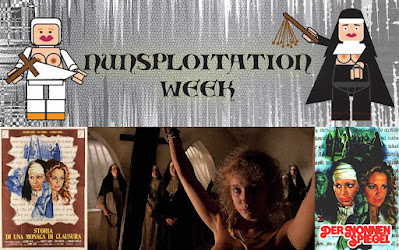
Story Of A Cloistered Nun


The Spartacus Solution

Story Of A Cloistered Nun
aka Storia di una
monaca di clausura

Italy/France/West Germany 1973
Directed by Domenico Paolella  
Severin Films Blu Ray Zone A/B


Warning: Many story spoilers here.

Story Of A Cloistered Nun is set in 1571 and tells the story of a young baby called Carmela (as we are first introduced to the character), who we see in a nuptial ceremony where her and the child of another family (I’m not sure if these kids are even a year old yet) are promised to each other in an arrangement designed to bind two families together. This sequence is following a fairly sedate set of opening titles where old etchings of monastic events are thrown up against Piero Piccione’s score, along with the text announcing that it’s “Adapted from authentic 17th Century Chonicles” (which makes no sense since it’s set in the 16th Century, I’m guessing) so, yeah, they were getting into marriage really early in those days, it seems. Then we find Carmela grown up and indulging what can only be classed as extraordinary tame lovemaking with her real boyfriend... honestly, not much is going on as they’ve still got their clothes on at this point but Carmela is already in raptures of ecstasy, her bosom heaving in that extra special bosomy way.

Now, Carmela obviously doesn’t want to marry the grown version of the toddler her family picked out for her so... dishonouring the family, she finds herself ‘gotten to a monastery’ to become a nun. There’s she’s subjected to lesbianism (which she completely refuses to partake in) from both her new friend Elisabeth (who has an underground group of libidinous nuns who secretly go to dress in colourful clothes, drink wine and indulge in things only hinted at in the dialogue) and also Elisabeth’s enemy, the Mother Superior. Both are in love with Carmela and both are scorned but Elisabeth gets back at her by having her boyfriend put to death, thus temporarily crushing Carmela’s will to live.

But then it turns out she’s pregnant and, when she comes to term and gives birth to a baby boy, the church hear about it and send priests and troops to investigate. In a bizarre moment, when the lead inquisitor (or whatever he’s called, this is not one of those torture porn films) questions whose child it is, Carmela owns up to proclaiming “I’m the mother!” However, in a  bizarrely Spartacus moment, Elisabeth also screams the same thing, followed quickly by the Mother Superior and then all the rest of the nuns in the convent. The powers that be have no choice but to shut down the order and expel everyone from the monastery but, before they all are split up and sent to other nunnerys, Carmela is given all the precious belongings the nuns come into the convent with so that she can flee and survive with the child, where she will wander the world helping those in need. The end of the film bitterly trumpets the fact that she’s never been beatified or canonised for her service to those in need.

The film stars a triumvirate of actresses in the key roles and whom many might remember especially in their roles in Dario Argento movies. So we have the main lady Carmela played by the beautiful Eleonora Giorgi, who would go on to play Sara in Argento’s horror film Inferno (reviewed here) and then from two of Argento’s gialli we also have Catherine Spaak as Elisabeth, who was the main female lead in Cat O’ Nine Tails (reviewed here) and Suzy Kendall as the Mother Superior, who was one of the female leads in Argento’s game changing directorial debut The Bird With The Crystal Plumage (reviewed here).

It’s another eye opener for nunnery life too. Like in Cristiana Devil Nun (reviewed here), Carmela has to wear a wedding veil to announce her wedding to God, although she renounces her vows before she actually takes them. Also, the nuns seem to all bind their breasts in a kind of half corset for some reason... hiding their femininity.

The camera work is pretty good. Carmela starts off arriving at the nunnery in very colourful clothing but... barring a window in one room, a wonderfully colourful shot of a distorted mirror and the scene where Elisabeth’s ‘secretly bad nun society’ are dressing up... most of the film is the dingy greys, whites and creams of the convent. However, the cinematography more than makes up for it and although the director is content for a while to split the screen vertically using architectural features to make areas for the actors, he does some really outrageous stuff with finding little triangular areas in front of the screen to use to segregate various characters in the spaces. For instance, in a scene where a tall monk and a shorter nun are walking side by side but in profile to the camera, he hangs a triangular frame down in front of the lens just splitting off a small area at the top of the screen. When the two characters pass behind it, the tall monk’s head is just in the triangle with both his lower body and the nun in the space below. It’s quite good stuff. And there’s a lovely introductory scene to a few of the nuns when Carmela arrives and they’re all observing her from behind what I could only call some kind of wrought iron, spiral web with a cross at the centre. The cinematography in this one is nothing if not creative, that’s for sure.

And there are a few stabs at other more exploitational tropes of the genre such as a topless whipping scene for Carmela and a scene where Elisabeth has to crawl along the ground of a big area in the convent with her tongue scraping along the ground, cleaning the floor as she goes but, I’d have to say this is all handled in a very non-sensational way and, in terms of nunsploitation, it all seems very tame compared to some other stuff I’ve seen.

All in all I would say, especially with the striking presence of Eleonora Giorgi as the main protagonist, that Story Of A Cloistered Nun is a perfectly fine and nice looking movie. I didn’t enjoy it as much as, say, Cristiana Devil Nun but then, that one seemed even less on board with the tropes of the genre than this one. I mainly had a good time with this film and, once again, am looking forward to seeing some more movies in this category very soon.


Sunday, 16 September 2018

The Cat O' Nine Tails


X + YY = 9

The Cat O' Nine Tails
( aka Il Gatto A Nove Code)

Italy/France/West Germany 1971
Directed by Dario Argento
Arrow Blu Ray Zone 2


Warning: Slight spoilers.

Well it’s been quite a long time since I last watched Dario Argento’s second feature film The Cat O’ Nine Tales. It’s one I think I’ve only seen once before because, out of his first 8 or so films (I’ve never gotten around to watching Five Days In Milan - aka The Five Days -  so I can’t include that one), it’s the film I like the least. Strangely enough, I think Argento was of a similar conclusion for many years (perhaps still) that this was his least favourite of his own movies. Now, I remember reading decades ago that in terms of success, the film played to packed audiences and it was, at the time, the most rented or bought of Argento’s films on the home video format. I’ve never understood this one’s popularity but if you can get away from the fact that the story is just a little dull and simplistic, it’s really not a bad film and, in retrospect, it really is an amazingly put together example of an auteur piece in terms of Dario’s output.

As I said, the script is somewhat dull but the acting is actually a notch up from what you get in many of Argento’s movies, as the two Americans who headline the picture are both turning in top gear performances here. It’s really unusual to see this calibre of work in an Italian giallo, even if it is made by one of the two kings of the genre, Dario Argento. Both James Franciscus, who you might remember from such films as The Valley Of Gwangi and Beneath The Planet Of The Apes (reviewed here) and his co-star Karl Malden, who you may remember from films like Murderer’s Row and Billion Dollar Brain... are as good as I’ve ever seen them here.

The film starts its set up with break-in at a high end Genetic Research Laboratory in which nothing appears to be stolen. Newspaper reporter Carlo (Franciscus) and retired, ex-journalist Franco (Malden), who is blind and does a wonderful job convincing the audience of that, join forces in trying to solve the mystery, which seems to be connected to a string of deaths and an attempt on both their own lives.

We also have the lovely Catherine Spaak in the movie, who plays the daughter of the boss of the company and it has to be said, her fashion choices are partially worth watching the film for. Her role is strangely silent for a lot of the time and her striking figure isn’t in a whole lot of the movie but that might be deliberate as it seems that Argento really goes out of his way to make her the person of suspicion in terms of the serial killer here. Actually, in terms of the sex of the killer, this second film is one of the few that breaks the Argento mould but I won’t say too much here because he does really seem to go to great lengths to make sure that his red herrings are well set up. That being said, when the killer was revealed I was surprised but, to a certain extent, not that inspired by the choice of killer as I really didn’t have anything emotionally invested in that person. In fact, I didn't even recognise them.

The film takes the X-YY chromosome revelations of the time and runs with the idea that people with this ending of chromosomes in their genetic make up are more likely to be troubled or violent individuals... something which holds no water today although the idea that anybody can pick out the father of their child and promote certain tendencies in their future offspring genetically is something still very much relevant, from what I remember in the news a few months back. So despite the false premise, the film almost seems bang up to date in terms of the explorations of this particular obsession.

That being said, while the violent set pieces are mainly dull - asides from an interesting shot of a man’s face hitting the front of a train - there are a lot of Argento-isms to enjoy in this film and I think it’s one of his best in terms of the way it’s put together visually.

For example, early on in the film there’s a wonderful, three quarters view of a poorly lit corridor with two men walking up it towards camera which pans along with them. The moonlight  from the unseen windows past the camera’s field of vision is creating a series of verticals in the shape of a diminishing pyramid along the full length of the corridor at a certain height on the screen, punctuated by stabs of colour as it also lights up the brown doors of the many offices in the corridor. A truly gut punchingly beautiful composition. Then, not ten minutes later, the shape of the train tracks in relation to the height of the platform on the scene where the train murder is committed is a huge visual echo of this earlier shot. The director also splits the screen up into shapes and does stuff like an actors head and shoulders, off centre in the composition masking the vertical corner of a wall where the two colour textures meet... good stuff.

And talking of visual echoes... he does a thing here where future parts of shots or even shots from a previous scene are strobe cut into the current scene to show you what a character is thinking about or to give it forward momentum before actually going into the next sequence (a little like what Dennis Hopper does with his quick cuts in certain sections of Easy Rider or a less overt form of what Nicholas Roeg would do in his movies). I don’t remember Argento ever employing this technique again but it certainly gives the film an interesting dynamic, with these little visual stutters suddenly popping up out of the blue and giving you either an insight into a thought process or propelling you forwards into the next set piece.

Other more familiar Argento-isms might be the photographer’s dark room being a bright, neon green instead of the usual red colour (any good for developing photos?) and a wonderfully bizarre, close up, camera mounted POV shot from behind two glasses of milk as they are carried over to Catherine Spaak... similar to other quirky highlights Argento introduces in his art. Not to mention the ‘brown eyed’ close up shots to signal to the audience that... the killer is watching.

It’s been said almost exclusively of Mario Bava, that you could take any frame of the footage from any one of his films and have a perfectly composed, still photograph. Well, of all of Argento’s movies which have exquisite cinematography, this is certainly one where you could do just that too. Some of the shot compositions are truly breathtaking and, to give you some extra icing on the cake, we have another wonderful ‘atonalism meets jazz’ score from the wonderful Ennio Morricone. It’s well worth a listen away from the film too. Very interesting stuff with, of course, the wonderfully hypnotic shenanigans of Edda Dell’ Orso’s truly amazing vocal performance. This is music made in both heaven and hell and the dynamic between the two is always an interesting listen.

And that’s about all I have to say about The Cat O’ Nine Tails. Despite the gorgeous visuals and audio, it’s still one of my least favourites of the early Argento’s but certainly still one, I suspect, which I could watch over and over, if I had the time. Possibly not one of the best ones to take on if you’re an Argento novice but well worth checking out at some point.... especially if you managed to snag one of Arrow’s limited edition boxed versions of this dual Blu Ray/DVD edition, which also includes a booklet, poster and miniature lobby cards along with the usual high quality extras you would expect from their discs. The print and transfer sure look good on this one.