Showing posts with label Suzy Kendall. Show all posts

Monday, 7 March 2022

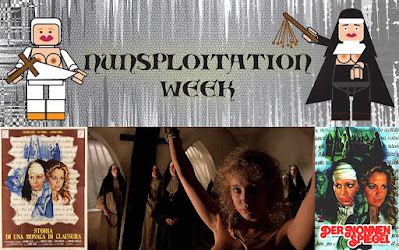
Story Of A Cloistered Nun


The Spartacus Solution

Story Of A Cloistered Nun
aka Storia di una
monaca di clausura

Italy/France/West Germany 1973
Directed by Domenico Paolella  
Severin Films Blu Ray Zone A/B


Warning: Many story spoilers here.

Story Of A Cloistered Nun is set in 1571 and tells the story of a young baby called Carmela (as we are first introduced to the character), who we see in a nuptial ceremony where her and the child of another family (I’m not sure if these kids are even a year old yet) are promised to each other in an arrangement designed to bind two families together. This sequence is following a fairly sedate set of opening titles where old etchings of monastic events are thrown up against Piero Piccione’s score, along with the text announcing that it’s “Adapted from authentic 17th Century Chonicles” (which makes no sense since it’s set in the 16th Century, I’m guessing) so, yeah, they were getting into marriage really early in those days, it seems. Then we find Carmela grown up and indulging what can only be classed as extraordinary tame lovemaking with her real boyfriend... honestly, not much is going on as they’ve still got their clothes on at this point but Carmela is already in raptures of ecstasy, her bosom heaving in that extra special bosomy way.

Now, Carmela obviously doesn’t want to marry the grown version of the toddler her family picked out for her so... dishonouring the family, she finds herself ‘gotten to a monastery’ to become a nun. There’s she’s subjected to lesbianism (which she completely refuses to partake in) from both her new friend Elisabeth (who has an underground group of libidinous nuns who secretly go to dress in colourful clothes, drink wine and indulge in things only hinted at in the dialogue) and also Elisabeth’s enemy, the Mother Superior. Both are in love with Carmela and both are scorned but Elisabeth gets back at her by having her boyfriend put to death, thus temporarily crushing Carmela’s will to live.

But then it turns out she’s pregnant and, when she comes to term and gives birth to a baby boy, the church hear about it and send priests and troops to investigate. In a bizarre moment, when the lead inquisitor (or whatever he’s called, this is not one of those torture porn films) questions whose child it is, Carmela owns up to proclaiming “I’m the mother!” However, in a  bizarrely Spartacus moment, Elisabeth also screams the same thing, followed quickly by the Mother Superior and then all the rest of the nuns in the convent. The powers that be have no choice but to shut down the order and expel everyone from the monastery but, before they all are split up and sent to other nunnerys, Carmela is given all the precious belongings the nuns come into the convent with so that she can flee and survive with the child, where she will wander the world helping those in need. The end of the film bitterly trumpets the fact that she’s never been beatified or canonised for her service to those in need.

The film stars a triumvirate of actresses in the key roles and whom many might remember especially in their roles in Dario Argento movies. So we have the main lady Carmela played by the beautiful Eleonora Giorgi, who would go on to play Sara in Argento’s horror film Inferno (reviewed here) and then from two of Argento’s gialli we also have Catherine Spaak as Elisabeth, who was the main female lead in Cat O’ Nine Tails (reviewed here) and Suzy Kendall as the Mother Superior, who was one of the female leads in Argento’s game changing directorial debut The Bird With The Crystal Plumage (reviewed here).

It’s another eye opener for nunnery life too. Like in Cristiana Devil Nun (reviewed here), Carmela has to wear a wedding veil to announce her wedding to God, although she renounces her vows before she actually takes them. Also, the nuns seem to all bind their breasts in a kind of half corset for some reason... hiding their femininity.

The camera work is pretty good. Carmela starts off arriving at the nunnery in very colourful clothing but... barring a window in one room, a wonderfully colourful shot of a distorted mirror and the scene where Elisabeth’s ‘secretly bad nun society’ are dressing up... most of the film is the dingy greys, whites and creams of the convent. However, the cinematography more than makes up for it and although the director is content for a while to split the screen vertically using architectural features to make areas for the actors, he does some really outrageous stuff with finding little triangular areas in front of the screen to use to segregate various characters in the spaces. For instance, in a scene where a tall monk and a shorter nun are walking side by side but in profile to the camera, he hangs a triangular frame down in front of the lens just splitting off a small area at the top of the screen. When the two characters pass behind it, the tall monk’s head is just in the triangle with both his lower body and the nun in the space below. It’s quite good stuff. And there’s a lovely introductory scene to a few of the nuns when Carmela arrives and they’re all observing her from behind what I could only call some kind of wrought iron, spiral web with a cross at the centre. The cinematography in this one is nothing if not creative, that’s for sure.

And there are a few stabs at other more exploitational tropes of the genre such as a topless whipping scene for Carmela and a scene where Elisabeth has to crawl along the ground of a big area in the convent with her tongue scraping along the ground, cleaning the floor as she goes but, I’d have to say this is all handled in a very non-sensational way and, in terms of nunsploitation, it all seems very tame compared to some other stuff I’ve seen.

All in all I would say, especially with the striking presence of Eleonora Giorgi as the main protagonist, that Story Of A Cloistered Nun is a perfectly fine and nice looking movie. I didn’t enjoy it as much as, say, Cristiana Devil Nun but then, that one seemed even less on board with the tropes of the genre than this one. I mainly had a good time with this film and, once again, am looking forward to seeing some more movies in this category very soon.


Sunday, 9 September 2018

The Bird With The Crystal Plumage


Knife ‘N’ Easy

The Bird With The Crystal Plumage
(aka
L'Uccello Dalle Piume Di Cristallo) Italy/West Germany 1969
Directed by Dario Argento
Arrow Blu Ray Zone B


It’s been a while since I last watched Dario Argento’s first feature film (as a writer/director, although he had written stuff for other directors such as Sergio Leone before this), The Bird With The Crystal Plumage. I first came by it via a couple of American DVDs in different editions over the years and I remember the last time I saw it was maybe 10 years ago when the BFI had a screening of it, in what turned out to be an astonishingly grubby print. This new Arrow Blu Ray edition brings back Argento’s early signature classic in style and, if like me you bought the limited boxed edition rather than their standard reissue, you also get some nice printed extras included in the slip case such as a thick booklet, a double sided poster (if you have any wall space to hang it) and, a big draw for me, a set of postcard reprints of the original Fotobustas (basically, the Italian version of lobby cards).

The film itself is remastered and, while it doesn’t look as crystal clear as the title might imply, I think it’s probably the best I’ve seen it looking here. If you are new to Argento and want a good jumping on point, this Arrow version would be a good place to start.

While it’s certainly not the first giallo of its kind... Mario Bava’s The Girl Who Knew Too Much and Blood And Black Lace (reviewed by me here) both pre-dated it... this is what single handedly started the slew of gialli that followed in its wake and it’s certainly the genre which gave Argento his fame and the one in which he’s worked the most. Not to mention, of course, that it’s the film which earned him the name ‘the Italian Hitchcock’. It’s also what was the start of what has been unofficially titled ‘the animal trilogy’ although, the only common links other than director style and genre is that animals are mentioned in the titles of the next two... The Cat O’ Nine Tails (which is a different thing altogether anyway) and Four Flies On Grey Velvet.

The film starts with the typical black gloved killer typing out a letter, still clad in said black gloves. Now I know 1960s typewriters were somewhat ‘gappier’ than modern day keyboards but, seriously, have you ever tried typing a letter wearing thick leather gloves? It seems somewhat silly and, furthermore, why would the killer not want to get any fingerprints on their own typewriter? This kind of doesn’t make sense. The scene also has the killer ‘fetishistically’ sharpening one of a set of nicely laid out knives. We then have the credits running properly, set to Ennio Morricone’s wonderful score, as the camera follows a young woman on her daily journey and Argento employs a trick here which he does throughout the movie in some fashion or another... he freezes the frame constantly and accompanies it by the shutter sound of a camera, the killer’s camera, taking a picture. Hold that thought, I’ll come back to this a little later. After this credit sequence we join the main protagonist as he is introduced, as an American writer based in Italy, staying with his girlfriend Julia (played by Suzy Kendall). Just before this, his friend buys a newspaper from a street kiosk which also has prominently displayed, some of those famous giallo magazines/novels of the time... so right away Argento was setting the scene for the genre in which he would, for the most part, work on for the rest of his life.

I remember that, when I first saw this movie decades ago, I had already seen four of the director’s movies. I had seen his two main horror movies, a genre which he rarely works in compared to the giallo, Suspiria and the direct, ‘official’ sequel Inferno. I had also seen Deep Red (aka Profondo Rosso, reviewed here) and Tenebre (aka Tenebrae... reviewed by me here). Now the thing about those two gialli is that they both have twist reveals as to the identity of the killer and, unusually for me, they both completely surprised me when said culprits were revealed at the end. The Bird With The Crystal Plumage, however, is the first one by Argento where he not only didn’t take me by surprise but the one where I worked out the identity of the killer within about five minutes of the opening credits. I always wondered why my dad, who was watching with me on that first viewing, never figured this one out because, for me, it just seemed quite obvious what was going on, when main protagonist Sam, played by Tony Musante, finds himself observing an attempted homicide as he is trapped between two sets of glass, sliding doors in the entrance to an art gallery, while he looks on as Monica Ranieri (played by Eva Renzi), is struggling with her stab wound on the floor. Now, I have to say, I always thought those double sets of doors with six feet or so between each set on either end of a long area were an invention of the movie because the design has always seemed completely impractical to me. Funny, then, that I now work in a building which has pretty much exactly the same set up in its entrance... I guess buildings like this do exist after all.

Even from this early scene, where Sam is watching the struggling girl pulling her bleeding body across the floor, Argento was displaying some of those wonderful shot designs he is so famous for... as this includes a lovely, almost iconic, shot looking up from Monica Ranieri’s POV as the camera looks up at Musante and frames his head and shoulders completely with the pattern on the ceiling above him... it’s lovely stuff.

By now, if you are an astute viewer, you have everything you need to solve the identity of the murderer and so Argento spends the remainder of the film trying to convince you that various people are the killer, by giving them character traits which match a somewhat false clue given early in the film and letting the audience get on with it and assume characters with matching traits (smokes Cuban cigars, is left handed etc) could be the killer and, like many a good giallo that was to come after it, various suspects die just when the audience figures out it could be them (not this audience member though... like I said, I found this one surprisingly easy to figure out after both Deep Red and Tenebre had fooled me). While it does this, it also keeps reminding the audience that there was definitely something a little 'off kilter' with the attack that Sam witnessed, by having Sam flashing back to it constantly with footage shot from different angles which, like the opening title sequence where the camera shutter sounds stopped the action dead, he uses in a similar manner to overtly step back from the film and highlight this mental process in as stylised a way as possible, in much the same manner that Godard would sometimes want to pop his audience out of the action to contemplate more what they were watching. And it works brilliantly here.

It’s also very interesting in terms of how Argento progressed as a director here because, although he often uses characters having what I shall call ‘memory attacks’ to remind the audience that there are doubts as to the nature of what they witnessed, he rarely does it in quite the way he does it here, literally calling a great deal of attention to those flashback moments, both visually and with hits of Morricone’s score, whereas in later films he tends to segue to them in a much smoother manner. That being said, I love the way he does it here and I am going to have to watch the new Arrow version of The Cat O’ Nine Tails (a film I haven’t seen for even longer than I have the gap between screenings of this one) to see if he’s still using this way of doing things there.

Morricone’s score, too, is a big talking point of this film, as far as I’m concerned. Argento was lucky enough to have the Italian musical superstar score his first three features before moving briefly onto Gaslini and then, of course, reinventing the sound of both Italian horror and giallo movies for all time by employing progressive rock band Goblin on Deep Red and many of his subsequent movies. Morricone would score a couple of his later movies (his score for The Stendhal Syndrome is wonderful) but these first three are probably what his musical collaboration with Dario Argento are best remembered by. The Bird With The Crystal Plumage fuses a melodic, contemporary jazz approach with a certain amount of ‘stinger’ atonalism and some wonderful wordless vocals which were, according to the IMDB, not sung by the usual suspect Edda Dell’Orso. Still, that haunting ‘la la la la la la la laaaa’ is not something easy to forget from Morricone’s score here.

And that’s all I’m going to say about this one here. The Bird With The Crystal Plumage is a wonderful giallo thriller from the maestro of the genre, Dario Argento... which he populates with a certain intensity balanced with a very likeable police inspector, played by actor/writer/director Enrico Maria Salerno and some decidedly oddball and larger than life characters who bring a lot of humour to the film. Definitely a good starting place if you’ve never seen any of this director’s work before and, if you can ignore some of the bad acting and ridiculous plot details which are part and parcel of this genre... Argento’s films in particular... and instead concentrate on the visual poetry of the film which he brings to all his work, then you will surely find this film wins you over with its edgy charm. And if you’re going to buy it, definitely grab the latest Arrow Blu Ray version because it’s the best version around, to date (and not the older Blu Ray they did from years ago which was incorrectly cropped on the image). If you're going to do Argento... do it right.