You Are
What You Eat
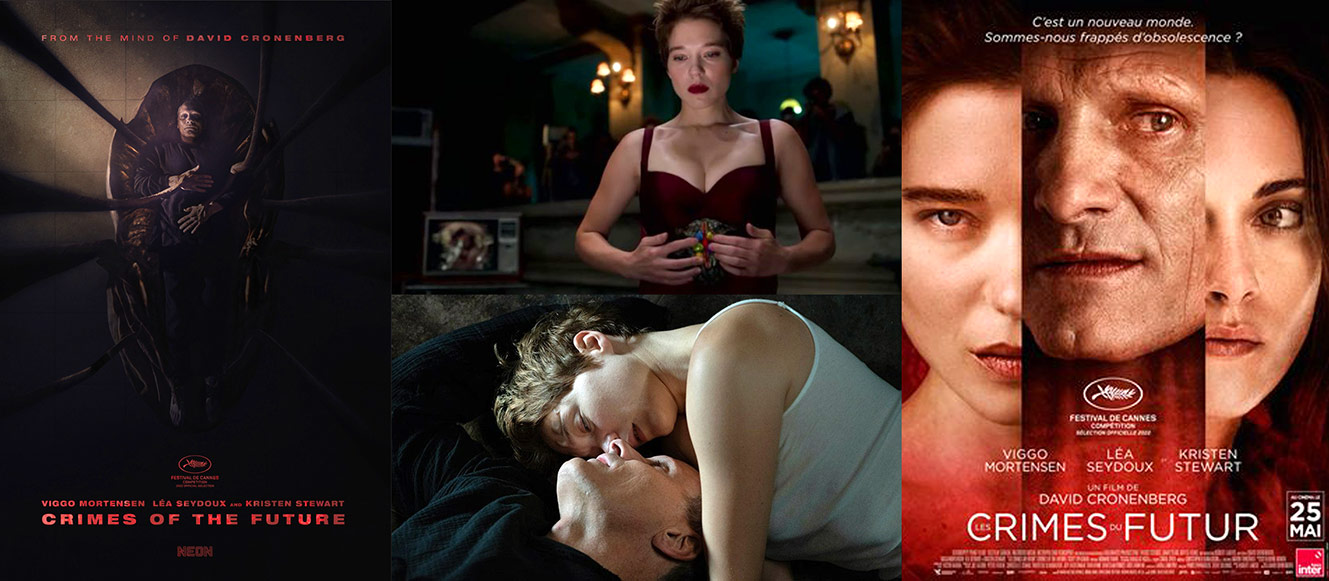
Crimes Of The Future
Canada/UK/Greece 2022
Directed by David Cronenberg
Canadian Broadcasting Corporation
Warning: Spoilers all over this one as I want
to talk about it properly. Please don’t read my
take on it until after you’ve seen the movie...
which you need to see if you are into the
art of cinema in any way, shape or form.
So Cronenberg returns triumphant with a great new film called, wait for it, Crimes Of The Future... which was also the original working title for his excellent eXistenZ and the title of his earlier short film (reviewed by me here). Now, first of all, let me address the elephant in the room which seems to be the little ‘out of place’ and unduly sensationalistic reportage of this film. I don’t know why people have been walking out of this one and putting it about that it’s somehow controversial but, no, it really isn’t. By modern horror film standards it’s actually quite tame (I just watched The Sadness, reviewed here, the other night so, please!) and, actually, this one isn’t even a horror film... it’s one of Cronenberg’s science fiction films, lacking the horror element completely. It maybe comes on as minor body horror but, I’ve always found that label a little problematic because, nine times out of ten, body horror movies don’t really shift into the horror genre, to be honest.
That aside, though, I always find Cronenberg a bit hit and miss... although more hit than miss I’d have to say and, if you like his work, then I’m happy to report that Crimes Of The Future is actually quite a charming and playful, fun movie. It’s properly old school Cronenberg delivered with the kind of visual sophistication which he started delivering as an aesthetically polished concept in the 1980s-1990s period of his work, I believe. I wasn’t expecting this to be as good as some of the movies I regard as his classics... such as Shivers, Rabid, Scanners, Videodrome, Dead Ringers, Crash and eXistenZ... in fact, I wasn’t expecting it to be much at all considering the, presumably manufactured ‘controversy’ hype used as a tool for marketers. But I have to say that it’s not only harkening back to a classic period of this director’s work, it’s also one of Mr. C’s best films, definitely in the top five of my favourite Cronenberg movies.
The film is set in a future which, it’s implied visually but not revealed, has survived some kind of apocalyptic event or possible evolutionary cull. The colour palette used throughout seems to be very dulled down, neutral and pastel versions of colours and everything seems consistent with that kind of aesthetic throughout... everything dialled back a notch and then infused with beiges, yellows, creams, blues and greens, I believe. Following an opening where a young boy starts eating his plastic wastepaper bin and then is smothered to death by his mother, our two main protagonists are introduced... Saul Tenser, played by Viggo Mortensen and Caprice, played by Léa Seydoux. The two are performance artists of some esteem. Humans don’t feel a lot of pain these days, the ability has left them but, Saul is one of those who still can and who is continually growing new, mysterious internal organs in his body, which Caprice then cuts out of him as the performance, using a Sark unit with robot arms wielding scalpels.... pulling apart new incisions, retrieving and slicing the organ in question and presenting it to the public (I’m assuming the Sark unit is derived from the term sarcophagous here).
However, after registering his next organ with a new, secret company called the National Organ Registry, things start to get complicated. Tenser meets Wippet, played by Don McKellar and Timlin, played by Kristen Stewart. We also meet the two maintenance technicians who come to service his organic bed (used to help him monitor and cultivate new internal organs) and feeding furniture (to help him eat), called Berst, played by Tanaya Beatty and Router, played by Nadia Litz. For reasons that become apparent later in the movie, the playful nature and agenda of these two struck me as being a female version of Wint and Kidd from Diamonds Are Forever (reviewed here). We also meet Scott Speedman in the best performance I’ve seen him give, as Lang Dotrice, father of the murdered child at the start, who wants Saul and Caprice to do a show based on the autopsy of his kid, for reasons which become apparent after Saul discovers he’s part of a cult of people surgically altered to consume plastic instead of food, in easy to consume chocolate looking bars referred to by one as ‘candy’. Of course, given Cronenberg’s passion for Philip K. Dick as evidenced quite explicitly in eXistenZ along with other movies, I couldn’t help but think this was also a reference to Can-D and Chew-Z from Dick’s novel The Three Stigmata Of Palmer Eldritch, which wouldn’t be the first time the director has referenced this specific novel.
However, a part of what qualifies as the government, as manifested by Welket Bungué playing a detective of the Body Crime Unit, are very much interested in this group of people, especially since the dead child has, it is rumoured, inherited the evolved genetic trait of consuming plastic from his father, rather than be surgically altered. All this is going on while Saul has registered for an Inner Beauty Pageant - Category: Best Original Organ With No Known Function... but he’s also an informant for the Body Crime Unit, unknown to Caprice but, as the film progresses, you realise a few of the people who he comes into contact with might know this already.
And its great. One of the buzz phrases associated with the marketing of the film is that ‘Surgery is the new sex’ which, I thought nothing of but it turns out that this is also a mantra of a few of the people in the movie and, certainly Saul and Caprice indulge their mutual sexuality in this way. With Saul controlling the Sark with a remote unit quite reminiscent of the pods in eXistenZ, she lays naked, enjoying each stroke as he slices up her flesh for her sexual pleasure, before putting the unit on remote and joining her. In another scene, she unzips the scar of a new hardware access point from something put in him to monitor the Inner Beauty Pageant and starts licking his open wound which is given and received in much the same manner as a blow job. The punchline to all this comes later when Kirsten Stewart, who coins the phrase ‘Surgery is the new sex’ in the movie, tries to instigate sex with him through a passionate kiss and he rejects her after a minute stating, “I’m not very good at the old sex.” So, yeah, as much as people are calling this one an edgy film, it’s more full of humour, almost to the level where at some points it’s almost functioning purely as a comedy.
And being as it’s Cronenberg, it all looks fantastic. There’s a brilliant moment where a shot is split vertically by the frame of a door. The door opening on the left with Stewart standing in it, with yellowy beige walls behind her and with Léa standing on the right against the wall of the room in which the camera is placed, the wall cream coloured behind her. It’s such a striking shot composition that one could be forgiven for thinking Cronenberg had used a split screen for the shot... it’s that much of a contrast, in spite of using colours which wouldn’t have a lot of perceived contrast against each other in a busier shot. The film is full of this kind of good stuff and you are constantly reminded you are in the hands of a master director all the time.
Once slight criticism might be that the blood effects in the film look like they’re handled by CGI. They may not be but, they do look like they don’t have much substance to them. At least to me. I have no idea how the effects were achieved but it might be a trade off to easily include the concept of the Sark unit (an earlier conceptual version of which was seen in Ridley Scott’s Prometheus, if memory serves).
And one observation, rather than criticism, is that time seems to drift without warning in the film. Everything seems to be taking place in close proximity to earlier events but, as you go through, you realise days, weeks or possibly even months may have taken place between one sequence and the next with no real warning. I was fine with that and the progression of people and organisations over this time can be easily tracked either visually or in details of the text but, I suspect some people may find this a barrier... not an insurmountable one though and I kind of grew to like that freestyle attitude to the story after a while. And it is a proper story, people... this one more than most of Cronenberg’s is actually leading up to a moment in the last shot which, once you think about the consequences of what you are seeing, actually has a meaning and resonance that hints at an actual evolutionary process in a certain direction without direct provocation. So that was pretty cool.
And all of this is supported by a typically Cronenbergian score, provided by the director's frequent collaborator Howard Shore and, frankly, the biggest crime of the future, in regard to this movie, is that this brilliant score at time of writing, has not been issued on a proper CD. Come on people, get your act together. People need a proper release of this stuff on the only format worth listening to it on.
And, apart from me singling out Kirsten Stewart’s performance as being brilliantly against type... I’m used to seeing her play very confident characters, not nervous and excitable people... I will leave you with a solid recommendation for Crimes Of The Future. It oozes old school Cronenberg charm and I found it hugely entertaining. He really knocked it out of the park here.
Showing posts with label Howard Shore. Show all posts
Wednesday, 14 September 2022
Crimes Of The Future 2022
Monday, 1 February 2016
Spotlight
A Priestful Of Dollars
Spotlight
2015 USA
Directed by Tom McCarthy
UK cinema release print.
So Spotlight, directed by actor, writer and director Tom McCarthy.... is not the kind of movie I would normally take a look at in my local cinema, to be honest. With the subject matter being the 2002 scandal of numerous Catholic Priests molesting children that the church was covered up or, more properly, the investigative team on The Boston Globe who brought it to light, the Spotlight of the title, it's really not something I would usually go for.
However, the trailer was pretty good for this one and it had a couple of actors in it, Michael Keaton and Mark Ruffalo, who I happen to think a lot of in terms of giving strong performances. I could tell from the trailer that the studio were trying to pitch it as a kind of modern equivalent, in terms of atmosphere, to the classic Watergate scandal movie All The President’s Men and I guess, yeah... that’s exactly what this is, in some ways. Although, if I’d known that the film was directed and co-written by the same guy who had written and directed The Station Agent, one of the great modern classics of American cinema, then I would have rushed to the cinema even faster.
Now, this is not a perfect film here, in my book, but it’s pretty close to being one and I have to say that if you want to be on the edge of your seat with a movie that’s based on real life events then this one’s a pretty good choice. It’s apparently fairly accurate to the original events and situations too... as much as a Hollywood movie could be, I guess. According to some quotes from various people who found themselves being played by some pretty great actors, that goes for the accuracy of the portrayal of the personalities in question too, by all accounts.
Michael Keaton and Mark Ruffalo knock it out of the park, just as I would expect form them. Liev Schrieber, Rachel McAdams, John Slattery, Stanley Tucci and Brian d'Arcy James are all pretty darned amazing too, it has to be said. If you want believability and credibility... not to mention a sense of naturalism that can carry a drama of this emotional weight while still accenting it enough to give it all a broader sense of entertainment value, then this group of actors are very much people who you are in good hands with. If you admire films which can flow forward breezily as you follow the characters in the course of their investigation then this is definitely one for you. It’s the kind of investigative movie that does what it should do... explain what the Spotlight team are after, explain the individual's assignments and then follow through on their detective work with well put together montages punctuated by key excerpts from their interviews. So that’s all good.
One thing which didn’t sit well with me, however, were some scenes... not all that many of them but enough for me to sit up and pop out of the experience somewhat... where the editing of the footage didn’t seem all that great. Not necessarily the fault of the editor, by the way, it might have been the only way to sort out the footage in some sequences. Those sequences in question being some of the back and forth conversations which litter the movie in several places. These are often treated with static shots and the standard TV style of editing where we cut from one shot to the reverse is very much a present constant in some kinds of scene. I also thought the placement of the focus of the eyes on those shots and their reverse equivalent was conflicted and it was the contrast of forcing the eye to suddenly jerk between different areas of the screen at speed in a few places which really started distracting me from what I was supposed to be looking at. Not throughout the whole movie, for sure, but I did find it quite gruelling on a few occasions in there.
The other minor thing, and it is a minor thing, was that I felt that Mark Ruffalo’s passionate, hot headed reporter was somewhat bereft. His wife or girlfriend is mentioned a couple of times but, though we see him in something like a home environment on a number of occasions, we never catch sight of the lady in question. This is even when we see him working on stuff at home at night... when you would think the lady of his life would be present in some way. Maybe I missed a detail in the dialogue to explain that but I think it would have given Ruffalo’s character a little more context if we’d had seen the lady in his life, to a certain extent.
But yeah, minor grumbles at best in a film which delivers the tone and passion you would expect from people being forced to confront the truth of a story rapidly expanding in scope as the Spotlight team discover more about the unwritten conspiracies which have kept the story from breaking in the press over the decades that this kind of abuse had being going on. Their initial story began with just one priest and, by the end of the investigation, there were around 87 priests who had been uncovered.
The film is very sparsely spotted in the musical content and I would have expected this kind of movie to have no score at all but certain key montages and highlights are given a certain emotional presence by Howard Shore’s piano dominant score. At points it maybe felt a little heavy handed in contrast to the many scenes without music but that’s always a hard balancing act to get right and, where some of these scenes reach for the music in a less naturalistic accompaniment... there’s always another scene where the score gets it dead right. I’ve been a big fan of Shore over the years, especially with his scores to the early David Cronenberg films and Kevin Smith’s Dogma and it’s not a bad match for the movie in most scenes. People who are only familiar with his brilliant scores to the less than brilliant adaptations of Tolkiens works by Peter Jackson may be a little surprised at the modest scope of this piece but, frankly, anything heavier may well have undermined a movie of this nature and even this one threatens that on occasion. I know I wouldn’t normally argue for this, being as I love movie music so much, but maybe the mix was a little more prominent than it could have been in certain scenes but... yeah, for the most part it’s pretty good and it may be a good stand alone listen too.
And that’s what I thought of Spotlight. A pretty amazing movie with some things which irritated me but which in no way put me off the movie as a whole. A brilliant cast and some nice dialogue make for pretty compulsive viewing, in my book, and I wouldn’t be too surprised if there isn’t at least one Oscar nod to this one sometime soon. Definitely worth a watch, as far as I’m concerned.
Monday, 5 January 2015
The Hobbit: The Battle Of The Five Armies
Look Who’s Tolkien
The Hobbit: The Battle Of The Five Armies
2014 USA/New Zealand
Directed by Peter Jackson
Playing now at cinemas in the UK.
Well then.
I come to what is hopefully my last, somewhat samey review of another film in the completely superfluous Hobbit trilogy. Why you need a trilogy of overlong movies for a book with a relatively low page count, I’ll never know.
Oh, wait. Yes I will... they can charge you a minimum of three times to see the movies and a minimum of three times if you like them enough to buy the three DVDs or Blu Rays. And then, as an extra special bonus, they can gouge you for the three extended cuts the following November.
What a cynical money making exercise this has become. And all in the name of adapting Tolkien who, to be honest, doesn’t really have much to do with this second, prequel trilogy of films. Much less, even, than the botched attempt at “adapting” Lord Of The Rings a while ago. You guys know The Battle Of The Five Armies lasts just about one chapter in the book, right?
Okay, so, all that being said...
The Battle Of The Five Armies is not a bad little entertainment. It’s certainly not terrible... at least not in terms of the kinds of values placed on movies by Hollywood these days... possibly it’s morally terrible but, I think I’ve already covered that ground just now and in my two previous reviews here and here. What it does have going for it, perhaps, in comparison with the other chapters in the trilogy, is its pacing.
It’s a speedy movie and the reason for this is it’s really, in some ways, just like the last third of Return Of The Jedi (reviewed on this blog soon). That is to say, it’s just pretty much one, big, long action scene taking up the whole movie with only a few bits of talking to break it up at odd intervals. And because the special effects in this installment are, mostly, pretty well done... it’s pretty impressive eye candy for a lot of the time. It doesn’t hurt that the performances of all the actors, stars and character parts alike, are all extremely good. You will believe in the people who are fighting their battles and you will, I’m delighted to say, feel for them to some small extent too. There’s a fair crack at an emotional hook between two of the characters in this segment... not a great one, to be fair, but it is present and so there’s a humanistic context to be had here... even if the two characters I’m talking about are a) an elf and a dwarf and the fact that b) one of the characters, the elf, isn’t a character from any of Tolkien’s works and made up for a specific actress to play.
The battles are exciting and, surprisingly, Jackson and co have managed to edit them, while using a lot of cross cutting from scene to scene and character to character, in such a way that it all makes sense in your head and it’s unlikely that you’ll get confused during the action scenes. Which, being as the film is pretty much just one giant action scene, as I said before, is an obvious bonus here.
Howard Shore’s score, though, is still the real star of the picture. I might never watch the movies again in my life but I’ll certainly give the soundtrack albums a spin or two over the years. The final song isn’t exactly great but the music throughout the movie is another mini masterpiece written by a genuinely great modern composer and... I suspect... they’ll be playing in concert versions and classical album selections for many decades after he, and I for that matter, are long dust in the ground.
And that’s about all I’ve got to say about this one, I’m afraid. This is an extremely short review, for me, and I apologise for that but, asides from keeping me entertained for a few hours, I really can’t find myself inspired by it enough to be able to dredge up anything else about either the technical merits of the movie or the way the story works. It is what it is, a Hollywood style cash in trading on the name of a much loved writer. If you’re a fan of heroic fantasy action cinema and have no interest in the source, then you should be fine with this latest pseudo-adaptation of The Hobbit. If, however, you’re not someone who can divorce the movie from its original source, and I am almost certainly guilty of doing this myself, to an extent (but at least I am trying to be objective about it), then this probably isn’t going to fill your heart with too much of anything except maybe rage. So see this one or don’t and you may, or may not, have a good time with it but... there are much better movies out there worth your time, I’m sure.
Wednesday, 2 January 2013
The Hobbit: An Unexpected Journey 3D
Kicking The Hobbit
The Hobbit: An Unexpected Journey 3D
New Zealand/USA 2012
Directed by Peter Jackson
Playing at cinemas now.
Warning: I quite like the works of one J. R. R. Tolkien...
so you might not like this review!
Sigh. I expect this will be a fairly short review.
I’d be more angry at this travesty but I just can’t summon the strength after Peter Jackson’s Lord Of The Rings trilogy annoyed me so much with the amount of stupid omissions and additions... not to mention the predictability of the master shots and close-ups within the edit (fortunately, this movie doesn’t quite suffer from those two symptoms nearly as much as its predecessors did).
There are some very good things about The Hobbit: An Unexpected Journey 3D and, in fairness to the director and production team, I’ll try to list as many of those things as I can... but I’m afraid this one played out as my worst fears for the project.
It’s a hard thing for me to write because I love movies so much and this “version” of The Hobbit is certainly a great piece of cinema. It’s exactly the kind of spectacle and feeling of epic fantasy which cinema was made for... and it’s competently handled and, I feel, will please a lot of movie goers. However, there is also a sense of betrayal and disrespect for the original works which leaves me with worse than mixed feelings about it.
I’m not the biggest Tolkien fan but I did like his books, The Hobbit and Lord Of The Rings (the latter of which I read in the 70s when it was right and proper that it was all published and read as a single volume and not split into three separately bound volumes, like is fashionable again these days) and found them to be good. I also remember Bernard Cribbins reading The Hobbit on TV in the 1980s on the BBC programme Jackanory (those were the days) and scratching many a furrowed brow at the ZX Spectrum game of the book, which I never did manage to complete.
Perhaps this is why I’m so “let down” with these new movie versions of the books, which I feel do not respect Tolkien’s original material as much as they should and are, mostly, poor adaptations. Goodish movies... but just generally bad versions of the source.
Here’s what’s good about this latest...
Great spectacle, competently put together and competently edited (as I said before). There are also some great performances, including an absolutely brilliant, own the role, turn from Martin Freeman as young(er) Bilbo and he seems to have great chemistry with Ian McKellen, who is obviously relishing his return to Gandalf The Grey.
There’s a brilliant performance by Sylvester McCoy (the Seventh Doctor) who gives a real sense of impish wizardry as Radagast The Brown but... you know... that character’s NOT IN THE BLOODY BOOK! Also a “nice to see him again” cameo scene from the great Christopher Lee, back as Saruman The White who... well you know... ISN’T IN THE HOBBIT YOU IDIOTS! Also good to see Cate Blanchett, one of the absolute finest and versatile actresses of her generation, reprising her role as the stunningly sensual Galadriel... that’d be, if memory serves, the same Galadriel who WASN’T IN THE ORIGINAL NOVEL! And it’s even got more dramatic weight for the character of Thorin Oakenshield as he faces down the orc who killed his father... who I think merited ONE LINE IN FLASHBACK in the book and wasn’t mentioned again.
What’s going on?
Well, let’s have a think here. Lord Of The Rings made loads of money and each film was three hours or a little more. The studios want a long trilogy they can make the same kind of tentpole money from.
The current edition of The Hobbit on sale is a short book numbering approximately 400 pages. Whereas Lord Of The Rings currently flags up 1664 pages (it always was a thick book).
And yet The Hobbit is being turned into a trilogy totalling almost nine hours in it’s first release cut... so you do the math here. It doesn’t take too much to figure out that this movie is going to be padded out to kingdom come... and padded out it is.
Jackson has tried to tie the whole thing to his earlier trilogy, when no extra adhesive was needed other than what was already on the written page. Honestly. Rock giant fights and troll battles! Clever scenes have been turned into action scenes for the sake of giving a young audience something to gawp at... it may be good cinema but it’s hardly Tolkien. He’s even got Ian Holm back as “old Bilbo” and Elijah Wood back as Frodo to give audience recognition. What rubbish!
Granted, some of the characters and incidents are sourced from other works by Tolkien but... let them stay where they were... what we have here is a greatest hits compilation but remixed with extra beats, bells and whistles which were, frankly, not needed and are certainly not welcome.
The one saving grace of this movie, like the original trilogy, is that Howard Shore is back on scoring duties. He’s tied up a lot of the leitmotif in this one by reusing thematic material (such as his steal... err... homage to Dvorak’s New World Symphony) or by retrofitting the music so it gives a more simplistic version of a theme which will grow and mutate (backwards) into the main melody lines used in Lord Of The Rings (such as Elmer Bernstein’s bandit theme from The Magnificent Seven... err... I mean, oh heck, if you know these scores you know exactly what I mean). His music is, though, absolutely fantastic and the main reason I’ll probably be going to see the next two installments (and forcing myself to write reviews of them). So if you like good music... that’s a reason to bother seeing this film.
Anyway, I think I’m about done here. All in all, I’d say I enjoyed The Hobbit a fair bit more than Jackson’s raping... err... interpretation of the Lord Of The Rings trilogy so I have to give it points for that. I think if you’re purely looking for some spectacular cinematic distraction from this movie then you’ll probably be in luck. However, I would warn all fans of Tolkien to beware... this is really going to annoy and irritate the heck out of you. A few well chosen references and basic plot points do not, a Tolkien movie, make!
Sunday, 5 August 2012
Sanshiro Sugata Part Two (The Films Of Akira Kurosawa #3)
Sanshiro The Hero
Sanshiro Sugata Part Two
Japan 1945
Directed by Akira Kurosawa
Criterion Eclipse Region 1
I was getting all ready to write the lead in to this review and I quickly looked on the IMDB to see if there was anything extra important I should know about it which I wasn’t going to cover, when I saw a review which really panned this movie, saying that Kurosawa’s heart wasn’t in it etc. It’s true, I would say, that Kurosawa’s heart wasn’t really in this, but I would have to say that this doesn’t stop this movie being another absolute masterpiece from an absolute “directing emperor” and I’ll highlight some of the reasons why I believe that as I go through.
It did make me angry though!
Okay, so my favourite director made this sequel only two years after his directorial debut with the first movie Sanshiro Sugata (reviewed here), which he had followed up with a wartime propaganda film called The Most Beautiful (reviewed here). It was here that Kurosawa, in his capacity as a director, first became the victim of his own popularity. Sanshiro Sugata was so successful, you see, that the studio practically forced Kurosawa to write and direct a sequel to the movie... something he would do only twice in is career, both times under studio pressure because his original movie scored hugely at the box office (the other sequel he made was Sanjuro, the sequel to his popular film Yojimbo).
And so he reassembled the cast of his original movie and went at it, perhaps a little less enthusiastically but no less diligently (I believe) than he did with any other of his films. There are possible flaws here, in that the action jumps around a little, but that could just be Kurosawa experimenting with a format that cut needless explanatory dialogue from the movie... and it’s not like anything is any less understandable or worse off for it. It’s a tad jarring in a couple of the transitions but, then again, it might be the effect he wanted to achieve.
The film is a double storyline, which leads up to two fight scenes which again show the simplistic, child-like intellect of the title character gaining a little wisdom and expansion while at the same time focusing on the purity of his naive point of view, which often leads him to the truth of the matter. One fight is the culmination of a set up in which Sanshiro is offered money to represent Japan against America in a fight to demonstrate that martial arts (such as Sanshiro’s expertise with Judo) are a match for the “art” of American boxing, by pitting him against a boxer in the ring for money and to profit the promoters. It’s a show match, purely for commercial reasons, and he wants no part of it.
The second storyline is of the two brothers of the man that Sanshiro fights at the end of the first movie, who want their revenge on him. The original character has been made very ill by the fighting and is dying. He comes to make his peace with Sanshiro but also warns him about his two, crazy, vengeance-hearted next of kin. In a brilliant piece of casting on Kurosawa’s part, the original actor playing this character also plays one of his two brothers in different make-up... something I didn’t even realise the first time I saw this movie at the cinema some ten years or more ago.
The set up to the first storyline is a classic piece of tension-and-release pre-action cinema staging and, considering the context of when this movie came out, is something which must have been really electrifying to the audiences on its initial release. Because an American Navy man is so tall and heavy, a rickshaw driver, on stopping, accidentally tips him out of the rickshaw... for which he begins to receive a beating by the brawnier US bully. After hitting and tossing him around a bit, the sailor brings his arm right back for another killer blow... when Kurosawa cuts to a close up of the same hand being grabbed from behind. Enter Sanshiro Sugata, who rescues the grateful Rickshaw driver by “taking care” of the bully and throwing him “in the drink”, so to speak. This unfortunate occurrence is what gets the Americans to notice the Japanese fighting style in the first place and so this incident is what sets off the US VS Japan theme of the plot. And, of course, it’s brilliantly staged by Kurosawa.
That “catching of the hand” shot has been used many times since and, due to the sheer inventiveness of silent movies, I’m guessing it had been used many times before this movie was made, but it’s a real interesting usage of something which has echoed down the years and which still keeps us watching this similar kind of dynamic interaction to the present day. Just think of the “entrance” of Jay and Silent Bob about 20 minutes into Kevin Smith’s Dogma, for example. Linda Fiorentino is about to be pummelled to death by the three minor, skateboarding, hockey-stick armed demons from hell when all of a sudden, just at the last second... Jay and Silent Bob arrive and despatch the three demons in a blare of heroic fanfare music (courtesy of composer Howard Shore). Kurosawa was doing this stuff a long time before that... powerful stuff and one of many visual master strokes in this film.
Another piece of brilliance is when the young rickshaw driver who was rescued by Sanshiro, and who has been pestering him to take him on as a Judo pupil, finally gets his wish. Instead of showing an action packed montage of the pupil going through his training, as many directors might choose to do, the director has one sequence where Sanshiro throws him about a lot to test his resolve, followed by a riveting montage with the camera locked in one place which shows the man entering from screen left and sitting down to begin a lesson. The same 6 - 10 seconds is repeated, each shot dissolving into the next, to show the way the attitude and confidence of the man changes and grows just by his demeanour and body language over time, lesson by lesson, as he enters and sits down in various ways in each of these silent shots. A brilliant and simple alternative to the obvious choice, of which a variation was used in a similar “locked camera” sequence with Charlotte Rampling, by Woody Allen in his greatest masterpiece, Stardust Memories. The montage of her repeating a phrase in different states to show her mental deterioration is, I think, something of a spiritual cousin to this sequence from the Kurosawa film, just used to reach a different conclusion.
Another piece of brilliance in the film is the fight where a Jujitsu man (who has stepped in because Sanshiro initially refuses to partake in the ballyhoo and commercialism of a “show fight”) is knocked down in the ring. Sanshiro already has a conscience about this as he has talked to the man prior to the beginning of the fight and is accused of making Judo so popular as a martial art, due to his prowess and status as a kind of figurehead for it, that the Jujitsu crowd are forced to perform for money. As the beaten man lays on the floor, the visuals are all about the audience going wild, then Sanshiro’s reaction to the audience, then a shot of the downed man failing to get up and then back to the crowd etc., in a cyclic montage which really presses the emotion buttons and pushes the point that Sanshiro is disgusted by the whole charade. This may be an old trick now, but it’s expertly done here and it’s always worth seeing a master director building sympathies like this.
The entrance of the two brothers in Sanshiro’s dojo is also amazing. Once of them is “touched in the head” and completely crazy... playing it in a very “in your face” (quite literally at one point) fashion in much the way I would imagine Toshiro Mifune would have played the role... if he wasn’t already busy at the time, before he became an actor, teaching Kamikaze pilots how to win the war. Similarly, his brother, has a laugh which is unexpected and creeps out unexpectedly, just the way in which Mifune would do it for his crazy samurai role in Seven Samurai, years later. It broaches and interesting question... where did “the Kurosawa” end and “the Mifune” begin, in terms of Mifune’s amazing acting prowess.
The final fight scene in the snow, where one of the brothers takes on Sanshiro, seems like two silhouettes fighting against the white and is a minor set piece intended, I believe, to echo the fight in the field at the end of the first movie. But it’s really only a prelude to the scene which comes after where Sanshiro in his sleep, simply by smiling in the midst of a dream, prevents his own death at the hands of the crazier of the two brothers... who is also seen to have become a little more enlightened, or at least agreeable, due to the good example of the title character.
So my final conclusion on Sanshiro Sugata Part Two, contrary to the drab condemnation of it on the IMDB, is that Kurosawa has indeed, through both sheer technical inventiveness and the invocation of some superb performances by the principal cast, managed to rend yet another celluloid masterpiece. If you’re not familiar with the work of Kurosawa then I would say that this film isn’t the best jumping on point (you really have to see his debut feature first to get the most out of this one) but it’s certainly another rich vein of textbook cinema at its best and should, perhaps, be treated a little with the level reserved for any great masterpiece. If you’ve seen the first movie though... seriously take a look at this astonishing sequel before the opportunity is no longer there. If the Criterion edition of this is anything to go by... that ropey old print isn’t getting any better as the years roll on.
.
Subscribe to:
Posts (Atom)


