Showing posts with label György Ligeti. Show all posts
Thursday, 31 October 2019
The Shining
Axe-simile
The Shining - Extended Edition
(aka, The Full Cut and not the
stupidly short European version)
UK/US 1980 Directed by Stanley Kubrick
HMV Exclusive Dual Edition
Blu Ray Zone B DVD Region 2
There’s surely no doubt in the minds of many, I’m sure (asides from Stephen King’s once much publicised disappointment with this movie version), that Stanley Kubrick’s The Shining is easily one of the most interesting horror movies ever made. The first few times you watch it, too, it’s kinda quite creepy... that perhaps diminishes somewhat over time and subsequent rewatches but what you are left with, even if it does have less impact through familiarity, is an amazingly beautiful looking movie which never really ages all that much.
The reason I’m revisiting this classic after more than a decade now, of course, is that the first screen adaptation of Stephen King’s fairly recent follow up novel, Doctor Sleep (I reviewed that here) is literally days from release (in fact, I think it comes out in the UK on the night I am intending to post this review). So I figured it was time for another look because, from the looks of the trailer (and I’m puzzled by this a little since King apparently loves this new movie), the director of Doctor Sleep has used a lot of the imagery from Kubrick’s version of The Shining in the new film.
As for Stanley Kubrick’s The Shining itself though... even from the opening camera work which follows a long journey of the vehicle driven by the as yet unseen central character Jack Torrance (played here quite maniacally throughout by Jack Nicholson), you are pulled into the story. One of the strengths of this opening, I suspect, is the way the speed of the photography of these sequences (the out-takes of which were famously plundered for the final scene in the original first release of Ridley Scott’s Blade Runner, reviewed here) is slowed down in terms of the soundtrack, which highlights Wendy Carlos and Rachel Elkind’s absolutely phenomenal variation on the Deus Irae... a truly eerie and unsettling take on the much used musical theme.
The film is a definite slow build for the most part... with little points being made slowly but methodically to lead up to the scenes where the Overlook Hotel and its ghostly inhabitants, overwhelm Jack Torrance and compel him to try and murder his wife and child... Wendy and Danny, played here by Shelley Duvall and young Danny Lloyd (who is being played as an adult by Ewan McGregor in the upcoming movie version of Doctor Sleep). I think I’d possibly agree with Stephen King’s assessment that Jack Nicholson seems a little too manic right off the bat (no pun intended) but that does nothing to diminish the fact that he’s extremely watchable in this. As is Shelley Duvall, who does an amazing job here along with newcomer Danny Lloyd in a role which could have gone way wrong for the film if the performance had been anything less than what it turned out to be. They are joined by the likes of Barry Nelson (the first screen James Bond), the always watchable Scatman Crothers and Dr. Eldon Tyrell himself, Joe Turkel, in the role of Lloyd the bartender... who plays the character absolutely deadpan and in an effectively chilling, minimalistic way.
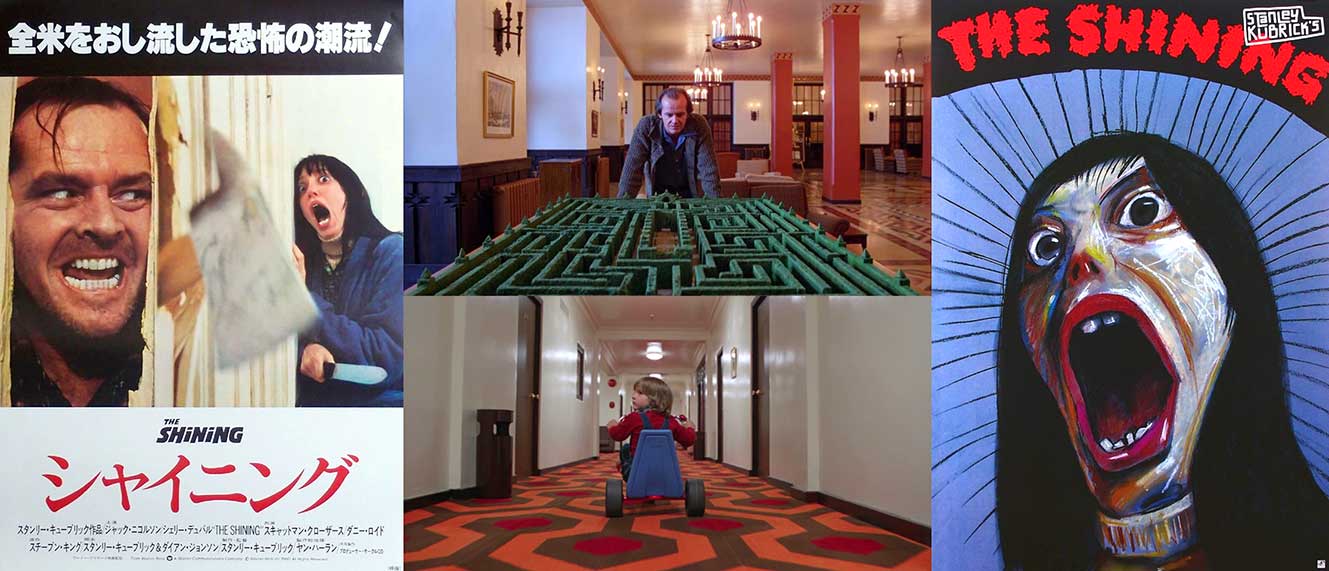
The film features many Kubrick signatures and watching this one always reminds me of one of his other masterpieces, 2001 - A Space Odyssey, which I reviewed here. So the shots of Danny tri-cycling his way around the hotel in fluid camera movement cross cut against other things going on in the building, for example, always puts me in mind of those long interior shots of Frank Pool keeping in shape in the former movie. Similarly, the little... almost subliminal... cuts to various shots such as the twin sisters, the mutilated corpses of the sisters and the reaction shots of characters such as Danny (when he’s flipping out in full ‘shine’ mode) which are always silent whenever Kubrick does this (in that they have no diegetic sound and are merely using the sonic backdrop of the shots into which they are spliced) reminds me of both the reaction shots of David Bowman in the high speed journey via the monolith at the end of 2001 and the reaction shots of Patrick Magee in A Clockwork Orange. And, of course, you have those long held shots focusing on the face of a staring character from time to time, most notably in The Shining when Jack Torrance really starts to wig out and you just realise the dark, rotting heart of the Overlook Hotel has finally seeped inside of him and become the dominating force in any already lost spiritual battle in his soul.
Another thing which ties it to 2001 is the chaptering. This film also consists of, quite a few, chapter stops and in this film they are, in order of their appearance... The Interview, Closing Day, A Month Later, Tuesday, Thursday, Saturday, Monday, Wednesday, 8am and 4pm. Like in 2001 they can be used to make a dramatic ending to a sequence, such as the unwavering stare of Jack Nicholson brought to you on a very slow zoom suddenly abruptly cutting to a title card... but they also function in this film, or at least I believe this is the case, to speed the rhythm of the story by giving us period markers going from an interview held a while before Torrance actually gets his job as caretaker of the out of season Overlook, to the closing day when he takes over and it’s abandoned to him and his family for the winter season... and then whittling down the times until you eventually get chapters talking about specific parts of just one day. It’s a kind of subconscious, accelerating spiral, I think, in terms of both the pacing of the action and also, of course, the internal state of Jack’s mind as he approaches full on serial killer mode in the film’s final sequences. It’s an interesting device and, for all I know, it’s just been employed to smooth over some awkward transition scenes that didn’t cut together properly but, whatever the reason for them, they function very well in this capacity.
Of course, one of the main ingredients in just how sinister this film feels is due to the music. I’ve already mentioned Carlos and Elkind but there’s also the use of Béla Bartók, Krzysztof Penderecki and, like 2001 before it, one of my favourite composers, György Ligeti. If you want a film to sound unbearably disturbing then many tracks by these composers are good for just that and, frankly, they often have the same effect on the human psyche when you’re not juxtaposing them with any imagery.
As usual with Kubrick, there are constant, beautifully designed frames throughout. Some may find the artifice involved in getting some of these, in some cases, almost symmetrical designs with very contrasting, almost primary colours a little off putting or overwhelming but, frankly, the gorgeous and constant eye candy of a Kubrick film is something I always find a sheer delight. So, yeah, he’ll have Wendy and Danny dressed in warm browns and reds for their walk through the green hedge maze to make them pop and, yes, he’ll have the majority of Jack Torrance’s encounter with the naked lady in Room 237 framed in it’s own little arched rectangle in the centre of the screen... but it all looks great as far as I’m concerned. And it’s a film, like many Kubrick films, full of iconic imagery. You all know the famous carpet pattern, for example and, of course, the wonderful shots of the elevators gushing blood and filling up the corridor.
The Shining is always going to be a hard recommend from me and will probably always be somewhere in my top ten horror films of all time. The HMV Exclusive (to the UK) dual edition of the so called ‘extended cut’ (aka, the version they’ve always shown on TV in this country, just not at the cinema) looks absolutely gorgeous. I honestly didn’t know films could look this good on my Blu Ray player, it’s phenomenal. That being said, the film is presented in its original theatrical widescreen aspect ratio as opposed to the 1.37:1 aspect ratio that it was shot in (and which Kubrick himself insisted the film should be shown in) but I’m more than happy to see it as it was when screened at the cinemas on its first run... although a 4:3 presentation with more image information at the top and bottom (open matte) might have been preferable. Still a great one to look at though... especially if you want to see what your Blu Ray can really show you in terms of quality. It’s never looked so good.
Tuesday, 15 May 2018
2001 - A Space Odyssey
Jupiter As Ending
2001 - A Space Odyssey
UK/USA 1968 Directed by Stanley Kubrick
MGM Blu Ray Zone B
Warning: Spoilers, I guess, if you’ve
never seen this masterpiece before.
I always find Stanley Kubrick a bit hit and miss as a director to be fair. Some of his movies are sheer genius while... certain others leave me cold. I’ve always had a soft spot for 2001 - A Space Odyssey but it’s been a while since I last saw it. However, as my father pointed out, now we have a high definition TV and a remastered blu ray release on the market, now would be the perfect time to catch up to this classic slice of cinematic science fiction again. So we did.
The film is one of those ‘fake Cinerama’ films where the process of shooting on three cameras for three screens joined together was dropped after being used for such features as The Wonderful World Of The Brothers Grimm and the quite extraordinary How The West Was Won. Instead, a single camera widescreen process designed to be projected on a curved screen was used and there were a number of films using this ‘in name only’ substitution for the real Cinerama process at the time (although it’s only referred to as Super Panavision on some posters). I’ve seen it a number of times on a large screen but I think I only ever saw it projected onto a massive, curved screen once, though. That was a great screening, however.
The film was somewhat divisive in its critical reception, it seems to me but the popularity and growing audiences due to the amount of hippies doing drugs and watching the famous star gate journey at the end is what kept it in cinemas longer than originally hoped for and helped make it a hit. At least, that’s the story. Nowadays, of course, it usually places quite highly in lists of the greatest movies ever made and, in my opinion, it’s certainly worthy of that honour.
The film is split into four sections and there are jumps in time or space between them so that only the final two sections share the same protagonist (although the main protagonist from the second section also gets a few minutes on a television screen towards the end of the third section). The four sections are The Dawn of Man, TMA-1, Jupiter Mission and finally, Jupiter and Beyond The Infinite. That being said, the title of the second section is the only one which isn’t introduced typographically on screen, instead relying on the cut from one element in The Dawn Of Man to another element as a way to throw the audience into the next section of the picture.
Based on the short story The Sentinel by co-writer (for the screen) Arthur C. Clarke, the film tells the story about the manipulated growth and development of mankind as precipitated by the mystery at the heart of the movie - the black, rectangular, alien slab known only as The Monolith. This mystery element is enhanced by some fairly minimalistic, or perhaps naturalistic would be a better word, acting from various cast members and some spectacular yet often quite clinical cinematography. It’s also enhanced greatly by a score of needle dropped music such as Thus Spake Zarathustra and The Blue Danube waltz but the real stars of the show, musically speaking, are the tracked in cues by one of my favourite composers, György Ligeti... who I discovered from listening to the old vinyl soundtrack of this back in the sixties and early seventies (when I was between one and five years of age, I guess). Actually, it wasn’t until Ligeti saw the film in cinemas that he was able to successfully sue Kubrick since, for some reason, Kubrick had assumed Ligeti’s quite startling works were the work of a long dead classical composer rather than a contemporary artist (the composer actually didn’t die until 2006, almost 40 years later). It is Ligeti’s music which gives full weight to the scary mystery which is the heart of the film and, although I absolutely love what survives of composer Alex North’s rejected score to this, I think Kubrick possibly made the right call here. Nobody can out-Ligeti Ligeti!
The Dawn Of Man sequence is an amazing thing with ape men in rival clans living through their daily routine. Actually, I’d never realised before this Blu Ray screening (or even after I’d seen it at the big old curved screen of the old Empire Cinema a couple of decades ago) that this sequence was shot in a studio with rear projection. Unfortunately (or fortunately, depending on your view point) there’s a kind of moiré pattern on the backdrop visible on this new transfer and it kind of gives the game away. That being said, the picture is pretty stunning and I also noticed something else for the first time during this sequence... but I’ll get to that in a bit. After the appearance of the monolith, one bright ape gets an idea and weaponises himself and his fellow clan with bones with which they kill animals to eat and, of course, rival ape men. So the monolith is a catalyst for technology (which brings murder and violence with it, naturally).
The second sequence, known by some as TMA-1, follows Doctor Haywood Floyd (played by William Sylvester... who was replaced in the sequel by Roy Scheider) as he journeys to the moon and gives a briefing there. There is a cover story that a quarantine has broken out on the moon base but the true story is, as revealed at the end of the section, that a second monolith (although these characters aren’t to know it’s the second time mankind has had an encounter with a monolith) has been found buried under the lunar surface... and it’s been there for quite some many millions of years. The climax of this section is when the monolith lets out an ear splitting sound which, we later find out, is it beaming out a signal to... something... near Jupiter.
The third sequence, Jupiter Mission, is where the lead Protagonist David Bowman (Kier Dullea), Frank Poole (Gary Lockwood) and three other hybernating crew members, are on their way to Jupiter... although they don’t know the true nature of thier mission yet. Accompanying them is their shipboard computer HAL900. Now, the reasons for HAL’s malfunction and attempt to kill all the crew members is not really blatantly touched upon here (and it wouldn’t be until the movie adaptation of the first of Clarke’s sequel novels, 2010) but he almost succeeds in wiping them all out during some intense sequences before the one surviving astronaut, David Bowman, manages to get himself back on their spaceship and disconnect HAL. After a nice little nod to the first song that a computer in real life ever sang, the disconnection of HAL’s higher brain functions triggers a video of Dr. Floyd’s deliberately delayed secret briefing to the astronauts, revealing the true nature of the mission to Bowman. To explore the area around Jupiter where the Monolith’s signal went and ‘make contact’ with whatever alien intelligence is behind it.
And then we come to the last sequence, Jupiter And Beyond The Infinite. Some time has passed again between sections and David Bowman is already out of the ship and in a small pod to investigate a floating monolith he’s discovered in the vicinity of Jupiter. Then comes the famous "star gate" sequence of special effects which is absolutely beautiful and fearsome at the same time... especially with Ligeti’s terrifying and awe inspiring music over it. Occasionally, frames of Bowman's face reacting to what he’s seeing as little half a second shots that pretty much amount to stills are intercut with this and... well it still, after all these decades, gives off a very uneasy atmosphere. And then, as if to compete with the quite long special effects sequences of Bowman’s ‘journey’, we have an extended sequence where Bowman is ‘a guest’ of the alien intelligence and we see him in an Escher-like existence as he intrudes on himself at different stages of his life as he ages to death in the space of five to ten minutes (in screen time). It’s a truly great artistic achievement and then, of course, with the return of the Thus Spake Zarathustra music which has become synonymous with this movie, he is reborn as The Star Child... a giant fetus in space. It’s interesting because you can see just how comic book artists like Jack Kirby were influenced by the film. Not only did Kirby do the Giant-Sized Marvel Treasury adaptation of the movie, which I still have... but also a continuation series which, after ten or so issues, mutated into a vehicle for his Machine Man character. But if you think of classic Kirby creations like The Watchers... you can see how this film must have been a tremendous inspiration for him.
2001 - A Space Odyssey is absolutely deserving of its reputation in the film community these days. The poetic and deliberate manner in which Kubrick moves his camera around the sets... and it’s not all just clinical whites, there are great bursts of colour in the set design too at regular intervals... is an absolute treat and its definitely a movie which stands up to many repeat viewings. It’s also a movie where it’s fun trying to figure out how they did some of those amazing, zero gravity effects sequences too. Some of these are as mind boggling as the open ‘space striptease’ sequence in Barbarella.
And talking about the camera work...
The thing I noticed this time around when I was watching The Dawn Of Man sequence is that the whole thing was done with static shots and cuts. There’s no discernible camera movement at all until you get to that one last, famous shot of the bone flying up to the air which Kubrick then cuts (on motion) to a nuclear satellite (as a grim reminder that we’ve gone from bone as weapon to full on nuclear capability). It’s at this moment that the camera then becomes free to roam as it does in the rest of the picture and this must have been a very deliberate and conscious decision on Kubricks part, I think. And an interesting one in a metatextual sense because it basically implies that the catalyst of the monolith in mankind’s progress has also freed the camera along with it... if you see what I mean. Technology plus violence equals camera motion as an unconscious enabler on the audience to absorb the implications on a level in which they’re partly complicit. And that’s a powerful cinematic tool which Kubrick really goes with here.
Other than that... not too much to say here. 2001 - A Space Odyssey has always been known as one of the greatest science fiction films ever made and it’s easy to see why. If you are already a fan of the genre and you haven’t seen this one then... seriously... what are you waiting for? A true spectacle of the cinema as art and an absolutely brilliant Blu Ray presentation loaded with a fair few extras too. It belongs on every cinephile’s movie shelf.
Subscribe to:
Posts (Atom)

