Showing posts with label Jack Nicholson. Show all posts

Tuesday, 8 December 2020

Batman


Bat’s Entertainment

Batman
USA/UK 1989
Directed by Tim Burton
Warner Brothers Blu Ray Zone B


1989 came to be known as The Year Of The Bat for many, due to the release of Tim Burton’s Batman on the 50th Anniversary of the popular comic book character. I remember the mood of the time well. I also remember the queues to get in.

This was pretty much the last time I recall queuing for a movie that was quite literally a ‘blockbuster’. It’s something that, despite the popularity of films these days, you don’t really see anymore. I remember my first experience of the power of the blockbuster, trying to get through a packed Oxford Street in London to see Star Wars at the Dominion Cinema at the tail end of 1977 (literally a day or so away from New Year celebrations... it's a theatre now). Everywhere while the film played for months, monster queues would pop up outside cinemas going on for blocks. Even the word ‘blockbuster’ was first coined for this ‘film queueing’ phenomenon, with the release of Easy Rider in 1969, if memory serves. I remember seeing Batman a few times at cinemas but, the one time which really sticks in my memory is of lining up outside Barnet cinema for a midnight screening with my friend Kerry, in a queue which literally snaked back on itself about 12 times in front of the cinema before ending several blocks away. There was a fair amount of uncertainty as to whether the cinema would have enough seats on any given night to accommodate the amount of people trying to get into a performance.

So it would be fair to say that the film was a huge success (although, I think it technically was financially in the red for decades, in part owing to the deal struck with Jack Nicholson on this film... who was also, due to his shrewd contract, being paid for the sequels even though he’s not in them... at least, I seem to remember reading that).

It was well loved by audiences and critics too, although I remember George Peppard appearing on Breakfast TV at the time and, when asked, saying that the film was terrible. Most people liked it though and that included me. I wasn’t intending to watch this one again for a while but I keep meaning to watch the sequel for a Christmas review (it being a Christmas movie) so, I didn’t want to go into that one again without this one still fresh in my mind.

Okay, so, I absolutely loved it back in 1989 but, in some ways, the film doesn’t really hold up that well today. I don’t know what it is about Burton’s vision (a director I find really hit and miss, although always uniquely creative) but, while it does kind of scrape through as a coherent whole, the film does seem to be just a series of nice looking set pieces with maybe no real downtime to give them strength in contrast. It feels like almost every scene is screaming in your face for attention and you almost can’t quite hear everything in the crowd. To be fair, though, I think that’s probably also a criticism of the whole of Hollywood cinema from the mid 1980s to mid 1990s so, in itself it’s probably unfair to bury it just for that. It’s like this is the first wave of movies to be somewhat ‘detrimentally’ swayed by the aftermath of the huge impact of Star Wars on popular culture because, sometimes the things which make a phenomenon successful are not best understood by the art that it unintentionally spawns.

That being said, I didn’t dislike the movie this time around and can understand why Batman still holds a certain place of high esteem in the hearts of certain cinephiles.

One of the reasons that this was a phenomenon, I believe, is because super hero movies were few and far between at the time and, successful ones were hard to find. The Christopher Reeve starring Superman The Movie had been a big hit but that was over a decade prior to this. Batman had been portrayed in cinemas by different actors three times before this one but, the last time had been in 1966. So, audiences of various ages were ready for a new take. They didn’t want a comical version like the last one had been though, so the casting of Michael Keaton as Bruce Wayne/Batman, someone who was known more for comic roles, met with a huge letter writing campaign objecting to his involvement... boy, I wonder what would have happened if this movie was being made in the internet era. I never had a problem with the idea myself (I’d quite liked him in his previous collaboration with the director, Beetlejuice) and, when I eventually saw him in the role, I think I was justified in holding my tongue. 

Keaton is an absolutely brilliant pick for this film as so many of the actors and actresses here are. What a cast! Kim Basinger is brilliant but there are also some great character artists here, among them Michael Gough (as Alfred), Pat Hingle (as Commissioner Gordon), Jack Palance, William Hootkins and even Lando Calrissian himself, Billy Dee Williams, in the role of District Attorney Harvey Dent. I remember getting excited in the cinema when I saw this and was waiting for him to transform into super villain Two-Face before the end of the picture although, well, it didn’t happen. “Huh?” I thought when the credits rolled, “They must be saving that for the sequel.” Alas, although Billy Dee Williams was contracted to continue playing the role, his contract was bought out by Warners and when Harvey Dent finally becomes Two Face for the third movie in the series, Tommy Lee Jones took over the job.

Looking at the film now, there are some nice things about it. It looks lovely in that dark, gothic way that Burton soon became known for although, I think some of the editing on this one is a bit jarring. Sometimes deliberately so, when we are startled by a close up of a TV screen being smashed by a boxing glove and sometimes, less so, when Burton will attempt to hide the visual edit by carrying on the sound of one scene into another (on a specific sound cue like The Joker’s laughter). Incidentally, the destruction of TV sets by The Joker as opposed to, I dunno, just changing the channel or switching them off like a normal person, seems to be some kind of running character trademark here.

Other things of note would be the turning over of a Joker card from a deck at a key point in the narrative, foreshadowing his character’s fate... and the strangely deliberate lack of period in the film, where technology from all eras comes crashing together to give the setting a timeless appearance (much like the old 1930s and 40s Universal Horror movies which, I’m sure, Burton was probably influenced by as a kid). I especially like the way that both Keaton and Nicholson compliment Kim Basinger on her apartment with the observation that it has "lots of space"... something which obviously re-enforces the connection between their two characters as being different impressions of the same coin, in the way in which they both tend to express their psychological abberations.

There are also a lot of references to other moments of both comic history and pop culture scattered throughout the movie... such as the police file photos of Jack Nicholson’s character, which look to me like they’ve been taken from One Flew Over A Cuckoo’s Nest, or the references to Vicky Vale’s photographic work in Corto Maltese (after the famous comic book character of the same name, no doubt).

There are also some nice musical references such as the use of Beautiful Dreamer woven into the score which, to be fair, always reminds me of Mighty Joe Young but it’s used nicely here for an expression of The Joker’s more artistic side. Danny Elfman’s score is, of course, phenomenal and, although he’d already done a great score with Beetlejuice, this one really put him on the map. It is kinda clouded by comments that a lot of it may have been... let’s say ‘more than assisted with’ by Shirley Walker, who only receives a conductor’s credit in the final film. Certainly her scores for the Batman animated series sound very Elfmanesque although, to be fair, that was probably part of the brief. Now that she’s dead I suspect the truth will never come out but, I like both composers so I don’t really care. It sounds like this was, maybe, a great collaborative venture, asides from the usual orchestration work by Steve Bartek but, you know, I’m just guessing from differing viewpoints I’ve read and information which sometimes seems to come to light. Great score though, either way.

And that’s all I’ve got to say about Batman. If you watch it now, it’s almost more a film about what cinema was doing at the time rather than something which holds together as all that much more. It’s somewhat flawed, I feel but, strangely watchable and certainly entertaining in parts. I’ve no desire to see it again for a while but chances are I will circle back to it again at some point in my life. At the time it was a benchmark movie and deserves a certain amount of respect for that, I think. Not to mention, it also really put cinematic artist Tim Burton on the map too, I believe. Worth a look, if only for the nostalgia rush.

Wednesday, 22 April 2020

Room 237


Overlooking The Obvious

Room 237
USA 2012 Directed by Rodney Ascher
101 Films  Blu Ray Zone B


It’s funny, I thought Room 237 was only a couple of years old at the most. I remember there being a lot of fuss about it on Twitter around about that time and so I was somewhat disappointed I didn’t catch a cinema release. I think I finally got this one a couple of months ago in a 101 Films sale or some such thing and, frankly, this wasn’t quite the film I’d hoped it would be. That being said, it’s technically quite well put together if the visual equivalent of ‘needle drop’ is your kind of thing.

The documentary, if you can call it such, explores some of the less usual fan theories about Stanley Kubrick’s 1980 masterpiece, his loose adaptation of Stephen King’s The Shining. Now I was prepared to keep an open mind going in here because I’d heard good things about it and I wanted to see if I could follow some of the lines of thought which make up the basis of these separate theories, from five very different people who I think I shall keep as nameless here so I don’t actually have to ridicule a specific person. So I went in open minded and... honestly... didn’t stay that way for all that long, it has to be said.

The format of the film is probably the most interesting thing about it. None of the people explaining their theories (voices crosscut with one another over the course of the film in chaptered sections) are ever shown. Instead, the director has used found footage from old newsreels and some fairly famous high profile movies like The Brain From Planet Arous, All The President’s Men or The Thief of Bagdad cut against each other to metaphorically illustrate what’s going on in the minds of the people talking. Quite often the footage is further digitally manipulated, such as the many shots of Tom Cruise from Kubrick’s Eyes Wide Shut where he walks by and contemplates posters of The Shining in the street as he passes. Similarly, in the many times footage from The Shining itself is played, at various speeds ranging from very slow to normal to very fast (and even backwards and forwards simultaneously superimposed)... the director will use things like big digital arrows to point out the specific area of the screen which is being talked about from a particular ‘guest’. It’s all quite skillfully put together and that, along with the synthesised musical version of the Dies Irae invoking the Wendy Carlos opening of The Shining, are pretty much the only saving graces of this movie... for me, at least.

Now, it’s interesting that one of the people talking in this film says something which actually rings quite true in some respects. Frankly, it’s a very pertinent statement, even if it half feels like it’s being used in defence of what the person is saying because they suspect they might sound like they’re being unreasonable in their conclusions. It is this...

“Author intent is only part of the story of any work of art.”

Yeah, absolutely. I can get behind that statement. The identity of the artist and their cultural, religious and political upbringing are obviously going to seep into an artist’s work, whether they are conscious of this or not. Totally get this and believe it completely... a wise statement. However, there are extremes of conclusions that people can make which are, frankly, outside of the remit of even this simple, scattergun statement and, frankly, when all is said and done and the arguments for and against whichever theory is being explored have run their course, I was forced to conclude, as I had suspected within the first ten to fifteen minutes of this movie, that all of the people being interviewed for this film are, in fact, total nutters.

And it’s a shame because I love The Shining and I wanted to learn something new about it. Not 'new and completely, balls to the wall, fruit loop crazy' which, quite a lot of this is. I mean, the placement of cans of baking soda with an Indian head on them and other cumulative imagery from the movie do not, honestly, make for a movie which is actually about man’s betrayal of the Native American Indian and their mistreatment. Similarly, the numerology all pointing to sevens and forty two.... such as the numerals of the famous Overlook Hotel room number multiplied out - 2 X 3 X 7 giving us the ‘magic number’... do not constitute yet another in a line of similarly misconstrued ‘clues’ laid down by Kubrick that the film is about the Holocaust and Nazi Germany in 1942 etc. Neither does Barry Nelson’s hips lining up with the side of an in-tray and looking momentarily like a pseudo erection while he’s shaking Jack Nicholson’s hand turn us on to the fact that The Shining is a movie about sex and the sex demons that live in Room 237. Nor does the disappearance of a sticker of Dopey from Snow White And The Seven Dwarfs signify that Danny, after his first vision, is no longer ‘a dope’ and understands everything that is going on around him. Seriously people, this is some advanced level of insanity creeping in behind the normal sounding voices of the people narrating this.

For a while there it gets like people are actually making sense in the film... especially when you compare the levels of craziness of each new theory. For example, when you follow with the camera, the path into the room where Jack has his interview, the woman narrating seems absolutely right that the window showing the view outside really could not exist... it’s in the middle of the building. So yeah, points to her here and also to the person who notices that the two shots of Danny and the ball on the carpet don’t match in terms of pattern... so they were obviously filmed in different places is what that means, not that something sinister has occurred.

Similarly, the ‘apparently false’ fact that the Earth is 237 miles from the moon plus the fact that Danny is wearing a moon landing sweater when he walks to Room 237 does sound like it almost could be a metaphor for a trip to the moon but, honestly, it doesn’t mean that Stanley Kubrick faked the moon landings for the government and I don’t believe, as this guy does, that the whole of the film is Kubrick trying to signify to mankind that he did it. Of course, it doesn’t help that Kubrick himself gave an interview which I heard once that he'd faked the moon landings but, you know, he was a bit of a wind up merchant when it came to people aiming crazy theories at him, I suspect.

Actually, that’s one of the things that bothered me most about the people in these interviews. The ‘author intent’ get out clause I quoted above does not excuse the fact that they are quite often picking up on some, admittedly insane and disturbingly lax continuity errors... such as the disappearing ‘Dopey’ or a chair going completely missing behind Jack Nicholson’s head in one shot between cuts or the changing carpet pattern... and making so much more of them than they need to. Do I think Kubrick... an admittedly meticulous director... was doing this on purpose. No, I do not. I just think he liked some parts of takes better than parts of others and edited them all together from multiple sources to get the best and most consistent performance out of the actors... and there’s nothing much more to it than that.

So, there you go. Room 237 is, ultimately a somewhat intriguing film in the odd ‘clue’ to the overall ‘mystery’ of The Shining (a mystery which I’m sure doesn’t exist outside of the heads of these people) but, I have to say that, even though there were a few shiny coins laying among the pebbles, it’s a pretty dull affair. The excellent execution of the way the ‘evidence’ is unpeeled and portrayed by the filmmakers doesn’t detract from the less than mesmerising stretches of tedium as various enthusiastic but quite possibly unhinged individuals try to convince you that their insane theory, which they obviously totally believe is so obvious once they’ve explained it, is anything like an arrival at some form of truth. Proceed with caution.

Thursday, 31 October 2019

The Shining


Axe-simile

The Shining - Extended Edition
(aka, The Full Cut and not the
stupidly short European version)

UK/US 1980 Directed by Stanley Kubrick
HMV Exclusive Dual Edition
Blu Ray Zone B DVD Region 2


There’s surely no doubt in the minds of many, I’m sure (asides from Stephen King’s once much publicised disappointment with this movie version), that Stanley Kubrick’s The Shining is easily one of the most interesting horror movies ever made. The first few times you watch it, too, it’s kinda quite creepy... that perhaps diminishes somewhat over time and subsequent rewatches but what you are left with, even if it does have less impact through familiarity, is an amazingly beautiful looking movie which never really ages all that much.

The reason I’m revisiting this classic after more than a decade now, of course, is that the first screen adaptation of Stephen King’s fairly recent follow up novel, Doctor Sleep (I reviewed that here) is literally days from release (in fact, I think it comes out in the UK on the night I am intending to post this review). So I figured it was time for another look because, from the looks of the trailer (and I’m puzzled by this a little since King apparently loves this new movie), the director of Doctor Sleep has used a lot of the imagery from Kubrick’s version of The Shining in the new film.

As for Stanley Kubrick’s The Shining itself though... even from the opening camera work which follows a long journey of the vehicle driven by the as yet unseen central character Jack Torrance (played here quite maniacally throughout by Jack Nicholson), you are pulled into the story. One of the strengths of this opening, I suspect, is the way the speed of the photography of these sequences (the out-takes of which were famously plundered for the final scene in the original first release of Ridley Scott’s Blade Runner, reviewed here) is slowed down in terms of the soundtrack, which highlights Wendy Carlos and Rachel Elkind’s absolutely phenomenal variation on the Deus Irae... a truly eerie and unsettling take on the much used musical theme.

The film is a definite slow build for the most part... with little points being made slowly but methodically to lead up to the scenes where the Overlook Hotel and its ghostly inhabitants, overwhelm Jack Torrance and compel him to try and murder his wife and child... Wendy and Danny, played here by Shelley Duvall and young Danny Lloyd (who is being played as an adult by Ewan McGregor in the upcoming movie version of Doctor Sleep). I think I’d possibly agree with Stephen King’s assessment that Jack Nicholson seems a little too manic right off the bat (no pun intended) but that does nothing to diminish the fact that he’s extremely watchable in this. As is Shelley Duvall, who does an amazing job here along with newcomer Danny Lloyd in a role which could have gone way wrong for the film if the performance had been anything less than what it turned out to be. They are joined by the likes of Barry Nelson (the first screen James Bond), the always watchable Scatman Crothers and Dr. Eldon Tyrell himself, Joe Turkel, in the role of Lloyd the bartender... who plays the character absolutely deadpan and in an effectively chilling, minimalistic way.

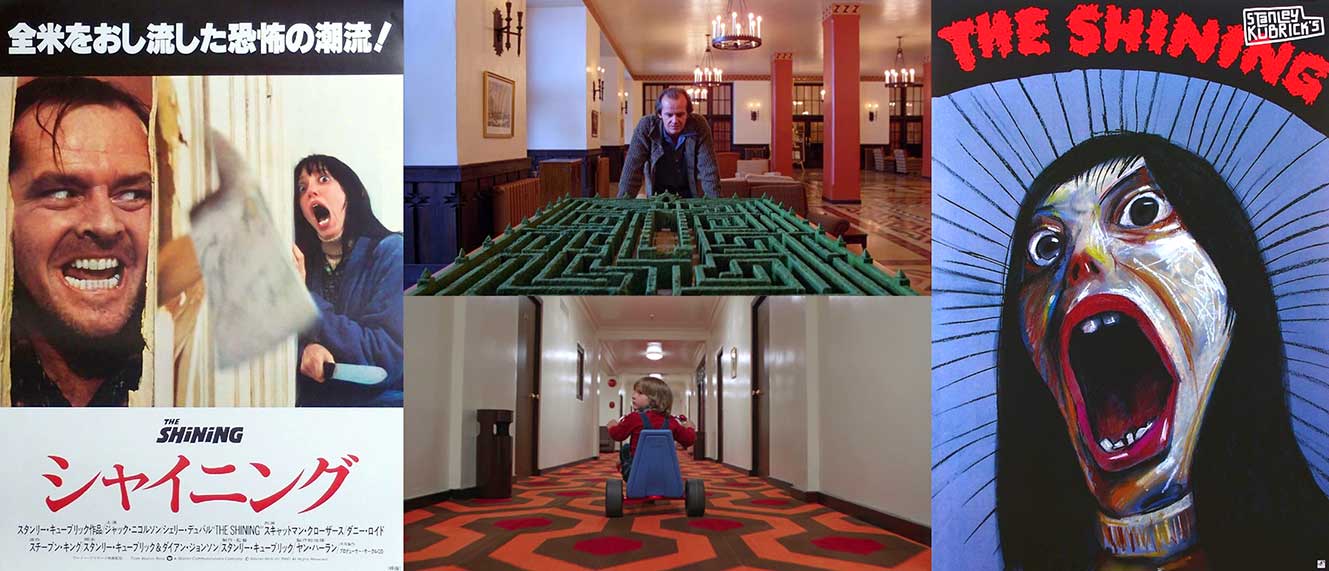
The film features many Kubrick signatures and watching this one always reminds me of one of his other masterpieces, 2001 - A Space Odyssey, which I reviewed here. So the shots of Danny tri-cycling his way around the hotel in fluid camera movement cross cut against other things going on in the building, for example, always puts me in mind of those long interior shots of Frank Pool keeping in shape in the former movie. Similarly, the little... almost subliminal... cuts to various shots such as the twin sisters, the mutilated corpses of the sisters and the reaction shots of characters such as Danny (when he’s flipping out in full ‘shine’ mode) which are always silent whenever Kubrick does this (in that they have no diegetic sound and are merely using the sonic backdrop of the shots into which they are spliced) reminds me of both the reaction shots of David Bowman in the high speed journey via the monolith at the end of 2001 and the reaction shots of Patrick Magee in A Clockwork Orange. And, of course, you have those long held shots focusing on the face of a staring character from time to time, most notably in The Shining when Jack Torrance really starts to wig out and you just realise the dark, rotting heart of the Overlook Hotel has finally seeped inside of him and become the dominating force in any already lost spiritual battle in his soul.

Another thing which ties it to 2001 is the chaptering. This film also consists of, quite a few, chapter stops and in this film they are, in order of their appearance... The Interview, Closing Day, A Month Later, Tuesday, Thursday, Saturday, Monday, Wednesday, 8am and 4pm. Like in 2001 they can be used to make a dramatic ending to a sequence, such as the unwavering stare of Jack Nicholson brought to you on a very slow zoom suddenly abruptly cutting to a title card... but they also function in this film, or at least I believe this is the case, to speed the rhythm of the story by giving us period markers going from an interview held a while before Torrance actually gets his job as caretaker of the out of season Overlook, to the closing day when he takes over and it’s abandoned to him and his family for the winter season... and then whittling down the times until you eventually get chapters talking about specific parts of just one day. It’s a kind of subconscious, accelerating spiral, I think, in terms of both the pacing of the action and also, of course, the internal state of Jack’s mind as he approaches full on serial killer mode in the film’s final sequences. It’s an interesting device and, for all I know, it’s just been employed to smooth over some awkward transition scenes that didn’t cut together properly but, whatever the reason for them, they function very well in this capacity.

Of course, one of the main ingredients in just how sinister this film feels is due to the music. I’ve already mentioned Carlos and Elkind but there’s also the use of Béla Bartók, Krzysztof Penderecki and, like 2001 before it, one of my favourite composers, György Ligeti. If you want a film to sound unbearably disturbing then many tracks by these composers are good for just that and, frankly, they often have the same effect on the human psyche when you’re not juxtaposing them with any imagery.

As usual with Kubrick, there are constant, beautifully designed frames throughout. Some may find the artifice involved in getting some of these, in some cases, almost symmetrical designs with very contrasting, almost primary colours a little off putting or overwhelming but, frankly, the gorgeous and constant eye candy of a Kubrick film is something I always find a sheer delight. So, yeah, he’ll have Wendy and Danny dressed in warm browns and reds for their walk through the green hedge maze to make them pop and, yes, he’ll have the majority of Jack Torrance’s encounter with the naked lady in Room 237 framed in it’s own little arched rectangle in the centre of the screen... but it all looks great as far as I’m concerned. And it’s a film, like many Kubrick films, full of iconic imagery. You all know the famous carpet pattern, for example and, of course, the wonderful shots of the elevators gushing blood and filling up the corridor. 

The Shining is always going to be a hard recommend from me and will probably always be somewhere in my top ten horror films of all time. The HMV Exclusive (to the UK) dual edition of the so called ‘extended cut’ (aka, the version they’ve always shown on TV in this country, just not at the cinema) looks absolutely gorgeous. I honestly didn’t know films could look this good on my Blu Ray player, it’s phenomenal. That being said, the film is presented in its original theatrical widescreen aspect ratio as opposed to the 1.37:1 aspect ratio that it was shot in (and which Kubrick himself insisted the film should be shown in) but I’m more than happy to see it as it was when screened at the cinemas on its first run... although a 4:3 presentation with more image information at the top and bottom (open matte) might have been preferable. Still a great one to look at though... especially if you want to see what your Blu Ray can really show you in terms of quality. It’s never looked so good.