Showing posts with label Shelley Duvall. Show all posts

Wednesday, 22 April 2020

Room 237


Overlooking The Obvious

Room 237
USA 2012 Directed by Rodney Ascher
101 Films  Blu Ray Zone B


It’s funny, I thought Room 237 was only a couple of years old at the most. I remember there being a lot of fuss about it on Twitter around about that time and so I was somewhat disappointed I didn’t catch a cinema release. I think I finally got this one a couple of months ago in a 101 Films sale or some such thing and, frankly, this wasn’t quite the film I’d hoped it would be. That being said, it’s technically quite well put together if the visual equivalent of ‘needle drop’ is your kind of thing.

The documentary, if you can call it such, explores some of the less usual fan theories about Stanley Kubrick’s 1980 masterpiece, his loose adaptation of Stephen King’s The Shining. Now I was prepared to keep an open mind going in here because I’d heard good things about it and I wanted to see if I could follow some of the lines of thought which make up the basis of these separate theories, from five very different people who I think I shall keep as nameless here so I don’t actually have to ridicule a specific person. So I went in open minded and... honestly... didn’t stay that way for all that long, it has to be said.

The format of the film is probably the most interesting thing about it. None of the people explaining their theories (voices crosscut with one another over the course of the film in chaptered sections) are ever shown. Instead, the director has used found footage from old newsreels and some fairly famous high profile movies like The Brain From Planet Arous, All The President’s Men or The Thief of Bagdad cut against each other to metaphorically illustrate what’s going on in the minds of the people talking. Quite often the footage is further digitally manipulated, such as the many shots of Tom Cruise from Kubrick’s Eyes Wide Shut where he walks by and contemplates posters of The Shining in the street as he passes. Similarly, in the many times footage from The Shining itself is played, at various speeds ranging from very slow to normal to very fast (and even backwards and forwards simultaneously superimposed)... the director will use things like big digital arrows to point out the specific area of the screen which is being talked about from a particular ‘guest’. It’s all quite skillfully put together and that, along with the synthesised musical version of the Dies Irae invoking the Wendy Carlos opening of The Shining, are pretty much the only saving graces of this movie... for me, at least.

Now, it’s interesting that one of the people talking in this film says something which actually rings quite true in some respects. Frankly, it’s a very pertinent statement, even if it half feels like it’s being used in defence of what the person is saying because they suspect they might sound like they’re being unreasonable in their conclusions. It is this...

“Author intent is only part of the story of any work of art.”

Yeah, absolutely. I can get behind that statement. The identity of the artist and their cultural, religious and political upbringing are obviously going to seep into an artist’s work, whether they are conscious of this or not. Totally get this and believe it completely... a wise statement. However, there are extremes of conclusions that people can make which are, frankly, outside of the remit of even this simple, scattergun statement and, frankly, when all is said and done and the arguments for and against whichever theory is being explored have run their course, I was forced to conclude, as I had suspected within the first ten to fifteen minutes of this movie, that all of the people being interviewed for this film are, in fact, total nutters.

And it’s a shame because I love The Shining and I wanted to learn something new about it. Not 'new and completely, balls to the wall, fruit loop crazy' which, quite a lot of this is. I mean, the placement of cans of baking soda with an Indian head on them and other cumulative imagery from the movie do not, honestly, make for a movie which is actually about man’s betrayal of the Native American Indian and their mistreatment. Similarly, the numerology all pointing to sevens and forty two.... such as the numerals of the famous Overlook Hotel room number multiplied out - 2 X 3 X 7 giving us the ‘magic number’... do not constitute yet another in a line of similarly misconstrued ‘clues’ laid down by Kubrick that the film is about the Holocaust and Nazi Germany in 1942 etc. Neither does Barry Nelson’s hips lining up with the side of an in-tray and looking momentarily like a pseudo erection while he’s shaking Jack Nicholson’s hand turn us on to the fact that The Shining is a movie about sex and the sex demons that live in Room 237. Nor does the disappearance of a sticker of Dopey from Snow White And The Seven Dwarfs signify that Danny, after his first vision, is no longer ‘a dope’ and understands everything that is going on around him. Seriously people, this is some advanced level of insanity creeping in behind the normal sounding voices of the people narrating this.

For a while there it gets like people are actually making sense in the film... especially when you compare the levels of craziness of each new theory. For example, when you follow with the camera, the path into the room where Jack has his interview, the woman narrating seems absolutely right that the window showing the view outside really could not exist... it’s in the middle of the building. So yeah, points to her here and also to the person who notices that the two shots of Danny and the ball on the carpet don’t match in terms of pattern... so they were obviously filmed in different places is what that means, not that something sinister has occurred.

Similarly, the ‘apparently false’ fact that the Earth is 237 miles from the moon plus the fact that Danny is wearing a moon landing sweater when he walks to Room 237 does sound like it almost could be a metaphor for a trip to the moon but, honestly, it doesn’t mean that Stanley Kubrick faked the moon landings for the government and I don’t believe, as this guy does, that the whole of the film is Kubrick trying to signify to mankind that he did it. Of course, it doesn’t help that Kubrick himself gave an interview which I heard once that he'd faked the moon landings but, you know, he was a bit of a wind up merchant when it came to people aiming crazy theories at him, I suspect.

Actually, that’s one of the things that bothered me most about the people in these interviews. The ‘author intent’ get out clause I quoted above does not excuse the fact that they are quite often picking up on some, admittedly insane and disturbingly lax continuity errors... such as the disappearing ‘Dopey’ or a chair going completely missing behind Jack Nicholson’s head in one shot between cuts or the changing carpet pattern... and making so much more of them than they need to. Do I think Kubrick... an admittedly meticulous director... was doing this on purpose. No, I do not. I just think he liked some parts of takes better than parts of others and edited them all together from multiple sources to get the best and most consistent performance out of the actors... and there’s nothing much more to it than that.

So, there you go. Room 237 is, ultimately a somewhat intriguing film in the odd ‘clue’ to the overall ‘mystery’ of The Shining (a mystery which I’m sure doesn’t exist outside of the heads of these people) but, I have to say that, even though there were a few shiny coins laying among the pebbles, it’s a pretty dull affair. The excellent execution of the way the ‘evidence’ is unpeeled and portrayed by the filmmakers doesn’t detract from the less than mesmerising stretches of tedium as various enthusiastic but quite possibly unhinged individuals try to convince you that their insane theory, which they obviously totally believe is so obvious once they’ve explained it, is anything like an arrival at some form of truth. Proceed with caution.

Thursday, 31 October 2019

The Shining


Axe-simile

The Shining - Extended Edition
(aka, The Full Cut and not the
stupidly short European version)

UK/US 1980 Directed by Stanley Kubrick
HMV Exclusive Dual Edition
Blu Ray Zone B DVD Region 2


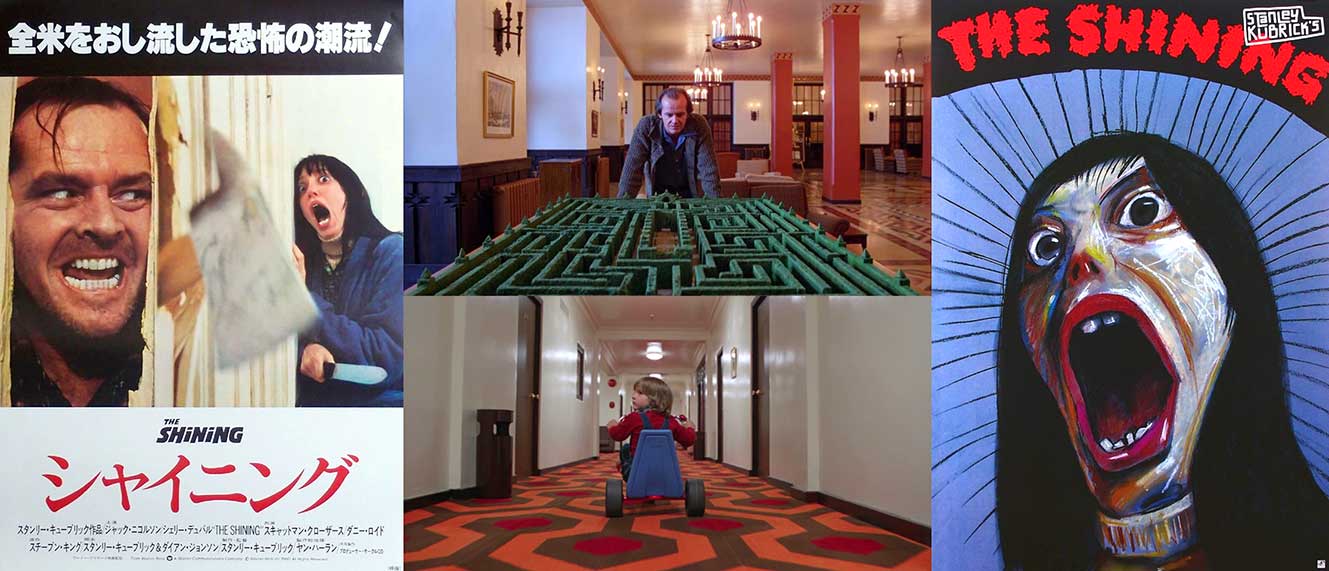
There’s surely no doubt in the minds of many, I’m sure (asides from Stephen King’s once much publicised disappointment with this movie version), that Stanley Kubrick’s The Shining is easily one of the most interesting horror movies ever made. The first few times you watch it, too, it’s kinda quite creepy... that perhaps diminishes somewhat over time and subsequent rewatches but what you are left with, even if it does have less impact through familiarity, is an amazingly beautiful looking movie which never really ages all that much.

The reason I’m revisiting this classic after more than a decade now, of course, is that the first screen adaptation of Stephen King’s fairly recent follow up novel, Doctor Sleep (I reviewed that here) is literally days from release (in fact, I think it comes out in the UK on the night I am intending to post this review). So I figured it was time for another look because, from the looks of the trailer (and I’m puzzled by this a little since King apparently loves this new movie), the director of Doctor Sleep has used a lot of the imagery from Kubrick’s version of The Shining in the new film.

As for Stanley Kubrick’s The Shining itself though... even from the opening camera work which follows a long journey of the vehicle driven by the as yet unseen central character Jack Torrance (played here quite maniacally throughout by Jack Nicholson), you are pulled into the story. One of the strengths of this opening, I suspect, is the way the speed of the photography of these sequences (the out-takes of which were famously plundered for the final scene in the original first release of Ridley Scott’s Blade Runner, reviewed here) is slowed down in terms of the soundtrack, which highlights Wendy Carlos and Rachel Elkind’s absolutely phenomenal variation on the Deus Irae... a truly eerie and unsettling take on the much used musical theme.

The film is a definite slow build for the most part... with little points being made slowly but methodically to lead up to the scenes where the Overlook Hotel and its ghostly inhabitants, overwhelm Jack Torrance and compel him to try and murder his wife and child... Wendy and Danny, played here by Shelley Duvall and young Danny Lloyd (who is being played as an adult by Ewan McGregor in the upcoming movie version of Doctor Sleep). I think I’d possibly agree with Stephen King’s assessment that Jack Nicholson seems a little too manic right off the bat (no pun intended) but that does nothing to diminish the fact that he’s extremely watchable in this. As is Shelley Duvall, who does an amazing job here along with newcomer Danny Lloyd in a role which could have gone way wrong for the film if the performance had been anything less than what it turned out to be. They are joined by the likes of Barry Nelson (the first screen James Bond), the always watchable Scatman Crothers and Dr. Eldon Tyrell himself, Joe Turkel, in the role of Lloyd the bartender... who plays the character absolutely deadpan and in an effectively chilling, minimalistic way.

The film features many Kubrick signatures and watching this one always reminds me of one of his other masterpieces, 2001 - A Space Odyssey, which I reviewed here. So the shots of Danny tri-cycling his way around the hotel in fluid camera movement cross cut against other things going on in the building, for example, always puts me in mind of those long interior shots of Frank Pool keeping in shape in the former movie. Similarly, the little... almost subliminal... cuts to various shots such as the twin sisters, the mutilated corpses of the sisters and the reaction shots of characters such as Danny (when he’s flipping out in full ‘shine’ mode) which are always silent whenever Kubrick does this (in that they have no diegetic sound and are merely using the sonic backdrop of the shots into which they are spliced) reminds me of both the reaction shots of David Bowman in the high speed journey via the monolith at the end of 2001 and the reaction shots of Patrick Magee in A Clockwork Orange. And, of course, you have those long held shots focusing on the face of a staring character from time to time, most notably in The Shining when Jack Torrance really starts to wig out and you just realise the dark, rotting heart of the Overlook Hotel has finally seeped inside of him and become the dominating force in any already lost spiritual battle in his soul.

Another thing which ties it to 2001 is the chaptering. This film also consists of, quite a few, chapter stops and in this film they are, in order of their appearance... The Interview, Closing Day, A Month Later, Tuesday, Thursday, Saturday, Monday, Wednesday, 8am and 4pm. Like in 2001 they can be used to make a dramatic ending to a sequence, such as the unwavering stare of Jack Nicholson brought to you on a very slow zoom suddenly abruptly cutting to a title card... but they also function in this film, or at least I believe this is the case, to speed the rhythm of the story by giving us period markers going from an interview held a while before Torrance actually gets his job as caretaker of the out of season Overlook, to the closing day when he takes over and it’s abandoned to him and his family for the winter season... and then whittling down the times until you eventually get chapters talking about specific parts of just one day. It’s a kind of subconscious, accelerating spiral, I think, in terms of both the pacing of the action and also, of course, the internal state of Jack’s mind as he approaches full on serial killer mode in the film’s final sequences. It’s an interesting device and, for all I know, it’s just been employed to smooth over some awkward transition scenes that didn’t cut together properly but, whatever the reason for them, they function very well in this capacity.

Of course, one of the main ingredients in just how sinister this film feels is due to the music. I’ve already mentioned Carlos and Elkind but there’s also the use of Béla Bartók, Krzysztof Penderecki and, like 2001 before it, one of my favourite composers, György Ligeti. If you want a film to sound unbearably disturbing then many tracks by these composers are good for just that and, frankly, they often have the same effect on the human psyche when you’re not juxtaposing them with any imagery.

As usual with Kubrick, there are constant, beautifully designed frames throughout. Some may find the artifice involved in getting some of these, in some cases, almost symmetrical designs with very contrasting, almost primary colours a little off putting or overwhelming but, frankly, the gorgeous and constant eye candy of a Kubrick film is something I always find a sheer delight. So, yeah, he’ll have Wendy and Danny dressed in warm browns and reds for their walk through the green hedge maze to make them pop and, yes, he’ll have the majority of Jack Torrance’s encounter with the naked lady in Room 237 framed in it’s own little arched rectangle in the centre of the screen... but it all looks great as far as I’m concerned. And it’s a film, like many Kubrick films, full of iconic imagery. You all know the famous carpet pattern, for example and, of course, the wonderful shots of the elevators gushing blood and filling up the corridor. 

The Shining is always going to be a hard recommend from me and will probably always be somewhere in my top ten horror films of all time. The HMV Exclusive (to the UK) dual edition of the so called ‘extended cut’ (aka, the version they’ve always shown on TV in this country, just not at the cinema) looks absolutely gorgeous. I honestly didn’t know films could look this good on my Blu Ray player, it’s phenomenal. That being said, the film is presented in its original theatrical widescreen aspect ratio as opposed to the 1.37:1 aspect ratio that it was shot in (and which Kubrick himself insisted the film should be shown in) but I’m more than happy to see it as it was when screened at the cinemas on its first run... although a 4:3 presentation with more image information at the top and bottom (open matte) might have been preferable. Still a great one to look at though... especially if you want to see what your Blu Ray can really show you in terms of quality. It’s never looked so good.

Thursday, 9 February 2017

3 Women (aka Three Women)


Three For All

3 Women (aka Three Women)
USA 1977 Directed by Robert Altman
Warner Brothers Blu Ray Zone B


Warning: Very slight spoilers, I suppose.

It’s funny... the first Robert Altman film I saw, years ago in my late teens, was M*A*S*H and it blew me away. Loved the style of it and found the way that the main parts of the book seemed to take a backseat while the lesser scenes were pushed into the foreground in Altman’s adaptation, made it a pretty good companion piece to the source (which is also excellent, by the way).

Ever since then, however, I’ve found Altman fairly hit and miss and, to be honest... mostly miss, although I seem to remember I quite liked McCabe and Mrs. Miller and I still haven’t seen The Long Goodbye yet (it’s in the ‘to watch’ pile). 3 Women, however, is one of those movies I’ve always wanted to see because a photographic still, usually the same one of a publicity shot not actually seen in the movie, was always turning up in various books on fantasy or horror cinema when I was reading through those in my teens. Having now seen the film I can’t really understand why it would have been included in them but... there you go, some people wouldn’t know a fantasy or horror movie if it leapt up from behind a rock and bit them in the face. As proved to me on an almost weekly basis on Twitter, it seems to me.

Altman has cited that he made 3 Women based on a series of dreams he had been having and he has also gone on record saying it was inspired by some of the films of Ingmar Bergman. Looking at this, I’m guessing that Cries and Whispers and The Silence were probably the most influential on this one here... although they’re less of a template and more of a mood which Altman then goes on to explore in a more 'crowded palette’, as it were.

The film concerns three women (no... really) who find themselves thrust into each others lives. The first of the three is Pinky Rose, played by Altman regular Sissy Spacek. She is a young, impetuous girl who leaves home in Texas to come to California and work in a kind of water therapy clinic for the elderly. It’s here she meets Millie Lammoreaux, played by another Altman regular, Shelley Duvall. Millie acts as if she’s a very popular and busy person but it’s soon clear that nobody really wants anything to do with her and they tend to ridicule her behind her back (or sometimes right up to her face). Pinky, however, is very taken with Millie... to the point of obsession... so when Millie needs a room mate, she goes to live with her.

When Millie takes Pinky to a bar, she meets the third woman of the story, Willie Hart (played by Janice Rule), an artist who hardly ever says a word and who is always working on one of many, kinda surreal and hypnotic paintings which are dotted at various places over the local county. Hart is rarely in the story much (and I do almost wonder why it was called 3 Women because of this fact) but her presence is felt by the constant reminder of her paintings and because of one of a number of tragedies that happen over the course of the movie. And, inevitably, because she only wanders into the odd scene here and there, not saying anything (you only hear her talk in the last ten minutes of the film), she is made all the more interesting and mysterious a character for it.

Certainly an interesting character for Pinky, who loves her spooky paintings and is almost as obsessed by her as she is with Millie. The film is a character study as we watch Pinky and Millie interact over a period of time and see how Pinky manages to get on Millie’s nerves so much that, when Millie commits an indiscretion with somebody on the peripheral of their lives, she then later goes on to regret what she angrily says to Pinky next in no uncertain terms.

At this point in the film something happens (which I won’t spoil here) and Pinky’s personality changes dramatically to something which seems to be more like what Millie imagines she, herself, is like... as opposed to the reality of the situation. There’s a scary, almost alien, moment where Spacek’s Pinky just laughs and... well it’s really quite unsettling in the way this exclamation is uttered. Pinky and Millie soon find themselves at each other’s throats until... a strangely surreal dream sequence happens and, before you can totally fathom how this has affected Pinky, we are thrust into another tragic event and things get vaguely bloody.

It’s then that we get an end coda for the movie which is totally open to interpretation due to its ambiguous nature. At least that’s the way it seems to me. My interpretation is that the three women have eaten/absorbed each other’s personalities and shifted the hierarchy, somewhat, living together in some kind of ‘survival mode pack’ with a death which has happened off screen being something they may or... you never know... may not, have been responsible for. It’s quite bleak and there’s not much closure in it, with certain mysteries implied in the movie left unanswered. It’s the kind of ending I really don’t mind, to be honest, as it gives the movie some time to live on in your mind for a while after you’ve first seen it.

The Bergmannesque element Altman cites is fairly evident in the design of the shots throughout as he uses reflective surfaces such as glass to double and treble the image planes in the movie so you can get some solidly delineated sections of the screen collaborating for the viewer in ways they aren’t actually doing in real life... except the viewer can see the juxtaposition of the characters in ways which lend an interesting dynamic to the movie. Although, again, I was puzzled as to why the director fairly often dwelled on splits of two with a title like 3 Women... especially since he also uses a set of identical twins to further push the illusion of duality throughout the movie. Although, now I think of it, it could also be a motif used to push the idea of a split personality which, by the end of the film, is something that pretty much all three of the title characters seem to be exhibiting in terms of splitting off into new/alternate versions of themselves/each other.

It’s an interesting movie and I’m glad I saw it. I’m not sure I would recommend it to anyone but the most sophisticated or, possibly, most jaded of cinephiles but, fans of the director’s work who appreciate the naturalistic kinds of performances he lets his actors run with shouldn’t have too much of a problem with this movie. Not everyone’s cup of tea, to be sure, but certainly something which I think was worth my while so... yeah... one to consider, maybe.