Showing posts with label Stanley Kubrick. Show all posts
Wednesday, 22 April 2020
Room 237
Overlooking The Obvious
Room 237
USA 2012 Directed by Rodney Ascher
101 Films Blu Ray Zone B
It’s funny, I thought Room 237 was only a couple of years old at the most. I remember there being a lot of fuss about it on Twitter around about that time and so I was somewhat disappointed I didn’t catch a cinema release. I think I finally got this one a couple of months ago in a 101 Films sale or some such thing and, frankly, this wasn’t quite the film I’d hoped it would be. That being said, it’s technically quite well put together if the visual equivalent of ‘needle drop’ is your kind of thing.
The documentary, if you can call it such, explores some of the less usual fan theories about Stanley Kubrick’s 1980 masterpiece, his loose adaptation of Stephen King’s The Shining. Now I was prepared to keep an open mind going in here because I’d heard good things about it and I wanted to see if I could follow some of the lines of thought which make up the basis of these separate theories, from five very different people who I think I shall keep as nameless here so I don’t actually have to ridicule a specific person. So I went in open minded and... honestly... didn’t stay that way for all that long, it has to be said.
The format of the film is probably the most interesting thing about it. None of the people explaining their theories (voices crosscut with one another over the course of the film in chaptered sections) are ever shown. Instead, the director has used found footage from old newsreels and some fairly famous high profile movies like The Brain From Planet Arous, All The President’s Men or The Thief of Bagdad cut against each other to metaphorically illustrate what’s going on in the minds of the people talking. Quite often the footage is further digitally manipulated, such as the many shots of Tom Cruise from Kubrick’s Eyes Wide Shut where he walks by and contemplates posters of The Shining in the street as he passes. Similarly, in the many times footage from The Shining itself is played, at various speeds ranging from very slow to normal to very fast (and even backwards and forwards simultaneously superimposed)... the director will use things like big digital arrows to point out the specific area of the screen which is being talked about from a particular ‘guest’. It’s all quite skillfully put together and that, along with the synthesised musical version of the Dies Irae invoking the Wendy Carlos opening of The Shining, are pretty much the only saving graces of this movie... for me, at least.
Now, it’s interesting that one of the people talking in this film says something which actually rings quite true in some respects. Frankly, it’s a very pertinent statement, even if it half feels like it’s being used in defence of what the person is saying because they suspect they might sound like they’re being unreasonable in their conclusions. It is this...
“Author intent is only part of the story of any work of art.”
Yeah, absolutely. I can get behind that statement. The identity of the artist and their cultural, religious and political upbringing are obviously going to seep into an artist’s work, whether they are conscious of this or not. Totally get this and believe it completely... a wise statement. However, there are extremes of conclusions that people can make which are, frankly, outside of the remit of even this simple, scattergun statement and, frankly, when all is said and done and the arguments for and against whichever theory is being explored have run their course, I was forced to conclude, as I had suspected within the first ten to fifteen minutes of this movie, that all of the people being interviewed for this film are, in fact, total nutters.
And it’s a shame because I love The Shining and I wanted to learn something new about it. Not 'new and completely, balls to the wall, fruit loop crazy' which, quite a lot of this is. I mean, the placement of cans of baking soda with an Indian head on them and other cumulative imagery from the movie do not, honestly, make for a movie which is actually about man’s betrayal of the Native American Indian and their mistreatment. Similarly, the numerology all pointing to sevens and forty two.... such as the numerals of the famous Overlook Hotel room number multiplied out - 2 X 3 X 7 giving us the ‘magic number’... do not constitute yet another in a line of similarly misconstrued ‘clues’ laid down by Kubrick that the film is about the Holocaust and Nazi Germany in 1942 etc. Neither does Barry Nelson’s hips lining up with the side of an in-tray and looking momentarily like a pseudo erection while he’s shaking Jack Nicholson’s hand turn us on to the fact that The Shining is a movie about sex and the sex demons that live in Room 237. Nor does the disappearance of a sticker of Dopey from Snow White And The Seven Dwarfs signify that Danny, after his first vision, is no longer ‘a dope’ and understands everything that is going on around him. Seriously people, this is some advanced level of insanity creeping in behind the normal sounding voices of the people narrating this.
For a while there it gets like people are actually making sense in the film... especially when you compare the levels of craziness of each new theory. For example, when you follow with the camera, the path into the room where Jack has his interview, the woman narrating seems absolutely right that the window showing the view outside really could not exist... it’s in the middle of the building. So yeah, points to her here and also to the person who notices that the two shots of Danny and the ball on the carpet don’t match in terms of pattern... so they were obviously filmed in different places is what that means, not that something sinister has occurred.
Similarly, the ‘apparently false’ fact that the Earth is 237 miles from the moon plus the fact that Danny is wearing a moon landing sweater when he walks to Room 237 does sound like it almost could be a metaphor for a trip to the moon but, honestly, it doesn’t mean that Stanley Kubrick faked the moon landings for the government and I don’t believe, as this guy does, that the whole of the film is Kubrick trying to signify to mankind that he did it. Of course, it doesn’t help that Kubrick himself gave an interview which I heard once that he'd faked the moon landings but, you know, he was a bit of a wind up merchant when it came to people aiming crazy theories at him, I suspect.
Actually, that’s one of the things that bothered me most about the people in these interviews. The ‘author intent’ get out clause I quoted above does not excuse the fact that they are quite often picking up on some, admittedly insane and disturbingly lax continuity errors... such as the disappearing ‘Dopey’ or a chair going completely missing behind Jack Nicholson’s head in one shot between cuts or the changing carpet pattern... and making so much more of them than they need to. Do I think Kubrick... an admittedly meticulous director... was doing this on purpose. No, I do not. I just think he liked some parts of takes better than parts of others and edited them all together from multiple sources to get the best and most consistent performance out of the actors... and there’s nothing much more to it than that.
So, there you go. Room 237 is, ultimately a somewhat intriguing film in the odd ‘clue’ to the overall ‘mystery’ of The Shining (a mystery which I’m sure doesn’t exist outside of the heads of these people) but, I have to say that, even though there were a few shiny coins laying among the pebbles, it’s a pretty dull affair. The excellent execution of the way the ‘evidence’ is unpeeled and portrayed by the filmmakers doesn’t detract from the less than mesmerising stretches of tedium as various enthusiastic but quite possibly unhinged individuals try to convince you that their insane theory, which they obviously totally believe is so obvious once they’ve explained it, is anything like an arrival at some form of truth. Proceed with caution.
Thursday, 31 October 2019
The Shining
Axe-simile
The Shining - Extended Edition
(aka, The Full Cut and not the
stupidly short European version)
UK/US 1980 Directed by Stanley Kubrick
HMV Exclusive Dual Edition
Blu Ray Zone B DVD Region 2
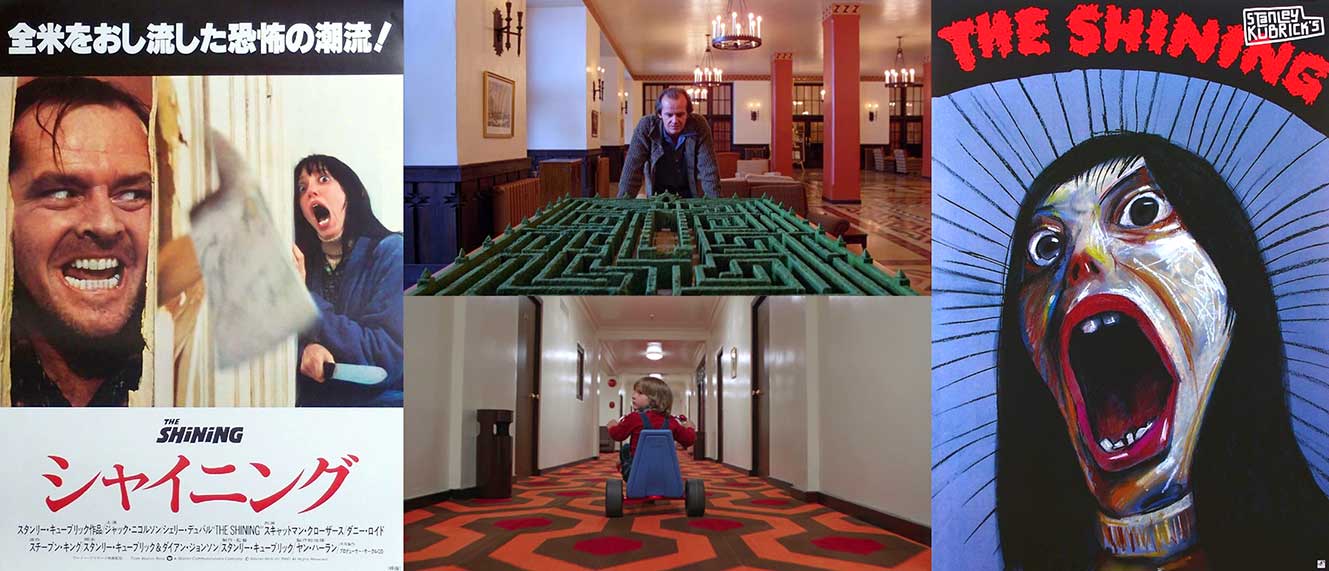
There’s surely no doubt in the minds of many, I’m sure (asides from Stephen King’s once much publicised disappointment with this movie version), that Stanley Kubrick’s The Shining is easily one of the most interesting horror movies ever made. The first few times you watch it, too, it’s kinda quite creepy... that perhaps diminishes somewhat over time and subsequent rewatches but what you are left with, even if it does have less impact through familiarity, is an amazingly beautiful looking movie which never really ages all that much.
The reason I’m revisiting this classic after more than a decade now, of course, is that the first screen adaptation of Stephen King’s fairly recent follow up novel, Doctor Sleep (I reviewed that here) is literally days from release (in fact, I think it comes out in the UK on the night I am intending to post this review). So I figured it was time for another look because, from the looks of the trailer (and I’m puzzled by this a little since King apparently loves this new movie), the director of Doctor Sleep has used a lot of the imagery from Kubrick’s version of The Shining in the new film.
As for Stanley Kubrick’s The Shining itself though... even from the opening camera work which follows a long journey of the vehicle driven by the as yet unseen central character Jack Torrance (played here quite maniacally throughout by Jack Nicholson), you are pulled into the story. One of the strengths of this opening, I suspect, is the way the speed of the photography of these sequences (the out-takes of which were famously plundered for the final scene in the original first release of Ridley Scott’s Blade Runner, reviewed here) is slowed down in terms of the soundtrack, which highlights Wendy Carlos and Rachel Elkind’s absolutely phenomenal variation on the Deus Irae... a truly eerie and unsettling take on the much used musical theme.
The film is a definite slow build for the most part... with little points being made slowly but methodically to lead up to the scenes where the Overlook Hotel and its ghostly inhabitants, overwhelm Jack Torrance and compel him to try and murder his wife and child... Wendy and Danny, played here by Shelley Duvall and young Danny Lloyd (who is being played as an adult by Ewan McGregor in the upcoming movie version of Doctor Sleep). I think I’d possibly agree with Stephen King’s assessment that Jack Nicholson seems a little too manic right off the bat (no pun intended) but that does nothing to diminish the fact that he’s extremely watchable in this. As is Shelley Duvall, who does an amazing job here along with newcomer Danny Lloyd in a role which could have gone way wrong for the film if the performance had been anything less than what it turned out to be. They are joined by the likes of Barry Nelson (the first screen James Bond), the always watchable Scatman Crothers and Dr. Eldon Tyrell himself, Joe Turkel, in the role of Lloyd the bartender... who plays the character absolutely deadpan and in an effectively chilling, minimalistic way.
The film features many Kubrick signatures and watching this one always reminds me of one of his other masterpieces, 2001 - A Space Odyssey, which I reviewed here. So the shots of Danny tri-cycling his way around the hotel in fluid camera movement cross cut against other things going on in the building, for example, always puts me in mind of those long interior shots of Frank Pool keeping in shape in the former movie. Similarly, the little... almost subliminal... cuts to various shots such as the twin sisters, the mutilated corpses of the sisters and the reaction shots of characters such as Danny (when he’s flipping out in full ‘shine’ mode) which are always silent whenever Kubrick does this (in that they have no diegetic sound and are merely using the sonic backdrop of the shots into which they are spliced) reminds me of both the reaction shots of David Bowman in the high speed journey via the monolith at the end of 2001 and the reaction shots of Patrick Magee in A Clockwork Orange. And, of course, you have those long held shots focusing on the face of a staring character from time to time, most notably in The Shining when Jack Torrance really starts to wig out and you just realise the dark, rotting heart of the Overlook Hotel has finally seeped inside of him and become the dominating force in any already lost spiritual battle in his soul.
Another thing which ties it to 2001 is the chaptering. This film also consists of, quite a few, chapter stops and in this film they are, in order of their appearance... The Interview, Closing Day, A Month Later, Tuesday, Thursday, Saturday, Monday, Wednesday, 8am and 4pm. Like in 2001 they can be used to make a dramatic ending to a sequence, such as the unwavering stare of Jack Nicholson brought to you on a very slow zoom suddenly abruptly cutting to a title card... but they also function in this film, or at least I believe this is the case, to speed the rhythm of the story by giving us period markers going from an interview held a while before Torrance actually gets his job as caretaker of the out of season Overlook, to the closing day when he takes over and it’s abandoned to him and his family for the winter season... and then whittling down the times until you eventually get chapters talking about specific parts of just one day. It’s a kind of subconscious, accelerating spiral, I think, in terms of both the pacing of the action and also, of course, the internal state of Jack’s mind as he approaches full on serial killer mode in the film’s final sequences. It’s an interesting device and, for all I know, it’s just been employed to smooth over some awkward transition scenes that didn’t cut together properly but, whatever the reason for them, they function very well in this capacity.
Of course, one of the main ingredients in just how sinister this film feels is due to the music. I’ve already mentioned Carlos and Elkind but there’s also the use of Béla Bartók, Krzysztof Penderecki and, like 2001 before it, one of my favourite composers, György Ligeti. If you want a film to sound unbearably disturbing then many tracks by these composers are good for just that and, frankly, they often have the same effect on the human psyche when you’re not juxtaposing them with any imagery.
As usual with Kubrick, there are constant, beautifully designed frames throughout. Some may find the artifice involved in getting some of these, in some cases, almost symmetrical designs with very contrasting, almost primary colours a little off putting or overwhelming but, frankly, the gorgeous and constant eye candy of a Kubrick film is something I always find a sheer delight. So, yeah, he’ll have Wendy and Danny dressed in warm browns and reds for their walk through the green hedge maze to make them pop and, yes, he’ll have the majority of Jack Torrance’s encounter with the naked lady in Room 237 framed in it’s own little arched rectangle in the centre of the screen... but it all looks great as far as I’m concerned. And it’s a film, like many Kubrick films, full of iconic imagery. You all know the famous carpet pattern, for example and, of course, the wonderful shots of the elevators gushing blood and filling up the corridor.
The Shining is always going to be a hard recommend from me and will probably always be somewhere in my top ten horror films of all time. The HMV Exclusive (to the UK) dual edition of the so called ‘extended cut’ (aka, the version they’ve always shown on TV in this country, just not at the cinema) looks absolutely gorgeous. I honestly didn’t know films could look this good on my Blu Ray player, it’s phenomenal. That being said, the film is presented in its original theatrical widescreen aspect ratio as opposed to the 1.37:1 aspect ratio that it was shot in (and which Kubrick himself insisted the film should be shown in) but I’m more than happy to see it as it was when screened at the cinemas on its first run... although a 4:3 presentation with more image information at the top and bottom (open matte) might have been preferable. Still a great one to look at though... especially if you want to see what your Blu Ray can really show you in terms of quality. It’s never looked so good.
Tuesday, 15 May 2018
2001 - A Space Odyssey
Jupiter As Ending
2001 - A Space Odyssey
UK/USA 1968 Directed by Stanley Kubrick
MGM Blu Ray Zone B
Warning: Spoilers, I guess, if you’ve
never seen this masterpiece before.
I always find Stanley Kubrick a bit hit and miss as a director to be fair. Some of his movies are sheer genius while... certain others leave me cold. I’ve always had a soft spot for 2001 - A Space Odyssey but it’s been a while since I last saw it. However, as my father pointed out, now we have a high definition TV and a remastered blu ray release on the market, now would be the perfect time to catch up to this classic slice of cinematic science fiction again. So we did.
The film is one of those ‘fake Cinerama’ films where the process of shooting on three cameras for three screens joined together was dropped after being used for such features as The Wonderful World Of The Brothers Grimm and the quite extraordinary How The West Was Won. Instead, a single camera widescreen process designed to be projected on a curved screen was used and there were a number of films using this ‘in name only’ substitution for the real Cinerama process at the time (although it’s only referred to as Super Panavision on some posters). I’ve seen it a number of times on a large screen but I think I only ever saw it projected onto a massive, curved screen once, though. That was a great screening, however.
The film was somewhat divisive in its critical reception, it seems to me but the popularity and growing audiences due to the amount of hippies doing drugs and watching the famous star gate journey at the end is what kept it in cinemas longer than originally hoped for and helped make it a hit. At least, that’s the story. Nowadays, of course, it usually places quite highly in lists of the greatest movies ever made and, in my opinion, it’s certainly worthy of that honour.
The film is split into four sections and there are jumps in time or space between them so that only the final two sections share the same protagonist (although the main protagonist from the second section also gets a few minutes on a television screen towards the end of the third section). The four sections are The Dawn of Man, TMA-1, Jupiter Mission and finally, Jupiter and Beyond The Infinite. That being said, the title of the second section is the only one which isn’t introduced typographically on screen, instead relying on the cut from one element in The Dawn Of Man to another element as a way to throw the audience into the next section of the picture.
Based on the short story The Sentinel by co-writer (for the screen) Arthur C. Clarke, the film tells the story about the manipulated growth and development of mankind as precipitated by the mystery at the heart of the movie - the black, rectangular, alien slab known only as The Monolith. This mystery element is enhanced by some fairly minimalistic, or perhaps naturalistic would be a better word, acting from various cast members and some spectacular yet often quite clinical cinematography. It’s also enhanced greatly by a score of needle dropped music such as Thus Spake Zarathustra and The Blue Danube waltz but the real stars of the show, musically speaking, are the tracked in cues by one of my favourite composers, György Ligeti... who I discovered from listening to the old vinyl soundtrack of this back in the sixties and early seventies (when I was between one and five years of age, I guess). Actually, it wasn’t until Ligeti saw the film in cinemas that he was able to successfully sue Kubrick since, for some reason, Kubrick had assumed Ligeti’s quite startling works were the work of a long dead classical composer rather than a contemporary artist (the composer actually didn’t die until 2006, almost 40 years later). It is Ligeti’s music which gives full weight to the scary mystery which is the heart of the film and, although I absolutely love what survives of composer Alex North’s rejected score to this, I think Kubrick possibly made the right call here. Nobody can out-Ligeti Ligeti!
The Dawn Of Man sequence is an amazing thing with ape men in rival clans living through their daily routine. Actually, I’d never realised before this Blu Ray screening (or even after I’d seen it at the big old curved screen of the old Empire Cinema a couple of decades ago) that this sequence was shot in a studio with rear projection. Unfortunately (or fortunately, depending on your view point) there’s a kind of moiré pattern on the backdrop visible on this new transfer and it kind of gives the game away. That being said, the picture is pretty stunning and I also noticed something else for the first time during this sequence... but I’ll get to that in a bit. After the appearance of the monolith, one bright ape gets an idea and weaponises himself and his fellow clan with bones with which they kill animals to eat and, of course, rival ape men. So the monolith is a catalyst for technology (which brings murder and violence with it, naturally).
The second sequence, known by some as TMA-1, follows Doctor Haywood Floyd (played by William Sylvester... who was replaced in the sequel by Roy Scheider) as he journeys to the moon and gives a briefing there. There is a cover story that a quarantine has broken out on the moon base but the true story is, as revealed at the end of the section, that a second monolith (although these characters aren’t to know it’s the second time mankind has had an encounter with a monolith) has been found buried under the lunar surface... and it’s been there for quite some many millions of years. The climax of this section is when the monolith lets out an ear splitting sound which, we later find out, is it beaming out a signal to... something... near Jupiter.
The third sequence, Jupiter Mission, is where the lead Protagonist David Bowman (Kier Dullea), Frank Poole (Gary Lockwood) and three other hybernating crew members, are on their way to Jupiter... although they don’t know the true nature of thier mission yet. Accompanying them is their shipboard computer HAL900. Now, the reasons for HAL’s malfunction and attempt to kill all the crew members is not really blatantly touched upon here (and it wouldn’t be until the movie adaptation of the first of Clarke’s sequel novels, 2010) but he almost succeeds in wiping them all out during some intense sequences before the one surviving astronaut, David Bowman, manages to get himself back on their spaceship and disconnect HAL. After a nice little nod to the first song that a computer in real life ever sang, the disconnection of HAL’s higher brain functions triggers a video of Dr. Floyd’s deliberately delayed secret briefing to the astronauts, revealing the true nature of the mission to Bowman. To explore the area around Jupiter where the Monolith’s signal went and ‘make contact’ with whatever alien intelligence is behind it.
And then we come to the last sequence, Jupiter And Beyond The Infinite. Some time has passed again between sections and David Bowman is already out of the ship and in a small pod to investigate a floating monolith he’s discovered in the vicinity of Jupiter. Then comes the famous "star gate" sequence of special effects which is absolutely beautiful and fearsome at the same time... especially with Ligeti’s terrifying and awe inspiring music over it. Occasionally, frames of Bowman's face reacting to what he’s seeing as little half a second shots that pretty much amount to stills are intercut with this and... well it still, after all these decades, gives off a very uneasy atmosphere. And then, as if to compete with the quite long special effects sequences of Bowman’s ‘journey’, we have an extended sequence where Bowman is ‘a guest’ of the alien intelligence and we see him in an Escher-like existence as he intrudes on himself at different stages of his life as he ages to death in the space of five to ten minutes (in screen time). It’s a truly great artistic achievement and then, of course, with the return of the Thus Spake Zarathustra music which has become synonymous with this movie, he is reborn as The Star Child... a giant fetus in space. It’s interesting because you can see just how comic book artists like Jack Kirby were influenced by the film. Not only did Kirby do the Giant-Sized Marvel Treasury adaptation of the movie, which I still have... but also a continuation series which, after ten or so issues, mutated into a vehicle for his Machine Man character. But if you think of classic Kirby creations like The Watchers... you can see how this film must have been a tremendous inspiration for him.
2001 - A Space Odyssey is absolutely deserving of its reputation in the film community these days. The poetic and deliberate manner in which Kubrick moves his camera around the sets... and it’s not all just clinical whites, there are great bursts of colour in the set design too at regular intervals... is an absolute treat and its definitely a movie which stands up to many repeat viewings. It’s also a movie where it’s fun trying to figure out how they did some of those amazing, zero gravity effects sequences too. Some of these are as mind boggling as the open ‘space striptease’ sequence in Barbarella.
And talking about the camera work...
The thing I noticed this time around when I was watching The Dawn Of Man sequence is that the whole thing was done with static shots and cuts. There’s no discernible camera movement at all until you get to that one last, famous shot of the bone flying up to the air which Kubrick then cuts (on motion) to a nuclear satellite (as a grim reminder that we’ve gone from bone as weapon to full on nuclear capability). It’s at this moment that the camera then becomes free to roam as it does in the rest of the picture and this must have been a very deliberate and conscious decision on Kubricks part, I think. And an interesting one in a metatextual sense because it basically implies that the catalyst of the monolith in mankind’s progress has also freed the camera along with it... if you see what I mean. Technology plus violence equals camera motion as an unconscious enabler on the audience to absorb the implications on a level in which they’re partly complicit. And that’s a powerful cinematic tool which Kubrick really goes with here.
Other than that... not too much to say here. 2001 - A Space Odyssey has always been known as one of the greatest science fiction films ever made and it’s easy to see why. If you are already a fan of the genre and you haven’t seen this one then... seriously... what are you waiting for? A true spectacle of the cinema as art and an absolutely brilliant Blu Ray presentation loaded with a fair few extras too. It belongs on every cinephile’s movie shelf.
Tuesday, 19 July 2016
Daydreaming With Stanley Kubrick
Kubrick-A-Brac
Daydreaming With Stanley Kubrick
6th July to 24th August
Somerset House, London, England
While I was on the way to stay with a friend for a London holiday over a few days, I noticed a tube train advert for an art exhibition called Daydreaming With Stanley Kubrick. Now Kubrick has always been a bit hit and miss for me (although he did some films which I hold in very high regard), so I didn’t give it much of a second glance. However, on the last day of the holiday, me and my friend decided to go to the show at Somerset House, last minute, since it’s located only a few minutes walk from the hotel where we were both staying.
I have to say... I’m glad we did. I also wish we’d got there earlier as two hours was not enough and one of the exhibits shuts at 5pm, before we could get to that room (although I will most certainly be going back there to check that one out too).
The exhibition is a selection of works with the common theme of art inspired by Stanley Kubrick and, although it sounds like its going to be a bit derivative of the director’s work... nothing could be further from the truth and there are some great works of art on display here, along with the fair share of pretentious rubbish you also get at these things. There are paintings, installations and also some films with big names such as Michael Nyman, Joanna Lumley, Cate Blanchett, Samantha Morton and Philip Castle involved in one way or another. Not to mention a contribution by Stanley’s wife, Christiane Kubrick.
After seeing one of her paintings opposite the desk where you buy your tickets, you go into a room and are confronted with an art installation of a space helmet with a screen inside depicting a monkey. No guesses for which of Kubrick’s famous films inspired this one then. After that, a fair amount of the exhibition is floored with shiny tiles which sport the same pattern as the carpet in the Overlook Hotel from Kubrick’s horror masterpiece, The Shining. After pausing to look at a pile of electric fires over the carpet, you enter a room with lots of old radios and the Dies Irae playing loudly in the background. It’s amazing stuff but it just keeps getting better and better as you make your way through this astonishing exhibition.
There were two works in particular which invoked the ‘wow’ factor in me when I saw them. One is a room you enter to watch a short film play out on each of the four walls. The piece is called The Corridor and it’s by Toby Dye. Each wall's film is shot in the same corridor but... stick around and look at all the screens as much as you can, constantly shifting your head, as the looping movies with no actual end or beginning (and starring Joanna Lumley, amongst others) start to interpenetrate and invade each other’s narrative space in a truly amazing way. I’ve got no idea how the artist was able to plan this one all out in his head but it’s worth standing in the centre of that room and just watching what is going on, constantly changing your viewpoint, as it plays out. Just mind blowing.
The other mind blower, for me, is a long, thin, flashing light situated near the end of the exhibition on the far wall of a lighted corridor. It’s stroboscopic and looks a bit pretentious until you... well... until you see the brilliance of it for yourself. The piece is by Chris Levine and it’s called Mr. Kubrick is Looking. I’ll quote the free booklet you get when you buy a ticket here, I think.
“A self-portrait by Kubrick is projected into the viewers peripheral vision using LED light technology. This ‘visual echo’ appears and disappears in a moment like a phantom. Levine is fascinated by the ‘sensory energy’ and ‘spiritual dimension’ of light.”
So, yeah, what happens here is quite uncanny and, being as I’m not technically minded, I am at a loss to explain exactly how it does this but... look at it full on and it’s a thin column of flashing light... look away from it and immediately, for half a second or so, you’ll get a photograph of Stanley Kubricks face as a fading ghost impression on your eyeball. As your eyes flash back and forth between the light and anywhere else in the room, the image briefly appears and reappears in your vision. Just incredible, amazing stuff. I was absolutely gobsmacked by the scientific alchemy on display here and will need to look into this at some point soon.
There are, of course, some not so hot pieces with fairly tenuous links in the show too. For me the two similar Scottish churches made of cardboard as a ‘tribute’ to the twin girls in The Shining seemed nicely constructed although a bit ludicrous but... you know... one person’s disappointment is another’s true art. I would certainly say the exhibition was way more positive than the few negatives I found and with 45 exhibits of varying shapes, sizes and media dotted about the ersatz Overlook, you’d be hard pushed, I think, not to find something to your liking here. Definitely a big recommendation for me and something which I’m still thinking about a week on from having first seen it. A repeat visit is certainly on the cards and you can find out more about Daydreaming With Stanley Kubrick at the website somersethouse.org.uk/dreamkubrick and photography is, apparently, allowed... although ‘flash photography’ is forbidden.
Subscribe to:
Posts (Atom)