Missile-Toe Monster
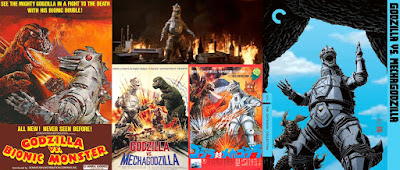
Godzilla VS Mechagodzilla
aka Gojira tai Mekagojira
aka Godzilla VS The Bionic Monster
Japan 1974
Directed by Jun Fukuda
Criterion Blu Ray Zone B
Well this one’s a bit if a fun romp. It’s nonsense with a capital G* but Godzilla VS Mechagodzilla, the penultimate film of the Showa Era Godzilla movies highlighted in Criterion’s recent Blu Ray set, is actually one of the better entries from this period. It also looks like it had a better budget than what the Godzilla films had deteriorated to in the last few outings and there’s very little recycled footage (apart from one major piece which I’ll get to in a minute... but it doesn’t last very long).
Okay, so the plot consists of two groups of main protagonists linked by one of each group being the brother of the other. One lot, including a good guy professor, is working on a piece of flat metal found in a cave. His conclusion is that the metal is ‘space titanium’ and so there must be some evil aliens up to no good somewhere (he’s not wrong... astonishingly). Meanwhile, a mini statue of local Okinawan monster deity King Caesar is found in another cavern... except the evil aliens are also after that. Why? Because it’s a key piece in enabling a gazillions of years old prophecy about a big monster arriving to destroy the world and then, when the sun sets in the West, two monsters teaming up to defeat it.
This prophecy is reenforced early in the film when a young girl doing her ritualistic ceremony at the House Of Azumi temple, where King Caesar is supposed to be the symbolic guardian, collapses momentarily when she has a vision of a big monster attacking the city. Now, this vision is the bit of recycled footage I mentioned a couple of paragraphs ago, since the monster in the dream seems to be King Ghidorah footage from another film. This is the only time, though, that Ghidorah is seen in this picture because the giant monster which comes in later is something else... so, yeah... this vision makes absolutely no sense and we could really have done without the visual heads up. Thanks a bunch, kaiju writers.
And from hereon in it's all shenanigans afoot. Godzilla surfaces and starts acting like a villain trying to destroy the city. So suddenly he’s a bad guy except... no he’s not. Isn’t it strange that Godzilla’s pal Anguirus is trying to fight Godzilla, getting defeated in a gory combat which sees Anguirus defeated and in retreat? However, it’s not before he knocks a bit of scale off of Godzilla to show a gleaming surface underneath. Then, when another Godzilla joins the fray, at the request of Anguirus, he also gets bashed up pretty badly but... not before he reveals to the world that he was being framed by tearing the outer skin off of the other Godzilla, to the point where it changes into its true self... Mechagodzilla! The Big G does manage to break Mecha-G’s head and the aliens bring it back to their secret base for repairs. Godzilla then finds a big thunderstorm on an island and, in a first since his affinity with electricity was first established 20 years earlier in Gojira (reviewed here), Godzilla charges himself up with the lightning bolts from the storm.
Meanwhile, a gunman has been trying to get the King Caeser statue from an archaeology gal and her friend, the professor’s nephew. When the gunman gets shot in the face for his trouble, half of said face goes through a shimmery transformation to reveal that he’s some kind of space ape. He is defeated by one of the secret Interpol agents who had been acting... just sinisterly enough... to make the audience think that they were the bad guys in this.
While all this stuff is happening, the aliens kidnap the professor and force him to fix Mechagodzilla’s head. It’s at this point I have to ask again, why? Since they invented and built the thing themselves... why would it be that the ‘aliens from Black Hole Planet No 3’ would need an Earth scientist to help them fix their creation. I have no idea what’s going on here anymore. However, as you can imagine, the whole thing leads to a big fight between Mechagodzilla... who has finger rockets, destructive laser vision and who can shoot missiles from his metallic toes... and Godzilla, helped by the long dormant King Caeser, who is revived in a ritual by the lady who had the vision earlier in the film.
Things get bloody in the later combat too, with Godzilla leaking some big jets of red, arterial spray from his neck courtesy of his mechanical counterpart (a monster inspired by Mechani-Kong from King Kong Escapes, reviewed here). Plus there's a nasty moment where Mecha-G shoots multiple hypodermic syringes into Godzilla for... well, for no apparent reason. However, things get resolved when, in a first for the series, The Big G somehow uses his electrical charge to turn himself into a giant electromagnet, to bring Mechagodzilla towards him just before, with King Caesar’s aid, he rips off the robotic antagonist’s head.
There’s a big escape and destroy sequence cross cut with this fight, which also makes use of arterial spray. When the professor and the Interpol man helping him use the professor’s ‘special pipe’ with magical properties of being able to shut down electrical currents to help themselves escape (now days we’d call it something which shuts down things with an EMF pulse) and when the leader of the aliens gets shot, we get black blood spraying out of his neck before he, too, turns into an actor in a bad ape face mask... with extra little sticky out bits jutting out to presumably denote his alien leader status.
And that’s about it. There’s not a great deal of inventive shot design going on in this one and in some of the effects shots, the wires are clearly visible (especially so when watching this in a high definition format). This film also features the very last score that the great Japanese composer Masaru Satô did for a Godzilla film although, I have to say, it’s not one of his best. He does, however, manage to invoke the piece of leitmotif established for Godzilla by composer Akira Ifukube in this in a couple of places by, literally, playing just the first, long held note and then ignoring the other notes because the musical phrase is so well known by this point that you kind of fill in the rest of it in your head. Ifukube himself would actually return for the next and final film in the Showa Era Godzilla film series, a direct sequel to this one.
Godzilla VS Mechagodzilla is a fun if full-on nonsensical film which, in all honesty, utilises a much better looking design for the film’s titular antagonist than the one revealed in this year’s Godzilla VS Kong movie (reviewed here). It’s pacey, action packed and the only real downside is that the director seems to have really discovered the way hand held photography can be used to lend a certain chaotic dynamic to a shot... to the point where it was actually making me feel a little nauseous in one sequence. However, like I said, one of the better of the later Showa Era films and, of course, the Mechagodzilla would also turn up in many films to come. And rightly so... flying, mechanical kaiju are always a welcome addition to any film, in my book.
*So that would be Gnonsense then.
Tuesday, 7 December 2021
Godzilla VS Mechagodzilla
Wednesday, 17 November 2021
Godzilla VS Megalon
Maim, Jet & Scratch
Godzilla VS Megalon
aka Gojira tai Megaro
Japan 1973
Directed by Jun Fukuda & Yoshimitsu Banno
Criterion Blu Ray Zone B
This is another one of those films which I loved in my twenties but, looking at it now, just seems like one of the lesser and most disappointing entries in the Godzilla series, although there’s also lots to enjoy and it’s still a heck of a lot more interesting than the previous movie, Godzilla VS Gigan (reviewed here).
Okay, so we hear that those pesky humans have been testing bombs again on a remote island.. the consequences of which can also be felt on Monster Island. You might ask why this would be the case and the answer seems to me to be two fold. Firstly, Godzilla doesn’t properly turn up in this movie until almost 50 mins into the 80 minute running time... so it’s kind of a way, I believe, of pacifying the audience, showing that it really is a Godzilla movie they have come here to see. There have been a lot of rumours that, in response to a young boy who won a design a creature competition for Toho, that his drastically changed creation (to the point that the crying young prize winner was inconsolable at the changes Toho made to the design), renamed Jet Jaguar, would be the sole headliner of the movie. Although that makes sense in many ways, there is apparently no real evidence to suggest that was the case, from what I understand. So yeah, they show Godzilla to remind the audience and, the other thing the studio gets to do is to use old footage from Monster Island at this point to pad out the running time.
Then, after this footage we have the opening credits and a kid in a wonderful little robot boat in a lake, which looks like three colourful dolphins, with the two side dolphins acting like paddles. However, his inventor dad and his friend almost can’t get the kid back after a fissure is opened in a series of earthquakes, one of which drains this lake. Luckily, the inventor friend has his handy “rope launcher” with him on the picnic because, yeah, this is just what you would take on a picnic, right? Anyway, the three escape the disruption and go back to the scientist’s pad where they fail to stop two thugs who are interested in the father’s latest project, the robot Jet Jaguar. But they do leave behind a red button and some red sand which, on scientific investigation... and I’ve no idea how this is science but I’ll suspend my disbelief here... they figure out comes from 2000 miles beneath the sea and is similar to sand found on Easter Island (which, as I said in my review of Gamera VS Jiger - right here), was all the rage at the time.
It turns out that survivors of the ancient cities of Lemuria and Mu (Atlantis), which were swallowed up by the Earth’s oceans, have built an underwater kingdom called Seatopia, complete with silly costumes and dancing girls. They are fed up with the horrible land dwellers testing bombs which have disastrous consequences for them, so they unleash Megalon... a giant bug with a star on his head that makes him look like a badly dressed Christmas tree that can spit bombs out of its mouth... to destroy humanity (later on, he accidentally swallows one of his own bombs when it fires straight up at Godzilla but lands back in his own mouth, which slows him down for a bit).
For some reason, the Seatopians need Jet Jaguar to tell Megalon what to do for about a quarter of an hour and there’s also a sub-plot where the scientist and his little nipper are kidnapped and driven in a container to be dropped in the cracks where the sunken lake... um... sank... only to be rescued by their friend in a highly non-sensical car and bike chase. Actually I have to ask how ocean dwellers suddenly got so proficient at riding motor bikes and cars. I mean, not quite so good that they can stop the guy they’re chasing but, still, pretty good for people who lived for thousands of years under the sea.
Finally the scientists regain control of Jet Jaguar but then, because he’d had his mechanical brain ‘stimulated by battle’, he gains free will and battles Megalon himself while waiting for Godzilla to arrive, whom he summons for aid. However, the Seatopians have also summoned help, this time from space, as the previous movie’s main villain, Gigan, arrives to help Megalon destroy humanity and its defenders. This is also, of course, in order that lots of footage of Gigan fighting Godzilla could be recycled from the previous films, along with various building carnage which, perhaps not surprisingly, is hardly ever in the same shot as the monsters inflicting the damage. Well, at least day and night footage doesn’t fluctuate so dramatically like it did in the previous movie but budgets at Toho were really stretched by this point in the cycle.
At one point, to make the ‘big fight’ more interesting, Jet Jaguar suddenly grows to giant kaiju size. Now I thought we were going to get some kind of bizarre pseudo-scientific explanation of how he manages to change size at will, such as organic metal or redistribution of molecules but, no, according to his creator... and I quote... “His determination made him grow this big.” Oh, well that’s a neat trick then. Must make a mental note to be more determined.
The fight scenes themselves are ludicrously bad, with Godzilla and Jet Jaguar teaming up to fight Megalon and Gigan and with all the beasts making signs and waving at each other etc like they’re human. A lot of the footage is recycled and spliced in with new stuff but it’s all just a bit dull to watch for any real amount of time, truth be told. It doesn’t help that Megalon’s signature move is to jump instead of walk. A really terrible, bizarre looking, series of progressive two legged hops which look about as credible as... insert least credible thing you’ve seen here...and which will probably make your eyes roll out of their sockets while you laugh at the unintentional hilarity. Things took on more poignancy about the sad state of affairs at Toho when I was researching this after watching it and found that the Megalon suit was extremely heavy and so it took the suit actor and the technicians huge efforts to manage those stupid looking jumps.
Later on, when Godzilla is throwing Megalon around, it’s pretty obvious that there’s no actual actor in the Megalon suit because every time The Big G throws him onto the ground, his floppy legs bend the wrong way. Other than this, when the military get involved, it’s just the usual live fireworks fired at the suit actors as a stand in for the shells of the cannons and, yeah, it just doesn’t look great.
One last thing I’ll menton is the music. Riichirô Manabe’s score doesn’t recycle any of Ifukube’s old themes and it’s not anywhere near the masterpiece of a score that the same composer supplied for Godzilla Vs Hedorah (reviewed here), although it does recycle a Godzilla theme from that one. It’s also interesting in that it’s a lot lighter in tone and, for a lot of the time, really doesn’t match the drama of the action, instead playing through the scenes with a kind of elevator pop muzak style. It does, however, have an interesting theme for Jet Jaguar which gets expanded into a full blown song for the film’s final minute or so. Which for me was probably the best part of the movie... a song very much in the style of the Gamera song found in rival Daiei movies around this time.
And that’s me just about done with Godzilla Vs Megalon. It’s not a film I could recommend to most people but, obviously, you can’t miss this one if you are into Godzilla movies. It’s definitely not Toho’s finest hour and their would be only two more films in the series before the first cycle of Godzilla films had run their course.
Wednesday, 20 October 2021
Godzilla VS Gigan
Gigan Counter
Godzilla VS Gigan
aka Chikyû kogeki meirei:
Gojira tai Gaigan
Japan 1972
Directed by Jun Fukuda & Yoshimitsu Banno
Toho/Criterion Collection Blu Ray Zone B
Okay, next up in my revisit of the original Godzilla films, courtesy of Criterion’s Godzilla - The Showa Era Blu Ray set, is Godzilla VS Gigan. Now, when I last watched this, maybe 25 -30 years ago on a PAL VHS tape, I seem to remember I quite liked it. Looking at it now though, I have to say it’s one of the worst in the series of films of this era although, as in a lot of them, it still has some interesting moments.
The film starts off, after a quick appearance by The Big G himself, on an opening credits sequence with a nice Akira Ifikube ostinato style credits march. As it happens, Ifikube was not actually involved with this film and all the music in this one composed by him is just needle dropped in from his previous Godzilla scores. We then get a nice, moving camera montage over several black and white comic book panels to introduce the main protagonist as an aspiring comic book artist. From this point on, though, which is only a few seconds after the opening titles, it would be fair to say the film rapidly goes downhill.
Okay, so comic book guy is not having much luck at finding employment so his... well he calls her his mother but she’s as young as he is and seems to act more like some kind of agent or sister so... I don’t know what relationship she has with him but she sends him to get a job at a relatively new company who are building a giant theme park called World Children’s Land. They even have a big tower with a lift on it built in the shape of Godzilla, at the heart of the theme park.
However, after some shenanigans with a man and woman who are, shall we say, concerned individuals... it becomes clear that the main players at World Children’s Land are all ‘space cockroaches’ who are masquerading as humans (but their shadows still show as cockroaches if you catch them in the right light). Their much publicised plan for bringing ‘Absolute Peace’ to the entire word really involves destroying Godzilla (which they fail to do) and bringing King Ghidorah and the new monster Gigan, from space, to decimate the cities of the world so they can live in peace on our planet in their cockroachy ways.
And it’s mostly painful to watch. The lead actor is almost comic in his ‘over selling’ of his facial expressions (perhaps he came from theatre, where that acting style works better than for screen acting?) and the various 'to'ing and 'fro'ing in and out of danger involving him and his new group of friends... and rescuing the brother of one of them before disrupting the plans of the cockroachy aliens... is kinda tiresome. All I will say about all that stuff is that it’s lucky his ‘sister/agent/whatever the hell she is supposed to be’ is a kung fu gal who can karate chop the aliens when they need to get out of a tight jam.
Now, there are a couple of things which are of interest. Number one is that Godzilla and his buddy Anguirus, from Monster Island, can speak to each other by crying out and then having their words translated as comic book speech bubbles filled with kanji (subsequently translated in the subtitles). So, yeah, nice but extremely silly. I think they dropped this element after this movie, if memory serves.
Another interesting thing is that Godzilla bleeds quite a lot in this one... finally. This was a response to children constantly asking why Godzilla never bleeds in battle and, I suspect, this is probably due to the more violent kaiju punch ups in rival studio Daiei’s various Gamera movies. So, yeah, when Gigan activates his front chest plates... which basically serve the same purpose as a giant buzz saw, you do finally get to see some arterial spray coming out of poor Gojira. Incidentally, Gigan doesn’t do much else in terms of fighting style to be honest. His only other move seems to be sweeping down with his sharpened arms to either swat jet fighters out of the air or bash a monster on the top of their head. I guess, because of his fighting style, I’d have to say that Gigan is pretty much the Bud Spencer of the kaiju world, for sure.
Overall, though, the film is very bad. The monster battles are made up with a huge chunk of footage from previous movies thrown into the mix... which is why the costumes and models don’t match each other from scene to scene (and why you have fights taking place at both night and day in the same scene). The model shot of Ghidorah flying whenever Gigan is in the same shot has absolutely no movement in it at all and looks just like a kids plastic model on a string... as opposed to footage from other movies where he has the full movement. You can see the budget was completely shredded for this film and also, special effects legend Eji Tsubura had died two years prior to this movie, which obviously doesn’t help. But even so, the effects still look cheap and the mismatching of the footage looks pretty bad all the way through.
Another head scratcher is... well... why the heck is King Ghidorah alive in this one anyway? We’d previously seen him killed in Destroy All Monsters (reviewed here). Well, the usual defensive explanation people seem to give is that Destroy All Monsters was set in the future and this film isn’t. Okay, fair enough but, if that’s the case, wasn’t Monster Island also started up in that same film set in the future then? Honestly, the continuity here is a bit loose at best. This would be King Ghidorah’s last appearance is a Showa era film, although he would obviously return in the various other era's movies since then. After this, he was also in a few episodes of the TV show Zone Fighter... but I don’t know anything about those.
And that’s me done on this one. I don’t think much of it, to be honest. It was supposed to be an antidote to the mis-step Toho thought they had made with Godzilla Vs Hedorah (which I reviewed here and which is, in fact, my favourite Showa Era Godzilla film) but, as far as I can see, they got something which is truly cheap and horrible as a follow up. There would be only three more Showa Era Godzilla films after this one and, yeah, I’ll be reviewing those on here very soon.
Thursday, 11 March 2021
Son Of Godzilla
It’s A Dad, Dad,
Dad, Dad World
Son Of Godzilla
aka Kaijûtô no kessen:
Gojira no musuko
Japan 1967 Directed by Jun Fukuda
Criterion Blu Ray Zone B
Jun Fukada returned in the next Godzilla film in the franchise, after his work in the previous film in the series, Ebirah - Horror Of The Deep (reviewed here). This one, Son Of Godzilla, sees the transformation or, some might say, devolution of the Godzilla character completed, going from out and out villanous menace in the early films, slowly evolving into heroic defender and protector of Japan and, for this one, he and his son Minilla (or Minira in the original Japanese, obviously, as short for Mini-Gojira, I suppose) are pretty much the cutesy comic relief of the film.
The movie starts with an insert shot of some planes in stormy weather who stumble upon Godzilla at sea, who himself seems to be mysteriously called to an island. The timing seems almost off here in terms of the timeline of events in the movie as Godzilla arrives (again) on the island later in the film but I’m guessing that, since the film is mostly ‘monster light’ for the first half, this and another scene showing a Kamacuras, one of the giant preying mantis creatures that populate the island which is the film’s only setting, are here to give us a glimpse of what we are all waiting for later in the story when the plot decides to get out of the way.
Said plot includes a Professor played by Tadao Takashima... we all know he’s a professor because barely a shot goes by with him in it where, no matter what is going on, he doesn’t have a pipe dangling out of his mouth... and his team of volunteer researchers who are doing weather experiments to try and freeze the island so we can later, in 100 years or so, transform fallow regions of the Earth like the Sahara desert into something which a starving and over populated mankind can grow things in to feed the planet. However, a young reporter played by Akira Kubo travels to the island to get a story about what they are doing there. Cue the usual antics until the reporter and professor bond and the reporter is allowed to stay... although nobody believes him when the sees the only woman on the island, played by the very interesting but underused actress Beverly Maeda, who has survived on the island alone since the death of her archaeologist dad in the 1950s.
However, their experiments go wrong as the calls from a giant egg upset the delicate controls of the experiment and they end up making it even more tropical and unlivable as an island. This causes the mantises to grow even larger and, also, for the egg to hatch to be Minilla, Son Of Gozilla, who is in immediate peril from said Mantises until his father finally arrives to kick ass, teach his son how to blow fire... in a wonderful and much re-used sequence in the movies where the cute, young tyke keeps blowing little smoke rings instead... and see off the other main monster in the film, a giant spider called Kumonga.
It’s a playful and fun film, for sure but, it’s a real sea change in the series for fans of The Big G as he originally used to be, continuing the trend from the last installment. Right from the start, with Masaru Satô’s quite wonderful and dynamic score, the stage is set with the whimsical and comic nature of the film played full throttle in terms of the musical content. It’s a fun listen away from the movie and equally appropriate to the on-screen visuals but... it’s a far cry from the serious but beautiful melodies of the films scored by Ifikube. Still, great stuff though.
One strange thing that happens, around about the twenty minute mark, is that the film suddenly takes on a narrator for about a minute, to explain to the audience just what is going on as a result of the failed experiment of the professor and his crew. It’s almost like the producers decided the plot was somehow just a little too convoluted for the target audience and decided to over explain things at the post-production stage, with absolutely no context as to who the narrator is and why his voice suddenly enters and then exits the narrative so inexplicably. It doesn’t hurt the film as such... just seems to be fairly superfluous in a story which doesn’t use this kind of technique from start to end so, yeah, a strange one.
The fight choreography is similar to the bizarre shenanigans when Godzilla fought the giant crab monster Ebirah in the previous film but, this time, the emphasis is on trying to put Minilla in comic situations where he gets inadvertently bumped for his troubles or, a lot of the time, is trapped by his enemies and has to call out for his poppa to come and help. For example, when Godzilla throws a rock at two mantis creatures they catch it, batting it back and forth between each other before launching it in Godzilla’s general direction, only for it to hit Minilla on the head instead and send him comically falling backwards. It’s that kind of film but... no argument from me because, at least it’s a fun movie and sometimes the potency of a really good, broad entertainment is forgotten with ‘serious’ film makers.
That being said, the film doesn’t have much in terms of substance to it, as you can probably tell and, when it ends, with the island freezing in the snow after an experiment goes right, allowing the pesky humans to escape, it takes one of the characters to tell us that Godzilla and son will be fine, they’ll just go into hibernation for a bit. Not often that kind of reassurance was given for the monster characters in a lot of these movies and I’m surprised they didn’t decide to bring back the bizarre 'narrator of the moment' to tell us this instead.
But there you have it, not much more to say other than this is an immensely enjoyable film and Criterion’s Godzilla - The Showa Era set gives us a nice, Blu Ray transfer which is the best way to see the movie. By this time the writers seem to have run out of ideas but some of the more interesting (and even more fun) Showa Era films were still to come.
Tuesday, 6 October 2020
Ebirah, Horror Of The Deep
Crusty Asians Up For Crabs!
Ebirah, Horror Of The Deep
(aka Gojira, Ebirâ, Mosura:
Nankai no daiketto)
Japan 1966 Directed by Jun Fukuda
Toho/Criterion Collection -
Godzilla - The Showa Era Box Set Blu Ray Zone B
Okay, so the seventh of the Showa Era Godzilla films, Ebirah, Horror Of the Deep, feels like a complete sea change in terms of the direction the series was heading in previously. It’s also the culmination of the little stabs of humour and humanisation that have been showing up as part of The Big G’s personality in the previous few films. Although he’s technically not a good guy here, he does save everyone in this and at the end of the film the human cast talk about how he really is the hero here.
This one was originally going to feature King Kong taking on Toho’s new crab monster (shrimp monster in Japanese if you go by the name but... yeah... it’s pretty clearly a giant crab) instead of Godzilla but rights issues etc means it soon developed as part of the Gojira franchise. Maybe that’s why Godzilla spends the first two thirds of the movie asleep. Which seems to be a common factor because the other big monster co-star here, Mothra, manages to stay asleep on her island until maybe the last ten minutes of the film, no matter how much the natives of Infant Island try to wake her from her slumber. Maybe she realised that the tiny, miniaturised twins who are her caretakers were, for the first time in the series, not played by The Peanuts but, instead, a different singing duet (they’re really not all that good as stand ins, I reckon). Regardless, as far as I’m aware this was the last time that Mothra would appear in her moth form (as opposed to her larvae form) in the Showa era movies. Not much of a swan song, to be honest.
Anyway, it’s a slow and convoluted plot. After a fishing boat goes down in the sea, the brother of one of the victims, after his mother consults a psychic, is convinced he’s still alive... but can’t interest the authorities in looking any further. So he does what anybody in his state of worry does... goes to watch a dance ‘’til you drop' contest in the hopes of winning a yacht to go look for himself. Alas, when he arrives, the contest has already been going for three days already. Fortunately for him, two of the people who drop out right at that moment say they’ll show him a yacht as they know where there are loads. After trespassing on one, they are startled by a guy already in the yacht. They assume it’s the owner who tells them they can stay the night but, overnight and unbeknown to all, the guy who’s brother is missing casts off with them and the newcomer... who turns out to be only hiding on the boat after a jewel heist... along for the ride.
With me so far? So, anyway, they look for the brother but Ebirah, the giant crab gets in their way and they wash up on shore of an island, finding that many more, mostly some of the inhabitants of Mothra's Infant Island but also the crew of the fishing boat that went down, are being used as slave labour by a shady organisation called The Red Bamboo. They control passage to the island past Ebirah with a yellow liquid and are making deadly, atomic bombs. However, the newcomers find themselves separated and, between them all, manage to accidentally wake the slumbering Godzilla they find in a cave by a clever, lightning strike method (which makes sense if you remember this was originally written to feature the ‘electrifying’ Japanese version of King Kong) while the island is scheduled for detonation and the islanders try to raise Mothra to rescue them.
And, despite the tangled machinations of the story, which I’ve abbreviated here or we’d be here all day, it’s actually not all that interesting, for the most part. The giant monster battles are few and far between and it’s just Godzilla and Ebirah having a go at each other, albeit in a comical fashion, that’s the real draw here. They basically have a game of ping pong with a rock one time followed up by a second volley of ‘rock tennis’ before Godzilla heads the rock like a football towards the crab. When he defeats Ebirah the first time, he even does a little dance in the sea to show his pleasure.
The film is scored by the famous composer Masaru Satô, one of a few in the series composed by him... so it doesn’t have any musical continuity with the Ifukube scores on the majority of the previous films in the series. It also doesn’t have the huge dramatic punch needed for the action scenes and this is very much spoof scoring to a certain extent. Now I know Satô can be very dramatic when he wants to be so my guess is the director really wanted him to play to the comedy of the monster brawls rather than try to make them more substantial in terms of the scoring. So, while I love this composer and the score by itself is a great listen as a series of musical cues in its own right... I’m not sure I’d say the scoring choices on this would have been the same ones I would have made but... yeah... it certainly gives the movie a different atmosphere from the others.
I’ve nothing against a fluffier, fun iteration of the Godzilla character though, who even looks a little like the ‘cookie monster’ from Sesame Street in this movie but... this is not my favourite of those ones and Ebirah, Horror Of The Deep wouldn’t be my first choice if I was looking for a quick monster mayhem’ style distraction either. It’s not a terrible movie by a long shot but... it’s one of the lesser pieces in the Showa era for my money. And as for King Kong? Well, the big ape would indeed make his way into one more Japanese kaiju eiga and that film will be the subject of one of my upcoming kaiju eiga reviews.


