Showing posts with label Masaru Satô. Show all posts

Tuesday, 7 December 2021

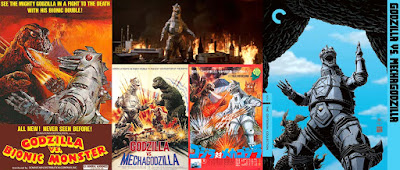
Godzilla VS Mechagodzilla


Missile-Toe Monster

Godzilla VS Mechagodzilla
aka Gojira tai Mekagojira
aka Godzilla VS The Bionic Monster
Japan 1974
Directed by Jun Fukuda
Criterion Blu Ray Zone B


Well this one’s a bit if a fun romp. It’s nonsense with a capital G* but Godzilla VS Mechagodzilla, the penultimate film of the Showa Era Godzilla movies highlighted in Criterion’s recent Blu Ray set, is actually one of the better entries from this period. It also looks like it had a better budget than what the Godzilla films had deteriorated to in the last few outings and there’s very little recycled footage (apart from one major piece which I’ll get to in a minute... but it doesn’t last very long).

Okay, so the plot consists of two groups of main protagonists linked by one of each group being the brother of the other. One lot, including a good guy professor, is working on a piece of flat metal found in a cave. His conclusion is that the metal is ‘space titanium’ and so there must be some evil aliens up to no good somewhere (he’s not wrong... astonishingly). Meanwhile, a mini statue of local Okinawan monster deity King Caesar is found in another cavern... except the evil aliens are also after that. Why? Because it’s a key piece in enabling a gazillions of years old prophecy about a big monster arriving to destroy the world and then, when the sun sets in the West, two monsters teaming up to defeat it.

This prophecy is reenforced early in the film when a young girl doing her ritualistic ceremony at the House Of Azumi temple, where King Caesar is supposed to be the symbolic guardian, collapses momentarily when she has a vision of a big monster attacking the city. Now, this vision is the bit of recycled footage I mentioned a couple of paragraphs ago, since the monster in the dream seems to be King Ghidorah footage from another film. This is the only time, though, that Ghidorah is seen in this picture because the giant monster which comes in later is something else... so, yeah... this vision makes absolutely no sense and we could really have done without the visual heads up. Thanks a bunch, kaiju writers.

And from hereon in it's all shenanigans afoot. Godzilla surfaces and starts acting like a villain trying to destroy the city. So suddenly he’s a bad guy except... no he’s not. Isn’t it strange that Godzilla’s pal Anguirus is trying to fight Godzilla, getting defeated in a gory combat which sees Anguirus defeated and in retreat? However, it’s not before he knocks a bit of scale off of Godzilla to show a gleaming surface underneath. Then, when another Godzilla joins the fray, at the request of Anguirus, he also gets bashed up pretty badly but... not before he reveals to the world that he was being framed by tearing the outer skin off of the other Godzilla, to the point where it changes into its true self... Mechagodzilla! The Big G does manage to break Mecha-G’s head and the aliens bring it back to their secret base for repairs. Godzilla then finds a big thunderstorm on an island and, in a first since his affinity with electricity was first established 20 years earlier in Gojira (reviewed here), Godzilla charges himself up with the lightning bolts from the storm.

Meanwhile, a gunman has been trying to get the King Caeser statue from an archaeology gal and her friend, the professor’s nephew. When the gunman gets shot in the face for his trouble, half of said face goes through a shimmery transformation to reveal that he’s some kind of space ape. He is defeated by one of the secret Interpol agents who had been acting... just sinisterly enough... to make the audience think that they were the bad guys in this.

While all this stuff is happening, the aliens kidnap the professor and force him to fix Mechagodzilla’s head. It’s at this point I have to ask again, why? Since they invented and built the thing themselves... why would it be that the ‘aliens from Black Hole Planet No 3’ would need an Earth scientist to help them fix their creation. I have no idea what’s going on here anymore. However, as you can imagine, the whole thing leads to a big fight between Mechagodzilla... who has finger rockets, destructive laser vision and who can shoot missiles from his metallic toes... and Godzilla, helped by the long dormant King Caeser, who is revived in a ritual by the lady who had the vision earlier in the film.

Things get bloody in the later combat too, with Godzilla leaking some big jets of red, arterial spray from his neck courtesy of his mechanical counterpart (a monster inspired by Mechani-Kong from King Kong Escapes, reviewed here). Plus there's a nasty moment where Mecha-G shoots multiple hypodermic syringes into Godzilla for... well, for no apparent reason. However, things get resolved when, in a first for the series, The Big G somehow uses his electrical charge to turn himself into a giant electromagnet, to bring Mechagodzilla towards him just before, with King Caesar’s aid, he rips off the robotic antagonist’s head.

There’s a big escape and destroy sequence cross cut with this fight, which also makes use of arterial spray. When the professor and the Interpol man helping him use the professor’s ‘special pipe’ with magical properties of being able to shut down electrical currents to help themselves escape (now days we’d call it something which shuts down things with an EMF pulse) and when the leader of the aliens gets shot, we get black blood spraying out of his neck before he, too, turns into an actor in a bad ape face mask... with extra little sticky out bits jutting out to presumably denote his alien leader status.

And that’s about it. There’s not a great deal of inventive shot design going on in this one and in some of the effects shots, the wires are clearly visible (especially so when watching this in a high definition format). This film also features the very last score that the great Japanese composer Masaru Satô did for a Godzilla film although, I have to say, it’s not one of his best. He does, however, manage to invoke the piece of leitmotif established for Godzilla by composer Akira Ifukube in this in a couple of places by, literally, playing just the first, long held note and then ignoring the other notes because the musical phrase is so well known by this point that you kind of fill in the rest of it in your head. Ifukube himself would actually return for the next and final film in the Showa Era Godzilla film series, a direct sequel to this one.

Godzilla VS Mechagodzilla is a fun if full-on nonsensical film which, in all honesty, utilises a much better looking design for the film’s titular antagonist than the one revealed in this year’s Godzilla VS Kong movie (reviewed here). It’s pacey, action packed and the only real downside is that the director seems to have really discovered the way hand held photography can be used to lend a certain chaotic dynamic to a shot... to the point where it was actually making me feel a little nauseous in one sequence. However, like I said, one of the better of the later Showa Era films and, of course, the Mechagodzilla would also turn up in many films to come. And rightly so... flying, mechanical kaiju are always a welcome addition to any film, in my book.

*So that would be Gnonsense then.

Thursday, 11 March 2021

Son Of Godzilla


It’s A Dad, Dad,
Dad, Dad World


Son Of Godzilla
aka Kaijûtô no kessen:
Gojira no musuko

Japan 1967 Directed by Jun Fukuda
Criterion Blu Ray Zone B


Jun Fukada returned in the next Godzilla film in the franchise, after his work in the previous film in the series, Ebirah - Horror Of The Deep (reviewed here). This one, Son Of Godzilla, sees the transformation or, some might say, devolution of the Godzilla character completed, going from out and out villanous menace in the early films, slowly evolving into heroic defender and protector of Japan and, for this one, he and his son Minilla (or Minira in the original Japanese, obviously, as short for Mini-Gojira, I suppose) are pretty much the cutesy comic relief of the film.

The movie starts with an insert shot of some planes in stormy weather who stumble upon Godzilla at sea, who himself seems to be mysteriously called to an island. The timing seems almost off here in terms of the timeline of events in the movie as Godzilla arrives (again) on the island later in the film but I’m guessing that, since the film is mostly ‘monster light’ for the first half, this and another scene showing a Kamacuras, one of the giant preying mantis creatures that populate the island which is the film’s only setting, are here to give us a glimpse of what we are all waiting for later in the story when the plot decides to get out of the way.

Said plot includes a Professor played by Tadao Takashima... we all know he’s a professor because barely a shot goes by with him in it where, no matter what is going on, he doesn’t have a pipe dangling out of his mouth... and his team of volunteer researchers who are doing weather experiments to try and freeze the island so we can later, in 100 years or so, transform fallow regions of the Earth like the Sahara desert into something which a starving and over populated mankind can grow things in to feed the planet. However, a young reporter played by Akira Kubo travels to the island to get a story about what they are doing there. Cue the usual antics until the reporter and professor bond and the reporter is allowed to stay... although nobody believes him when the sees the only woman on the island, played by the very interesting but underused actress Beverly Maeda, who has survived on the island alone since the death of her archaeologist dad in the 1950s.

However, their experiments go wrong as the calls from a giant egg upset the delicate controls of the experiment and they end up making it even more tropical and unlivable as an island. This causes the mantises to grow even larger and, also, for the egg to hatch to be Minilla, Son Of Gozilla, who is in immediate peril from said Mantises until his father finally arrives to kick ass, teach his son how to blow fire... in a wonderful and much re-used sequence in the movies where the cute, young tyke keeps blowing little smoke rings instead... and see off the other main monster in the film, a giant spider called Kumonga.

It’s a playful and fun film, for sure but, it’s a real sea change in the series for fans of The Big G as he originally used to be, continuing the trend from the last installment. Right from the start, with Masaru Satô’s quite wonderful and dynamic score, the stage is set with the whimsical and comic nature of the film played full throttle in terms of the musical content. It’s a fun listen away from the movie and equally appropriate to the on-screen visuals but... it’s a far cry from the serious but beautiful melodies of the films scored by Ifikube. Still, great stuff though.

One strange thing that happens, around about the twenty minute mark, is that the film suddenly takes on a narrator for about a minute, to explain to the audience just what is going on as a result of the failed experiment of the professor and his crew. It’s almost like the producers decided the plot was somehow just a little too convoluted for the target audience and decided to over explain things at the post-production stage, with absolutely no context as to who the narrator is and why his voice suddenly enters and then exits the narrative so inexplicably. It doesn’t hurt the film as such... just seems to be fairly superfluous in a story which doesn’t use this kind of technique from start to end so, yeah, a strange one.

The fight choreography is similar to the bizarre shenanigans when Godzilla fought the giant crab monster Ebirah in the previous film but, this time, the emphasis is on trying to put Minilla in comic situations where he gets inadvertently bumped for his troubles or, a lot of the time, is trapped by his enemies and has to call out for his poppa to come and help. For example, when Godzilla throws a rock at two mantis creatures they catch it, batting it back and forth between each other before launching it in Godzilla’s general direction, only for it to hit Minilla on the head instead and send him comically falling backwards. It’s that kind of film but... no argument from me because, at least it’s a fun movie and sometimes the potency of a really good, broad entertainment is forgotten with ‘serious’ film makers.

That being said, the film doesn’t have much in terms of substance to it, as you can probably tell and, when it ends, with the island freezing in the snow after an experiment goes right, allowing the pesky humans to escape, it takes one of the characters to tell us that Godzilla and son will be fine, they’ll just go into hibernation for a bit. Not often that kind of reassurance was given for the monster characters in a lot of these movies and I’m surprised they didn’t decide to bring back the bizarre 'narrator of the moment' to tell us this instead.

But there you have it, not much more to say other than this is an immensely enjoyable film and Criterion’s Godzilla - The Showa Era set gives us a nice, Blu Ray transfer which is the best way to see the movie. By this time the writers seem to have run out of ideas but some of the more interesting (and even more fun) Showa Era films were still to come.

Sunday, 28 February 2021

Beast-Human Snowman (Half Human)


Yeti’s Berg Addressed

Beast-Human Snowman
aka Jû jin yuki otoko
aka Half Human
Japan 1955
Directed by Ishirô Honda


Warning: Some very slight spoilers but probably not enough to warrant stopping interested readers from pursuing this review, I suspect.

Although not his next film after his original Godzilla, Beast-Human Snowman was the second of a steady stream of sci-fi, horror and /fantasy films made just one year after Ishirô Honda’s most famous behemoth, The Big G, was released onto Japanese screens.

It’s also a lost film.

Yeah... so this film was released to cinemas for a short while by Toho in Japan before being 'unofficially banned’ by them, due to various misconceptions (and possibly the nation’s collective guilt), about the depiction of the mountain tribe in parts of the film who, like the title character,  live on and around Mount Fuji...  many of whom appear deformed due to in-breeding. As such it’s never been released onto any home video format (it was almost released once on VHS tape but got pulled at the last minute) and has remained largely unseen apart from a print which, very occasionally, gets screened at Ishirô Honda film festivals in Japan. I can only assume that’s the source for this blurry transfer of, what looks like a pretty good print, which I purchased from one of the ‘usual kind of places online’, because I didn’t want to end up dying at some point before ever being given the opportunity to watch this film.

It’s true, the usual truncated recut for American audiences, called ‘Half Human’ in this case, was released into cinemas in 1958 but, from what I can understand, this is probably the most compromised version of a Japanese film recut for American release that I’ve ever heard of. Reportedly, between various scenes utilising footage of John Carradine in a new, grafted on and tonally changed story, only half an hour of footage from this original Japanese version found it’s way into that re-cut, by all accounts. So, frankly, I was willing to take a punt on the possibility that the print here might be totally unwatchable in the hopes of being able to see this at last. As it happens, the print is pretty much like one of those bad transfers of old movies at the dawn of DVD so... yeah, quite watchable depending on your expectations, I suspect.

It’s also, as it turns out, another early masterpiece from Honda and, frankly, it’s a crime against filmanity that a film this good has been left to wallow unseen for, so far, 66 years. This needs a decent Blu Ray print released on the double but I suspect the chances of that happening in my lifetime are slim to nothing.

The film starts off in a grim setting... a kind of station waiting room in the rain where a reporter finds a small group of Alpine Club members deep in gloom. They have been to find out what happened to another party lead by a professor who is a brother to one of them. A woman in part of this second expedition, played by Momoko Kôchi, also has... well, had... a brother on the first team but they find his remains a little while into the movie. Apart from one brief cut back to this scene a third of the way through... and then back to it at the end of the movie, the entire film appears as a flashback as told to the reporter. And what a film it is.

After finding the remains of one person, they wait and go back after the ‘spring thaw’ to resume their explorations. Meanwhile, another outfit trying to discover the ‘big foot’ creature that lives there for exploitation purposes, in the tradition of King Kong but more ruthless and unrelenting, are keeping an eye on them without them being aware of their presence. And also, the mountain tribe I mentioned earlier, with the beautiful village daughter played by Akemi Negishi (who was discovered by Von Sternberg and who you might remember from roles in such films as Lady Snowblood and the Female Prisoner Scorpion movies), is a third ‘interested party’ in that they help feed the bigfoot and his son, worshipped as deities in the village.

And there are a lot of shenanigans and twists to the story which I won’t relate or spoil here but, I will say that, at no time, is the title creature presented as anything other than a pacifistic, non-threatening and tranquil creature, completely worthy of our sympathies. Indeed, when one of the characters is being held prisoner and left dangling over a mountain for vultures to finish off, the creature pulls him up and then frees him from his bonds before going peacefully back to what he was doing. Indeed, the only time the creature becomes aggressive and wilfully violent is when, upon regaining consciousness after his son attempts to rescue him, he sees his young ‘un shot to death. So he first kills the people involved with the murder before going to the village of the local tribe and tearing through it in a frenzy of revenge (the tribe actually had nothing to do with the death of his offspring but, he has no way of knowing that as he now obviously sees humans as treacherous and dangerous).

It’s a beautiful looking film shot with a group of actors who are all highly convincing (even the larger than life, evil stereotype of the fortune seeking entrepreneur serves the film well) and also, it has to be said, very familiar. I think I recognised a few members of Akira Kurosawa’s stock company of actors here including the ‘morale booster’ character from Seven Samurai.

There are some great compositions in the 4:3 aspect ratio and Honda uses the frames well, especially in the group shots where everyone seems to be on the screen without the shots seeming over crowded. Also, there are some great skiing shots where big, diagonal swathes of snow take up a lot of the composition as the team of the Alpine Club glide across the frame. There’s even one shot which reminded me a little of a moment in a Kurosawa film called Stray Dog, where he goes to an extreme amount of non-action space on a frame. In this case, we see a big mountain valley and, at the very bottom of the shot, like ants and taking up less than a 20th of the vertical space, the small group of the expedition are walking from one side of the frame to another, almost hidden before the eye is attracted to the movement.

Added to all this, there’s some interesting stuff where the camera shoots through undergrowth and we can just make out the movement of a figure behind it all. Are we watching one of the party or a bigfoot, seems to be the challenge of shots like this and, I have to say, they fit in really well.

The film is genuinely intriguing and atmospheric too, primarily in the way the tension is ratcheted up before the audience is let in on the true, peaceable nature of the title creature.

One such scene is when the expedition first go to find out what’s going on and are staying at a log cabin (where they meet Akemi Negishi’s character the first time). In one sequence where the gloomy tension and mood of the expedition is dominant, the silence of the room is first shattered by the hourly warblings of a cuckoo clock before immediately being followed by the sound of a phone ringing. When one of the party answers it, we hear yelling, the wailing of a beast and a shot, heralding an ominous atmosphere of a potentially hostile creature (later we find that the creature was trying to rescue and care for an injured party but, by then, things have escalated).

Another great sequence full of creepiness is when we first meet the bigfoot. Momoko Kôchi’s character is sleeping in her tent when, in the window of the canvass just above her sleeping form, appears the face of the creature. It then reaches inside an opening in the tent with its hand and, out of curiosity, starts feeling around her face before she wakes up and screams in terror. It’s a nice moment and also our first inkling that the ‘Beast-Human Snowman’ is not the aggressive creature one might expect in this kind of genre movie.

And that’s me more or less done on this one. Masaru Satô’s score is perhaps less striking than I would have expected from him but perfectly suits the mood and tone of the picture. There’s a bit of an error when you may realise that many of the events being told by the returned party and conveyed to the reporter are not anything the Alpine Club members could have possibly had any knowledge about but, I think I’ll kindly put that down to framing the whole story for the audience as opposed to the first hand knowledge the reporter is getting. Artistic license and all that.

Whatever its very minor faults though, make no mistake, Beast-Human Snowman is one of Honda’s best films and, like I said earlier, it’s a real crime that this one has not had a release and that, at time of writing this article, most people haven’t seen the film and a lot of people are probably even unaware that this film exists. So, in the end, yeah, I was glad I paid the money on this one and am really happy to have been given the opportunity to see it. If you are a fan of Japanese fantasy films of this type, you may well want to try and track down a source for this one. Great movie. Deserves a proper release.

Sunday, 10 January 2021

The H Man


Blob’s Your Uncle

The H Man
aka Bijo to ekitai ningen

Japan 1958 Directed by Ishirô Honda
Toho/Eureka Masters Of Cinema Blu Ray Zone B


It’s been a while since I saw The H Man but I’m really grateful for Eureka putting this out on a really nicely restored Blu Ray (as part of a double bill set with The Battle In Outer Space) because the film hasn’t grown old for me. I still think this is a much more interesting movie than the original version of The Blob, which was released the same year as this one and shares a somewhat common element. The inspiration for this was the real life incident of the Lucky Dragon Number 5 fishing boat which strayed into a nuclear testing zone, the very same thing which inspired the director’s earlier classic, Godzilla (aka Gojira, reviewed by me here).

I’m also delighted to find that the print is subtitled with the actual translation of the real movie title on the Japanese language version here, so it’s Beauty And The Liquid People which is, frankly, a much more accurate title for the film. Although The H Man is also pretty cool, let’s be honest.

The film starts off strongly with some eerie pinging from Masaru Satô’s wonderful score, marking time on the soundtrack as the suspenseful prelude to a rainy night’s narcotics pick up goes wrong for the gang members involved. One gang member starts shooting at the floor and runs into the centre of the road and into the path of an oncoming vehicle and, when his partner gets out of the getaway car to see what’s happened, all that’s left of him are his clothes.

We then get the usual bafflement from the police, headed up by kaiju eiga legend Akihiko Hirata. They go and hassle the disappearing gang member’s girlfriend, the ‘beauty’ of the Japanese title, played by the wonderful Yumi Shirakawa, who is a singer at the local night club. The police obviously mitigate their bafflement by assuming that the gang member, quick as a flash and before anyone could see him, removed his clothing and ran off. Because, yeah, that’s just what a normal person would do in the middle of a rainstorm, right? Well, apparently, according to the police and various members of the gang in question, who also hassle Shirakawa (one of them coming too close and being violently absorbed by The H Man of the UK title).

Meanwhile, a dashing young scientist and new love interest for Shirakawa, played by classic kaiju actor Kenji Sahara, believes a liquid monster, possibly more than one, is absorbing people it doesn’t like, who are getting in the way of its former girlfriend. And, of course, after the police refuse to listen to him multiple times, he’s later proved right.

The whole thing is actually pretty fun and, well, some of the special effects are wonderful and... others not so good but it never once stops being entertaining. Honda brings his usual, wonderful sense of screen composition and injects the thing with a sense of cool more reminiscent of something Seijun Suzuki might have cooked up if he’d have wanted to make a monster movie.

Beautiful frame designs abound with some nice greys and greens plus a really good eye for using natural and, not so natural, vertical slabs of the screen to frame different things in. Indeed, this is so pronounced in some shots that they are literally split into exact thirds by the vertical slats created by doors or boxes etc. There’s a flashback scene on a ship where some sailors discover the bizarre ‘liquid people’ of the Japanese title, when they are going into the belly of the ship with lanterns to light the way... and the director uses these shots to further push his fascination with vertical patterns, using the travelling light source in the actors hand to literally light upright rectangular slabs filled with people while the rest of the screen is left black. It’s a really wonderful use of the ‘Tohoscope’ ratio and exactly the reason why I end up watching these kinds of films in the first place.

Another thing he does, which is something I would more associate with much later films, is to use a cut to a shot meaning one thing before cutting away to reveal a transition to another scene. For instance, when the lead scientist drops the lifebuoy of the irradiated ship onto the floor at police headquarters, we cut to a close up of the shot of the buoy on the floor and then, when we cut away from it again, we are already in the scientist’s crowded lab with the various people also looking at it on their floor. So, yeah, nice stuff like this is what watching these films are mostly about for me. Along with listening to some cool music and seeing outrageously bad monsters, of course. Although, the two night club scenes, where the actress is dubbed with a completely inappropriate voice as she sings to songs in English, had me scratching my head a little... especially as to why Eureka felt they needed to subtitle the song when it was already being sung in English. It’s a little bizarre.

However, when it comes to great colours, great composition, slime monsters and a cool soundtrack, this movie really delivers the goods and, I think, is one of Honda’s better movies (and he made a lot of highly entertaining movies in his time, as watchers of his various kaiju eiga will know. So, yeah, Eureka Masters Of Cinema’s new Blu Ray restoration of The H Man is definitely one I’d recommend for any fans of this period of Japanese cinema’s output. I’m really pleased that I have this version on a beautiful looking Blu Ray.

Tuesday, 6 October 2020

Ebirah, Horror Of The Deep

Crusty Asians Up For Crabs!

Ebirah, Horror Of The Deep
(aka Gojira, Ebirâ, Mosura:
Nankai no daiketto)

Japan 1966 Directed by Jun Fukuda
Toho/Criterion Collection -
Godzilla - The Showa Era Box Set  Blu Ray Zone B


Okay, so the seventh of the Showa Era Godzilla films, Ebirah, Horror Of the Deep, feels like a complete sea change in terms of the direction the series was heading in previously. It’s also the culmination of the little stabs of humour and humanisation that have been showing up as part of The Big G’s personality in the previous few films. Although he’s technically not a good guy here, he does save everyone in this and at the end of the film the human cast talk about how he really is the hero here.

This one was originally going to feature King Kong taking on Toho’s new crab monster (shrimp monster in Japanese if you go by the name but... yeah... it’s pretty clearly a giant crab) instead of Godzilla but rights issues etc means it soon developed as part of the Gojira franchise. Maybe that’s why Godzilla spends the first two thirds of the movie asleep. Which seems to be a common factor because the other big monster co-star here, Mothra, manages to stay asleep on her island until maybe the last ten minutes of the film, no matter how much the natives of Infant Island try to wake her from her slumber. Maybe she realised that the tiny, miniaturised twins who are her caretakers were, for the first time in the series, not played by The Peanuts but, instead, a different singing duet (they’re really not all that good as stand ins, I reckon). Regardless, as far as I’m aware this was the last time that Mothra would appear in her moth form (as opposed to her larvae form) in the Showa era movies. Not much of a swan song, to be honest.

Anyway, it’s a slow and convoluted plot. After a fishing boat goes down in the sea, the brother of one of the victims, after his mother consults a psychic, is convinced he’s still alive... but can’t interest the authorities in looking any further. So he does what anybody in his state of worry does... goes to watch a dance ‘’til you drop' contest in the hopes of winning a yacht to go look for himself. Alas, when he arrives, the contest has already been going for three days already. Fortunately for him, two of the people who drop out right at that moment say they’ll show him a yacht as they know where there are loads. After trespassing on one, they are startled by a guy already in the yacht. They assume it’s the owner who tells them they can stay the night but, overnight and unbeknown to all, the guy who’s brother is missing casts off with them and the newcomer... who turns out to be only hiding on the boat after a jewel heist... along for the ride.

With me so far? So, anyway, they look for the brother but Ebirah, the giant crab gets in their way and they wash up on shore of an island, finding that many more, mostly some of the inhabitants of Mothra's Infant Island but also the crew of the fishing boat that went down, are being used as slave labour by a shady organisation called The Red Bamboo. They control passage to the island past Ebirah with a yellow liquid and are making deadly, atomic bombs. However, the newcomers find themselves separated and, between them all, manage to accidentally wake the slumbering Godzilla they find in a cave by a clever, lightning strike method (which makes sense if you remember this was originally written to feature the ‘electrifying’ Japanese version of King Kong) while the island is scheduled for detonation and the islanders try to raise Mothra to rescue them.

And, despite the tangled machinations of the story, which I’ve abbreviated here or we’d be here all day, it’s actually not all that interesting, for the most part. The giant monster battles are few and far between and it’s just Godzilla and Ebirah having a go at each other, albeit in a comical fashion, that’s the real draw here. They basically have a game of ping pong with a rock one time followed up by a second volley of ‘rock tennis’ before Godzilla heads the rock like a football towards the crab. When he defeats Ebirah the first time, he even does a little dance in the sea to show his pleasure.

The film is scored by the famous composer Masaru Satô, one of a few in the series composed by him... so it doesn’t have any musical continuity with the Ifukube scores on the majority of the previous films in the series. It also doesn’t have the huge dramatic punch needed for the action scenes and this is very much spoof scoring to a certain extent. Now I know Satô can be very dramatic when he wants to be so my guess is the director really wanted him to play to the comedy of the monster brawls rather than try to make them more substantial in terms of the scoring. So, while I love this composer and the score by itself is a great listen as a series of musical cues in its own right... I’m not sure I’d say the scoring choices on this would have been the same ones I would have made but... yeah... it certainly gives the movie a different atmosphere from the others.

I’ve nothing against a fluffier, fun iteration of the Godzilla character though, who even looks a little like the ‘cookie monster’ from Sesame Street in this movie but... this is not my favourite of those ones and Ebirah, Horror Of The Deep wouldn’t be my first choice if I was looking for a quick monster mayhem’ style distraction either. It’s not a terrible movie by a long shot but... it’s one of the lesser pieces in the Showa era for my money. And as for King Kong? Well, the big ape would indeed make his way into one more Japanese kaiju eiga and that film will be the subject of one of my upcoming kaiju eiga reviews.

Sunday, 26 April 2020

Godzilla Raids Again


Fisherman’s Foe

Godzilla Raids Again
aka Gojira no gyakushû
aka Gigantis The Fire Monster
Japan 1955 Directed by Motoyoshi Oda
Toho/Criterion Collection Blu Ray Zone B


Warning: Very minor spoilers not worth worrying about.

Okay, so on to the second main feature of the new Godzilla - The Showa Era Blu Ray box set from Criterion (more like ‘book’ set, actually) and a film which used to be one of my favourites from the series, Godzilla Raids Again. Now, I’ve seen this a few times in the past, just not recently and, I have to say, this is so not the film I remember. There’s stuff in here I didn’t recall at all and I remembered my favourite of the two main ‘pilot’ protagonists, played by Minoru Chiaki, surviving at the end and somehow saving the day. Instead, the last quarter of an hour or so plays without him because he dies before the film’s final resolution. I just don’t remember this at all.

Chiaki, of course, will be remembered by fans of the great director Akira Kurosawa as he’s in a lot of his films (such as Seven Samurai, Rashomon, The Hidden Fortress and much more) and, here, he plays comic relief to the other romantic lead played by Hiroshi Koizumi, who was in a lot of Japanese keiju eiga including some more Godzilla movies... just not playing the same character in any of them. Here, the two play pilots for a fishing company and they go out in their small seaplanes to spot schools of fish out at sea and then lead their big fishing vessels to those locations. Of course, it isn’t that long into the story before they spot something much bigger than fish, when Chiaki’s character has to go down on an island and wait to be rescued by Hiroshi. When the two are on the island, they come across Godzilla having a fight with this movie’s first guest monster, an ankylosaurus named Anguirus.

Anguirus would, of course, later star in a number of Godzilla films over various era franchises, including the recent American films (during the corona virus era, it’s uncertain now if the new Godzilla/Kong film will actually be released this year or not but, if it is, he’s scheduled to appear in this one too). This film marks not only his first appearance on film but it also makes this the first film in which Godzilla has to fight another monster. A tradition which would continue in, not quite all but certainly most other Godzilla films which came after it.

This film starts off really strongly with a series of establishing shots setting up the character of the main romantic lead... a long shot of the shadow of the seaplane on the water before cutting to a shot of the plane in the air (which I believe, like most shots of this ilk in the movie, is a model shot), followed by a studio shot looking in through the window of the cockpit where the live action inside the plane takes place. It’s nicely done, as is the second and final fight between Godzilla and Anguirus around about halfway through the movie... which amounts to a 'building obliterating' wrestling match where Godzilla kills Anguirus by biting into his neck in a dead spit of Christopher Lee doing much the same thing in the Hammer Dracula movies.

However, even though this is more 'story based' in terms of human characters, there really isn’t enough monster action in the movie and also, compared to the first movie, the special effects seem to look really ropy throughout... especially on the bits of film where they’re trying to fuse live action with inserts of the bigger effects in the same shot. In fact, this film was rush released and hit Japanese cinemas six months after the phenomenal success of the first film... so I’m guessing the deadlines were a hindrance here. Everything looks a bit cheap and underdone. The wires can clearly be seen on a lot of the fighter planes (especially on this new Blu Ray edition... the format is not kind to old special effects in general anyway) and there’s even a shot where a plane pulls up and does a kind of loop the loop but... the clouds in the sky loop with it, indicating that the camera operator is just twisting the camera around to get the effect. Hmm.

The rushed schedule and the lack of major monster action might also explain, perhaps, the one scene in this movie where a character from the first film returns. Kurosawa alumnus Takashi Shimura (one of my all time favourite actors) reappears in what amounts to a cameo scene as Dr. Yamane, the paleontologist geezah from Godzilla. Although, it’s almost an embarrassing cameo because it seems to be there only to serve two functions...

The first being to remind the audience that Godzilla actually died at the end of the last film, due to Dr. Serizawa’s Oxygen Detroyer and that, as Yamane had prophesised at the close of the last movie, there are probably other Godzillas around somewhere (and I really don’t like Godzilla being used as a plural like that but, what can you do?). So yeah, people often forget that this is a second Godzilla who went on to shoulder the rest of the Showa era and not the original.

Secondly, the good doctor brings a silent cine camera film of Godzilla causing destruction in Tokyo to remind the audience where this story is set and show the authorities just what they’re up against. This amounts to an extended sequence of compiled ‘highlights’ from the first movie which are left to play out in silence for a few minutes. I got quite a bit outraged that the ‘footage’ actually included a shot inside a train hurtling towards ‘destruction by The Big G’ because, of course, they couldn’t possibly have that shot in a POV movie surviving this. I suspect this whole extended sequence is merely in here because the producers probably recognised that they didn’t have enough monster action in the movie and needed to get a little extra spectacle in there somehow.

Just in case you forgot, Godzilla is still very much the villain in this at this point in the cycle. Indeed, one of the characters refers to him as “The bastard spawn of the hydrogen bomb.” The shift from destroyer of Japan to defender would not come until a few more films down the line.

Masaru Satô’s score is fine but there’s not much of it. Of course, it doesn’t gel musically at all with Ikira Ifukube’s majestic scores for Gojira but Satô did do some great scores for the series, kind of alternating on an almost film to film basis with Ifikube for a while. However, like I said, there’s not a heck of a lot of it and it’s even more sparsely spotted than the first film. Which is a shame because there are some sequences in this which could really benefit from some kind of musical lift, for sure.

This film as it’s presented here also shows up a bit of a disappointment with this new Criterion set. Don’t get me wrong, it’s a truly astonishing set and we are incredibly lucky to have it but it would have been really nice to also get the terrible, bastardised Gigantis The Fire Monster, dubbed American version as an extra... with voices by the likes of George (Mr. Sulu) Takei and Keye (Number One Son) Luke. After all, they included the American version of the first film on the previous disc.

Either way, if you’re a fan of Godzilla then Godzilla Raids Again is certainly a necessary entry in the series because it bridges the eight year gap between this film, the last in the series to be in black and white and in a standard, non-widescreen aspect ratio... and all that comes after, in that Godzilla himself is more or less where they left him at the end of this movie. So, you know, an inferior but invaluable film in the history of the series.