Showing posts with label Tilda Swinton. Show all posts

Sunday, 25 September 2022

Three Thousand Years Of Longing


Djinn & Tonic

Three Thousand
Years Of Longing

Australia/USA 2022
Directed by George Miller
Metro Goldwyn Mayer


I’ve not got a very good track record with the films of George Miller, to be honest. Of the eight I’ve seen, only Mad Max 2 - The Road Warrior and his segment of Twilight Zone The Movie were worth crossing the street for... unless there was heavy traffic in the way, in which case not even then. So I’m extremely pleased to say I’ve now seen Three Thousand Years Of Longing and so discovered that Miller had an absolute masterpiece in him after all.

Based on a novella length short story by A. S. Byatt called The Djinn in the Nightingale's Eye, I will give you now my customary warning that, no, I haven’t read the source material and so I can’t tell you in the slightest how good the film is as an adaptation. I can only respond to it, without that particular baggage, in terms of its engagement as a film.

The story tells of the somewhat isolated, or perhaps that should be muffled, personality who is Alithea, played by the great Tilda Swinton with a striking Northern accent (at least that’s what I hear it as). Alithea is a well respected Narratologist, someone who studies narratives... or stories, I guess... and makes deductions and conclusions about the way they are used and perceived by humanity. The film opens with her going to Istanbul to be a guest speaker at a World Of Narratology conference, booked into the local hotel in their Agatha Christie room, where the late writer wrote Murder On The Orient Express. However, after a couple of bizarre visions which I’m still not sure about (or at least in terms of how they tie in with this particular narrative) she finds herself in a nearby antique shop. Here she takes a shine to an old bottle which is purchased for her as a souvenir of her visit. It’s in the hotel room when she is cleaning said bottle, rubbing it briskly with a toothbrush, that the stopper is finally pulled and a genie or djinn is released into her room, in the form of another great actor, Idris Elba. He, of course, offers her three wishes.

Now, Alithea, who knows the cautionary tales of all the prior, ancient Djinn stories involving three wishes... knows that this concept rarely goes well for the person making the wishes. She at first refuses to wish at all and, as she and the Djinn get to know each other, they start swapping stories and she learns, through beautifully recreated flashbacks, of the circumstances surrounding this particular Djinn’s three prior bottle incarcerations and various releases. And I’m not telling you where it goes from there but, this is one of those films which is, adventures and magic aside, a good solid romantic movie. I don’t often take to those, they usually have to be really good or really intriguing... two qualities that this film possesses in spades.

And it’s just a beautifully shot, well put together movie about the nature of humans and their relationship to stories and their unfolding. The structure is such that we have Tilda Swinton doing voice-over narrative and talking directly to the audience to tell her present story and, in a lot of the sections, Idris Elba doing voice-over narrative as the Djinn, relaying his tale to Alithea. And it works really well and reflects as much on the nature, traps and pitfalls of romantic relationships as much as the way in which narratives can give insight into the nature of reality.

It also has some great lines in it... the writing is superb and I had to wonder how much of that came from the original short and how much if it is original to the movie. My favourite moment in regards to the dialogue, was when Tilda Swinton, playing this great, no nonsense powerhouse of intellectual thinking, tells the Djinn... “I’m a literary scholar. We don’t understand much.”

The film also has a truly wonderful score by Tom Holkenborg (aka Junkie XL), sadly not released on a proper CD... because why would they want to release a superb, richly orchestrated score like this on the most popular form of physical media so people can listen to it properly, eh?

And I don’t have much else to say about this one because it’s one of those truly wonderful, damn near perfect movie experiences but, I will say I was astonished and gleefully happy that, during her lecture on the use of narrative, Alithea has two big slides of super-hero artwork from both DC and Marvel side by side... not a crossover you would expect to see in a modern cinematic landscape, I guess. At least not yet (yeah, it’ll be coming).

And that’s me done with Three Thousand Years Of Longing. If you respond well to romantic movies, in both the modern sense and the original usage of the word as used to describe imagination and inventiveness in storytelling, then you surely won’t be disappointed in this one. It’s a lovely, moving and somewhat fast paced piece of cinema which truly is a spectacle and should be on every cinephile’s ‘to watch’ list. This one’s really wonderful.

Monday, 31 January 2022

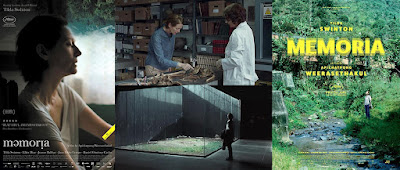
Memoria


Lost & Sound

Memoria
Colombia/Thailand/France/Germany/
Mexico/Qatar/United Kingdom/
China/Switzerland 2021
Directed by Apichatpong Weerasethakul
Sovereign Film Distribution


Warning: Possibly very slight spoilers...
I’m not sure if there are, to be honest.


I’ve not seen a film by Apichatpong Weerasethakul before and this one, Memoria, which marks his first English language film (although half of it is in Spanish), deals with a character called Jessica, played by Tilda Swinton (one of the greatest living actresses), as she wanders around bits of Spain and Columbia in search of the answer to the mystery which is haunting her.

Now I’m going to try and write this review without any spoilers which is going to be both bizarrely difficult and easy to attempt in equal measure but, ultimately, having spent over two hours of my time watching the film, trying to tell an audience what it’s actually about may prove something like trying to find a needle in a haystack.

I will say straight up that the movie is shot in that beautiful, languid, relaxed and simple manner I adore, that I might associate with someone like the great Andrei Tarkovsky. Most of the shots are long and there’s not always a lot of movement, if any, within a shot... sometimes for a good few minutes. It takes its time as both Jessica and the audience is hearing, every now and again, a fairly distinctive audio thump when nobody else can. The director likes to use the juxtaposition of sounds which aren’t actually this thump to both wrong foot the audience and also establish a difference between the thumps in Jessica’s head and ‘real’ ones. There’s also no underscore on the picture to distract from the sound design, which almost takes on the personae of being its own character in the film (if that’s not too pretentious a thing to say... although I’m sure a few reviewers might take this tack). So any music heard in the film is diegetic as in, an on screen source for any melody is clearly established.

The problem with the film for me is something I half saw coming from very early on in the narrative actually... if this could be called a narrative... in that I began to think of the main protagonist as being a more malleable screen presence than I think I was, at first, supposed to question. But question it I did and so, when one main character who is helping Jessica build an audio interpretation of the sound she keeps hearing just disappears from everyone’s narrative except hers... I felt myself a little vindicated in my original suspicions. Ditto when her sister, who she has been visiting in hospital but once released, doesn’t remember a conversation that she had with her in bed once she gets out... although considering the nature of the mystery illness which has struck her down, this is partially explainable within a traditional narrative interpretation of events, I think. Her sister's memory seems somewhat questionable anyway.

However, my own discomfort with believing everything put in front of my eyeballs as narrative truth... with good reason it perhaps transpires... wasn’t in anyway comforted by the ending of the movie which everything is leading up to. It also doesn’t help matters when, during the second or third long static shot of the movie, a load of car alarms go off in the city from no visible prompt, helping to re-enforce the notion in the collective mind of the audience that something ‘unseen by many’ is clearly afoot.

But, as I said, the film does work towards an end game and it certainly shows, at least, the source of the sound Jessica is seeing (or possibly two sources, depending on your interpretation) which I can certainly see as being the main clue for various catalogues and listings to label this up as a science fiction movie. That being said, any hopeful revelations on this point are kinda lost in the aftermath of certain statements in a conversation Jessica has with a guy taking up quite a large chunk of the conclusion of the movie. In fact, it becomes clear that not even Jessica is really able to properly comprehend the explanation behind the chain of events that have brought her to this point in the... yeah, let's call it narrative then.

By this stage, it’s fair to say that I think the viewer needs to bring his or her own interpretation of events and personal baggage with them and not feel like it’s an illegitimate way to approach the film... otherwise, I’d have to say, I can see a huge chunk of the audience getting extremely cross with the movie... at least as many as I suspect will look on it as a work of genius. For myself, in terms of the story, I guess I’m half and half with it but, as a deliberately slow paced spectacle with a wonderful central performance by the always reliable Swinton, I think I’d definitely have to err on the side of future classic, although I suspect it might not quite get that place in cinematic history books.

So, yeah, all in all I’m glad I saw Memoria and I’m also glad that, here in the UK, it didn’t have the gnarly release pattern it has in the US... where it will play in only one cinema for one week announced just a few days before it plays, before moving onto another cinema for one week... with no future home video release in its future. So, in that way, I guess I have to thank Sovereign Film Distribution for making it... just a little easier to ever see over here. My final word on it is... well... apart from the fact that I only have a little of a handle on what the film was actually about (there are, I think, a few possibilities and as I said, I think it’s down to individual interpretation)... I think it’s no spoiler to say that the final narrative punch of the film (or maybe just a slow poke in the cheek rather than punch, it might be said), is not all that different from the first time I experienced the ending of Michelangelo Antonioni’s Blow Up. It’s not the same ending or at least as direct (and again, it’s open to interpretation and also has a definitive, single, science fiction shot in it) but it’s certainly not easy to forget either and it’s one of those films, I think, that will both divide audiences but also haunt them all for a while after being seen. So, personally, I think you should take that as a recommendation of a good movie worth trying to see but... you know... that’s all open to interpretation.

Sunday, 16 January 2022

The French Dispatch


French Letters

The French Dispatch
USA/Germany 2021
Directed by Wes Anderson


Warning: Very mild spoilers.

A new Wes Anderson movie is always a cause for celebration. He’s a director who, in my humble opinion, has been consistently stunning since fairly early on in his career and when I sat down to watch this, I was fully expecting this to be my favourite film of the year... which it was for the first third of the movie but, although this is indeed another of Anderson’s amazing, cinematic spectacles which once again remind people that you can shoot an intensely personal artistic vision and still turn it into a glorious epic in this kind of medium, I’d have to say the film came up just a little short of being movie of the year for me. But, hey, this would surely be in anybody’s top ten last year once they’ve seen this amazing, visual feast.

The film starts off with the death of the founder of the news magazine The French Dispatch, played by Bill Murray and, in typical Anderson style, the film is presented to the audience as articles in that magazine. The magazine is an American publication but based in France, in the small fictional town of Ennui (Ha! I love that Anderson can boldly get away with ridiculous jokes like this without losing credibility for his elaborately concocted fictions) and, in addition to Bill Murray, includes a whole host of A list actors in all kinds of roles, large and small, such as Benicio Del Toro, Adrien Brody, Tilda Swinton, Léa Seydoux, Frances McDormand, Timothée Chalamet, Jeffrey Wright, Mathieu Amalric, Owen Wilson, Bob Balaban, Henry Winkler (yes, The Fonz is back in a movie and doing an unbelievably good job as a perfect, understated Anderson character), Christoph Waltz, Willem Dafoe, Edward Norton, Saoirse Ronan and Elisabeth Moss.

So a star studded cast and all caught in little pockets of the story but, as I said, the structure is that for the main sections sandwiched between the obituary and the End Note - Declines and Deaths section, the film is actually four ‘articles’ told from the point of view of one of the main writers of the magazine. So we have The Cycling Reporter from the Travel section (the briefest of the four main ‘articles’ told by Owen Wilson’s character) followed by Tilda Swinton of the Art And Artists section telling us about The Concrete Masterpiece (my favourite section of the movie), Frances McDormand’s Revisions To A Manifesto for the Politics/Poetry section and Jeffrey Wright, who seems to be channeling the performance style of Orson Welles (unless I’m missing a more literary allusion to the basis of his line delivery) to captivate the audience with the tale of The Private Dining Room Of The Police Commissioner for the Tastes And Smells section.

So, what we actually have, rather than one consistent linear narrative, is a medley or showcase of Wes Anderson short films... which is alright by me. The only weakness of the film is the inherent one of taking this format as the break from a single arc, meaning the audience will naturally compare and rate the various sections, as they would do in any kind of portmanteau movie. The ‘hit and miss’ nature of the strength of each episode being part of the territory. That being said, with Anderson being such a master of his craft now, it’s more of a ‘hit and not quite as much of a hit’ affair in terms of quality. In other words... there are no misses.

I’m not sure when each article is set but the death of the editor comes in 1975, with the publication of the last issue of The French Dispatch, which is shut down as part of the provision of the will. Whether these articles are all put together for this final issue or are a selection from various years is not something I could quite make out but, certainly, the Revisions To A Manifesto felt more 1960s to me than some of the other articles.

And once again, Anderson is mixing it up in terms of the different formats of the picture... a lot of it is black and white, some of it is in colour, most of it is in a 4:3 ratio with other moments in widescreen and even split screen where additions to the 4:3 ratio can be added as an appendix or reference to the content of the main shot mixing both colour and monotone simultaneously in one, nice sequence. This is not a division between different sections, more that every section contains all these kinds of treatments within the boundaries of its own ‘magazine article’. He also, uses a couple of animated cartoons to illustrate parts of some of these sections and, as quirky as that is... and also considering his past works where live action and animated styles have co-existed in the same picture (such as The Life Aquatic With Steve Zissou or The Grand Budapest Hotel)... I couldn’t help but think that in the second, cartoon animated car chase, the budgetary concerns of shooting such a section may also have come into play as to where best to unleash this technique.

The storytelling of each segment continues the style of the writer/director as sudden tangents to the storyline of each segment are often revealed to be Russian nesting dolls of ideas that ultimately grow from each other to add to the forward momentum of that particular arc.

There’s not much more for me to say on this one but I will reveal one delightful thing which, I suspect, would have had an audience composed of Jean Luc Godard and David Lynch howling with delight if such a situation were possible. When Tony Revolori (Zero from The Grand Budapest Hotel) is playing a young version of the imprisoned, psychotic, homicidal Moses Rosenthaler, he suddenly grows up into the later version of the artist, played by Benicio Del Toro. This is not done with a clever dissolve or other trickery but with the simple and ‘immersive defying’ moment of Revolori vacating his chair as Del Toro then sits in it, while taking his medallion off and putting it around Del Toros neck. One actor handing a character over to another, in fact. A truly nice touch and this one brought my personal house down, so to speak.

And that’s me done on this. If you like Anderson’s quirky, ‘catalogue and categorise’ style of narrative coupled by his squeaky clean shots, quirky physical space negotiations (such as when we track the progress of a character journeying up a tall building by his accelerated appearances at windows and balconies) and truly strong performances by actors investing in larger than life characters, then The French Dispatch should definitely top your list of ‘must see’ movies of 2021. And, of course, it’s all made more sweeter by the needledrop soundtrack selections punctuated by another of Alexandre Desplat’s masterpiece scores... this one very similar to his work on The Grand Budapest Hotel and yet another great triumph in this composer/director relationship. If not the best then, certainly, one of the best of last year.

Sunday, 31 May 2020

Snowpiercer


Scenes From
A Carriage


Snowpiercer
South Korea/Czechoslovakia 2013
Directed by Bong Joon Ho
Anchor Bay  Blu Ray Zone A


Snowpiercer is another fine movie from Bong Joon Ho, director of the absolutely brilliant, giant monster movie The Host and the ‘so so’ multiple Oscar winner Parasite. It’s based on a comic book I’ve never actually read called Le Transperceneige so, please forgive me that I’m not able to convey whether this is an accurate adaptation of the source material or not... I just don’t know. It’s also the movie that the notorious Harvey Weinstein famously sat on and blocked from release in the US (it’s still not been released over here in the UK*) for many years now due to the director correctly refusing to cut the film down. I got so fed up with not being able to see this, since there’s now also a TV series based on the work, that I finally got around to importing a Blu Ray release of this thing.

And, yeah, it’s not a bad film. It’s a nice 1950s style sci-fi novel concept (as modern sci-fi often is) although the whole thing feels a little bit dated to me in terms of the film reminding me of a lot of stuff I was seeing from places like Korea in the 1990s. That is to say, the film is kinda complex in terms of the amount of detail crammed into the thing... it made me think of some live action manga adaptations from the end of the last millennium.

The plot is of a post-apocalyptic Earth where nobody can survive (after mankind absolutely doomed themselves by bringing in the ‘big freeze’) unless they are in this specific, very long train which keeps moving and circling the planet on one large track over the course of a year... so, for example, you will always know from the wreckage of the place you are passing again when it is New Year’s Day. Stay on the constantly moving and self sufficient train and you live... exit and you freeze to death within minutes.

However, there is a class system established on the train, from the rich folk at the front, down to the lower classes at the rear who are more or less treated like prisoners in Nazi Germany and it’s here where our main protagonists work together to throw off the chains of their oppressors. The story tells of a group of characters played by the likes of Chris Evans, Kang-ho Song, Jamie Bell, Ko Asung, Octavia Spencer, Ewan Bremner and John Hurt as they finally organise themselves enough to try and fight their way to the front of the train and seize control of their situation. In their path, a whole host of bad guys and henchmen including Tilda Swinton, playing her evil character as kind of a Northern shop steward and the man at the top, Ed Harris.

And so, yeah, if this sounds all very like the original intended version of the late Bruce Lee’s Game Of Death, where his character was supposed to fight his way level by level up the tower... this is exactly what we have here. Except the tower is vertical, moving very fast and much longer. Plus there’s no kung fu action, of course.

As you can imagine from a cast as good as this, all the performances in this are superb (and it’s very grim too, because of it) but it’s the constant changes in interior locations and the inventiveness of different settings which continue to hold the interest as the story progresses. The first three quarters of an hour or more, for example, are really dark and grey and exactly the kind of colour palette you’d imagine for depicting a Jewish ghetto in a film set during the Second World War but, as new sections of the train are unlocked and revealed to the constantly diminishing band of survivors, everything gets more brighter and, of course more decadent as things go on, with the various ruling classes juxtaposed with our ‘low life heroes’ from the back of the train.

There’s a beautiful, breathtaking aquarium environment, for example, where the walls of one carriage are completely lined with aquatic life so the rest of the train can have sushi during certain times of the year. There’s a school room with kids and a somewhat irritating, singing teacher and even some ‘clubbing’ quarters where dancing, drinking and drugs is going on.

There’s lots of fighting going on too and it’s interesting how director Ho manages to get you to feel the emotional weight of some of the deaths when you’ve really only known certain characters for a half an hour. One interesting fight scene is where the incredibly long train is turning around on a huge u-turn of track, allowing a sniper to fire in a gun battle between two carriages while they are in view of each other. This was a nice touch and I have to wonder if this was in the original comic or if someone thought of this visual possibility purely for the film.

Adding to both this emotional weight and the gravitas of some of the action scenes is Marco Beltrami’s excellent score (I need to put this one on order soon). I was especially taken with a ‘call to action’ around halfway through the film where the underlying rhythm of the piece echoes, or actually creates, the sound of the locomotion of the transport. Very nicely done.

Okay, short review then because I’ve not got a whole lot more to say about Snowpiercer other than the fact that there’s a nice kind of twist as to where the narrative is going which you might suspect is coming at some point if you keep your eye on Ho’s regular actor Kang-ho Song... but may not realise is an option until this character starts offering up some science about their situation. It’s an okay ending but doesn’t neccessarily answer anything unless you are able to assume there’s a little more to what you are seeing than you have been shown... at least in terms of the aftermath of the film’s denouement. Not as good as The Host (which also stars Kang-ho Song and Ko Asung) but, at least for me, a solid science fiction vehicle with an interesting premise. 

*Wrote this a few months ago... it’s coming out over here in the on Blu Ray very soon.

Sunday, 14 July 2019

The Dead Don't Die


Fourth Wall Of The Dead

The Dead Don't Die
USA/Sweden 2019 Directed by Jim Jarmusch
UK cinema release print


Warning: Some very slight spoilerage.

I’ve always liked Jim Jarmusch as a writer/director, since first seeing his early masterpiece Down By Law in the late 1980s. I’ve not seen all of his movies... there are a few gaps... but I have seen and enjoyed most of them. Every now and again he will make a movie that seems to be a complete side step from his usual fayre. The first time I noticed this was in his truly excellent Ghost Dog - The Way Of The Samurai but he also took me by surprise by making a ‘vampire movie’ a few years back called Only Lovers Left Alive (reviewed by me here). Both of those films were much more commercially minded, it seems to me (either by design or by fluke) but each still transcended their genre trappings and held the key elements that I tend to associate with Jarmusch’s work over the years...

Those being: They were funny, poignant and highlighted the alienation of people sharing different languages and cultures even as they drew together.

So when it was announced that Jarmusch had made a zombie movie, I was interested... not just because I happen to like that sub-genre of horror movie anyway but because I knew, coming from Jarmusch, that it would be like no other zombie movie that ever came before it. Well... I got that right.

The film stars Bill Murray and Adam Driver, both regular collaborators with the director (check out Driver’s role in the directors last non-documentary movie Paterson, which I reviewed here) as two cops who are the main police presence in their small town of Centerville, along with the only other cop in town played by Chloë Sevigny. And they are all supported by a star studded cast, many of whom have worked with the director before, including Danny Glover, Tom Waits, Steve Buscemi, Tilda Swinton, RZA, Selena Gomez, Iggy Pop and Caleb Landry Jones (in a wonderful turn as a petrol and film/comic book merchandise dealer who wears a Nosferatu t-shirt). And, as you would expect from a cast like this (or pretty much any cast under this director, actually), they are all pretty amazing. Between them, Murray and Driver keep the mood sombre with their perpetually downbeat expressions and this helps maintain the minimalistic, gloomy atmosphere of a town, one of many, which has suddenly been overrun with a plague of zombies.

Now, I think this film is going to really divide people and there’s an element that even I, while laughing out loud at a lot of the wonderful humour on display here, found somewhat annoying. I’ll get to just what that is in a minute but let me first look at what this film both shares and, often, doesn’t share with the zombie genre in general.

Well, the common traits are a marked goriness when the humans are attacked although, conversely, when older zombies are out walking there is just dust instead of blood, which is possibly more accurate (I’m not sure, not being an expert on the undead myself). There’s also... and this is quite blatant here and almost being done just to check off boxes, it seems... the comparison of zombies who, like their nearest on-screen antecedents in the George A. Romero zombie flicks, are a satire of various aspects of our culture. Indeed, Jarmusch almost goes over the top to prove a point here by comparing some of the zombies to mobile phone/social media users and demonstrating this while it’s already been established earlier on in the text of the film what the ‘wifi’ so desired by the walking dead has already failed in the town.

However, it does do a lot which the modern, post-Romero zombie movie doesn’t often do. For example, it gives us a pseudo-scientific reason for the outbreak of the undead (which somehow comes in two stages in its ressurectional properties and thus renders the narrative nonsensical anyway... possibly what Jarmusch wants here) whereas most modern zombie films don’t try to find a rationale behind the undead shenanigans, they just deliberately side step it and cut to the chase. Here, Jarmusch has introduced the concept of polar fracking throwing the earth off its axis and this somehow raising the dead. Honestly, though... I think this is just another excuse to heavy hand the various metaphors used within the genre and, in some ways poke fun of it.

And that’s where I have my main problem with this film... the lack of respect for the genre. Now, don’t get me wrong, I have no problem with a director like Jarmusch seeming to say that films made in these kinds of genres are dumb and I’m more than happy for him to have a pop at them. However, the way in which he does it, with a blatant disregard for his own story mechanics where its later shown that... quite literally... anything goes (and if you’ve seen the movie I’m talking about both the final exit scene of Tilda Swinton’s character and the awareness of its non-feasibility in the script by Adam Driver’s character). And this is a big problem for me because, as I’ll get to in a minute, this kinda feels like the director is insulting the intelligence of the kinds of people who would turn out for a film like this... or at least that’s the way it felt to me, anyway.

Also, there’s a lot of referential, postmodernistic jokes in the main body of the film and while the director has done this just a little in the past, usually with a lot more of a story impact than the ‘thrown off’, almost Tarantino-esque way he does it here, I think this dumbs down the movie somewhat too. Again, don’t get me wrong because I had a little chuckle when I saw the late, great director Sam Fuller’s name on a tombstone but this film seems to be loaded with this sort of stuff and, outside of the obvious and loving references to Pittsburgh (where Romero plied his zombie trade), there seemed to be to be way too much of this kind of thing and it felt like the high calibre director was kind of slumming it, to some extent. Jarmusch is better than this, is what I kept thinking... it just seemed a little out of character for him.

Okay, so there were a few walk outs in the audience when I saw this (I’m pleased to say because, if someone like Jarmusch doesn’t get some walk outs then he’s almost failed) and I think this may be due to the quite blatant self awareness of some of the characters, Adam Driver’s in particular... and their inability or disinterest in helping themselves out in terms of where the script is taking them. So, yes, Adam Driver and Bill Murray’s characters both show, from very early in the film, that they are characters in a film and this kinda grates in the way it’s done. We’re not being asked to share in any peril or the particularly humourous modes of speech that the various characters explore (including cycles of repeat phrases which got me smiling quite a lot, it has to be said) because we can’t invest with them in any way as characters. In fact, we are being asked to interact with them on a more metatextual level, it seems but... only when it doesn’t get in the way of the on-screen action... which is a bit like the director is trying to ‘eat all the pies’ and not helpful in creating a film which holds together tonally, despite the minimalistic air of cynicism and acceptance that Jarmusch pulls from the air almost effortlessly.

Despite all these criticisms though, I personally really enjoyed The Dead Don't Die. It’s not ever going to make the top of my list in terms of favourite Jarmusch movies but it’s an entertaining piece and I think long time fans of the director shouldn’t have as much of a problem with it as a more commercially minded audience expecting to see a ‘cool zombie movie’ might have. Recommended to cineastes who are not worried about seeing what I think is personally too many directorial experiments thrown together into the same film. It’s interesting, funny and entertaining so, honestly, what more could you want from a night out at your local cinema?

Sunday, 18 November 2018

Suspiria 2018


Entrail Acte

Suspiria 2018
2018 Italy/USA Directed by Luca Guadagnino
UK cinema release print.


Well this is a worryingly problematic film which I’d be tempted to sum up in just a line or two but, since some of it seems to be fairly well made, I’ll give the project its due. Fair warning though... I’ve not seen any other films by this director so I can’t comment on how his particular sensibilities find any commonality with any of his other projects.

Let’s get all the preliminary nonsense out of the way first by clearly stating that there’s no reason and, really no way, that you should... or could... attempt a remake of Dario Argento’s masterpiece Suspiria (which I reviewed here). The original/real Suspiria is a unique film and is also unshakeably bound by the artistic sensibilities of its director. I would no more think of remaking this classic than I would any other classic of cinema such as Citizen Kane, Star Wars or Taxi Driver (and you can bet at least two of those are coming in the next 10-30 years). It’s almost impossible to subvert Suspiria to a modern sensibility with another creative team behind the film and... in some ways it’s a relief to find that this is, in fact, not what Luca Guadagnino has done here with his new, ‘updated’ version.

In fact, the approach to this version seems almost childlike in that he’s almost gone in exactly the opposite direction from all the things that made the original so unique in order to not be compared to it. If that was the case, "well done" because it’s certainly true that this could never be compared to the original. It’s just too different. The original had two things which are common to the majority (not all) of Dario Argento’s work... bad acting and a not so great story. It also had absolutely stunning mise en scene, shot in bright, primary colours via a technicolour printer and an absolutely awesome score by Goblin. It is incomparable to most any other film (even to Argento’s equally superb sequel Inferno) and stands alone as the piece of art it is.

In this new version, it’s hard to find much of any common ground. You have the basics of Daria Nicolodi and Dario Argento’s story of a dance academy housing a coven of witches, also remotely inspired by a certain couple of essay pages written by Thomas De Quincey about the three mothers, often published in compendiums of his writing bundled with Confessions Of An English Opium Eater. And... that’s about it as far as connections go. You have characters who aren’t necessarily fulfilling the same kind of story roles as they did in the original. Dakota Johnson’s Susie Bannion is a completely different kind of protagonist and she has a much different arc here... as does, surprisingly, the character of Helena Marcos (played as one of three roles by Tilda Swinton)... who has a kind of demotion from her status in the previous version (I won’t go into spoiler territory here though).

You also have a great cast... with Johnson and Swinton having to hold their own among equally gifted actors such as Mia Goth, Chloë Grace Moretz and Angela Winkler. One thing this film is big on is acting talent. There’s even a cameo from Jessica Harper in this but the character she’s playing (again without giving too much away as to the true nature of her role), is connected to an element of the film which is in no way present in the original story. Indeed, Swinton’s turn as the male Dr. Josef Klemperer is one of many different avenues the film goes down into a story, set the same year as the original release of 1977, which seems to be more about fallout from World War Two and, also, the whole Bader-Meinhof thing than it does to the witchy goings on in a dance school.

Furthermore, the famous primary colours have been dropped in favour of an almost exclusively washed out colour palette and, although there are a few sequences with smooth, longish camera movements there is also, it seemed to me, an abundance of short, static shots in an edit which is something which pretty much removes this film’s right to be compared to Argento’s opus even more. So you really have to look at this movie on its own terms as, frankly, anything you could use to compare it to the former is taken away from you.

As a film in it’s own right then... well, it starts off really strong and builds up a nicely unsettling and powerful atmosphere which it manages to sustain for the first two thirds of the movie... which it then somehow manages to waste completely by getting truly dull and uninspiring by the time it reaches the last third. This last third includes scenes of orgiastic goriness which, frankly, should have left me shocked and gasping but which... and maybe it’s just the way it was cut and paced... distanced and comforted me in a kind of dull, passive way almost, rather than confront me with the visceral jolt of horror I was expecting. I mean, people having their entrails pulled out, limbs twisted and heads half severed to spray fountains of arterial blood over the rest of the cast sounds like a great and visually ostentatious, fun time should be had by all but, the way it was shot and presented here it just felt a little too much like David Cronenberg-lite, to be honest.

The most interesting things about the film were the bits where it built up the political and redemption sub plots but, honestly, they seem to amount to nothing by the end of the movie and when it comes to Tilda Swinton, one of the great actresses of our time, playing Dr. Klemperer in this one... a character who isn’t even in the original... one has to ask the obvious question here. Why? She does it well but... could they not afford another male actor?

And then there’s Thom Yorke’s celebrated score. It’s just fine. It’s mostly appropriate... although I could do without the songs... but the film is really not as special or as visually striking as the 1977 movie so it doesn’t have to serve the same function as Goblin’s absolute masterpiece of the original. It must be a hard thing to score, knowing you’re going to be compared to Goblin in this way but, there you have it. It’s not nearly as strong but it doesn’t have to be and so, being appropriate and probably a nice enough listen away from the images is absolutely fine. It’s pleasant rather than essential but, frankly, that’s no mean feat anyway so I’m not complaining. I’ll be picking up the CD of this one soonest, I suspect.

And that’s all I’ve got for you as a first impression. This is really not a remake of Dario Argento’s Suspiria. Instead, it’s a nice but somehow muddied (plot wise) horror film which starts off phenomenally well but which then gets burdened with an overlong and excessively dull final third which kind of felt like it wasn’t living up to the strength of its set up. Still, it’s an interesting curio but... why call it Suspiria? I’d hate for youngsters today to think this is in anyway a substitute for the real thing. A nice enough attempt to do something interesting but a failed one (not necessarily a bad thing... spectacular failures can be as interesting as successes) and something which seems unnecessary to be birthed in, quite, this ‘named branded’ manner. I couldn’t watch it over and over again like the original but, then again, I really wasn’t expecting that to be the case anyway.

Thursday, 27 October 2016

Doctor Strange


Benedict In Monks

Doctor Strange
2016 USA  Directed by Scott Derrickson
UK cinema release print.


Doctor Strange is one of those comic book characters who I loved as a kid and I got quite excited when I’d heard Johnny Depp was in consideration for the role. I wasn’t too disappointed when he exited the scene because, frankly, Benedict Cumberbatch is one of those actors who you know will do a great job with any material he’s given and I could see how the arrogance his Sherlock character projected would be something which could really help bring the pre-magical version of Dr. Stephen V. Strange to life (the V stands for Vincent and that was who the original look of the character in those early 1960s appearances in Strange Tales, which I loved so much in reprint form, was based on... Vincent Price).

Now, I used to love these comics because Doctor Strange could jump out of his physical body and do battle on the astral planes, while somebody was hanging around and guarding his physical form so it was kept safe from harm. As a young 7 or 8 year old, of course, I was all about things like astral projection and ‘out of the body’ experiences so, when you had a Marvel superhero who could do all that stuff, it was a treat.

I went to the cinema on the first night of release in the UK, which was unusual enough in that it was a Tuesday, because I just couldn’t wait to see how this character fits into and pushes the boundaries of the Marvel Cinematic Universe and the answer, on both those counts, was... well, actually pretty well. Scott Derrickson, who directed this wonderful movie, has actually treated the material with the respect it deserves and you get a real feeling of those early short strips co-created by Stan Lee and, as importantly (perhaps more so), original Spider-Man artist Steve Ditko, who helped write and then drew the strips. They were pretty much a guide to the psychedelic world of the spirit in its hippiest, trippiest form but, a good few years before all that wave of counter culture hit (I’d personally say that certain sequences in Roger Corman’s Edgar Allan Poe cycle of movies also foresaw and possibly ‘usher’ed in the birth of psychedelia... possibly as influenced by the colour work that Mario Bava brought to the cinema and which the people at AIP studios at the time were more than aware of).

The movie really does those early 1963 and 1964 tales justice and the origin is pretty much the same as the one depicted in the comics, although I believe The Ancient One was originally based in the Himalayas and, either way, he was most certainly an old man...not Tilda Swinton, who plays the role in the film. And that’s not a dig by the way... the casting of the always brilliant Tilda is a really shrewd one, especially since the wonderful Rachel McAdams plays the only other female character in this movie and she’s pretty much wasted in how little screen time she has for the majority of the story. We also have the amazing Chiwetel Ejiofor, a villainous Mads Mikkelsen and a very funny Benedict Wong in the cast. Along with Cumberbatch, absolutely nailing Strange as you would expect from him, they have a really great ensemble group of actors here... at least two or three of whom will definitely need to come back for further Marvel movies.

I do have a few disappointments in the film but they are really minor. I’ll just get them out of the way now.

Okay... so somewhere in The Avengers (aka Marvel’s Avengers Assemble and reviewed here), I’m pretty sure Doctor Strange is mentioned in the helicarrier (also in Captain America: The Winter Soldier, reviewed here... but that’s a different issue). Now the Stark Tower wasn’t rebuilt as The Avengers Tower until after the events that took place in that movie so... how can a ‘pre-heroed up’ version of the character be looking out on a New York skyline that includes The Avenger’s Tower? Surely the timeline here doesn’t make sense and is a bit of a... well, a huge continuity error? I may be wrong but that kind of hit me between the eyes when I was looking at this movie in cinemas.

The other thing is that the tone of the story seems a bit... hmmm... somehow a bit too ‘even’. The magical battles are really something special in that they’ve done it all superbly... well okay, the astral plane versions of the characters aren't totally white ghosts like they were in the comics but what they’ve done here gets the message across pretty well and probably appears a lot more acceptable on screen than taking the look straight from the page, is my guess. However, there doesn’t seem to be much contrast within the scenes... with the last third of the movie being a few battles at different locations following on in quick succession without any real contrast in the sequences. I felt it needed just a little more ‘oomph and rest’ between set pieces to give you time to breathe and pace things a little more... thus enhancing the action sequences when they come...  but that didn’t quite get that feel here so it almost threatens to become somewhat less than the sum of its parts on occasion.

A third thing is problematic purely because I knew the early comics. There’s a character in here and, as soon as I heard his name, I knew where the story arc was going to be taking him... I won’t reveal the character name here because if you know the comics you’ll know it already... and I don’t want to put in any spoilers here. I didn’t know if they were going to be saving a certain ‘turning point’ for that character for a later movie or maybe they were going to go the full Green Lantern movie route and have that character do his thing in an epilogue scene. Well, this movie has two post-movie scenes, as do a lot of MCU movies these days. One superb one in the middle of the credits with exactly the Marvel character I had suspected would turn up making an appearance and gluing it together with one of next year’s MCU movies... and a post credits scene where the character I mentioned before gets to live up to the character as portrayed in the comics. So, yeah, they went the full Green Lantern on this one... which is fine by me because I’m one of the few people who actually loved the Green Lantern movie and I believe the plot and structure of the new Doctor Strange movie shares a lot of DNA with it, actually. Anyway, my problem was that I knew something pretty basic about a certain character who is in the movie way before it happened and so... maybe that wasn’t the wisest move. Then again, there are probably a significantly less number of people who used to read Doctor Strange than most of the other Marvel comics so... it’s not such a big deal, I guess.

Everything else about the movie works really well. The acting, the look and design, the spectacular special effects are all absolutely brilliant... and the dialogue in this one is really great too. There’s definitely a lot of fun and humour about this movie and it’s certainly a sharp relief from the previous MCU movie, Captain America - Civil War (reviewed by me here). Another great thing about it is the music...

Now, I’m gutted that Brian Tyler didn’t get a chance to work on this because I like how he’s slowly been bringing the musical elements of the Marvel cinematic universe into some kind of coherent style (something the company seriously needs) but now they’ve pulled in Michael Giacchino on scoring duties. Now I quite like Giacchino anyway (although I don’t like his opening, Marvel company fanfare as much as Tyler’s) and he turns in a really great score here. Definitely loved the sitars used in the end titles and it all works really well with the movie. Cant wait to get the CD of this one... it’ll be on for quite a few spins, I can tell you.

This movie has all the usual tie ups that the Marvel Cinematic Universe is known for and I’m sure Doctor Strange will be playing a special role in the proceedings in the third of The Avengers films. There’s a special artefact he always had in the comics, apart from the famous red cloak (blue in those original stories... if memory serves me... it didn’t change to red until later) and I’m sure anyone familiar with the artefact I’m talking about from the strips will realise exactly how this factors in with some of the last few years’ Marvel movies... so I won’t say anything more on that subject here because one of the characters, Wong, makes the connection quite implicit by the end of the film. So, basically, if you’re trying to watch all the specific Marvel movies which link into each other at the cinema... definitely don’t miss this one.

And, really, you don’t want to miss Doctor Strange anyway. It’s a terrific, fun movie and, although it injects a certain gravitas into some of the subject matter, it’s a welcome antidote to some of those solemn, darker super hero movies which have been doing the rounds at the cinema lately... juggling a dark, frightening tone with a light, frothy window dressing. Great stuff and easily the best of the superhero movies I’ve seen this year. Watch it while it’s hot!

Monday, 7 March 2016

Hail, Caesar!


Hot Hail

Hail, Caesar!
2016 UK/USA/Japan
Directed by The Coen Brothers
UK cinema release print.


Ha! You know, when I first saw a trailer for this movie on the internet sometime last year, I thought the idea of this one looked promising but I was in no way expecting this to be a good movie. It looked like a whole bunch of actors and film-makers having a whale of a time and, quite often when this happens, you often find the people making the movie are going to have a far better time than the audience who are going to be watching this. I might cite the 1967 version of Casino Royale or 2015’s Mortdecai (reviewed here) as examples where this tactic seems to seriously backfire on the studio.

Another problem I have, and which made me fairly wary is that, much as I love some of the Coen’s movies dearly, I do find them a bit hit and miss and, over the last five or six years, I have found their movies definitely in the miss category, for me. I love the Coens of The Big Liebowski, Oh Brother Where Art Thou and The Man Who Wasn’t There but some of their other stuff seems to be less emotionally involving to me.

Well, I needn’t have worried on either count, as it happens, because although it took me 20 minutes or so to warm up to their latest opus, Hail, Caesar!, I absolutely loved it, once it got going. The film stars Josh Brolin as famous Hollywood ‘fixer’ Eddie Mannix, a fictional version of the real person who works here in a made up studio where thinly disguised ‘Coenised’ movies from Hollywoodland’s rich legacy are in production. When famous film star Baird Whitlock, played by George Clooney as a kind of Charlton Heston via Victor Mature type, is kidnapped from the set before the completion of his latest movie Hail, Caesar!, it’s up to Eddie to get him back while still trouble shooting other problems with various stars who work for the studio.

In a nice touch to the William Wyler version of Ben Hur, the fictional Hail, Caesar! shares the exact same subtitle of that movie, A Tale Of The Christ. There’s even a hilarious scene where Clooney is trying to channel the same look of reverence that Heston does in Ben Hur, when Christ gives him water on his journey to be a galley slave, although the roles are slightly twisted around here, just like a lot of other stuff in this movie is nicely subverted... such as the gay subtext highlighted with a joke in the sailor’s song and dance number performed by Channing Tatum as Burt Gurney, this film’s equivalent of Gene Kelley.

Other people who populate this film are Tilda Swinton in a kind of dual role playing a kind of ‘twins’ version of gossip columnist Hedda Hopper, Ralph Fiennes as Laurence Laurentz and Scarlet Johannson doing a kind of earthy version of famous water dancer Esther Williams. The character which made it completely watchable for me though, is the role of Alden Ehrenreich as ‘singing cowboy’ sensation Hobie Doyle. I don’t know who this guy is but he’s phenomenal. Sure, he gets some good laughs in scenes with Ralph Fiennes character as the studio attempt to ‘change his image’ but it’s his other role in the film which really help bring this all to life.

Hobie is obviously a parody of the Roy Rogers/Gene Autrey cowboy stars of yesteryear and can perform some neat tricks as demonstrated here. He even has his very close parody of a Gabby Hayes style sidekick who, obviously, gets all the laughs from the fictional audience when he takes his date to see one of his films. And about that ‘date’. This movie is very much a film watcher’s movie... like a Quentin Tarantino piece, a lot of the pleasure in watching it is derived from how many famous movie references you can pick up on. A real movie spotter’s pursuit, is this. We only hear her name teased a few times in the movie, for a while, and as soon as I heard her name, Carlotta Valdez, my brain was on fire. I spent the next twenty minutes or so of the movie agonising where I’d heard it before until it finally kicked in and I realised that this was the name of the fictional, historical figure that Kim Novak is pretending to be channeling for the benefit of James Stewart in Alfred Hitchcock’s masterpiece Vertigo. Oh my gosh, I thought to myself, are they going to go the whole hog and make her look like the ‘Portrait of Carlotta’ right down to the iconic hairstyle in the Hitchcock movie?

As the film wore on and I realised the Coens weren’t taking the strength of their parody too seriously (I’ll get to that in a minute) I then started thinking that maybe they were going to have Hobie dating a parody of the Mexican Spitfire, Lupe Velez, herself. As it happens, it turns out Hobie is dating a version of the famous actress Carmen Miranda and, it has to be said, Veronica Osorio, the wonderful actress playing her here, makes it more than apparent who she’s supposed to be in her very first scene. She is an absolute delight in the role and her scenes with Alden Ehrenreich, as Hobie entertains her with both a real lasso and, later, a spaghetti lasso, are just so charming they will probably win your heart right over. However, Hobie’s solo scenes as he goes after the kidnappers are equally great and... I’ll briefly mention those in a little while.

George Clooney, of course, is also brilliant in his role and when it turns out he’s kidnapped by communist writers, his scenes with them are pretty funny too. And it was nice to see Patrick Fischler as one of those writers... I always wondered what had happened to that guy who played the video store clerk in Ghost World and... here he is. He has a very distinctive face which makes him a good person if you want someone to stand out and add texture to a crowd. Clooney is marvellous, though, and the more stuff he makes these days which border on almost parodying himself, to an extent (with a little bit of stretch), forces me to admire him more and more as both an actor and a star as the years go by. Some people might be afraid to take on this kind of role but, as usual, Clooney gives it his all.

Now there are some problems with the parody in this movie, to be sure, and I’ll highlight those soon enough, but one of the things which made me stop worrying about the authenticity of a lot of the stuff on show in the movie is that, it soon becomes obvious that the Coen’s just don’t worry too much about making it all authentic. These are broad strokes which create a brief impression rather than full blown homage and, as such, it kinda works at its own level. Where it’s less satisfying is when some aspects of a parody are finely tuned to the smallest details but maybe slightly tarnished by another element being less so...

For example, the sailor’s song and dance number, headed up by Channing Tatum, is an incredible movie moment. It’s clear that the choreography and dialogue of those big MGM mid-fifties numbers have been studied here to the nth degree. And Tatum has obviously been looking at Gene Kelly and the way he moves, the way his face expresses (or doesn’t always) and the way he delivers his lines... it all works really well. As does the consistency of the simplicity of the colour scheme of the set being used. However, what doesn’t work about this scene is the veracity of those colours themselves. The MGM films used to be... well, over the top and almost over saturated beyond belief in those movies... the colours here, while simply wrought, have none of the luminosity of the hues used in the films the Coens are trying to emulate in this scene... which kind of spoiled the overall effect of it, for me.

Another example would be Carter Burwell's score throughout the movie. Now this must have been a dream job for a composer to work on as he has to cover a range of musical styles due to the nature of the content... but I noticed that he was more successful in some styles than others... although that might not have been his fault. For instance, the music he delivers for the Hail, Caesar! movie within a movie scenes are typical in structure and tone of the kinds of scores these films were getting by the likes of Dr. Miklos Rozsa but... well, they just don’t seem to have the same punch or over the top-ness, over scored quality of the originals. However, like I said, it might not be the composer’s fault, it might just be mixed too far back into the background compared to the way the music would have been mixed into a genuine Roman/Religious epic of the mid 1950s so... well I’ll find out once the CD arrives.

The composer does do some really great stuff here too though and, getting back to Hobie going after the kidnappers, the scenes where the Coen’s get almost metatextual and use the vernacular of the 1940s and 1950s film noirs to tell that part of Hobie’s story is faithfully backed up by Burwell with something which really does the trick in those sequences. So, yeah... looking forward to this score arriving in the post sometime soon.

And that’s what I thought of Joel and Ethan Coen’s Hail, Caesar! Once it starts coasting along the movie is a real breath of fresh, or maybe that should be reconditioned, air midst a cinematic climate where no other film is being made quite like this one at the moment. So as far as subject matter and approach are concerned, there’s nothing else like it out there currently... so if you want to see something different then check this one out. I, for one, had a great time with this movie and if you’re a fan of old school Hollywood movies then you’ll probably have a good evening with this one. Definitely a big thumbs up for this one... if I had a massive, giant thumb to do that with.

Sunday, 9 March 2014

The Grand Budapest Hotel


Hotel Recall

The Grand Budapest Hotel
2014 UK/Germany
Directed by Wes Anderson
Playing at UK cinemas now.

There’s something about a Wes Anderson movie that creeps up behind you and just grabs you right from the start, pulling you into the realm of the story and providing a totally immersive experience for their “always too short” running times.

I was trying to pinpoint, after leaving a screening of his latest film, The Grand Budapest Hotel, just what makes the majority of his movies, as far as I’m concerned, just so perfect. In the end I’m forced to confess that there’s no “one” real signature element of his style which can take the full responsibility for the absolute joy one gets from watching his stories play out in front of you. It’s a terminally infectious combination of all round stylish movie-making infused with an absolute perfection of execution, even at the points where he deliberately dumbs down on the technical expectations to feed the whimsy of his pieces (think the various stop-motion sea life in The Life Aquatic with Steve Zissou or the high speed ski chase in this movie, by way of example), that feeds your mind and allows you to switch off to all concerns other than the shadows and light playing out in front of you in a darkened cinema, that allows for such a fantastic marriage of small scale stories made epic.

I usually hate doing lists but the elements in and of themselves are easy to identify, of course:

1. The clean, sometimes sweeping and sometimes static, but always simplistic movements of the camera through an artifical environment which leaves you in no confusion as to where you are.

2. The matter of fact neatness of the sets which are always easy to understand, with the director often giving you an overview far more detailed than any mere establishing shot, which perhaps mirrors the agenda of Kurosawa to give the audience a very clear map of where the action is transpiring before fully spinning his narrative web.

3. The level of detail in those sets. They are always quite neat, which lends an air of art versus reality, and they are always filled to the brim with little insights into the characters that inhabit them.

4. Perfect casting, employing actors who are some of the best in their field and who are not just playing to type. They are being used in a movie which, you can tell, they want to be in rather than just pick up another pay cheque. This film includes cameos and extended cameos from a large number of Anderson’s back catalogue of actors and actresses and it’s a joy to watch each one pop up, one completely uncredited one (even on the IMDB) for literally about one or two seconds of footage. I’d do a list but it would go on forever.

5. A musical undercurrent which is usually quite diverse in its style and sourcing, although The Grand Budapest Hotel is slightly different in this respect and I’ll get to that a little later.

6. The quirky and fun writing which is always witty and more often than not takes what, to another writer/director, would be a fairly small scale story, and then imbuing it with a sense of grandeur which allows it to shine at its own pace... which is rarely slow or boring.

7. A constant and stable pacing, presumably arrived at through the editing, which allows the brisk intermissions of action... random fleeing, window jumping, cat throwing etc... to come alive as startling little highlights, enhanced by their throwaway treatment, rather than muffled by this artistic attitude.

I could go on, but those are the main ones.

And, of course, The Grand Budapest Hotel has all this in spades... apart from, to a certain extent, the musical element... but the treatment and use of that here shows a trust perhaps lacking in the director’s previous work and, like I said, I’ll get to that soon enough.

The Grand Budapest Hotel tells the story of the titular hotel’s concierge through the eyes of his lobby boy. We have a Russian nesting doll format for the story within a story within a story structure, but the main narrative is told through the eyes of the lobby boy from his old age as the rich owner of the hotel (I’m not giving anything away here... you’ll know this much within the first 10 minutes of the movie). Anderson uses shifting aspect ratios to differentiate between the “narrative stacks”, with most of the movie being screened in a 1.33:1 aspect ratio, and it works pretty well, with the shifts from one ratio to another being mostly noticeable on purely a subconscious level once he’s done it a couple of times.

The performances, as you would expect, are astonishing. Ralph Fiennes has finally got my attention and possibly respect as an actor and he is an absolutely joy to watch in this as a slightly camp womaniser who appreciates the finer things in life. His lobby boy, played by relative newcomer Tony Revolori, is an absolute wonder and, as I said, this is all the norm in a film directed by Mr. Wes Anderson. And, honestly, Tilda Swinton's old age make-up is absolutely amazing. I rarely find “ageing” make up in any way convincing but this time it’s really impressive. I didn’t at first realise I wasn’t watching an 80-something actress unknown to me.

And Willem Dafoe’s caricature of an evil henchman is at once thoroughly sinister and over-the-top funny. It’s not got the depth of the role which Dafoe played for Anderson in The Life Aquatic, but it’s not supposed to. Conversely, Edward Norton’s character is really just an extension, albeit in a different profession, of the character he plays in the wonderful Anderson movie Moonrise Kingdom (reviewed here). And it’s just as poe-faced and funny.

But don’t get me started on Harvey Kietel. You may find yourself bursting out with laughter just at his appearance in this one. He's always so good in this stuff.

And then there’s the music.

Wes Anderson tends to employ a lot of “found” needle-drop style music in his films, although this is often supported at times with an actual composed score to give certain moments the kind of unity which music can easily create to glue different parts of a movie together with a leitmotif or atmospheric approach. Mark Mothersbaugh’s music for The Life Aquatic, for example, utilises a melody in different orchestrations... from something that deliberately sounds like it’s being played on a cheap, 1980s Cassio synthesiser through to a full-blooded action cue representation of the theme... to bring together the elements as a unified “Team Zissou” force within the film. Similarly, a more subtle but similarly progressive set of orchestrations is employed by the always brilliant Alexandre Desplat with his “Heroic Weather” theme in Anderson’s Moonrise Kingdom, to further enhance the sense of unity and harmony with the various characters.

In The Grand Budapest Hotel, Anderson pretty much throws the needle-drop element, cat-like (no don’t ask), out of the window and instead has hired Desplat to provide a full score and, while it does tonally go through a needledrop like quality in terms of the style in places, it finally feels like an Anderson film has a full and cohesive musical direction and, given that it’s composed by Desplat, of course, it’s an absolutely marvellous piece of scoring. The CD should hopefully be arriving through my door for a closer listen sometime this week, I hope.

And that’s about it. I could go on and on about how wonderful a movie this is but I think you’ve probably got the idea by now... at least if you’ve read this far. What I will add though, is this...

I’ve seen most of this director’s work now and I would rank this movie as fourth within his oeuvre. But it’s an absolutely brilliant and joyful experience and I plan on seeing this movie several times more in my life. I may rank it fourth in his movies but it’s fourth out of four absolute masterpieces he’s made. If that isn’t enough of a recommendation for you to rush out and see this truly splendid artefact of cinematic wonder then I don’t know what is. Run, don’t walk*, to your nearest cinema and see this fabulous creation for yourself.

*Please note, this writer takes no responsibility for any accidents, injury or death resulting in the investment of this advice.

Monday, 24 February 2014

Only Lovers Left Alive


Drink Tilda Blood Runs Cold

Only Lovers Left Alive
2013 UK/Germany/France/Cyprus/USA
Directed by Jim Jarmusch
Playing at UK cinemas now.

Up until a few years ago I thought the modern vampire movie was gone as a legitimate form of artistic expression and figured it was going to stay dead for a while. Zombies had taken over and not many people were really doing too much interesting with the genre, or at least that’s what I thought. Now I’ve seen four really great contemporary vampire films in the space of as many years and Only Lovers Left Alive is definitely one of the greats (the other three being Let The Right One In, reviewed here, We Are The Night, reviewed here, and Byzantium, reviewed here).

This time, master movie maker Jim Jarmusch takes his turn to play with vampires. That is to say, he’s using vampires to bring out one of the broader themes of his body of work and using that as a backdrop to, basically, have some fun with the possibilities inherent in the genre. This is not to say it isn’t a strong genre piece, it’s definitely a “Vampire movie” with an upper case V... but the way he uses the genetic make up and popular tropes of this type of experience very much requires a certain level of familiarity from the audience.

And in this artistic choice, of course, Jarmusch is not alone among film-makers.

I’ve noticed that a fair few writers and directors are taking the ingredients of the myth of the vampire, using the bits which they want and throwing the other rules out, making oblique mention of the parts of the myth that they have discarded for each film, assuming the audience already knows what those rules are... and thereby freeing themselves up to get on with “the story”. Which is an excellent way of doing things, no doubt, for an older audience... but young people who are perhaps less equipped to be familiar with the ritualistic elements of the vampire movie/novel may find themselves in danger of being left out of the loop if filmmakers keep using this tactic. Although I’m sure there’s an argument that, by the time one is old enough to see movies like this, the knowledge is already there. Which, I guess, certainly holds up for now with contemporary audiences... but future generations may not be so fortunate with the opportunity, and willingness, to watch the vast back catalogue of vampire films made over the last 100 years or so... but that’s an argument for another time.

Jarmusch starts this film with a startling array of rich imagery, beginning with some titles, in a quite clichéd font to match the legacy of the subject matter, superimposed over a slow circling backdrop of stars. This immediately puts the viewer under a little bit of tension and ready to enter a more hypnagogic realm as the titles have the illusion of veering off on their own if you lose your concentration or glance away from them to another part of the screen. It’s quite hypnotic. The motion is continued post-credits, as the starry background is replaced by a vinyl record rotating on a turntable and we are introduced to the two main vampires of the piece, Adam and Eve, played by Tom Hiddleton and Tilda Swinton respectively, in a series of shots which match the circling camera eye.

The swirling continues as they are intercut in their mutual slumber but, in different rooms and, once they get up and go about their business in two completely different places (Adam is sleeping in Detroit and Eve is sleeping in Tangiers) our perception of what we were just watching is completely overturned and we realise the dazzling camerawork and shifting distance of the main players from the lens is Jarmusch’s way of showing the mental connection between the vampires, even though they are separated by gazillions of miles, physically. Another series of shots of three of the main vampires drinking, which utilises a camera strapped to each actor I suspect, yields a similar sense of psychic camaraderie a little later into the running time of the film.

As Adam goes to get his blood supply from Dr. Watson (played by Jeffrey Wright) and gets some new guitars from his source, Ian (played by Anton Yelchin, the new Chekov in the Star Trek movies), Tilda Swinton’s Eve goes to see her vampire friend Marlow (yes, that Marlow, who wrote Faust and, in this version of celluloid reality, definitely wrote the entire output of William Shakespeare), as played by John Hurt, for her blood supply. The colours are really interesting as Jarmusch uses both fluid camerawork (and the occasional stint of handheld) to focus on what appear, at least to my eye, to be vibrant colours which have deliberately been toned down... so we get a kind of “filtered reality” feeling which is perhaps a visual rumination on the fact that, when you’re lived for as many centuries as the vampires characters in this film have, you get kind of jaded to things after a while.

The characters are set so you have Adam as a suicidal, Byronesque vampire archetype (something commented on quite blatantly by Eve during the course of the movie) who passes his time making great music which is never released and who gets a wooden bullet made so he can kill himself when necessary. And then you have the lightness and calm of the piece, his devoted wife who travels to Detroit to cheer him back up and act as the ying to his yang. The situations allow Jarmusch to comment and reflect upon the ideas made possible by the vampire myth in general, and since there are obviously only a few vampires here and there in this fantasy microcosm, it allows him to indulge on his kind of “last days of dying cultures rubbing together” theme, which he has dwelt on a few times, quite memorably in Ghost Dog: The Way Of The Samurai. As he explores the possibilities of the genre, he gets to also invent some great responses to the nature of conversation between people who have been around this long and lived in this way... which is kinda the point I think.

A nice little idea, for instance, is the fact that the vampires tend to regard the general living human race as zombies and, when we look at our own culture’s current definition of all that means as defined by the slow, shuffling, brain dead legacy of the George A. Romero take on zombies from the 1960s and onwards, and then apply that conclusion to the supercharged senses of the vampires in this movie, that’s a pretty cool analogy to make. Cool being the thing here because, like a lot of Jarmusch movies, Only Lovers Left Alive is nothing if not extremely cool movie making.

It also gets allows Jarmusch an arena to get away with some cracking humour, which I think is where the bizarre accusations of pretension may have come from. The writing, if taken out of context, maybe does seem a little indulgent but, frankly, if you are decoding the scenes and the tone in which they are played, you’ll realise that a lot of the dialogue is high comedy. “You drank Ian!” for example, or my personal favourite moment, where I let out a large, inadvertent chuckle, as John Hurt pointed out that the old “zombie, Shakespeare” was a talentless hack.

However, a fourth vampire enters the picture, in the form of Mia Wasikowska playing Ava, and with her she leaves a wake of disruption which finds our main two protagonists fighting for their lives and, ultimately, reverting back to their behaviour from the 15th Century. Which is kind of an interesting angle for two characters such as these, who are lazing through life at their own pace and reflecting on the almost soporific nature of their existence.

I absolutely can’t reveal to you what happens by the end of the movie, but I will say that the pace is pleasant and leisurely, always fascinating, with stops to take in tranquil moments of beauty whenever those whims of fancy need to be indulged... all set to a fantastically simplistic, yet texturally rich, musical soundtrack which includes Jarmusch’s own band Sqürl in the mix too. And just when you think the pain of the reflection of the future survival of these vampires is about to take itself too seriously, it leads in to a final shot which is an absolutely delightful celebration of the vampire genre and which will, no doubt, please many people... just like it did me.

If you like Jim Jarmusch films in general then you’re not going to want to miss out on this genuine masterpiece. I’d place it up with my personal favourites of his ouevre like the aforementioned Ghost Dog and Down By Law (reviewed here). Similarly, if you like vampire cinema, he’s successfully made a film which both reflects on the genre rulebook while somehow still managing to keep it fresh and as alive as, it turns out, it always was. If you like works of art then, of course, you too will love this movie. If I’d had seen this movie last year, it may well have been my number one film, despite some strong opposition. My worst problem this year, however, is that it’s probably the best film I’ll see all year... and it’s only February.

Don’t miss out on this one, though, whatever you do. It’s one of those films that the cinema of reflection was invented for.

Tuesday, 8 November 2011

We Need To Talk About Kevin


Straight N’ Arrow

We Need To Talk About Kevin 2011 UK/USA
Directed by Lynne Ramsay
Screening at UK cinemas.

Warning: There are kind of spoilers here I guess...
although it’s pretty much all worn on it’s sleeve
from the start of the movie.

I didn’t really know much about the latest Lynne Ramsay movie, other than it had an unpleasing (to my ear) and unwieldy title and, consequently, I didn’t really know what to expect from it. My expectations hadn’t changed any after having seen the trailer either. Somebody had said, after also having seen the same trailer, that they assumed it was about some kind of devil-child like in The Omen movies. I couldn’t myself disagree with them entirely because, in many ways, the trailer was was cut like a horror movie, to some extent.

As you've probably guessed by now... I’ve not read the novel on which We Need To Talk About Kevin is based and any reference to the rather grim actions of the title character in the trailer were oblique at best. What I did know, however, is that it was directed by Lynne Ramsay, it’s her third feature length film and that I’d seen her last film, Morvern Callar, and thought it one of the most extraordinary films of that year. So, on the strength of Morvern Callar and the fact that one of the more artistically reliable actresses of contemporary cinema, Tilda Swinton, had a major role in it... I thought it best not to miss this one and I braved London as the times of the single daily screening at my local cineplex were preposterous, and watched it at a time better suited to the needs of the average cinema going public.

I was pretty sure, on the strength of her last feature, that We Need To Talk About Kevin would highlight a solid artist of the cinema directing a work which would demonstrate impeccable taste, great cinematography and a cast capable of giving some of the best performances in current cinema... and I was right. We Need To Talk About Kevin does all that and more. But for me, there were a few little negatives in their which kind of balanced out the movie so it became a little less than jaw dropping on this occasion.

The story, if the movie can be said to have one (as much as this director could be said to deal with such a locked in sequence of events that could make up such a thing as “a story”), is about Kevin’s mum Eva (played by Tilda Swinton) as she looks back over periods of her life of trying to raise an extremely difficult, hostile child, in the aftermath of a high school slaughter in which Kevin has taken a bow and quiver full of arrows and maimed and killed, not only all his classmates but also his father (played by the always fantastic John C. Reilly) and his little sister.

Eva, aggressively ostracised and terrorised by her local community in the wake of her son’s murder spree, now inhabits a world of red where the red paint from her vandalised house and car (which she is forever scrubbing away) is a constant visual metaphor for the blood on her son’s hands. The film is cut in a slightly less than linear way as visual or aural signals trigger her memory and jolt us back to different parts of her life. This kind of technique to give the viewer a slow sense of everything developing at once, like an old self developing polaroid picture will slowly fade into being all at once rather than bit by bit, coupled with the use in this film of large amounts of red, made me think of the closeness of style between Lynne Ramsey in this movie and another of my old directing heroes, Nicholas Roeg. Although Roeg’s sudden flash-back or indeed flash-forward cuts will often be a lot more dramatic in speed and intensity throughout the majority of his movies, the technique is very similar with Ramsay being, perhaps, a more laid back version of Roeg. Laid back in terms of the speed of the contrast, if you will, but not necessarily laid back in terms of dramatic gravitas, it has to be said.

One thing Ramsay seemed to be doing, and I didn’t notice this until a good two thirds of the way through the film but I suspect it holds true for the majority of the running time, is to pitch static shots against hand-held camera shots when the camera does need to move. For example, think of the cinema of Ozu where a scene is comprised of shots from locked down cameras with no motion from the apparatus involved at all... although in this movie there are certainly some of those static shots which have a lot of movement going on within the frame of the shot and which, on one memorable occasion, may trick your eye into thinking the camera is moving. This shot after shot after shot gatling gun technique creates a little jolt on the subconscious when immediately followed by a jerky, hand held shot as a character is being followed around by the cameraman and this kind of dynamism created by the juxtaposition of image types obviously gives the film a lively pacing to it which kind of seeps into you without really calling attention to itself. This is, of course, more evidence to support Ramsay’s genius as an artist of the moving image.

For me, though, there were a few things about the movie that made the final version much less than the sum of its parts, even though the thing taken as a whole was surely not a visual treat that was, in any way, uneasy to digest.

First of all, the film is being promoted with a quote implying that this is Tilda Swinton’s finest performance. Well it may be or it may not be but I don't think one could categorically say that this performance is in any way better than several of her others. And this is not to derogatise or diminish Swinton’s presence in this movie... I’ve certainly made it no secret in the past that I consider Tilda to be one of the most interesting on-screen personalities in many years and the quality of her work in this particular movie is as astonishing as some of her previous roles. It is, though, very much an ensemble piece with John C. Reilly giving good support and some absolutely amazing performances by the various actors playing Kevin at different stages of his life... you will have absolutely no sympathy for this character in any way, shape or form and his totally evil nature will grab ahold of you and not let you go.

My main problem with the movie, though, is that it never really gets grim enough for my liking. Here we are dealing with a terrible subject and a character who is all but going to pieces as she tries to cope with holding everything together... and yet we never really see that inner turmoil unleashed as something tangible on screen and nor do we see the actual events in question as they played out... only the reactions of those around the events. Now I’m not stupid (well, not completely), I realise that this muffled visual expression is designed to keep the tension just this side of the watched kettle never quite boiling and I know the actual events of the high school slaughter are designed to be more enhanced due to the audiences own imagination... and that kind of stuff usually works really well for me in that the implied narrative event will often be much more enhanced than the actual visual realisation of it. However, on this one I just needed more bleak and gloomy and ultimately the film didn’t quite measure up to my own expectations created by the set up of the films opening. But, frankly, that’s my own problem and not something a prospective viewer should worry about when going in to see this movie for the first time.

So... when we come down to it, what we really have is this. We Need To Talk About Kevin is not a film I could watch again like I could with Morvern Callar (which I’d be happy to watch at least once a year) but I’d still have to recommend it on the grounds that, despite the baggage I personally brought with me when I turned up at the cinema to watch this film... it’s still also everything I’d assumed it would be which was, to quote myself from above, a film made by “a solid artist of the cinema directing a work which would demonstrate impeccable taste, great cinematography and a cast capable of giving some of the best performances in current cinema”... so I was right all along, there’s absolutely no point in missing out on this one. Catch it before people start talking about things other than Kevin.