Showing posts with label Universal Horror. Show all posts

Sunday, 29 March 2026

Monster On The Campus


Coelacampus

Monster On The Campus
USA 1958
Directed by Jack Arnold
Universal/Eureka Masters Of Cinema 
Blu Ray Zone B


Warning: Primitive spoilers lurching your way.

So the third and final film presented in the Eureka Masters Of Cinema Blu Ray set Three Monster Tales Of Sci-Fi Terror, in as amazing a transfer as you could possibly want, is the great Jack Arnold’s last sci-fi/horror movie, Monster On The Campus... an attempt to cash in on the phenomenal success of AIP’s I Was A Teenage Werewolf. In this one though, it’s the authority figure Professor Donald Blake, played by the always likeable Arthur Franz, who is the victim of inadvertent transformations while the teenage contingent of the movie, as represented by the likes of future teen star Troy Donahue as Jimmy, no less, are on the sidelines as observers to the monster shenanigans in this one. 

So the film starts off with the delivery of a coelacanth being brought in a van to the Dunsfield University, specifically to the lab/classroom combination used by Professor Blake (yeah, I know, I’ll get to that character name in a little while, true believers). Blake is dating Madeline, played by Joanna Moore, the daughter of the principal of the university. However, the bloody water washed off by this creature, which we find out later has been treated with gamma radiation to help keep it fresh, drips down form the van and Jimmy’s German Shepherd, Samson, has a drink. It’s only a matter of minutes before the dog goes berserk and attacks people, its canine teeth grown to twice their size. After a while the dog returns to its normal, docile self but, before then, lots of other things have happened.

Professor Blake must be the unluckiest scientist in the world. Not only does he accidentally snag his hand on the tooth of the coelacanth when he’s moving it, he also accidentally dunks his wound in the same bloody water. It’s not long before the professor transforms into a ‘badly masked up’ ape man (courtesy of Bud Westmore, demonstrating here that he obviously didn’t have much of a hand in the great Millicent Patrick’s Creature From The Black Lagoon design... read my review of the book The Lady From The Black Lagoon for further information on that right here) and he kills a girl before waking up, transformed back into a man with no memory of the incident, just as concerned as the police with catching the vile killer who did such a thing. It turns out later that, you are only affected once by the blood but, like I said, unluckiest scientist in the world because, after shooing away a dragon fly which had been feeding off the coelacanth, it returns in a two foot long giant form and the professor has to kill it with a dagger before it eats itself out of the net he’s tried to capture it with. However, when he’s moving its body, infected blood from it drips into the bulb of his pipe and, it’s not long before he’s inhaling coelacanth blood fumes and turns into the ape man again... killing his police bodyguard (assigned to him should ‘the killer’ return). 

And so on and so it goes. This is not remembered as much as some of the other famous ‘atomic era’ Universal monster movies of the 1950s and, it was their penultimate grab at this kind of movie for the decade, but it’s entertaining enough even though some of it, such as the awful mask used to create the ape creature, signifying man’s transformation back to a primitive state, is quite laughable. But the giant dragonfly, even though it’s obviously a mechanical creature with the only moving parts being the flapping wings, is actually pretty good, I thought and I would love to have seen more done with a movie just about these things. 

As usual for the time, the acting is all good stuff and everyone is taking it all very seriously, including the great Whit Bissell, playing a doctor in this one (of the many creature movies in which you can see him in). There are also some nice in-jokes in this one too, all taken in deadly earnest of course, such as when somebody rings a Dr Moreau in Madagascar to get some information about how the coelacanth was packaged and shipped. This is, of course, a reference to the title character from H. G. Wells ‘man to creature’ novel, The Island Of Dr, Moreau. Stuff like this will always keep me watching... as will the music with it’s bold stingers and sinister noodling. 

What’s not a joke and what hit me straight away on this viewing (I obviously didn’t remember this film from the last time I watched it over a decade ago but, it all came back to me as I was looking at it on this wonderful new presentation), was the main protagonist/antagonist’s lead character, Dr. Donald Blake. Now I’ve said on a fair few of these 1950s Universal B movie monster reviews that certain elements seem to have inspired the creators of the early 1960s Marvel comics, such as Stan Lee, Steve Ditko and Jack ‘King’ Kirby and... this one is no exception...

Donald Blake would, of course, in a few years, be the alter ego of The Mighty Thor, back in the days when the frail human would bang his cane into the ground and (without even saying the magic word Shazam, which was obviously another inspiration from Fawcett’s original Captain Marvel comics) suddenly transform by a lightning bolt into Thor (although Blake does get a brief mention in the 2011 Thor movie... but as an entirely different character). Also, one of the ‘plaster of Paris’ masks of man’s faces throughout the process of evolution, displayed in Blake’s classroom, looks amazingly similar to the original Jack Kirby artwork of The Incredible Hulk. I’m not sure if that is a coincidence or not but, given the evidence of other obvious ‘cinematic influences’, there’s a chance that we might be looking at the prototype of Hulk right there, especially if a shot from the film including that prop was ever used in any publicity photos of the time. 

And, yeah, I don’t have much more to say about Monster On The Canpus. It’s actually, despite the bad mask worn by the title campus dweller, quite an entertaining and quirky picture. Definitely one which is worth screening alongside the other similar movies of this period and, frankly, I can’t imagine it looking any better than it does here. As I said, both the print and the transfer are absolutely excellent... like it was shot just last week. Definitely a must purchase for fans of the genre of this period, for sure. 

Sunday, 11 January 2026

The Mole People


Mole Keeper

The Mole People
USA 1956
Directed by Virgil W. Vogel
Universal/101 Films
Dual Edition 
Blu Ray Zone B/DVD Region 2


Warning: Yeah, this one has a bit of an ending spoiler.

Okay, so The Mole People is not exactly the best of the Universal atomic age monster movies, for sure but, for all its faults, I still find it a lot more watchable than Tarantula (reviewed here), it has to be said. It is quite a sluggish movie, however and, certainly does nothing to hook the audience from the start. After the familiar Universal logo comes up, we are presented with Dr. Frank C. Baxter appearing as... Dr. Frank C. Baxter, in a bizarre attempt to fool the audience that he’s a real expert on what he’s talking about. And he talks and talks and talks. Audiences are treated to around four and a half minutes of him telling us of various theories put forward over the centuries, using illustrations on a board, consisting of speculation about what lays beneath the Earth’s surface. Frankly, I would imagine he’s already lost half his audience fairly quickly and half of the drive-in customers would have possibly turned around and driven out again. 

For those that stayed, we are then treated to some opening titles which are quite well done, with the various bits of typography rising from the foreground rim of a steaming crater, presumably implying some volcanic activity. Then we join the three main male protagonists of the movie... Dr. Roger Bently (played by the sturdy block of wood that is John Agar), Dr. Jud Bellamin (played by Hugh Beaumont) and Professor Etienne Lafarge (played by the always watchable Nestor Paiva). The three of them, with various colleagues and diggers, are in Mesopotamia trying to find out what happened to the Chero dynasty. As luck would have it, they find a tablet which points to a snowy mountain. They climb it and find the ruins of a Sumerian temple but, one of their number is swallowed by the earth, opening a long shaft beneath the surface of the mountain. They follow their now dead colleague down and discover a race of Sumerian albinos who have been living beneath the Earth for years. How they’re albinos I don’t know... they have black hair and white painted faces which tend to make everyone look like Data from Star Trek The Next Generation. The sumerians also employ a bunch of mole monsters to do the digging for their mushroom food. 

Anyway, the doctors convince the antagonistic Sumerians, by way of their torch (the Sumerian’s are sensitive to strong light) that they are ambassadors to their God, explaining away Nestor Paiva’s death at the hands of a mole monster as him being summoned back to heaven. But the king and especially the high priest are unsure and it’s a race against time as to whether they can find their way back to the surface world before tensions become murderous for them. The high priest is played by none other than Alan Napier who, ten years later, would play the role he is probably best remembered for these days, as Alfred the Butler opposite Adam West’s Bruce Wayne in the Batman TV show. Meanwhile, the female love interest for John Agar appears in the form of Cynthia Patrick as Adad. She is given to Agar as she is different from all the others, not being born an albino. Things get a bit vague here I think.

And, it’s not a bad film but certainly not a pacey one for sure. We have to wait for almost half an hour of the 77 minute running time, for example, before we even catch sight of a mole monster. Now, it has to be said the many mole monster costumes and masks aren’t really anything to write home about in terms of convincing anyone that these are genuine living organisms, as opposed to just various men in monster suits but, it also has to be said, I do like the design of the monsters and they are a bit iconic (enough that they’ve been reproduced as various Universal monster themed action figures over the years). The make up design is credited, as a lot of these movies, to Bud Westmore but, yeah, whether it actually was Westmore who did these or one of his underlings well, I couldn’t tell you. I certainly don’t take it on trust (see Mallory O’Meara’s fantastic book, The Lady From The Black Lagoon, which I reviewed here for more information on the notorious Westmore). 

Actually, the monsters are pretty much everything here, as a lot of the first half an hour is various stock footage from previous films mixed in with close ups of actors dressed similarly, as the three original protagonists climb the mountain etc. Another bit of padding comes along when an ‘albino’ girl does a long and less than sexy slave dance to fill out the time. This film doesn’t really have an awful lot going for it when you put it down on paper but there are a few other things of interest asides from the monsters. 

One is a comment from one of the male heros when they are caught in a snowy avalanche and he remarks that sitting there in the middle of the avalanche is still safer than crossing Times Square. So, wow, Times Square must have had a bit of a reputation even in the 1950s, it would seem. 

Another interesting moment of genuine horror (for those days) is when three slave girls are sacrificed to the ‘Light Of Ishtar’... aka put in a room which lets in the bright sun from an opening above. Being as they are sensitive to light, when the dead bodies of the three girls are brought out of the room, they are burned black and flaky all over and it’s kinda interesting to see this strong an image as they are carted off in a 1950s Universal monster movie, to be honest. Earlier in the film, the director even tries a ‘fake out’ jump scare but, to be honest, it doesn’t really work. He does give it a good go though. 

One last thing of note is that, in the original cut presented to the studio, Bently and Bellamin escape with Bently’s new middle earth girlfriend Adad and, originally Bently and Adad were supposed to go off hand in hand, living happily every after. This doesn’t happen in the final release print however. In a bizarre twist, just as they get back to the ruined temple above ground, there is a small ground tremor and a big column falls on Adad, crushing her to death. Apparently, this reshoot took place at the insistence of the studio because, even though Adad is clearly not an albino and is just a normal looking person, the powers that be didn’t like the idea that this was still promoting an interracial relationship... so they nipped that in the bud by dropping a column on her. 

And there you go, that’s The Mole People. It’s not the film I remembered it being and it’s certainly a bit ploddy but, if you are a fan of these 1950s B-movie monster flicks then you should still have a good time with this one, especially when, in another moment which defies audience expectations, the mole monsters rise up to overthrow their oppressors and help the heroes escape. Yep, did not see that one coming for a while into the plot, it has to be said. So The Mole People does have a lot of interesting moments, for sure. Whether you think they add up to be something more than the sum of their parts though, is up to you.

Tuesday, 5 November 2024

Man Made Monster


The Elec-Strickfaden Man

Man Made Monster
aka The Electric Man
aka The Atomic Monster
USA 1941
Directed by George Waggner
Universal/Eureka Masters Of Cinema
Blu Ray Zone B


Warning: Slight spoilers.

Man Made Monster, directed by George Waggner, was adapted from a short story, The Electric Man, by Harry Essex, Sid Schwartz and Len Golos and was originally intended to be a vehicle for Boris Karloff and Bela Lugosi before being put on hold for a little while. It stars Lon Chaney Jr as Dan, the titular horror and, well, it was a very important movie, despite it not being one of the best remembered horrors from Univeral at the time. Not only was it important to the careers of Chaney and director Waggner... it also was important, ultimately, to a famous comedy team of the 1940s and 1950s... I’ll get to all that in a minute.

So the film starts out with a bus crashing into an electrical pylon, killing the driver and five of the six passengers. That surviving passenger is Dan, played as I said by Lon Chaney Jr in what was pretty much his first starring role in a Universal picture, although he gets second billing behind the mad scientist character Dr. Rigas, played by Lionel Atwill. Anyway, Dan survives the crash and is invited by kindly Dr. Lawrence, played by Samuel S. Hinds (who played George Bailey’s dad in It’s A Wonderful Life, reviewed here), to stay with him at his laboratory/home for pay and food so he can study the condition that Dan seems to have. Dan had a sideshow carny act involving electricity... or rather electrickery, much like the shows I suspect Ken Strickfaden was involved with in real life, many years before. And, certainly, Stirckfaden’s marvellous machines feature prominently in this movie (you can read my review of a biography of Strickfaden and find out his importance to mad science movies everywhere here).

However, while Dr. Lawrence is away for a science conference, Rigas starts experimenting with Dan and gives him daily charges of superhuman amounts of energy. Eventually Dan becomes a shadow of his former self because he comes to depend on the electric treatment for his strength. Of course, a side effect is he can shoot electricity from his fingers and so on... so another movie which I’m sure comic book gurus Stan Lee and Steve Ditko would have seen and been influenced by back in the day. Of course, when Lawrence twigs what’s been going on, with a little insight from his daughter played by Anne Nagel and her newspaper man boyfriend Mark, played by Frank Albertson (who would go on to play... Hee Haaaw... Sam Wainwright in It’s A Wonderful Life), things turn sour and Rigas gets Dan to kill Frank and uses hypnotic powers over him, to make him confess to the killing (and forget everything else about it). But, when he is given the electric chair for his perceived crimes, of course, thing take the expected turn, leading to one of those ‘Just’ but, tragic endings that Universal did so well with some of their horror pictures.

And it’s great. A really nicely put together slice of ridiculous pseudo-scientific gobbledy gook played for drama and a cautionary tale (the Second World War had just started and Rigas wants to build an army of such electric supermen). It’s well acted by all the principal cast but the outstanding actor in the crowd is Corky... as Corky The Dog. He’s Lawrence’s canine who takes a shine to Dan and does funny, doggy things throughout the movie, including some clever tricks. He’s the one character I was most afraid might come to harm but, spoiler, he survives the movie to give a touching performance as he rests his arms and head on the lifeless body of Dan at the finale. The only problem with his performance was that you can occasionally catch him looking off screen to see what his owner wants him to do next but, this is something many porn actresses have also been caught doing on camera over the years in many productions so, I think I can cut the four legged thespian some slack here.

It’s an entertaining film and clocks in at just under an hour. It also has some nice shot compositions in it too, which is something I always find astonishing considering the 4:3 aspect ratio of these pictures. For instance, there’s a scene where Lionel Atwill is standing over Lon Chaney Jr’s body on a medical table, using his stethoscope to figure out if he’s accidentally killed him or just made him faint. A loop of wire from one of Strickfaden’s marvellous machines loops down from above into the foreground of the shot just above Chaney’s horizontal slab and, of course, Atwill is perfectly framed within the loop. Some nice noirish moments too, where the shadow of the police guard is seen only as a bold silhouette against the wall, as it approaches the lever for the electric chair. Yeah, there’s some nice stuff in the movie, for sure.

And, like I said, it’s also important. In that it was well liked enough that it gave director George Waggner and star Lon Chaney Jr their next picture together, released later that same year. That picture was, of course, The Wolf Man (reviewed by me here) and without it, the Universal werewolf movies that followed (if there had been any at all), would certainly have turned out a little differently. Would they have contributed to the later ‘monster rally’ movies and therefore, at the end of the 40s, have contributed significantly to saving the career of two comedy stars on the wane, Bud Abbot and Lou Costello, when their combined project Abbot And Costello Meet Frankenstein (which included Dracula, the Frankenstein Monster and The Wolf Man, reviewed by me here) took in big bucks at the box office? Who knows what would have happened if this director and actor hadn’t done this picture together.

Man Made Monster is part of Eureka Masters Of Cinema’s recent(ish) Blu Ray set Three Monster Tales Of Sci Fi Terror, alongside The Monolith Monsters and Monster On The Campus. It’s treated as well as all the other sets they’ve recently been releasing in a similar vein, which means it has some nice commentaries and, frankly, is about as good a transfer and print as you’re ever going to see it in. So, yeah, lovers of Universal Horror might want to check this set out and I’m very pleased to now have these wonderful films on the shelf, so to speak.

Wednesday, 8 December 2021

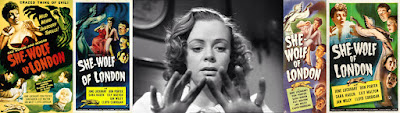
She Wolf Of London


Werewolf By Gaslight

She Wolf Of London
aka The Curse Of The Allenbys
USA 1946 Directed by Jean Yarbrough
Universal Blu Ray Zone B


Warning: Huge spoilers from the outset.

Okay, so this film has highlighted to me a bizarre and interesting thing about the way the Internet works, or doesn’t work, for no good reason that I can figure out. Here’s the thing... when I climbed onto my Macbook for the cast list on the IMDB and typed in She Wolf Of London, I had absolutely no problem finding this film, all well and good. However, prior to this, when I typed it into the IMDB app on my iPhone, well, it’s a different story. You type that title in and you will not have a chance of finding this film (at time of writing in the UK). I found it by knowing one of the actors and retracing it to the year but, on my iPhone IMDB app, the film is only locatable if you type in the title The Curse Of The Allenbys.

So, the internet version of IMDB tells me that this is what the film is known as in the UK. Well, I could certainly understand if the original title was replaced because... big spoiler here... there’s actually no werewolf in this movie. So the title implying a wonderful female lycanthrope is just hogwash and will, I’m sure, be as much as a disappointment to most audiences as it was to me when I first saw it decades ago. That being said, I have to tell you, I’ve been living in the UK for 53 years now and this is the first time I’ve ever heard of The Curse Of The Allenbys as a title. All my previous DVD versions of the film included in various sets, from the US or the UK, have always carried the title She Wolf Of London. So I don’t know what’s going on with the regional versions of the IMDB app but, someone really should address this issue and sort it out.

Now then, I mentioned I was disappointed with the film on my prior viewings and, I’d have to say that the same holds true now. Don’t get me wrong, there are a few points of interest and some nice things happening and I’ll get to all those in a minute but, really this is a not too clever, watchable but unimpressive film. And, like I said, there is no actual monster in this one and it certainly isn’t a horror story. This film would best be described as a ‘gaslighting’ thriller so... yeah... why it’s always marketed as part of the Universal Classic Horror movies and bundled in with their various werewolf films is anybody’s guess. I’m thinking there were less werewolf movies so they needed to add a film to trick the customers into thinking they are getting value for money at the price point. That’s my best guess at that one, anyway.

The film stars June Lockhart, future star of the TV show Lost In Space, as young Phyllis Allenby, sole heir to her parents sizeable country estate in London, living with her Aunt (who is really the housekeeper her father nearly married but she doesn’t necessarily know that), played by Sara Haden and her Aunt’s daughter played by Jan Wiley. Allenby is about to marry her sweetheart Barry, played by Don Porter but she suddenly calls things off when locals are either mutilated or murdered by an unknown ‘beast woman’. She fears it’s herself doing it because of the famous (and non-existent except as a silly legend) Allenby Curse, which says members of the family will... well it’s all a bit obscure but, basically, she thinks she must be turning into a werewolf and feeding off the locals in her sleep.

Meanwhile we have a local police detective played wonderfully by Lloyd Corrigan on the case, answering to his boss played by the one and only Dennis Hoey. Of course, fans of the Basil Rathbone/Nigel Bruce Sherlock Holmes film series will know Hoey as the much put upon Inspector Lestrade who was a regular in the series and, honestly, his role here really isn’t any different from that.

And there are some good things about the film including some nicely done compositions. For example, bearing in mind it’s shot in the standard 1.33:1 aspect ratio of the time, the director manages to still split the screen into thirds in one shot, using vertical lines made up from the environment to show all the main action of this particular moment in the middle sliver of a space. Nicely done. Later on, towards the end of the film when the ‘Aunt’ brings Phyllis her drugged milk in order to murder her, the director uses very oblique Dutch angles from shot to shot at odds with each other to accent the Aunt’s sinister intentions. So yeah, some very nice stuff but... it’s just not a great story.

Even the first time I saw it I was suspecting the Aunt of gaslighting Phyliss and committing the local murders herself (leaving the blood on the hands and clothes of the drugged Allenby at night, after she does so) within the first ten minutes and that was before I even suspected there was going to be no werewolf in the film. In fact, that’s the only thing which stops most audiences from seeing through the trick straight away, I suspect. The fact that the film is (whether the IMDB believes this or not) called She Wolf Of London, implying the presence of a supernatural creature... re-enforced by the fact that Phyliss is seen reading a book called Lycanthropy - The Werewolf Legacy at one point.

And not much more to say. Sara Haden’s performance is outstanding, especially when she lets her ‘crazy’ show before her accidental demise at the end of the movie and... so is Corrigan, as the bumbling detective. June Lockhart is okay, I guess but, she’s playing such a weak and shilly shally whiner of a character that I have absolutely no sympathy at all for this person, so obviously born with a silver spoon in her mouth that, by the end, I really wish the aunt had ‘done her in’, in the parlance of the film, because she’s just so irritating.

So, yeah, that’s me done with She Wolf Of London and it’s kind of doubtful that I’ll ever bother revisiting it again now this review is written. Not really worthy of being included in the classic Universal Horror canon, especially since it’s really only a modern marketing designation, I suspect. Nice performances, nicely made... a bit of a duff movie, in all honesty.


Thursday, 8 October 2020

The Invisible Woman

Kitty Woman

The Invisible Woman
USA 1940 Directed by A. Edward Sutherland
Universal  Blu Ray Zone B


Okay, so next in my list of classic Universal Horror/Monster movies is the third entry in The Invisible Man series... a set of films which I have a hard time of thinking of as either horror or monster movies, to be honest. Most of these are thrillers but there are exceptions and this one is, as it happens, one of those films in the franchise where, around this kind of time, Universal were making some brave and often lucrative choices in the direction they would take the various parts of their franchises. See upcoming reviews of The Mummy’s Tomb and Frankenstein Meets The Wolfman for further elaboration on that comment. Oh... and if you want to read my review of the next Universal Monsters movie after this, it’s been on the blog for a number of years now so, check the link at the bottom of this review.

But for now, lets get back to The Invisible Woman, which is a complete sea change for the franchise (not the last either) in that it’s a light and frothy romantic comedy, reminiscent of those screwball comedies of the 1930s, except with the highly successful invisibility element thrown into the mix. The film stars Virginia Bruce as the title character, Kitty Carroll and, here, she is joined by a number of popular actors such as John Barrymore (as the Professor who makes Kitty invisible), John Howard as the wealthy playboy love interest for the ‘common shop store fashion model’ Kitty and a young Oskar Homolka as Blackie, head of a Mexican crime syndicate who will, as humourously as possible, stop at nothing to get the secret behind the professor's invisibility machine. Also in the film is the Wicked Witch of the West herself, Margaret Hamilton (as the professor’s house keeper), Mary Gordon (who eagle eyed viewers may remember as Mrs Hudson in the Basil Rathbone series of Sherlock Holmes films) and Shemp Howard, famous for being one of the many iterations of The Three Stooges, as one of Homolka’s comedy hoodlums.

And, yeah, it’s quite entertaining. The film sees Kitty answering the professor’s advert for a volunteer to become invisible and comedy hijinks ensue as she falls for John Howard's character and we see the butler getting some terrible, cringe worthy but thoroughly entertaining lines and taking a heck of a lot of falls and trips which seem really dangerous, it has to be said. The dialogue writing is fast and furious and this is just bread and butter to a cast who deliver it in that breezy and larger than life way that was common for the period. Even with the raft of ‘Here kitty, kitty...’ jokes that pop up on occasion.

The invisibility effects are okay but not as well done, it seems to me, as in some of the previous movies in the series. When Kitty is walking around headless in a dress, for example, you can often see feint lines where the head actually was. Some of the other effects such as ‘invisible woman lays on a rug’ or ‘invisible woman sits in a chair’ are okay though and I guess I never really tire of seeing these old visual chestnuts run out time and again. Which probably says something about my age.

We also have a nice moral lesson thrown in for good measure. When the newly invisible Kitty sneaks into work to confront her vile and ruthless boss and gives him a good kicking for his troubles... telling him that she is the manifestation of his conscience... we see the character completely reform and introduce things like tea breaks and ‘not being fired for being ill’ into the job. Always nice to see object lessons taught on screen in this manner.

And, despite this one being one of the shortest reviews in the history of this blog... I really don’t have much else to say other than to note that... The Invisible Woman is the first of the ‘invisible’ films not to use the name Griffin in the story as a nod to H. G. Wells original character and... that this is a unique and thoroughly watchable entry in the series, if a little different in tone to the others (as is the next in the ‘invisible’ series). If you want to read my review of the next film in the Universal Horror franchise, the 1941 character starter The Wolfman, you can read my earlier review of it here, where I’ve coupled it with my review of the 2010 remake. And stay tuned for the review of the next Universal Monster movie coming soon. I love these movies and am going to probably burn through these fairly quickly over the coming months.

Tuesday, 29 September 2020

The Mummy’s Hand


Wrap-ture!

The Mummy’s Hand
USA 1940 Directed by Christy Cabanne
Universal  Blu Ray Zone B


So, following on quickly from The Invisible Man Returns earlier that year (reviewed here), Universal continued their revival of monster movies from the previous decade with The Mummy’s Hand and, I have to say, even though I love the original The Mummy and its importance in the pantheon of Universal Classic Monsters, I think The Mummy’s Hand is also a very important and influential film in its own right. The main reason for my thinking on this is because, although we have a new Mummy character completely, in the form of Kharis The Mummy, played here by B movie Western star Tom Tyler... who would go on to play the titular superhero characters in both the 1941 serial The Adventures Of Captain Marvel (reviewed here) and 1943’s The Phantom... we also have the first, to my knowledge, American movie where the Mummy is an actual bandaged monster who slowly limps around killing people with its superhuman strength. In The Mummy, Karloff was only seen opening his eyes in bandages, followed by a shot of his bandaged hand reaching for some papyrus... so this is the first time that we get the full monty, so to speak, of the Mummy in all his wrapped up glory. So all later films which feature mummies swathed in bandages and shambling about owe a debt to this movie in particular, I think.

Now, in The Mummy (reviewed here), the titular character was Imhotep (who would later be revived in the Stephen Sommers reboot movie in 1999). Here, however... and for the next three sequels too... we have Kharis but, this is the only time he is played by Tom Tyler. After this, Lon Chaney Jr would don the bandages three more times.

Now, the film primarily focuses on the lead protagonists of archeologists Steve Banning (played by Dick Foran) and Babe Jenson (played by Wallace Ford), who make up a kind of Abbot and Costello straight man and funny man partnership. Here they are joined by Cecil Kellaway (who we saw in The Invisible Man Returns) as stage magician Silvani plus Peggy Moran as his daughter and love interest for Banning... Marta. Silvani is bankrolling Banning’s expedition (after a little way into the picture, after some fairly entertaining shenanigans) but they are abetted by George Zucco as Andoheb, one of the guardians of the High Priests of Karnack, who will stop at nothing to ensure the American ‘defilers of tombs’ will not find the tomb of the Princess they are looking for. As luck would have it, they find Kharis instead... who is controlled by Zucco to kill for him.

In a long sequence before we even meet any of the main protagonists, a High Priest who is Andoheb’s father passes down the secret of making Kharis mobile and its all to do with the bizarre and unfortunately persistent plot device of the brewing of a potion made from Tana leaves. A brew made form three leaves during the full moon will ensure Kharis continues to live but, nine leaves allows him to get up and start doing killer shenanigans for his masters. And I seem to remember in terms of Kharis getting up to his tricks in the next three movies, these rules keep changing or at least being broken somewhat but, we shall see.

Now, in this opening sequence we find the High Priest character has a little pool which acts just like Boris Karloff’s did  in The Mummy... it projects pictures of what the guy is talking about. Here, he tells the back story of Kharis the mummy which is, it has to be said, almost identical to that of Imhotep... barring the inclusion of the Tana leaves. That’s handy then, since an awful lot of the back story of The Mummy is included via re-used footage with the odd shot of Tom Tyler inserted whenever we need to see his face. It’s quite comical once you start spotting the way the footage has been put together. Here’s a hint... when the footage looks just a little grainier and doesn’t include Tom Tyler’s face, you are almost certainly looking at the back of Boris Karloff’s head and other bits from the previous film. One truly dead giveaway is when Tyler is bending over a box of Tana leaves and turns his head to see the temple guardians behind him... in long shot with his head turned away from us, he is suddenly bending over a scroll... he turns his head back in close up and... it’s magically a big casket of Tana leaves again. So yeah... Karloff standing in... err... bending in for Tom Tyler there via the miracle of re-used footage. There’s a heck of a lot of that kind of thing in this sequence and, if you are familiar with the first movie, it’s fairly easy to spot.

More recycling is Andoheb’s father as the Writers here are... maybe not trying to be lazy, just on brand... with a bit of famous dialogue recycled to give a similar beat from the very first talking Universal horror movie, Dracula (reviewed here). In that movie Bela Lugosi hears the wolves howling and says... “The children of the night. What music they make.” Here, the guy hears the jackals baying and says... “The children of the night. They howl about the Hill of the Seven Jackals and Kharis must be fed.” So, yeah, trying to echo their earlier successes no doubt.

Now, at just under 67 minutes, the film is fast moving, entertaining and has some nice dialogue. The classic Hans J Salter music, partially recycled, is augmented by some Flash Gordon fight music during a bar fight and its one of those films that trundles along nicely to its inevitable conclusion.There are some interesting little errors and oddities I noticed about the film which I’ve not come across listed anywhere else though... not to mention the huge problems with continuity which would go on to kill the credibility of the entire Mummy franchise after this one.

Okay, so something I noticed was that, when Kharis enters the tent shared by Silvani and his daughter and strangles the father (more in that in a moment), Marta screams and then feints before being carried off by Kharis. However, when we cut to Banning and Babe’s reaction shot outside the tent, they then hear her scream a second time. But... hey there Mr. Director... she’d already feinted.

Secondly and, as far as I’m concerned, much more interestingly... when Banning investigates Silvani he replaces what looks like his lifeless corpse back on the bed. Even though they both have a line of dialogue! Well, since Silvano does look so lifeless here, my guess is those two lines were added in post synch to pull together continuity. I don’t know what the script was like in terms of changes on a day to day basis but later on, when Banning tells Marta that her father is going to be okay, when he’s trying to rescue her from the clutches of Kharis, I suspect that the decision had been made to have Silvani’s character survive too. However, I also suspect when the scene was shot with Kharis in SIlvano’s tent earlier, the idea was probably that the father would be the next victim of... The Mummy’s Hand. Somewhere before filming the later scene, the decision was made and they overdubbed the dialogue in on the earlier scene to try and hoodwink the audience. That’s completely a guess, by the way and, I’ve not seen it mentioned anywhere else but... that’s my deduction as to what happened here.

And then, of course, there’s the really alarming thing. Not for this movie but for the next three sequels... some of which would also compound the problem themselves. From the contract Banning draws up with Silvani in a bar near the start of the movie, it’s clear that the film is set in 1940. However, when the next mummy film came out in 1942... well, I won’t jump on that one just yet, I’ll wait until my review of The Mummy’s Tomb before I spring that one on you.

Nevertheless, for all it’s faults , The Mummy's Hand is also, as I said, quite influential in its own right and, perhaps more importantly, a very entertaining film with some stand out performances from the principal actors. As always, a pleasure to watch and recommended viewing for anyone who wants to take in these classic, Universal monster movies. A gift-wrapped bundle of joy.

Tuesday, 30 June 2020

Son Of Frankenstein


Heir Gloom

Son Of Frankenstein
USA 1939 Directed by Rowland V. Lee
Universal Blu Ray Zone B


Warning: Some spoilerage here.

So this next review of my rewatch of the classic Universal Monsters movies is another of my favourites... and it’s probably not hard for most people to see why. This is easily the best looking black and white movie of the 1930s that I’ve seen and the latest Blu Ray set from Universal certainly shows off the crisp monotone photography to its advantage. I’ll get back to the look of the film in a minute.

Son Of Frankenstein starts off a little differently to how I remembered it, with an opening sequence that highlights Bela Lugosi in the role of the convicted and hung murderer Ygor... who returned to life after being pronounced dead by the coroner some years before. This is followed by a town meeting scene which, if it does anything other than look nice, is all about reminding the audience just who Frankenstein and his creation were. We then cut to Basil Rathbone as the titular character, Baron Wolf von Frankenstein, his wife Elsa (played by Josephine Hutchinson) and his young son Peter (Donnie Dunagan), on a sleeping car train bound for the town where Wolf’s father did his infamous work. For some reason, the village is now called Frankenstein itself which, as we are aware from the mood of the villagers in the earlier part of the film, does nothing good for the tourist trade. This sequence, as they rumble into ‘Banhof Frankenstein’ shows off just how good the dialogue writing is here. Wolf is talking to Elsa about his father’s accursed legacy and he just gets up to the bit where he is about to say the family name...

“... nine out of ten people call that misshapen creature of my father’s experiments...”

when the railway porter shouts out “Frankenstein! Frankenstein!” to announce the stop. It’s a wonderful piece of early dialogue juxtaposition, taking two pieces of dialogue of differing intent and then rubbing them together to push the meaning of the first. It also nicely underlines the mistake of the commonly held assumption that the monster itself is called Frankenstein when, clearly, it is not.

Now lets talk about Rathbone here for a minute because he was at a turning point in his career. He did, however, detest appearing in horror movies although he would appear opposite Boris Karloff again in Jacques Tourneur’s 1963 AIP Edgar Allan Poe cycle entry, The Comedy Of Terrors, of course. His lack of respect of the horror genre might explain why this one is a little bit ‘all over the place’ in certain scenes he performs here but it’s easy to watch and a lot of fun too. I’ve always had a soft spot for Rathbone and you have to remember that this was only a year after he had played the villanous Sir Guy of Gisbourne opposite Errol Flynn in the definitive Robin Hood  movie, The Adventures Of Robin Hood. His very next film after Son Of Frankenstein and released in the same year would be the one which was the first time he played the role which he is probably best well known for to this day... playing Sherlock Holmes opposite Nigel Bruce (as Doctor Watson) in the first of a long series of films and, also, a large number of radio shows starring the pair too.

He is, of course, ably supported in this by some great Universal regulars such as Boris Karloff, reprising his role as the Frankenstein monster. Now, despite the monster being able to speak in the last installment, The Bride Of Frankenstein (reviewed here), here he is once more rendered mute with no real explanation as to why. I love what he’s wearing in this too... instead of the dark jacket he’s wearing what can only be described as a furry tank top and it looks great. This is my favourite fashion look for the Frankenstein monster, for sure. This was the third and final time Karloff would play the role of Frankenstein’s creation but not his final role in a classic Universal Frankenstein movie, as you will see in an upcoming review. His scene with Rathbone as he discovers himself reflected in a mirror is quite long but expertly done as we see the monster pantomime various emotional states while he tries to come to terms with his hideous looks. This is pure cinema although, it has to be said, that when we have assassinations performed by the creature who then stages things to look like an accident with some considered thought, he does at times become the very thing that Karloff was afraid he would become with more exposure in a series of films... a professional killing machine.

Then we have Lionel Atwill, who appears in a number of these Universal monster movies but whose career was ruined just a few years later due to a scandalous sex orgy and rape party which took place at his home. Although he’s going to appear in a few of the films I will be reviewing after this, he died of lung cancer only seven years after Son Of Frankenstein was released. Of course, in this he plays the wonderfully Germanic Inspector Kogh, the one armed police inspector who is trying to find out who is doing all the killings in the village (funny how all the people who died are the same people who condemned Ygor to death). Even without the one armed police inspector in Mel Brooks’ Young Frankenstein being based on him, his handicapped shenanigans in this do often border on the comical... especially when he plays Wolf at darts and sticks them all into his arm to store them as he is taking his turn.

By the way, when did it become normal to have only three darts to throw per player? Not before 1939 I guess because here they are playing with five a piece. The reason for Kogh's handicap however, is far from comical. His history goes that, when he was a young toddler, the Frankenstein monster was busy terrifying the villagers and he ‘tore his arm out by the root.’ Of course, once this information and disability is introduced, you just know it’s going to come back and be revisited on him again and, sure enough, in his final confrontation with the Frankenstein monster in the film, his artificial limb is torn from him by the monster, who tries to use it as a club to keep everybody back.

The basic plot of this is of Wolf trying to restore the long surviving monster in his father’s laboratory while trying to ignore the obvious that Ygor is using him as a killing machine while warding off the questions of the inspector... until he is finally threatened himself and after shooting Ygor dead with three bullets to the chest (although this is not enough of a mortal injury to prevent Lugosi reprising his role through the course of the next Frankenstein movie). He then finds himself trying to rescue his son who the monster has stolen from him in revenge for the killing, ready to throw him into the pit of sulphur which the laboratory was somehow built over. And, again, once you know there’s a pit of sulphur under the lab, it’s no prizes for guessing just how the creature will meet its supposed end in this film, after a bit of swashbuckling action from Rathbone saves the day when he swings from a winch and knocks Karloff into the pit. Then we watch a not so great dummy of the monster sink below the bubbling surface.

But enough of the story... it’s the look of the film which is where the strength of the picture lays. This is the Frankenstein film where the set design and lighting go ‘the full Caligari’ with amazing twisted geometry and dark, distorted blacks which reflect straight back to the German Expressionist form of cinema from which they derive, as fleeing film crews deserted Nazi Germany and pitched up into Hollywoodland. Just amazing angles and things that sit strangely within the beautiful, slanted compositions such as, for example, chairs with amazingly tall backs that only a giant would truly be able to appreciate. These are further highlighted by some beautiful shadow work. You know that scene at the start of the bar fight in Raiders Of The Lost Ark, where Spielberg emphasises people by having their shadows arrive first... well that style was always straight out of the 1920s/30s where that kind of emphasis on the look was common.

For example, there’s a wonderful moment where Rathbone follows Lugosi into a kind of tomb-like approach to the laboratory. Rathbone’s silhouette, completely black, is framed perfectly in the doorway at the centre of the shot with his shadow cast down below him and into the laps of the audience at the foreground of the shot... then Lugosi lights a torch on the wall which instantly allows Rathbone’s full figure to materialise out of the silhouette, while still maintaining the shadow... expert stuff. Another shot where Rathbone’s shadow precedes him up a ladder, through a hatch in the floor before Rathbone follows it up into the shot, is also mesmerising. And even the shadow of a ladder that Rathbone descends from in one scene, has a twisted rung accenting the strange and angular set design. Like I said, it’s one of the best looking and best lit movies of the 1930s you are ever likely to see.

There’s also an interesting addition to the Frankenstein legend in this one. Wolf’s research reveals that, unknown to his father, it wasn’t just the lightning he summoned into the creature which gave life to the creation that Karloff so brilliantly plays on screen. It was, in fact, according to this iteration of Shelley’s creation... cosmic rays. These had already been known about when Victor Hess discovered them in 1912 and my guess is they were still fresh in people’s minds since Hess had won a Nobel Prize in Physics for his discovery only three years before this picture was released. So that’s kind of interesting I think (and yes, I had to look that up when the words were uttered on screen... I had no idea as my first exposure to the term myself was as a kid in a reprint of the first issue of Fantastic Four from 1961).

I’d better mention the music too, while I’m here. This was the first of the classic Universal horrors to feature the music of Frank Skinner (who was often paired with Hans Salter in later movies in the various monster series). It’s a classic score and the one which, despite the strength and influence of Franz Waxman’s score for the previous Frankenstein film, ended up becoming the classic, ‘brand sound’ for the Universal monster movies that followed it. Lots of this was recycled into other horror films by the company over the years and it became quite evocative of a certain kind of genre package, especially after the various films aired on television in the late 1950s when it gathered a lot of recognition and a large following with film music fans. The montage sequence where Wolf cures the ailing monster is almost as splendid as Waxman’s creation music from The Bride Of Frankenstein and the score is even used, in this film, in a metatextual manner in two scenes. In those scenes, Ygor is seen playing a bizarre looking kind of flute/horn and the tune he plays is... Skinner’s main monster theme to the movie. So, again, a nice touch and, perhaps, somewhat ahead of its time.

And there you have it. Not much more to say about Son Of Frankenstein other than... it’s an absolutely brilliant film and worth the time of any true lover of cinema to sit down and study. I can’t over emphasise the sheer spectacle of the mise en scène in this movie... it’s absolutely gorgeous and there’s absolutely no way you can go wrong with a film of this calibre. The last great Frankenstein movie... not the last fun or watchable one, for sure but, in terms of greatness, this one was the absolute peak of perfection for the Universal Horror series and the success of it convinced the company to resurrect its now, almost retired, monsters for a huge amount of sequels throughout the 1940s... all of which I hope to review for you on here some time soon. If you are any fan of not just horror movies but the art of cinema in general then, this one is simply not something you’d want to miss out on. So good.

Sunday, 7 June 2020

Dracula’s Daughter


Gorier Holden’s
Girl On Girl Suction


Dracula’s Daughter
USA 1936 Directed by Lambert Hillyer
Universal  Blu Ray Zone B


Directed by the man who would go on to direct the first theatrical Batman serial seven years later, Dracula’s Daughter is one of those charming oddities which almost but, doesn’t quite, make sense when you inject it into the overall franchise. The next of Universal’s big ‘monster movies’ after Werewolf Of London (reviewed here), the film takes place literally seconds/minutes after the events of Dracula, with the one recurring character from that film returning... kind of. Once again, Edward Van Sloan does a wonderful job as Professor Van Helsing but, for some strange reason, his name has been changed slightly to Von Helsing for this one.

The film was originally supposed to have been based on the, then unpublished, Dracula short story (aka missing chapter) Dracula’s Guest by Stoker but I think legal issues surrounded it although, conveniently, Dracula had been accidentally left in the public domain and it was back to John L Balderston (among others) to pen a totally new, 'Dracula inspired' adventure... despite the screen credit that it’s based on a work by Bram Stoker.

So we start off quite bravely and unusually, I think, with Van Helsing (wearing a hat I’m sure he isn’t wearing in the prior film) being arrested by two policemen for the ‘murder’ he happily admits to, as they find him standing over Dracula’s corpse. They promptly take the corpse, which really is a poor waxwork’s dummy of Bela Lugosi in the few shots where you can catch a glimpse of the features, to the local lock up and there then ensues a truly unfunny and protracted scene of ‘comedy policemen’ shenanigans before Dracula’s corpse is stolen by none other than the title character, played by a young Gloria Holden.

Meanwhile, Van... sorry... Von Helsing enlists the aid of his former student, the main heroic lead psychiatrist, played by Otto Kruger, to help keep him from the gallows. Kruger looks quite a bit old for the part, honestly... but he’s pretty good in the role and the script between him and his secretary, played by Marguerite Churchill, is excellent. It’s as though the two stepped right out of a 1930s screwball comedy and the chemistry and dialogue is wonderful in the scenes they share together.

Actually there are quite a few good lines in this film, such as Gloria Holden’s lovely parody of Shakespeare... “There are more things in heaven and earth then ever dreamed of in your... psychiatry”. It’s an interesting story too as it follows Gloria Holden’s Countess Marya Zaleska... a reluctant vampire who seeks, coincidentally from the same psychiatrist, a cure for her vampirism. She doesn’t tell him why she keeps seeking him out but she wants to stop having to bite up some young man or woman each night to keep herself alive. She seems to be a strangely reluctant vampire and even goes to the trouble of burning her father’s staked body so he can never rise again (well, I guess that put a stop on anymore films being made about Dracula then, right?). She also seems to have a strange relationship with her truly sinister and, perhaps, somewhat out of place assistant Sandor, played by Irving Pichel.

The film soon becomes a straight ‘solve the murders and then chase the vampire back to Transylvania’ kind of movie by the last reel but there are things touched on such as the suggestion of an idea, at least at the start of the film, that the term ‘Dracula’s Daughter’ could metaphorically mean any young lady who Dracula has bitten and turned into a vampire. Alas, by the last act she has definitely confirmed she is the true heir to Dracula’s castle which is, perhaps, a little less interesting.

The film also features one of the earlier lesbian/bisexual seductions on screen as the countess, an artist, asks a ‘model’ played by Nan Grey to pose for her but can't help but give in to the blood lust which takes her and ends up vamping her up and, ultimately, providing the good guys with a clue as to her whereabouts. The scene doesn’t really pull any punches because the subtext of the thing is pretty overt even now and would have been a lot more stronger on its release in 1936... indeed, while some reviewers either missed it completely or turned a blind eye, others were more condemning in their reading of the scene as it plays out (it was very tightly controlled/censored before it was even shot, too).

The writers have gone out of their way to put in a lot of references to the 1931 Dracula, in ways you wouldn’t expect... especially as a lot of the references come quite late in the picture when the Countess is back at Dracula’s castle. For instance, the set at the start where Edward Van Sloane is recreating his final scenes from Dracula is reminiscent of the original (indeed, lovers of Dracula and Frankenstein will also recognise the hospital set in the film). There are also references to Borgo Pass in Transylvania and some ‘bit part’ actors you may remember from the first film... not to mention that same damned spider web across the entrance to the stairway when Otto Kruger finally arrives at Castle Dracula. One of my favourite references is when, in a party scene in the earlier part of the movie, Holden slips into conversation, in a completely different way to how Lugosi said it, the line... “I never drink... wine.” In that party scene, by the way, you may spot a young Hedda Hopper, who would start up her famous ‘Hollywood star career-killing’ gossip column in the same year.

Also, remember that time when I discovered (young thing that I am), on reading and reviewing the single issue Gold Key Doc Savage comic (review here), that Croydon used to have an airport back then? Well the same airport is referenced here, when the main protagonist takes a plane from Croydon to Transylvania.

And then we have the score... composed, uncredited, by Heinz Roemheld, who did such a good job on Werewolf Of London. Alas, he doesn’t do that great a job here during the comedy sections of the film... the way too ‘on the nose’ and ‘funny music hitting all the action and comments’ moments really don’t work that well here. That being said there’s a nice moment where Gloria Holden is playing the piano, heavily augmented by the orchestra somehow and, as she finds the music she is playing is getting more dark and sinister while Sandor fills her head with malevolent thoughts, she jumps up and shouts “Stop! Stop! Stop!” Well, not only the piano but all the orchestral augmentation stops too, like a bizarre, metatextual musical joke... so that was nice and, perhaps, a little unexpected.

That being said, I loved Roemheld’s score for the montage scene following the chief of police ordering a dragnet be thrown around London... because it’s the same music used for many of the fighting and similar montage scenes in the first of the three Flash Gordon serials (and possibly the two sequels too) released the month before. I’m not sure which of these two Roemheld actually wrote it for though... one was needle dropped (or possibly re-recorded in those days) into the other.

Looking at the film again now, I would say that Gloria Holden’s performance seems, at times, just a little over the top to me and perhaps a bit wooden but it depends what she... and her director... were going for. I could easily say it’s a highly stylised performance done to deliberately invoke a kind of off-kilter strangeness in the character but, either way, it’s certainly one people remember her by, I suspect.

Not much else to say here other than, with the exception of the first Mummy movie, out of all the Universal monster films it’s the Dracula franchise which is the most troubled. It doesn’t, past this one sequel, really hold up as a continuing franchise at all and has new starts and jumps in logic when Dracula reappears (and arguably doesn’t in one case, depending on your view of Son Of Dracula) over the following films... as you’ll see when I continue to review them as I slowly work my way through the Universal Horror franchises over the coming year. Dracula’s Daughter, though, is certainly a fun film and one I’m sure I’ll watch a fair few times more over the coming years.

Sunday, 17 May 2020

Werewolf Of London


Mariphasas Set To Stun

Werewolf Of London
USA 1935 Directed by Stuart Walker
Universal  Blu Ray Zone B


Continuing my re-watch of classic Universal Monster movies for my blog, I finally catch up to another of my favourites, Werewolf Of London.

Six years before they hit on a werewolf franchise that was a success for them, with the Lon Chaney Jr picture The Wolfman (which I reviewed along with its remake here), Universal attempted to jump start a werewolf franchise with this wonderful gem, Werewolf Of London. Alas, it was nowhere near as successful as their previous five monster movies... Dracula (reviewed here), Frankenstein (reviewed here), The Mummy (reviewed here), The Invisible Man (reviewed here) and Bride Of Frankenstein (reviewed here). It is one of the ones which is well worth a watch, though... and there are a number of reasons for this.

Number one being that this, like The Wolfman which came after it, pretty much reinvented the modern concept of legends surrounding the werewolf and influenced all that follow in much the same way that Romero’s Night Of The Living Dead helped refashion the zombie movie years later. So things like the titular creature changing at moonlight, which is essential to the plot in this one as the main protagonist/antagonist, Dr. Wilfred Glendon as played by Henry Hull, is involved in experiments with creating artificial moonlight which, in turn, brings him into contact with the other lycanthrope, Dr. Yogami, at the opening of the movie.

Another thing this film sorts out for future generations is the idea that werewolvery can be passed through a bite, such as an infection may pass from person to person. Both these elements were, of course, retained for The Wolfman in 1941 although, curiously, there is no shot of the moon in The Wolfman at all. Also, presumably due to a mixture of limitations of the makeup and perhaps the end result not looking scary enough, this might well have been (according to the IMDB, so take this one with a pinch of salt) the first werewolf tale to depict a man/wolf hybrid creature rather than a straight transformation into a wolf (such as Dracula might utilise).

Six years later and The Wolfman would add elements such as the now cinematically forgotten, it seems, idea of a werewolf seeing a pentagram on the palm of the hand of the next person to be his or her victim. It also added the idea that silver in the form of a weapon such as bullets or, in The Wolfman, the silver head of a cane, can be used to kill a werewolf. This last is an element definitely not set in place by Universal here yet as the titular character has as much to fear from the common lead bullet as any other projectile or weapon in the film.

What Werewolf Of London does have in its freshly created set of rules, which certainly didn’t travel to later productions, was the idea that a rare flower that grows only in Tibet and which only blooms in the moonlight can, when an infected human pricks himself with a fresh thorn, fend off the transformation for one night when the moon is full.

This flower is called the Mariphasa Lupina Lumina and it’s the very reason why Dr. Glendon finds himself in Tibet in the first place... so he can get a sample to bring home with him and prove to himself (and the scientific community at some point in the future) that his new invention is working. And it’s in Tibet that the movie starts.

That is to say... it’s in Tibet where the opening of the movie is supposed to take place. Anybody who loves the old, classic Star Trek show or even the Bill And Ted movies will tell you, of course, that the Tibet depicted here looks remarkably like the Vasquez rocks, famed for their appearance in the Star Trek episode Arena. There’s a wonderful dialogue moment near the start when Glendon is warned by a Tibetan wise man thusly... “You are foolish... but without fools there would be no wisdom”. It almost sounds like something Charlie Chan might say, talking of which...

It’s here in ‘Tibet’ that Dr. Yogami, played by Charlie Chan and Fu Manchu luminary Warner Oland, bites Glendon and curses him with the same affliction as himself. Not speaking in aphorisms... werewolvery. An affliction which causes Yogami to follow Glendon back to London and steal his samples of the Mariphasa Lupina Lumina to stunt his own, hairy murder sprees. Now it’s down to Glendon to try and resist the pull of the moon and stop himself from murdering the one he loves most, which in this case takes the form of his very young wife played by Bride Of Frankenstein’s Valeria Hobson.

In the case of Hull, this was one of the world famous and much in demand stage actor’s big attempts to break into movies... alas, he never did get much of a hold with cinema audiences and, when this was shot, he was 45 years old. Valerie Hobson was only 19 years still and was already playing the wife of 35 year old Colin Clive the same year in Bride Of Frankenstein. In these days of Twitter that’s seen as a big age gap but in those days, when love conquered all, well... what’s a few years between lovers?

A couple of other things worth watching this for... besides the fact that it’s completely entertaining... would be the transition scenes, one of which is both an eye opener and a disappointment at the same time.

There’s a wonderful moment at the end of the Tibetan sequence, where Henry Hull has been fighting the Dr. Yogami incarnation of a werewolf and he’s beaten it off but he’s been bitten on the arm and, for a 1930s movie, there’s quite a lot of visible blood (when you’d expect to see none). As we see a close up of his bloodied arm reaching out for the flower he came for, we transition to the same arm, scarred but not bloody, reaching out for the same flower in his laboratory in London... which is nice stuff.

Now the other transition which I was primarily thinking of is the first time we see Hull transform into a wolfman. These sequences are not nearly done as well as the later ones in The Wolfman even but the first of these is interesting because it’s using what I can only refer to as a travelling matte. Remember, this is 1935 and it may be my own ignorance but I didn’t think they were as adept in those days as we are now at this kind of thing. This involves Hull walking along in mid shot from left to right with the camera moving along with him. However, he passes three columns in the foreground of the shot and, of course, each time he reappears from the right hand side of a column, he has fuller werewolf transformation makeup on his face, courtesy of Jack Pierce. Okay, so it’s clumsy in concept but the moving camera and everything else must surely have made it a stand out shot of it’s era, I suspect.

The other big pull for me in this movie, asides from the wonderful comic relief of the two old landladies in the local pub, Mrs. Moncaster (Zeffie Tilbury) and Mrs. Whack (Ethel Griffies), who each punch the other into unconsciousness when the mood takes them... is the soundtrack by Karl Hajos. It’s never been released commercially, more's the pity, but the whole score was pretty much recycled for the first of the three big budget Universal Flash Gordon serials the following year (with the second and third serials using a lot of the Bride Of Frankenstein score in their musical DNA). And it’s grand hearing anything with this music playing alongside the on screen action... this is just brilliant stuff.

And there you have it. A werewolf movie with a, it has to be said, fairly emotionless actor in the title role but which has a monster who actually welcomes death, wears a flat cap and apologises at the end. It’s not for everyone but Werewolf Of London is certainly my all time favourite werewolf movie and it’s always something I’d recommend to fellow cinema enthusiasts. An essential piece of classic monster cinema, despite the lack of extras on even the latest Blu Ray release.

Wednesday, 8 April 2020

The Mummy


Of Human Bandage

The Mummy
USA 1932 Directed by Karl Freund
Universal  Blu Ray Zone B


After the surprise success of Dracula (reviewed here) and Frankenstein (reviewed here), Universal embarked on the next of their big horror franchises, once more using their star Boris Karloff (who was by now being billed as Karloff The Uncanny) in the title role of Imhotep, The Mummy who was buried alive for breaking the holy codes of his people and attempting to bring his great love, Ankh-es-en-Amon, back from the dead.

This film was obviously made as a response to Howard Carter’s ‘Tutankhamun’ expedition which had finally struck lucky in 1922 (read more of the whole Egyptian invasion of popular culture around the world in my review of Eyptomania Goes To The Movies right here). One of the news reporters sent to cover that discovery was none other than John L. Balderston, who had of course written the screenplay of Dracula and the stage adaptation which gave rise to that movie.

Here, he writes a mummy movie for Universal but, really, it’s... how can I put this diplomatically... it’s pretty much a stealth rewrite of Dracula in all but name. Several elements which were in Dracula feature here, such as the pseudo-romantic pull of the titular monster on the leading lady, played here by exotic beauty Zita Johann, who is the living embodiment of Princess Ankh-es-en-Amon. To further seal the deal in terms of trying to capitalise on the success of their earlier pictures (not to mention casting the Frankenstein’s monster actor himself as the main antagonist) we also have David Manners reprising his role as the lover of the leading lady who is trying to save her from 'the monster who wants to have his way with her' and Edward Van Sloan, who played Van Helsing in the two Dracula films before and after this, as Dr. Muller, a similar ‘enemy of the monster, knowledgeable in the ways of destroying him’ kind of character.

And every time I watch this film I remember I really liked it and thought I remembered it well, only to find myself seeing it with fresh eyes and having forgotten most of it. It is quite a gripping watch, though and we have Karloff in two different make-ups by Jack Pearce. The bandaged mummy version of Imhotep is quite striking and effective but you only see Karloff in this in one close up shot as he opens his eyes and moves his hand... what a shot though, completely effective with Karloffs inky black whirlpools of eyes slowly imbibing life (the bandaged up ‘dummy version’ of the mummy in his sarcophagus in the long shots never quite matches the close up, sadly). And we see his hand reaching out for the scroll which brought him to life, as we also admire Bramwell Fletcher’s brief appearance as the man who is sent mad by witnessing the wanderings of this reincarnated, bandaged Boris. There were obviously some full mummy sequences shot for this scene in this make up because there is photographic evidence and one shot even made it to one of the lobby cards but, alas, that's it for the bandaged version of Karloff in this movie.

The other make up we see Karloff in, is that of his ‘alter ego’ character Ardeth Bay, once he has assimilated himself into the modern Egyptian landscape of 1932 (ten years after he is resurrected in the opening scenes of the movie). This is absolutely brilliant make up where his skin has completely wrinkled over (goodness knows why nobody in the movie notices this) and it’s helped by some wonderful lighting on some shots, where his black eyes are lit up to become piercing, hypnotic beacons. Of course, in the 1999 version of The Mummy and its sequel, The Mummy Returns, Ardeth Bay is not the same character as Imhotep at all and is one of the ‘good guys’.

The film is, as I said, pretty much a rerun of Dracula in a lot of ways but it works really well in terms of ‘slightly less original’ entertainment and the chemistry between Karloff and Johann is amazing. Actually, a lot of unused stuff was shot for this movie as we were supposed to see Johann’s Helen Grovesnor/Ankh-es-en-Amon reincarnated over several historical periods such as Ancient Rome and the times of the Saxons, for example. Photographic stills exist for these scenes but they were removed from the movie before release (never to be seen again, alas) and that may be why, compared to the two previous Universal movies, The Mummy is about a quarter of an hour shorter than what we’d expect from these specific ‘monster pictures’ at this period of their history.

Director Freund, who famously got on very badly with his leading lady here, does some amazing work and his German Expressionist cinematography skills are certainly in evidence. The film looks fantastic, it has to be said. This new Blu Ray from Universal certainly does justice to the visual richness of the shots and is definitely a necessary purchase, as far as I’m concerned.

One thing which doesn’t seem to be discussed much... and it really should be... is the use of music in the film. There really shouldn’t be a score here because, after all, we all know that the film which brought the musical score back to talking pictures was Max Steiner’s score for King Kong in 1933 (reviewed by me here), right? Even though he also provided a score for The Most Dangerous Game the year before. Well, whatever you believe, The Mummy certainly has a fair few ‘scored’ passages in it... although I think Kong can certainly be credited with the film that gave Hollywood filmmakers the confidence to reintroduce music properly into their films once more.

So, after going into the music from Swan Lake again during the opening titles, attempting to tie it in with Dracula as a branded Universal horror picture, no doubt... we actually get some sections introduced with underscore, as the titles finish and the music doesn’t stop. It’s not an abundant score by any means but James Dietrich’s compositions are used in a few scenes in the movie as proper underscore as opposed to just standing in for source music, perhaps most notably in what remains of the flashback sequence, where Imhotep shows Helen Grovesnor her past life and again in the sequence where Inhotep causes Arthur Byron, playing the father of David Manners’ character, to have a deadly heart attack by remote control, as it were.    

Unlike the sequels to Dracula and Frankenstein which were soon to be unleashed into the world, the sequels to The Mummy would feature a completely different central character (Kharis the mummy) and have not much to do with this one at all... although the back story to Kharis is pretty much the same as Imhotep and the flashbacks utilise long shots of Karloff from this movie mixed in with Tom Tyler for the close ups during the first one.

If you like your Universal monsters, well this is the first entry in the franchise of one of the big five (Dracula, Frankenstein, The Mummy, The Wolfman and the Creature From The Black Lagoon) and its importance in the history of the series can’t be overlooked. Also, the 1999 version was pretty much an adventure reboot of this film. But beyond all that, it’s a well made movie which is always entertaining and fun... although a lot seems to be unsaid or possibly just cut from the running time. And Karloff, without moving much and understating his lines, still has such screen presence that he’s... well... ‘uncannily good’, I guess. Definitely one that every film lover should take a look at some time.

Monday, 12 June 2017

The Mummy 2017


MILF Dead Ramble

The Mummy 2017
2017 USA Directed by Alex Kurtzman  
UK cinema release print.


Semi warning: Very minor spoilers here.

I’ve always loved the Universal Monsters movies, ever since I was a nipper when I first saw the classics like Dracula (and his daughter), Frankenstein (and his bride), The Wolfman (reviewed here), Creature From The Black Lagoon (reviewed here) and, of course, The Mummy. I even loved the ‘actionised’ versions by Stephen Sommers too (well, the first two anyway). When I bought my first DVD player, many years ago, the imported discs of the various Universal Monster gems were at the top of my list of cool movies I needed to purchase...along with the other big essentials The Final Programme (reviewed here) and the 1930s Flash Gordon serials. I rediscovered these timeless classics again and loved to be able to finally see all the movies produced in clean transfers and in the correct sequence without resorting to disjointed TV broadcast dates.

Regular readers of this blog will probably know that, although I don’t have anything good to say about Scientology, I really think a lot of Tom Cruise, both as an actor and as a personality who brings a heck of a lot of good thoughts and hard work to the roles he undertakes. So when I heard that one of my favourite modern performers was going to join yet another reboot of The Mummy, I was pretty happy about that. I went to the debut concert of one of my favourite modern score composers last year... Brian Tyler (concert reviewed here)... in London and Tom Cruise was in the audience too (presumably over here shooting this movie, as it happens) and the next day it was announced that Mr. Tyler would be doing the score for it too. So, again, I was happy about that.

I didn’t think too much of the trailers for this movie, to be honest... but I was intrigued by the fact that the film was being headlined by a female mummy (not such a rarity, actually... but they’re usually downplayed for some reason). This time we had the gorgeous Sofia Boutella as the new “boobs n’ bandages” incarnation of The Mummy, Princess Ahmanet and I was intrigued to see what kind of dynamic a female antagonist would bring to the picture this time.

I also got wind somehow that Russel Crowe was playing Dr. Henry Jekyll and it was then that I realised there was going to be a bit of a 1940s Universal ‘monster rally’ vibe going on in this picture. Sure enough, it wasn’t long before the company announced that this was going to be the first of the Universal ‘Dark Universe’ series, which would include such characters as Frankenstein’s monster, The Bride Of Frankenstein, The Wolfman, Creature From The Black Lagoon and The Invisible Man (played by Johnny Depp, no less). True, I could be cynical (and very accurate) in saying that the company was obviously doing what DC have started doing and going for that Marvel Avengers money... in that they obviously want to cross over all the characters and reap the huge profits to be had from the combination of different characters that appeal to different fans... but of all the companies going for this kind of cross pollination of characters at the moment, I reckon Universal studios with their famous monsters have the right to do this more than any other company out there. After all, they’ve being doing it since 1943 when they unleashed Frankenstein Meets The Wolfman... which was so successful that their next two pictures had three monsters apiece... the Frankenstein monster, The Wolfman and Dracula... in them, in House Of Frankenstein (1944) and House Of Dracula (1945). Although that last one was pretty much the last hurrah for these particular Universal monsters in a totally serious horror movie for a while, they did all return together for what must be one of the first films to cross pollinate both serious horror and comedy in the much loved Abbott and Costello Meet Frankenstein... which starred Glenn Strange as the Frankenstein monster (his third time in the role), Lon Chaney Jr as The Wolfman (his fifth time in the role) and, returning for his second and final time as Dracula, the original champ vamp Bela Lugosi. Of course, Lon Chaney Jr would also play Dracula once and The Mummy in three of the Mummy sequels (after Boris Karloff and Tom Tyler had both had a crack at the role). Strangely enough, The Mummy character never came up against his fellow monsters back then and even an appearance in Abbott and Costello Meet The Mummy was devoid of any monsters. So I’m really hoping this modern film series runs its course and sets things right on that score.

So, yes... no matter how bad the trailer was, not to mention the terrible critical drubbing the movie has gotten... this was a Universal Monster movie, scored by one of my favourite modern composers and... I was looking forward to it a lot.

Funnily enough, despite what people have been saying about it... I was not disappointed with it.

Okay, so the film doesn’t start off as strongly as it could. After an extension to the Universal fanfare which ushers in their new Dark Universe logo (Was this also scored by Brian Tyler?) we get a brief detour with the Knights Templar (which does, I promise, become somewhat relevant to the story much later in the film) and we are also introduced to Russel Crowe's Jeykll. Some of the dialogue is not great in this scene as Crowe sets up the story, for the audience, with a big flashback to Princess Ahmanet’s history and her origin as The Mummy. Now, I have to say that the brilliant Stephen Sommers movie of 1999 also has a similar sequence at the opening but, it would be remiss of me not to point out that the 1999 one doesn’t need the ‘not very well written’ narration as this one does. True, it does also use voice-over narrative but a lot of the points that Sommers needed to hit in his version are made more interesting in the lurid but actually quite subtly expressed visuals and, although this new version certainly has that, the narrative just feels a little overplayed here, truth be told.

That being said, this is a, mostly, different kind of movie from that incarnation of the franchise and this opening, pre-title scene is pretty much the weakest moment in the picture. Which is a shame because for some of the audience that will really set the tone and persist in their memory. After this, the movie is actually pretty strong and although there’s plenty of action in it, I’m wondering if a lot of the disappointment from the critics comes from expecting an action/horror movie rather than what we have here which is actually more a horror/action movie... if you know what I mean.

One huge difference is that Sofia Boutella is not once sympathetic. In the Sommer’s version the audience can, at least, identify with the reasons why the two lovers do what they do... here, Ahmanet was as evil in life as she is in her living death so that’s a clear difference in the way you are asked to view the monster. And, while the script is possibly a bit ropey in places... such as the ludicrous but hugely enjoyable fight scene between Tom Cruise’s anti-hero Nick Morton and Russel Crowe’s ‘gor blimey guv’nor’ performance as Jekyll’s alter-ego Mr. Hyde, it is at least, for the most part, focusing on a singular story goal.

That is to say, it’s not the potpourri of different movies and scripts sandwiched together as some critics have been saying, I believe. Sure, it’s got a few moments where the tone is uneven and it perhaps tries to do a few too many things... we have the main story line of Ahmanet trying to reincarnate Set in Tom Cruise’s body, we have the secret organisation of Monster Fighters run by Crowe’s Jekyll/Hyde character and we also have a series of strange moments where Cruise’s best mate Chris, played by Jake Johnson as the comic relief, returns from the dead to talk to the cursed Cruise character in much the same manner as the male protagonist of John Landis’ An American Werewolf In London is ‘cursed’ with his dead friend visiting him at regular intervals. However, I don’t think there’s enough of a melange here to cause too much confusion for the audience... well, unless you have the attention span of a two year old maybe but most people, I suspect, will be fine with it.

The performances are all cool too. Cruise is pitch perfect as always and Sofia Boutella absolutely nails it as an incarnation of seductive evil as Ahmanet. The on-screen chemistry between Cruise and his other leading lady in the film...  Annabelle Wallis as Jenny Halsey... is perhaps a little off but I honestly think that’s nothing to do with either of these actor’s performances and everything to do with a script which moves so fast it could have, perhaps, just allowed a little more breathing space with another scene or two to establish the, ‘already before you met them’, strained sexual relationship between these characters.

There are also some great little rewarding references to the history of the Universal Monsters franchise of both the long past and the more recent history. A vampire’s skull, for instance, plus a nice moment where you see the hand of the gillman from Creature From The Black Lagoon preserved in a jar. Also, aside from the obvious giant sandstorm face reference to Stephen Sommers’ version of The Mummy, check out the brief appearance of the quite distinctive tome with which Anabelle Wallis knocks Jekyll’s bodyguard unconscious. A little hint... “You must not read from the boooooooook!”

Oh, and for the record... Brian Tyler’s score is characteristically excellent and adds some interesting textures to some of the quieter, suspenseful scenes too. I’m a bit annoyed that the electronic download (I don’t do downloads) is twice the length of the already generous CD release which is due out in a few weeks but, you know, at least it’s getting a CD release so I’ll at least be able to hear half of it away from the movie. Looking forward to revisiting some of his quite distinctive themes for this coming from my stereo.

All in all, The Mummy is not a bad movie at all and far from the disaster that everyone, the critics at least, seems to be making it out to be. I understand it’s not done too well at the US box office but I also understand it’s done very well, Tom Cruises biggest opening, at the Chinese box office and so I’m really hoping the Dark Universe project at Universal is not scaled back or dead in the water because of its domestic performance. I really want to see the sequel which is left very clearly primed for this movie... as well as all the other monster mash-ups the new franchise has got planned (although I don’t really see how the proposed Hunchback Of Notre Dame and The Phantom Of The Opera movies would work alongside the other projects they have planned in this series, to be perfectly honest). Still, good luck to them and if you are a fan of the old Universal monster movies and don’t mind the possibly over-adrenalised action sequences that these kinds of movies utilise to capture a younger audience, then you should have an okay time with this one. I’ll certainly be looking to pick up the Blu Ray as soon as it gets released.