Showing posts with label Boris Karloff. Show all posts

Monday, 14 July 2025

Universal Horrors


Shock Theatre

Universal Horrors - 
The Studio’s Classic 
Films 1931-1946

Second Edition
By Tom Weaver, Michael Brunas and John Brunas
McFarland Books
ISBN: 9781476672953


Universal Horrors - The Studio’s Classic Films 1931-1946 is the first of, to date, three books co-written by Tom Weaver covering the horror fantasy output of Universal Pictures... the other two being The  Creature Chronicles - Exploring the Black Lagoon Trilogy (reviewed by me here) and Universal Terrors 1951-55 (reviewed by me here). 

And once again, a book written by Tom Weaver took me ages to get through (what with my very limited weekly reading time)... not because it’s in any way dull (it’s exactly the stuff I love to read about) but because it’s a doorstep of a tome with a deceptively dense amount of enlightening text packed between its nearly 600 pages. This one does, mostly, what it says on the tin but, with some dubious justification from the authors to enable them to also include some of the studio’s mystery output too. For instance, of the fourteen Basil Rathbone/Nigel Bruce movies based on Sherlock Holmes (the first two put out by 20th Century Fox, of course), the twelve Universal movies are also covered extensively in this book. I’m not complaining too much though... I love those films and you will find reviews of all of them in the index of this blog. 

The book tells you a load of information about the main films covered here (of which there are many) so there’s lots here that even the most jaded Universal monster kid may not know. For instance, I know now that Gloria Stuart did not get on well with Claude Rains on the set of The Invisible Man reviewed here). I know now of Henry Hull’s intervention on his make-up in my favourite werewolf movie (Werewolf Of London, reviewed here) to make him look more human so that, as in the script, his on-screen wife would recognise it’s him. 

And then there’s the time that Boris Karloff put his foot down with a director on Black Friday so that Anne Gwynne could get some decent close up shots. And I was also surprised to hear that Abbott and Costello were working the burlesque circuit for years and that their respective wives were strippers. And upset when I learned that Lon Chaney Jr’s dog was run over on the shoot of Cobra Woman. And smiled at the tales of Chaney Jr’s hidden vodka hip flask with a straw beneath his bandages on the Mummy movies... as well as his obsession over buying and preserving huge amounts of canned food, in case something ever happened.

Now there are some personal caveats here for me as I was reading. I like both the English and Spanish versions of the 1931 Dracula (both reviewed here) so I was a little disappointed to find that the writer does not seem to like this film much at all. And, with an extensive ‘also ran’ index including capsule reviews for such notable entries as the Flash Gordon and Buck Rogers serials (those four reviews found in my index also), I was not happy that that, though it was a 1949 film and therefor outside the field of this book somewhat, one of my favourite Universal monster rallys, Abbott And Costello Meet Frankenstein (reviewed here) was not mentioned more than it was. Especially since it was Lugosi’s second and final time playing Dracula and Glenn Strange’s third time as the Frankenstein monster. 

That being said though, Universal Horrors - The Studio’s Classic Films 1931-1946 is another very thorough and well researched tome that illuminates the classic movies and also gives new leads to some of the less available ones... which some people, especially in the UK, may not have had the opportunity to see. Although the Eureka Masters Of Cinema label have been doing a great service to Universal Horror fans in recent years with the likes of their Blu Ray Boris Karloff collections and their complete Inner Sanctum boxed set. So, yeah, if you are into these classic monster movies then this is certainly a ‘must purchase’ I would say... so I wait with baited breath for a fourth book in this loosely held together series of fascinating and indispensable tomes. Great stuff. 

Sunday, 26 January 2025

Sinister Serials


Killer Serials

Sinister Serials
of Boris Karloff,
Bela Lugosi and
Lon Chaney Jr

By Leonard J Kohl
Midnight Marquee Press Inc
ISBN: 9781887664318


You’ve got to hand it to Leonard J Kohl. Researching this book in the ‘VHS age’ must have been quite a challenge, certainly a little less easy than it would be these days but, this man has done as thorough a job as anyone could do and you have to admire the detective work involved in a tome of this nature.

Sinister Serials of Boris Karloff, Bela Lugosi and Lon Chaney Jr pretty much does what it says on the tin, by examining the often neglected side of cinema, the serials (probably less books written about this part of the American cinematic legacy than any other aspect of the art, I suspect) and then applying it to three great actors who owe their fame to the Universal monster productions and, at least in the extent of two of these actors, who had their talent fostered by Universal, achieving mostly rewarding careers. So the book covers the serial productions of William Henry Pratt, Bela Blasko and Creighton Tull Chaney, better known as Boris Karloff, Bela Lugosi and Lon Chaney Jr.

What it doesn’t do is give much more than just a little of the personal history of each of these, instead choosing to focus just on their serial work, which is something a lot of people won’t know much about, I suspect. I didn’t realise until I read this that these three had made so few serials between them, truth be told. Karloff made twelve, Lugosi made five and Chaney Jr made seven. The book does, however, fill you in on where each actor was in his career at the time they came to make these serials. For Karloff the acting was sometimes his second job, for example... and it also looks at how Karloff and Lugosi both approached Hollywood by treading the boards on stage first. Which is interesting because it wasn’t until Lon Chaney Jr, coming out from his father’s shadow and working in films soon after his dad’s death, starred as Lennie in his well received stage production (and the subsequent movie version) of Steinbeck’s Of Mice And Men, that the studios realised he could handle more interesting acting roles.

Of the three actors in question, it was Karloff who was the only one of the three to star in a few fair silent film serials before he made the transition into the talkies but many of the serials he was in didn’t survive and there is no documentation left either... but the author has tried to work out which ones he was in from evidence like a few surviving film stills. I suspect Karloff may have made more but Kohl has given his best educated guesses, so to speak... and there does seem to be some evidence to back up all of the included claims.

One particular serial in which Karloff had a minor role is certainly one which I would have loved to have seen but, alas, it is among the missing presumed destroyed list (the silver nitrate stock possibly melted down to extract the silver). I found it most interesting that he was included in an American chapter play remake of Louis Feuillade’s 1913 film serial adaptation of Fantômas. I had no idea the Americans were making stuff like this at the time and I have to wonder if the title character has the edge to him he did in both the original novels and the French film serial.

The book only runs for six big chapters (roughly half the length of a talkie serial) but Kohl manages to say a lot within them, even going so far as to give notes on the music used (and reused) in some of them... as well as getting first hand accounts from the sons and daughters of the actors in question, not to mention the heirs of various actors and directors who used to work with them... including the likes of Ford Beebe Jr, which is a name I’m sure a lot of serial enthusiasts would have time for. I also now know why there’s no first serial before Lugosi’s star turn in The Return Of Chandu... it was a sequel to a movie in which Lugosi played a different role entirely, it turns out.

And I think I’ve said most of what needs to be said here. Sinister Serials of Boris Karloff, Bela Lugosi and Lon Chaney Jr is a fun tome and loving homage to the serial phenomenom itself, not to mention the three ‘horror’ personalities of the title. A well researched and enlightening book which every fan of the format will likely embrace. So if you’re a lover of such serials as The Hope Diamond Mystery, King Of The Kongo (technically the first talking serial), Shadow Over Chinatown, SOS Coastguard, The Phantom Creeps, The Three Musketeers (reviewed by me here) and Undersea Kingdom, then I reckon you will want to dip in between the covers of this particular tome sometime soon.

Tuesday, 28 May 2024

Black Sabbath aka I Tre Volti Della Paura


A Wurdulak
In Your Ear


Black Sabbath
aka I Tre Volti Della Paura
Italy 1963
Directed by Mario Bava  
Arrow Blu Ray Zone B
From the Macabre Visions -
The Films Of Mario Bava Blu Ray box


Warning: Various spoilers in this review.

Black Sabbath, or I Tre Volti Della Paura to give its original title, is Mario Bava’s 7th film where he’s actually credited as director (although followers of his work will know he helped out on a lot more uncredited directing jobs throughout his career). It’s the third film presented in Arrows ‘blink and you missed it’ Macabre Visions - The Films Of Mario Bava Blu Ray boxed edition and it’s a film which has been released in two, very different versions over the years. The I Tre Volti Della Paura version in Italy which, for the record, is the version I watched for this review and the Black Sabbath US version, retitled to cash in on Bava’s success with Black Sunday (reviewed here). Both versions are included in the Arrow disc, with an additionally interesting, half hour long visual essay of side by side comparisons on some of the many differences between the two versions.

The film is one of those portmanteau horror movies which became so popular in the 1960s and early 1970s especially. The Italian version is bookended with two scenes where Boris Karloff, who is also in one of the three segments, talks to the audience. The opening on the Italian one has him standing on some other-worldly precipice with a blue background until, by the end, his features in close up are purely lit in red against the blue, making for a very vibrant, trademark use of colour by Bava. The US edition merely has a floating head close up of Karloff and is far less interesting visually. The bookend scene, where Karloff is still dressed as the character from his segment and riding a horse, is a wonderful piece where the artifice of the production is deliberately shown... the camera pulling out to show the half horse mechanism Karloff is riding with the background going by and men holding branches running around the camera for the foreground scenery. This was completely excised from the US version.

So we have three stories... The Telephone, The Wurdulak and A Drop Of Water. At least that’s the order of them in the Italian version... in the US print they kind of shuffled them around.

The Telephone is set in the apartment of a woman, Rosy, played by Michèle Mercier, who is told she will die that night. It’s strongly intimated to her that it’s er ex-lover Frank, who has escaped from jail and coming to kill her for revenge. However, half way through, when she calls on her ex-girlfriend Mary (played by Lidia Alfonsi) for help, it’s revealed that it’s really her former lesbian lover who has been making the calls to try and get back with her. And then, since the former boyfriend escape was also true, it turns out... Frank arrives and kills Mary before being stabbed to death by Rosy.

The Wurdulack features Mark Damon as a young count who falls in with a family worried by a vampire creature called a Wurdulak. Karloff went to hunt down and kill the one who was terrorising the local area but, in the process, became one himself and, as the segment progresses and Damon falls in love with a character played by the truly beautiful Susy Andersen, the whole family are eventually turned into the creatures. It’s actually not the twist ending I was expecting but it works well enough.

The third segment, A Drop Of Water, is my favourite of the three and, after a trained nurse is called to a home to dress the body of an old woman who has died while holding a seance, she steals her ring. The eerie sounds in her apartment such as the drop of water and the sound of a fly which was on the cadaver's ring finger follow the nurse home and she is slowly terrorised by these various sounds before the corpse shows up and the nurse ends up strangling herself due to its supernatural dominance over her.

The film is, of course, jam packed with various Bava signatures such as use of various shapes and details in the foreground of the camera, used to split different sections of the shots. There’s also that propensity to shoot from a bit above the characters or, often, from just below their eye line.

And then there’s his use of colour lighting, of course. Almost the whole of The Telephone takes place in Rosy’s flat and it’s all filtered through a pale lilac lighting scheme. It’s interesting that, for the most part, Bava’s colour use is still big washes of specific hues but, in these three segments they’re mostly much more subdued than in many of the movies he’s known for. The Wurdulak goes from the blues of night to kind of subdued pinks of a family home and A Drop Of Water uses pale blues and reds with the odd bit of orange. Everything is a bit less overt but no less ‘Bavaesque’ but it’s interesting to note that, on the US version the colours were still further muted, perhaps because they just weren’t used to seeing colour manipulated as strongly and expressively as when the great Mario Bava brought them out to play.

All in all, Black Sabbath is a pretty fun watch and it’s nice seeing the consummate acting of Boris Karloff in the middle segment. The visual essay about the differences in the US version, with different sound mixes, alternate footage in some sequences and some unsubtle musical stingers on Les Baxter’s strident musical score on the US version (it’s a more appropriate score by Roberto Nicolosi on the Italian version, I think) is an eye opener. Especially when the one giallo segment, The Telephone, has been completely changed on the US version. The implication that Rosy and Mary were once lovers is completely obliterated. As is the plot about Frank escaping from prison. In the US version, he’s dead and it’s actually Frank’s ghost who is coming for Rosy... from mystery giallo to supernatural horror with just a few ommissions and inserts. So, yeah, I still don’t trust the US versions of other countries’ movies, for sure. So, if you’re going to watch this movie, my best advice would be to make sure whatever version you own has the original Italian print on it. It’s worth the trade off against Karloff’s own voice being dubbed over in Italian because it’s a much stronger film in its original incarnation. Definitely one to have a look at if you are in the mood for something spooky and colourful, for sure.

Tuesday, 16 January 2024

Targets


Screen Hole
Screenplay


Targets
Directed by Peter Bogdanovich

USA 1968
BFI Blu Ray Zone B


Warning: Minor spoilers.

I’ve been wanting to catch up to Targets for a great many years and then, bizarrely, two turn up on Blu Ray in the same year. I’ve plumped for the one put out by the British Film Institute (which a friend gave to me for Christmas) over the Criterion edition because I understand it’s a slightly better version than its US counterpart.

Targets is the great director Peter Bogdanovich’s debut feature, which he wrote with his then wife Polly Platt and also, uncredited, the late, great Sam Fuller. Bogdanovich was very much a protege of the ‘Roger Corman school of film-making’ and Corman let him make this one if he included 20 minutes of footage of Karloff from his own film, The Terror, 20 minutes of new Karloff footage and the rest of new non-Karloff footage. Karloff, riddled by ill health but working quite a bit at the end of his career, only had one more year to live himself, but he liked the script for this so much that he did three extra days unpaid, which allowed for him to be in the film's finale too (he was originally going to be killed off half way through the story). It’s often cited by many, not least by Karloff, as his last film but he did make another five before he died (although some of the Mexican ones that he did were not released until 1971).

You can see why Karloff liked this one. Not only is it a well written piece that has an atmosphere probably unlike a lot of what was being produced back in 1969, but he also gets to play a role somewhat similar to himself (although not in attitude, as Karloff loved making movies and was never out of work). He plays a version of himself here, though, Byron Orlok, who is very much a down on his heels, ageing horror icon who has had enough of the movies he’s been making (such as The Terror) and, after the film’s opening where he’s watching it in the screening room with the director (an extended role for Bogdanovich himself, who does really great as an actor in this, it has to be said), he announces his retirement and, indeed, a lot of the film concerns people trying to get him to not do that. He eventually gets persuaded into going to give a talk (where he’ll announce his retirement) at the drive-in premiere of the film on the following night.

Meanwhile, Tim O'Kelly plays a perfectly normal looking guy but... he’s a gun nutter. The old ‘right to bear arms’ rubbish which is still, unbelievably, in the American constitution enables this person to suddenly go off the deep end, in his own muffled way... he kills his wife, his mother and then goes on a killing spree. Ending up at the drive-in screening at which Orlock is going to talk to the crowd, picking off people in their cars by shooting through a hole in the screen. The two strands of the film slightly overlap at the start, where this character has Orlock in his sights when he is testing out a rifle he buys in a gun shop across the road from the film company... but the two strands go their separate ways, cross cutting until they come together at the end in a really wonderful scene where Karloff confronts the gunman near the end of the picture. I have to say, the ending didn’t go at all like I expected it to and... wow.

It’s a great film and a wonderful debut from the legendary director. Because of various similar shooting instances and massacres, not to mention assassinations, around the time of the film’s release, Paramount only released eight prints out into the wild and so it did very little box office at the time. All I can say is, I’m glad it’s being properly re-evaluated now because, well I’m a bit hit and miss with Bogdanovich myself but this one is definitely a solid hit for me.

I loved the slow pacing and the ‘unnecessary to the story’ details and footage, really reminding the audience nowadays of the sheer artistry of the American films back then, before directors in the US became obsessive about making every shot count towards a story beat. I also loved the muted colour palette in some scenes, juxtaposed to other settings of brighter tones when the two stories rub up against one another. For instance, a shot inside the sniper’s muted urban house with his family is suddenly cut against Karloff and his PA (played by the lovely Nancy Hsueh) in a restaurant where all the walls are brightly lit on jarring green and yellow, vertical stripes. The sound design is great too, doing that thing of dialling back or bleeding out and in when needed to highlight certain things, almost an expressionistic approach to the audio element.

Also, the film has no score, the only music being diegetic and the only actual ‘film score’ being heard in the sequences where The Terror is being screened... which is great because, in the fraught and suspenseful final act, when Karloff goes to confront O’Kelly, the score of that movie emphasises the on screen action of Targets nicely. A beautiful juxtaposition where the diegetic source stands in for the non-diegetic element which is missing.

And that’s all I’ve got to say about Targets other than, Karloff is absolutely sensational in this and it’s no wonder that, in a memorable monologue half way through the film, which he did in one take, the cast and crew started applauding him as soon as the director called “cut”. This is a film I will definitely be coming back to and the new BFI release has plenty of good looking extras for me to explore when I do. A sensational picture, not to be missed.

Sunday, 7 August 2022

The Raven (1935)


Surgeon On The Rocks

The Raven
USA 1935
Directed by Lew Landers
Universal/Eureka Masters Of  Cinema
Three Edgar Allan Poe Films of Bela Lugosi
Blu Ray Set Zone B


Warning: As of some spoiler gently spoiling, spoilering at my chamber door.

So it was time for me to revisit, courtesy of Eureka Masters Of Cinema’s Blu Ray edition of three Bela Lugosi films adapted from the works of Edgar Allan Poe... Lugosi and Boris Karloff’s follow up to their successful pairing in The Black Cat (reviewed here). The Raven is, once again, one of the many Edgar Allan Poe works which really can’t be translated into something cinematic all that well and, despite the number of films with the same title made over the decades (which claim to be just that)... well... The Raven is a poem for starters. Which is just another abstract thing which allows movie makers purporting to adapt it to just do their own thing with the mention of the original material before going over to their own narrative. This one, in the opening credits, says that it’s “Suggested by Edgar Allan Poe’s immortal classic” and, yeah, I guess that’s about as honest a credit as you’re going to get for one of these.

The film starts off with a famous dancer, Jean (played by Irene Ware), crashing her car off a cliff edge and then laying comatose in hospital, at deaths door. Her father, Judge Thatcher (played by Samuel S. Hinds... you know, George Bailey’s dad in It’s A Wonderful Life, reviewed here) insists that the genius Doctor Vollin, played by Bela Lugosi, is brought out of retirement against his will, to save the life of his daughter. He does and, although Jean is due to marry Jerry (played by Lester Matthews), Vollin becomes infatuated with her, despite the disapproval of her father (and with her not realising he is serious in his pursuit of a younger woman).

Then, a criminal on the run, Bateman (played by Boris Karloff, somehow sneaking top billing and billed only as Karloff) tries to force Vollin to alter his appearance. Vollin does so, by cutting the nerves on the back of Bateman's neck, leaving him with a grotesque appearance of a slipping rubber eyeball and slack mouth in what is, frankly, the most laughable makeup I’ve ever seen by the master of the craft, Jack Pearce. In order for Vollin to change Bateman’s appearance to something more appealing, he blackmails him into helping him ‘take care’ of Jean, Jerry and the Judge in a dinner party at his secluded house. There, he tries to kill all his guests with torture devices which he has constructed himself, said to be inspired by the work of Poe but, by this time Bateman himself has fallen for the charms of the girl and helps everyone to escape, crushing the mad Vollin in a chamber with slow closing walls.

It’s a fairly mean spirited film, it has to be said. Not exactly a horror film at all but this didn’t stop the BBFC in the UK using it as an excuse to not allow anymore horror films to be imported into the country for a while. Karloff plays a kind of anti-hero character quite well and Lugosi plays the whole ‘mad doctor’ bit to the hilt, squeezing every drop of insanity out of the role. So from an acting point of view, it’s business as usual from Universal with, you know, ‘a good cast that’s worth repeating’ all round.

That being said, even though there’s no real connection to the story by Edgar Allan Poe, it really does try quite hard to justify it’s title. For instance, when the audience first meets Lugosi’s character, he is sitting by the side of the shadow of his stuffed raven, reciting the words of Edgar Allan Poe’s poem in his own, phonetically learned manner. And it turns out his character has the biggest collection of Poe memorabilia in his house, the envy of other collectors. And, as a surprise to Vollin for saving her life, Jean dances in a ballet sequence based on Poe’s The Raven, with an actor even done up to look like the writer on stage with her at one point.

The last section of the film, dealing with Vollin’s hand built torture chamber and the ‘guests’ he has trapped there has, at its centre piece the slowly descending, pendulum knife from Poe’s The Pit And The Pendulum and, since it so dominates certain scenes of this movie, I have to say I’m surprised that this wasn’t also the title used for this movie. Especially since the last film made with that title prior to this one was all the way back in 1913. So, yeah, not quite sure why that didn’t happen but, well, at least Vollin has a stuffed raven so, yeah, there’s some small tie-in at least. And, at one point, Vollin does try and shoehorn his situation into the famous poem somehow, although it really doesn’t fit things all that well.

And I don’t have much more to say about The Raven, to be honest. The black and white photography, shot design and lighting are all quite stark and interesting, as many films of this era and, if you like the Flash Gordon serials, well a load of the music in this was tracked into the first serial a year later (and reviewed by me here). If you like the old Universal classic monsters, well... aside from not having any real monsters in it and not being a strict horror movie, The Raven is definitely in the same vein and something you should maybe take a look at. Eureka’s new three movie set of this, gathered together with The Black Cat and Murders In The Rue Morgue (reviewed here) is definitely the best I’ve seen these movies looking and, if this is your kind of thing, it's worth the upgrade, for sure.

Sunday, 17 July 2022

The Black Cat (1934)


Werdegastly
Delight


The Black Cat
USA 1934 Directed by Edward G. Ulmer
Universal/Eureka Masters Of  Cinema
Three Films of Bela Lugosi
Blu Ray Set Zone B


While it’s nowhere near the first ‘Edgar Allan Poe’ movie to do so, the 1934 version of The Black Cat certainly continued and upheld the tradition of being almost nothing of consequence to do with Poe’s short tale, despite the opening credits heralding it as being “Suggested by the immortal Edgar Allan Poe classic”... well, you can suggest and you can certainly lead a black cat to milk but, you can’t make it drink. I don’t blame the writers and director here for making something which has barely any relation to the so called source material... they weren’t the first and they surely won’t be the last. You see, if you’ve read Poe’s tales you’ll know that his short stories rarely lend themselves to having any of the kind of substance that would lend well to a cinematic retelling. They’re moody, short slabs of atmosphere and attempting to extract a screen story from them must prove almost impossible for some writers. That being said, one of the Poe inspired versions of The Black Cat put out by Hemisphere in the 1960s (which I’ll review on here this week) is pretty darned close and shows just what can be done with an enthusiastic approach.

This version was the first of eight films to team up Universal’s newest horror superstars, Boris Karloff and Bela Lugosi. The film also features a freshly married couple as protagonists, Joan and Peter, played by Julie Bishop and David Manners. Manners himself, of course, already had experience playing the leading, male romantic interest opposite both Lugosi (in Dracula, reviewed here) and Karloff (in The Mummy, reviewed here). After a coach wreck on their wedding night, en route to their honeymoon, the two newly weds find themselves pitched up, along with Lugosi’s Dr. Werdegast, in a fine looking mansion built on the grounds of an old fortress where Werdegast and the man who built it, architect Poelzig (played by Karloff), both served in the first war, 15 years prior. The two have a score to settle but the young couple keep them polite before Poelzig makes his play to sacrifice young Joan in a satanic ritual with his friends and add her perfectly preserved body to the ones he keeps in his cellar... along with Werdegast’s dead wife who he killed, while also having married Werdegast’s daughter. Yeah, it’s all very strange since she can only be 15 - 17 years old (as opposed to Karloff’s 47 years at the time) but the 'grudge keeping' Werdegast, who is mostly portrayed in a sympathetic and heroic way here, doesn’t find out any of this until the three of them are forced by circumstance (Joan is injured in the crash) to stay the night.

I was always blown away by the music on this thing since it was tracked in a few years later and reused for the second of the Flash Gordon serials, Flash Gordon’s Trip To Mars, including the striking title music by Heinz Roemheld. The film is a very short 65 minutes but it’s a delight, with the director making use of the wonderful house by using ample vertical lines built into the design of the interiors to contribute to some lovely  shot compositions, compartmentalising his actors in their own, allocated portion of the frame space. Later, in a satanic cult scene, he makes full use of a wonderful diagonal, double cross set of beams to further enhance his beautiful black and white photography.

Everyone does a great job here in terms of performance too, with Lugosi playing slightly off type (for him, he would soon become more associated with villanous roles) although, his heroism is somewhat compromised when his character makes good on his promise to skin Poelzig alive, which we see him doing in silhouette in a sequence which suffered many censor cuts in various countries. There’s also an interesting moment, when Werdegast’s man servant is shot, that we see blood coming out of his mouth... I’m not sure if this was the start of that particular cinematic cliché but blood was in short supply in terms of being show in movies at that time (unless it’s a pre-code thing and I’ve just not seen enough of them... certainly it's an element which was less enhanced in the various Universal classic monster movies of the time).

Poelzig, in an iconic looking role from Karloff with his big widow’s peak and stylised features (it’s this version of Karloff which was used as a caricature on the bag design for the second branch of Forbidden Planet, which opened in London in the 1980s, along with James Dean, Marilyn Monroe, Clint Eastwood, Jane Fonda, Mick Jagger, Debbie Harry, David Bowie and Robby The Robot), was partially based on a famous Austrian architect of the same name and, it would seem, partially based on the famous British satanist Aleister Crowley. Indeed, it’s been reported that this is the first film to feature the idea of satanic cults but, honestly, I don’t think so. Surely satanism must have been mentioned, at the very least, in the 1922 classic Häxan... so maybe ‘first American made movie’ might be a more accurate description.

Either way, although Poelzig as played by Karloff is certainly the more charming of the two starring roles, he’s definitely the more villanous in this one. He must be the villain because, at one point, he is seen playing Bach’s Toccata And Fugue In D Minor on a pipe organ so... he must be bad, right? Whether that choice of instrument and specific piece of music was a cliché at the time this was made is unknown to me... but it’s certainly become one over the years, for sure.

Fans of The Monkees’ amazing cinematic excursion Head will be interested to know that this is where the famous “Supernatural perhaps... baloney, perhaps not.” exchange between Lugosi and Manners takes place. The film is grim but never drags and, frankly, the use of various bits of music which would go on to become staples in the three Flash Gordon serials means that, someone like myself is always going to be tapping their toes as the film plays out anyway. So that’s me done with the 1934 version of The Black Cat, which is a film I can’t help but recommend to those who love the old, black and white horror classics. Edgar Allan Poe might disapprove of being associated with this, since the only shout out to him is Werdegast’s fear of the black cat who wanders around Poelzig’s house, but with great, stylised acting to match the great, stylised sets, good music and perverse things going on in the cellar... what more would you require?

Tuesday, 15 March 2022

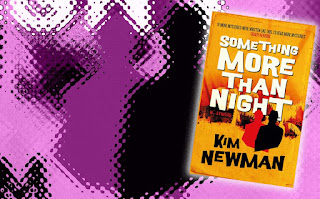
Something More Than Night


Pratt Falls
And Big Sleeps


Something More
Than Night

by Kim Newman
Titan Books
ISBN: 9781789097719


Well this one is utterly brilliant too.

Allow me a brief shout out of a review for the latest mystery thriller from Kim Newman, one of my writing heroes. Well I say that, I’ve only read four of his fictional works and a smattering of his film criticism books but, yeah, still very much a literary hero.

It was in the very early 1990s that I first knowingly came across Mr. Newman’s name, when a friend of mine (please contact me sometime if you’re somehow reading this Rob!) leant me his first edition of Anno Dracula. Well, first paperback edition at any rate... not sure if it made it into a hardback at that time. I was absolutely enthralled with the tome and the absolutely brilliant nods to other cultural characters from myriad sources in abundance, all pulled together and, in the modern parlance,’mashed up’ to weave an alternate version of literary history in which Dracula was successful in his visitation to England (contrary to the ending of Mr. Bram Stoker’s account in Dracula), set up shop with Queen Victoria and paved the way to where various vampires and humans were living together in the same society. That level of post-modernistic melange was new to me then and there weren’t that many people doing it at the time... certainly not as successfully and entertainingly as Mr. Newman and, though I could find no edition for sale in any new book store, a couple of years later I managed to pick up my own copy of the same edition in a second hand bookshop.

Nowadays, of course, the practice of taking various literary characters from different stories is much more common. For example, every year I read the ‘second from latest’ collection of a series of anthologies of new stories called Tales From The Shadowmen from Black Coat Press, which make this cross-fiction character mixing almost the criterion for inclusion (indeed, Mr. Newman has certainly contributed to some of these tomes in previous years) .

Now, remember, there was no internet in those days to find out what, if anything, was going on in the world. CEEFAX was our closest equivalent and, if you’re old enough to remember that, then you know just how useless a dispenser of information that was, back in the day. So I was absolutely thrilled when I found a hardback copy of a sequel to Anno Dracula entitled The Bloody Red Baron (and now set during World War I) which is, from memory, equally as brilliant. And a similar experience happened to me again, a few years later in one of those ‘brand new but remaindered’ style bookshops when I was on holiday in Llandudno... this time a brand new hardback of the third (and at that point final) in the series, Dracula Cha Cha Cha. Now, the books seem to be much more successful currently than they were in the 1990s and Mr. Newman has not only reissued these in expanded versions which I need to pick up and re-read... but also published a whole load more sequels over the last decade. So, yes, I keep promising myself I will get onto those at some point and, yeah, maybe this is the year.

Of course, I’ve seen Mr. Newman in person a fair few times now because he does seem to turn up to a lot of the same kinds of events I go to (not to mention appearing on a lot of DVD and Blu Ray ‘expert interviews’) although I’ve mostly only been in the same room as him rather than actually met him (unless you count that one time where I saw him on his own rushing to a FrightFest and stopped him, really only for 30 seconds or so, to tell him how much his writing meant to me).

And here I am reading his latest, Something More Than Night. The premise is as follows... the majority of the book is set in 1939 and it details the fictional adventures of one William Henry Pratt, better known to the world as Boris Karloff of course... and his friend, the equally famous writer Raymond Chandler (Karloff went to the same Grammar School in Enfield that I, myself, attended in the 1970s and early 1980s and they never once publicised it, which I always thought was a bit of a missed opportunity). The two characters in this iteration of them have had some ‘history’ together from their school days and now their detective friend is found hideously murdered. It’s up to the two of them to take up the reins of the mystery they were embroiled in, slightly earlier in their lives, joining the dots and... oh no, I’m stopping right there with the story content. It’s an incredible book and I’m certainly not going to be wrecking it for people who want to read it.

What I can, I think, say is that it’s certainly not a conventional mystery and it involves... well let’s just say it has some strong ‘weird science’ elements to the tale. Some people might also think it tiptoes from one side of the thin line which sometimes separates mystery tales from horror yarns... to the other but, yeah, that’s not an argument I want to get involved in, for sure.

The book is hugely entertaining and fans of Raymond Chandler’s works will especially love this one because the majority of the tale (apart from a few chapters of third person yarn spinning, where it was obviously necessary to switch to a third person viewpoint) is told by the voice of Chandler himself, Newman adopting the author’s writing style in as credible a manner as I’ve seen done. Well, okay, it’s been a few decades since I last read anything by Chandler but this certainly hit the mark as far as I was concerned. Mr. Newman also does wonders with his descriptions of Karloff and I really could remember certain moments from various films where the mannerisms, gestures and character traits that the writer imbues in him here are gloriously manifest.

The novel is split up into six sections, themselves split irregularly into a number of chapters, including a wonderfully titled, single chapter section called The Man In Chapter 30. And yes, there are a lot of characters from real life history mentioned but also as many made up, parody versions and stereotypes working for, for example, a fake ‘poverty row’ style Hollywoodland studio called Pyramid Pictures. And, yes, it’s full of wonderful appearances including one of the cast of Tod Browning’s Freaks and a nice reference to Margaret Brundage (I reviewed a book about her here). And, honestly, Frankenstein fans will love lines such as... “Cats love Billy. As do women. And small children he hasn’t drowned.” There’s even a nice bit of business where two of the characters get into a discussion about who would win in a fight between Flash Gordon and The Lone Ranger. And fans of Karloff would appreciate, perhaps, one of my favourite jokes in the book, when a mutual friend of Karloff and Chandler gives them the nicknames “Invisible Ray’ and ‘Visible Ray’. Yes, the book is a hoot and well worth the time of anyone who loves the movies and pulps from this particular era.

Now, there were two things that irked me just a little but, since they’re just part of the baggage that I, as a reader, brought along with me to Mr, Newman’s perfect literary venue, these mild criticisms really are my problem alone... but I’ll mention them anyway. One of them lays in Newman’s eliminating a pretty important (to me), real life character and replacing him with an entirely fictional one. Specifically, Kenneth Strickfadden, who invented all those old, sparky machines you see turning up time and time again in Universal monster movies and Flash Gordon serials (I reviewed his biography here...), has been eliminated from the fictional world portrayed here and replaced by someone else fairly important to the plot. Which is kind of a shame but these things happen.

The other thing I was bizarrely upset with, purely because I was expecting him to make an appearance and, during one sequence at the centre of the book, I thought he did... before a character was revealed as someone else.... was the fact that, not once (unless I missed a veiled reference) does Rondo Hatton turn up as a character in this one. Which is a shame but, yeah, that was just my personal wish and expectation of the book and so, boo hoo, I guess I’ll live.

All said and done, Mr. Newman has once more thrilled me with a book like no other, turned to perfection with a well researched look at the milieu of the people he’s writing about and nicely phrased to make the various characters and credibility stretching situations in which they find themselves, dance to life on the page and lodge in your brain in a way which you know will make you miss them later, when the book is done. So, yeah, Something More Than Night is yet another great work by Kim Newman and, yes, I really do have to revisit and explore the Anno Dracula series again sometime soon (not to mention some other compelling novels I’ve seen listed over the last few years which also carry his name). In other words... another great read. Go get this one.

Tuesday, 30 June 2020

Son Of Frankenstein


Heir Gloom

Son Of Frankenstein
USA 1939 Directed by Rowland V. Lee
Universal Blu Ray Zone B


Warning: Some spoilerage here.

So this next review of my rewatch of the classic Universal Monsters movies is another of my favourites... and it’s probably not hard for most people to see why. This is easily the best looking black and white movie of the 1930s that I’ve seen and the latest Blu Ray set from Universal certainly shows off the crisp monotone photography to its advantage. I’ll get back to the look of the film in a minute.

Son Of Frankenstein starts off a little differently to how I remembered it, with an opening sequence that highlights Bela Lugosi in the role of the convicted and hung murderer Ygor... who returned to life after being pronounced dead by the coroner some years before. This is followed by a town meeting scene which, if it does anything other than look nice, is all about reminding the audience just who Frankenstein and his creation were. We then cut to Basil Rathbone as the titular character, Baron Wolf von Frankenstein, his wife Elsa (played by Josephine Hutchinson) and his young son Peter (Donnie Dunagan), on a sleeping car train bound for the town where Wolf’s father did his infamous work. For some reason, the village is now called Frankenstein itself which, as we are aware from the mood of the villagers in the earlier part of the film, does nothing good for the tourist trade. This sequence, as they rumble into ‘Banhof Frankenstein’ shows off just how good the dialogue writing is here. Wolf is talking to Elsa about his father’s accursed legacy and he just gets up to the bit where he is about to say the family name...

“... nine out of ten people call that misshapen creature of my father’s experiments...”

when the railway porter shouts out “Frankenstein! Frankenstein!” to announce the stop. It’s a wonderful piece of early dialogue juxtaposition, taking two pieces of dialogue of differing intent and then rubbing them together to push the meaning of the first. It also nicely underlines the mistake of the commonly held assumption that the monster itself is called Frankenstein when, clearly, it is not.

Now lets talk about Rathbone here for a minute because he was at a turning point in his career. He did, however, detest appearing in horror movies although he would appear opposite Boris Karloff again in Jacques Tourneur’s 1963 AIP Edgar Allan Poe cycle entry, The Comedy Of Terrors, of course. His lack of respect of the horror genre might explain why this one is a little bit ‘all over the place’ in certain scenes he performs here but it’s easy to watch and a lot of fun too. I’ve always had a soft spot for Rathbone and you have to remember that this was only a year after he had played the villanous Sir Guy of Gisbourne opposite Errol Flynn in the definitive Robin Hood  movie, The Adventures Of Robin Hood. His very next film after Son Of Frankenstein and released in the same year would be the one which was the first time he played the role which he is probably best well known for to this day... playing Sherlock Holmes opposite Nigel Bruce (as Doctor Watson) in the first of a long series of films and, also, a large number of radio shows starring the pair too.

He is, of course, ably supported in this by some great Universal regulars such as Boris Karloff, reprising his role as the Frankenstein monster. Now, despite the monster being able to speak in the last installment, The Bride Of Frankenstein (reviewed here), here he is once more rendered mute with no real explanation as to why. I love what he’s wearing in this too... instead of the dark jacket he’s wearing what can only be described as a furry tank top and it looks great. This is my favourite fashion look for the Frankenstein monster, for sure. This was the third and final time Karloff would play the role of Frankenstein’s creation but not his final role in a classic Universal Frankenstein movie, as you will see in an upcoming review. His scene with Rathbone as he discovers himself reflected in a mirror is quite long but expertly done as we see the monster pantomime various emotional states while he tries to come to terms with his hideous looks. This is pure cinema although, it has to be said, that when we have assassinations performed by the creature who then stages things to look like an accident with some considered thought, he does at times become the very thing that Karloff was afraid he would become with more exposure in a series of films... a professional killing machine.

Then we have Lionel Atwill, who appears in a number of these Universal monster movies but whose career was ruined just a few years later due to a scandalous sex orgy and rape party which took place at his home. Although he’s going to appear in a few of the films I will be reviewing after this, he died of lung cancer only seven years after Son Of Frankenstein was released. Of course, in this he plays the wonderfully Germanic Inspector Kogh, the one armed police inspector who is trying to find out who is doing all the killings in the village (funny how all the people who died are the same people who condemned Ygor to death). Even without the one armed police inspector in Mel Brooks’ Young Frankenstein being based on him, his handicapped shenanigans in this do often border on the comical... especially when he plays Wolf at darts and sticks them all into his arm to store them as he is taking his turn.

By the way, when did it become normal to have only three darts to throw per player? Not before 1939 I guess because here they are playing with five a piece. The reason for Kogh's handicap however, is far from comical. His history goes that, when he was a young toddler, the Frankenstein monster was busy terrifying the villagers and he ‘tore his arm out by the root.’ Of course, once this information and disability is introduced, you just know it’s going to come back and be revisited on him again and, sure enough, in his final confrontation with the Frankenstein monster in the film, his artificial limb is torn from him by the monster, who tries to use it as a club to keep everybody back.

The basic plot of this is of Wolf trying to restore the long surviving monster in his father’s laboratory while trying to ignore the obvious that Ygor is using him as a killing machine while warding off the questions of the inspector... until he is finally threatened himself and after shooting Ygor dead with three bullets to the chest (although this is not enough of a mortal injury to prevent Lugosi reprising his role through the course of the next Frankenstein movie). He then finds himself trying to rescue his son who the monster has stolen from him in revenge for the killing, ready to throw him into the pit of sulphur which the laboratory was somehow built over. And, again, once you know there’s a pit of sulphur under the lab, it’s no prizes for guessing just how the creature will meet its supposed end in this film, after a bit of swashbuckling action from Rathbone saves the day when he swings from a winch and knocks Karloff into the pit. Then we watch a not so great dummy of the monster sink below the bubbling surface.

But enough of the story... it’s the look of the film which is where the strength of the picture lays. This is the Frankenstein film where the set design and lighting go ‘the full Caligari’ with amazing twisted geometry and dark, distorted blacks which reflect straight back to the German Expressionist form of cinema from which they derive, as fleeing film crews deserted Nazi Germany and pitched up into Hollywoodland. Just amazing angles and things that sit strangely within the beautiful, slanted compositions such as, for example, chairs with amazingly tall backs that only a giant would truly be able to appreciate. These are further highlighted by some beautiful shadow work. You know that scene at the start of the bar fight in Raiders Of The Lost Ark, where Spielberg emphasises people by having their shadows arrive first... well that style was always straight out of the 1920s/30s where that kind of emphasis on the look was common.

For example, there’s a wonderful moment where Rathbone follows Lugosi into a kind of tomb-like approach to the laboratory. Rathbone’s silhouette, completely black, is framed perfectly in the doorway at the centre of the shot with his shadow cast down below him and into the laps of the audience at the foreground of the shot... then Lugosi lights a torch on the wall which instantly allows Rathbone’s full figure to materialise out of the silhouette, while still maintaining the shadow... expert stuff. Another shot where Rathbone’s shadow precedes him up a ladder, through a hatch in the floor before Rathbone follows it up into the shot, is also mesmerising. And even the shadow of a ladder that Rathbone descends from in one scene, has a twisted rung accenting the strange and angular set design. Like I said, it’s one of the best looking and best lit movies of the 1930s you are ever likely to see.

There’s also an interesting addition to the Frankenstein legend in this one. Wolf’s research reveals that, unknown to his father, it wasn’t just the lightning he summoned into the creature which gave life to the creation that Karloff so brilliantly plays on screen. It was, in fact, according to this iteration of Shelley’s creation... cosmic rays. These had already been known about when Victor Hess discovered them in 1912 and my guess is they were still fresh in people’s minds since Hess had won a Nobel Prize in Physics for his discovery only three years before this picture was released. So that’s kind of interesting I think (and yes, I had to look that up when the words were uttered on screen... I had no idea as my first exposure to the term myself was as a kid in a reprint of the first issue of Fantastic Four from 1961).

I’d better mention the music too, while I’m here. This was the first of the classic Universal horrors to feature the music of Frank Skinner (who was often paired with Hans Salter in later movies in the various monster series). It’s a classic score and the one which, despite the strength and influence of Franz Waxman’s score for the previous Frankenstein film, ended up becoming the classic, ‘brand sound’ for the Universal monster movies that followed it. Lots of this was recycled into other horror films by the company over the years and it became quite evocative of a certain kind of genre package, especially after the various films aired on television in the late 1950s when it gathered a lot of recognition and a large following with film music fans. The montage sequence where Wolf cures the ailing monster is almost as splendid as Waxman’s creation music from The Bride Of Frankenstein and the score is even used, in this film, in a metatextual manner in two scenes. In those scenes, Ygor is seen playing a bizarre looking kind of flute/horn and the tune he plays is... Skinner’s main monster theme to the movie. So, again, a nice touch and, perhaps, somewhat ahead of its time.

And there you have it. Not much more to say about Son Of Frankenstein other than... it’s an absolutely brilliant film and worth the time of any true lover of cinema to sit down and study. I can’t over emphasise the sheer spectacle of the mise en scène in this movie... it’s absolutely gorgeous and there’s absolutely no way you can go wrong with a film of this calibre. The last great Frankenstein movie... not the last fun or watchable one, for sure but, in terms of greatness, this one was the absolute peak of perfection for the Universal Horror series and the success of it convinced the company to resurrect its now, almost retired, monsters for a huge amount of sequels throughout the 1940s... all of which I hope to review for you on here some time soon. If you are any fan of not just horror movies but the art of cinema in general then, this one is simply not something you’d want to miss out on. So good.

Thursday, 30 April 2020

Bride Of Frankenstein


Harbinger Of Groom

Bride Of Frankenstein
USA 1935 Directed by James Whale
Universal Blu Ray Zone B


Time to revisit one of the great classics finally on Blu Ray.

You know, whenever I watch Bride Of Frankenstein (also known as The Bride Of Frankenstein on most posters but without the 'definite article' on the actual title card of the movie), I always think that this is my favourite of the Universal Frankenstein movies. Then, whenever I watch the next sequel, Son Of Frankenstein, I always think that is. It’s a thin line because they both have a very different atmosphere to them but, for now, I’lll say just on the strength of the blindingly cool score, I’ll have to go with Bride Of Frankenstein as the best of these Universal Monster Classics. Well... until I get around to rewatching and reviewing the next one in the sequence, at any rate.

After a cast list which bills, like the end credits, the titular character of The Bride as being played by ‘?’ (much like Karloff in the original, to preserve the mystery) we get a camera moving in to an establishing shot via a model building where we get a quite wonderful (and heavily pre-cut due to sexual implications of both a verbal and visual nature), prologue featuring Lord Byron, Percy Shelley
and, of course, the character of his wife Mary Wollstonecraft Shelley, who wrote the original novel Frankenstein and who is played here by the ‘button cute’ Elsa Lanchester. It is for this role, relatively near the top of the cast list, that Lanchester is credited for, as opposed to her iconic dual role as the Bride Of Frankenstein. Also, since her first character is only on screen for five minutes at the start and her classic monster character only for about five minutes (without bandages) at the end, I think many audience members probably don’t put two and two together in regards to this fact the first time they see it... especially since the make-up is quite different.

Towards the end of the prologue is a montage of scenes from the first film (where Franz Waxman’s amazing score really drives the edits together as a unified whole and which, if memory serves, might even include alternate or unused snippets from Whale’s previous Frankenstein movie too) and then Mary is coaxed into telling Byron and Shelley the rest of the ‘continuing story’ (despite the fact that a tombstone in the film has a death date many decades after Mary died in real life).

And the rest of the film is half some unused parts from the original Frankenstein novel dressed up in new clothes (the book does, indeed, deal with the creation of a ‘bride’ too), along with the usual Hollywood nonsense, some successful and some not so, which can be completely credited to director James Whale who, at this time in his career at least, had complete control of the film.

It’s an interesting film and uses some great lighting effects too (if you watch the films of Ridley Scott, there’s a certain kind of lighting he uses in a lot of his movies... the name of which escapes me... and certain scenes like the interiors of Baron Frankenstein’s home use the same effect) and there’s also the odd hint of German Expressionism again which grows organically from the sets... not as much as it would become a dominating factor as it does in Son Of Frankenstein, perhaps but... it’s definitely in here.

There’s some wonderful acting in this one. Much to Boris Karloff’s dismay, the monster learns to talk this time around, due to his investigation of the siren call of the violin played by an old, blind hermit (played by O.P. Heggie) who befriends him and teaches him rudimentary speaking skills... as well as teaching him how to smoke (can never quite work out how that’s ‘a thing’ to teach anyone but what do I know?). Karloff is absolutely electric in these scenes though, never once going into comedy mode although, you can tell that certain elements of Fred Gwynne's Herman Munster must have come from studying his performance in this film.

Then there’s the somewhat campy Ernest Thesiger playing the equally campy Doctor Pretorious, helping to push the less than hidden ‘gay subtext’ of the movie, which would quite possibly have gone over many of its audiences’ heads at the time. Alas, he also dominates in the one scene which seems completely out of place in the film, where he shows Frankenstein the collection of miniature people he’s grown in bottles. This is the one scene in the movie I almost can’t bear to look at because it’s so off kilter with the rest of the film (but at least Waxman’s music is appropriate... it’s also out of place with the rest of the score in this scene). In fact, going to skip quickly over the memory of this sequence now, thanks.

One of Whale’s favourite ‘doom laden comedy hystrionics’ actresses, Una O' Connor, who had provided similar laughs in the director’s The Invisible Man (reviewed here) also has lots of screaming to do, along with such dialogue nuggets as, when talking about the probable burning of the Frankenstein monster under the mill (wrecked at the climax of the last film)... “Insides is always the last to be consumed”. She also gets the first of the ‘He’s alive!’ lines when talking about the ‘presumed dead’ character of Henry Frankenstein, who has been removed to his and his fiance’s home, in relation to when he first moves his arm and indicates he’s alive. Of course, this completely contradicts the happy ending added on to the film at the end of the last one against Whale’s wishes but, I guess he was happy to ignore it here. Frankenstein is once again played by Colin Clive (two years before his alcoholism fuelled death at the age of 37) but his fiance is played by the then 17 year old Valerie Hobson, who really gives her all in the role.

And, though he had already been killed by Karloff in the last one, we have wonderful character actor Dwight Frye returning as a very similar character called Glutz. It’s always good to see Frye in any Universal movie, to be honest. Even a young John Carradine turns up briefly as a woodsman, foreshadowing his involvement, perhaps, with The Mummy films and also his turns as Dracula for the studio in two of the Frankenstein sequels.

The film was quite heavily trimmed before general release for scenes of religious inappropriateness and sexuality (such as cutting out various sequences which included close ups of Mary Shelley’s cleavage in the prologue and, originally, in an epilogue which also didn’t make it into the final cut) and... I just wish the footage had survived today. Even now, where the script had been censored, you can see where Whale ‘got away with it’ in certain scenes. There’s a great line by Dr. Pretorius where he tells Henry...

“Leave the charnel house and follow the lead of nature... or of God, if you like your bible stories”.

This second part of the line is said with great sarcasm and it’s pretty apparent what Whale’s stance on religion is. What I’d forgotten until rewatching the documentary which has been ported over from some of the DVD releases onto the new Blu Ray, is that the original line before the censors got a hold of it finished... “... or of God, if you like your fairy tales.” It doesn’t really matter though because Thesgiger’s line reading leaves you in absolutely no doubt of his religious standing.

And then there’s the music by composer Franz Waxman. This is what I was always drawn to with this movie, not because of its brilliance here but because I was familiar with it from the many times it was recycled by Universal into other things, like many of their serials. I first heard this score in the Buster Crabbe Flash Gordon and Buck Rogers serials and, whenever I would go out into the back garden and play at being one of these two iconic heroes, I would be constantly whistling the score from Bride Of Frankenstein as I played, even though I didn’t know that at the time. It’s very much in the leitmotif style which was becoming increasingly popular in Hollywood and it’s just wonderful. LaLaLand Records managed to resurrect and restore the long thought lost master tapes of the majority of this score last year for a limited edition CD release, which sounds surprisingly great for the age of the recording. You can still, at time of writing, purchase a copy from them in the US here. It’s not only been used in numerous Universal films and serials contemporary to this, it’s also been used in terms of film referencing over the years... perhaps the most blatant being the use of the ‘creation’ music in a parody sequence in Joe Dante’s Small Soldiers. If you’ve never heard it before, well... it’s just wonderful. What I hadnt noticed before is the moment in the opening credits where it says it’s conducted by Bakaleinikoff, who did a number of scores such as those for Val Lewton, whose ‘antidote’ to Universal Horror’ movies for RKO are also very much respected.

And there you have it. Bride Of Frankenstein is one of those rare movies where the sequel actually is superior to the original work... in this case by the same director. And I say that with all due respect to Frankenstein (reviewed by me here) which is a truly great movie too. Definitely this and the two Frankenstein films either side of it are required viewing for all those in love with the art of cinema. And very entertaining they are too. Give them a watch.

Wednesday, 8 April 2020

The Mummy


Of Human Bandage

The Mummy
USA 1932 Directed by Karl Freund
Universal  Blu Ray Zone B


After the surprise success of Dracula (reviewed here) and Frankenstein (reviewed here), Universal embarked on the next of their big horror franchises, once more using their star Boris Karloff (who was by now being billed as Karloff The Uncanny) in the title role of Imhotep, The Mummy who was buried alive for breaking the holy codes of his people and attempting to bring his great love, Ankh-es-en-Amon, back from the dead.

This film was obviously made as a response to Howard Carter’s ‘Tutankhamun’ expedition which had finally struck lucky in 1922 (read more of the whole Egyptian invasion of popular culture around the world in my review of Eyptomania Goes To The Movies right here). One of the news reporters sent to cover that discovery was none other than John L. Balderston, who had of course written the screenplay of Dracula and the stage adaptation which gave rise to that movie.

Here, he writes a mummy movie for Universal but, really, it’s... how can I put this diplomatically... it’s pretty much a stealth rewrite of Dracula in all but name. Several elements which were in Dracula feature here, such as the pseudo-romantic pull of the titular monster on the leading lady, played here by exotic beauty Zita Johann, who is the living embodiment of Princess Ankh-es-en-Amon. To further seal the deal in terms of trying to capitalise on the success of their earlier pictures (not to mention casting the Frankenstein’s monster actor himself as the main antagonist) we also have David Manners reprising his role as the lover of the leading lady who is trying to save her from 'the monster who wants to have his way with her' and Edward Van Sloan, who played Van Helsing in the two Dracula films before and after this, as Dr. Muller, a similar ‘enemy of the monster, knowledgeable in the ways of destroying him’ kind of character.

And every time I watch this film I remember I really liked it and thought I remembered it well, only to find myself seeing it with fresh eyes and having forgotten most of it. It is quite a gripping watch, though and we have Karloff in two different make-ups by Jack Pearce. The bandaged mummy version of Imhotep is quite striking and effective but you only see Karloff in this in one close up shot as he opens his eyes and moves his hand... what a shot though, completely effective with Karloffs inky black whirlpools of eyes slowly imbibing life (the bandaged up ‘dummy version’ of the mummy in his sarcophagus in the long shots never quite matches the close up, sadly). And we see his hand reaching out for the scroll which brought him to life, as we also admire Bramwell Fletcher’s brief appearance as the man who is sent mad by witnessing the wanderings of this reincarnated, bandaged Boris. There were obviously some full mummy sequences shot for this scene in this make up because there is photographic evidence and one shot even made it to one of the lobby cards but, alas, that's it for the bandaged version of Karloff in this movie.

The other make up we see Karloff in, is that of his ‘alter ego’ character Ardeth Bay, once he has assimilated himself into the modern Egyptian landscape of 1932 (ten years after he is resurrected in the opening scenes of the movie). This is absolutely brilliant make up where his skin has completely wrinkled over (goodness knows why nobody in the movie notices this) and it’s helped by some wonderful lighting on some shots, where his black eyes are lit up to become piercing, hypnotic beacons. Of course, in the 1999 version of The Mummy and its sequel, The Mummy Returns, Ardeth Bay is not the same character as Imhotep at all and is one of the ‘good guys’.

The film is, as I said, pretty much a rerun of Dracula in a lot of ways but it works really well in terms of ‘slightly less original’ entertainment and the chemistry between Karloff and Johann is amazing. Actually, a lot of unused stuff was shot for this movie as we were supposed to see Johann’s Helen Grovesnor/Ankh-es-en-Amon reincarnated over several historical periods such as Ancient Rome and the times of the Saxons, for example. Photographic stills exist for these scenes but they were removed from the movie before release (never to be seen again, alas) and that may be why, compared to the two previous Universal movies, The Mummy is about a quarter of an hour shorter than what we’d expect from these specific ‘monster pictures’ at this period of their history.

Director Freund, who famously got on very badly with his leading lady here, does some amazing work and his German Expressionist cinematography skills are certainly in evidence. The film looks fantastic, it has to be said. This new Blu Ray from Universal certainly does justice to the visual richness of the shots and is definitely a necessary purchase, as far as I’m concerned.

One thing which doesn’t seem to be discussed much... and it really should be... is the use of music in the film. There really shouldn’t be a score here because, after all, we all know that the film which brought the musical score back to talking pictures was Max Steiner’s score for King Kong in 1933 (reviewed by me here), right? Even though he also provided a score for The Most Dangerous Game the year before. Well, whatever you believe, The Mummy certainly has a fair few ‘scored’ passages in it... although I think Kong can certainly be credited with the film that gave Hollywood filmmakers the confidence to reintroduce music properly into their films once more.

So, after going into the music from Swan Lake again during the opening titles, attempting to tie it in with Dracula as a branded Universal horror picture, no doubt... we actually get some sections introduced with underscore, as the titles finish and the music doesn’t stop. It’s not an abundant score by any means but James Dietrich’s compositions are used in a few scenes in the movie as proper underscore as opposed to just standing in for source music, perhaps most notably in what remains of the flashback sequence, where Imhotep shows Helen Grovesnor her past life and again in the sequence where Inhotep causes Arthur Byron, playing the father of David Manners’ character, to have a deadly heart attack by remote control, as it were.    

Unlike the sequels to Dracula and Frankenstein which were soon to be unleashed into the world, the sequels to The Mummy would feature a completely different central character (Kharis the mummy) and have not much to do with this one at all... although the back story to Kharis is pretty much the same as Imhotep and the flashbacks utilise long shots of Karloff from this movie mixed in with Tom Tyler for the close ups during the first one.

If you like your Universal monsters, well this is the first entry in the franchise of one of the big five (Dracula, Frankenstein, The Mummy, The Wolfman and the Creature From The Black Lagoon) and its importance in the history of the series can’t be overlooked. Also, the 1999 version was pretty much an adventure reboot of this film. But beyond all that, it’s a well made movie which is always entertaining and fun... although a lot seems to be unsaid or possibly just cut from the running time. And Karloff, without moving much and understating his lines, still has such screen presence that he’s... well... ‘uncannily good’, I guess. Definitely one that every film lover should take a look at some time.

Thursday, 23 May 2019

Frankenstein


Strickfadenmageddon!

Frankenstein
USA 1931 Directed by James Whale
Universal Blu Ray Zone B


Okay so... next up on my Universal Horror rewatch list is James Whale’s Frankenstein, which would eclipse even Tod Browning’s Dracula from the same year and re-enforce the idea that these brand new motion picture spectacles focusing on the, as yet unnamed, genre of ‘horror’ can really bring in a lot of box office take for the studio. So this one was rushed into production with Robert Florey originally scheduled to direct, along with new Dracula star Bela Lugosi as the monster. After some twenty minutes of, sadly lost, test footage of Lugosi in a quite different make up as the monster, the actor turned the job down which, considering what shape the script was in at the time, wasn’t necessarily something you can blame him for but it was certainly a missed opportunity and rocketed Boris Karloff to fame when the final choice of director for the film, James Whale, was brought in and spotted Karloff in the canteen.

After some gruelling evenings of various make up tests with studio monster make up genius Jack Pearce, Karloff was ready. One of Karloff’s contributions to the make-up came by way of a dental bridge in one of his cheeks, which he was able to take out to leave a hollowed out side to his face, something which Pearce accentuated with his brushes. That being said... the haunting make up from this film never looked the same on Karloff in the sequels and one of the contributing factors to that is that, due to his new found fame, popularity and success that this role and others subsequently brought him (in his mid 40s, after already having made over 80 films in Hollywood in minor roles), he was able to afford to get his teeth fixed up properly and so he couldn’t repeat the same trick twice for his subsequent roles as the monster in The Bride Of Frankenstein (1935) and Son Of Frankenstein (1939). Indeed, Karloff’s name wasn’t even included in the opening credits of the first movie as he was just left with a question mark where his name should be as “The Monster........?”, just as Elsa Lanchester would have the same treatment in the opening credits of the first sequel. His name was, however, obviously restored for the end credits... ‘a good cast is worth repeating’ as Universal pictures of that period often used to say at the end. Although the typeface they chose for certain words here use these terrible, sideways versions of the letter ‘s’ which I can never get used to.

The film begins with a mirror of something from another film which people haven’t been able to see for about 88 years and which is now deemed lost to time, alas. I’m talking about the lost footage from the 1931 film Dracula (which I reviewed here) in which Edward Van Sloan, who played Van Helsing, came out and gave little monologue to calm the audience down after the picture had finished. It’s a shame that this footage that has never turned up since the first release but Whale, or his studio bosses, chose to open Frankenstein in exactly the same way. This gives it some continuity in terms of Universal trying to create some horror branding in a way... although they possibly didn’t know it yet. So we once more have Edward Van Sloan, who plays Dr. Waldman in this production, come out from behind some curtains and do a little pre-credits speech to warn the ‘faint of heart’ and sensitive souls in the audience of what they are about to see. Of course, by now and after the roaring success of Dracula, this is as much about showmanship as it is about anything else but it’s a nice moment before we go into some opening titles (where Mary Shelley is billed, unbelievably, as Mrs. Percy B. Shelley) and the film starts proper.

The film opens with the end of a funeral with Henry Frankenstein (not Victor as in the original novel) played by Colin Clive and his hunchbacked assistant Fritz played by Dwight Frye, who was so brilliant as Renfield in Dracula, looking on from behind cover and ready to rob the grave in the aftermath for Henry’s experiments. Clive was, in fact, a direct descendent of Clive of India and even acted in a film four years later about his ancestor although, bizarrely, Ronald Coleman actually played the famous Clive. Colin Clive, however, had his own problems and struggled with alcoholism which would lead to complications and help kill him just six years after he filmed Frankenstein (and two years after he reprised his role for the sequel).

Once the mourners are gone we have Frankenstein and Fritz digging up the body and the whole sequence from the funeral to the finish of the scene is a strangely long and protracted affair, taking time to build the atmosphere over many minutes where the later Universal Horrors of the 1940s, which were admittedly more B movies, were as likely to do this kind of set up with visual shorthand. Thanks to film historian Rudy Behlmer on one of the wonderful commentary tracks provided on this latet Blu Ray Legacy Edition (the other is by Sir Christopher Frayling) for pointing out that, with a statue of death present in the background, we have Henry Frankenstein literally shovelling the soil from the grave (amplified with a microphone hidden below) and, literally, throwing dirt in the face of death, via this tombstone statue. It’s a nice comment on Frankenstein’s target of facing down death and bringing life, albeit in monstrous fashion, into the world and, given the placing of the statue and the obvious choice to literally fling the dirt in this particular direction, I think it’s more than likely that Whale or one of the actors probably introduced this concept on the day of shooting and were more than aware of this visual metaphor they were creating.

Following this scene, as Frankenstein and Fritz are wheeling the corpse home, they come across an executed man (or dummy) on a gibbet and Fritz is told to cut him down to add to the good professor’s stock of cadavers and Frye deliberately plays Fritz as nervous and jumpy in the face of all things to do with death... presumably so that in one of the following sequences, when he drops the jar containing the ‘normal brain’, we believe he really is startled and jumping at his own shadow as a bumping sound causes him to lose grip on the jar.

So we come to that scene and here we meet, for the second time, Edward Van Sloan teaching students in his medical college about human biology and specifically about the difference between a ‘normal’ and ‘criminal’ brain and, this is exactly how his jars containing the two brains are, hilariously, labelled up... ‘Normal Brain’ and ‘Criminal Brain’. After the class has finished, Fritz goes down to take the ‘Normal Brain’ but is startled, smashes it and instead absconds with the ‘Criminal Brain’ as a replacement... thus robbing the obvious innocence of the resulting creature and rendering his actions somewhat more fateful in the final analysis. It should perhaps be pointed out that this scene was not in the original novel and neither was Fritz, who was a character invented for some of the many stage versions of the play, one of which this film, like Dracula before it, was based on as opposed to the first version of the source material. That being said, and again thanks to Behlmer for this piece of info, the distinction between the ‘normal’ and ‘criminal’ brain is not made in the stage plays and is therefore a completely new invention for the film. Which is kind of interesting, I think, given its implications.

Okay, so after this we meet Mae Clark as the future Mrs. Frankenstein and her bizarre love triangle person Victor, played by John Boles, a relationship which is almost completely forgotten about for most of the rest of the movie (there’s a reason for this, I suspect and I’ll get back to it later). They decide, along with Frankenstein’s father played by Frederick Kerr and Edward Van Sloan as young Frankenstein’s former teacher, to go out to Henry’s forbidden lab which Baron Frankenstein, Henry’s father, refers to as being in a windmill. This is kinda interesting because it’s not.. its a big watchtower but it was originally meant to have been a windmill and, when the monster ‘returns home’ with Henry at the end of the movie, it is actually to a windmill. So this was possibly overlooked and left in the script at this point in the filming. It’s also mentioned about Henry Frankenstein’s “insane desire to create life” and it says something, I think, about him and the long line of ‘creation mad’ scientists who came after him because, as I always say, they could have a lot more fun creating life in the old fashioned way.

So the various sets in the watchtower look, to me, like they were recycled from Dracula, including the big staircase that Dracula flung Renfield down at the end and, I think, must have been used and recycled from production to production a lot at Universal. As were the wonderful electric gizmos invented by electrician/hobbyist/tinkerer Kenneth Strickfaden, who would build these things as a hobby and, before he knew it, was doing a lucrative business hiring them out to organisations like Universal for their ‘crazy and sparkly lab equipment’ sets. Certainly they are reused, probably along with half the sets, in the Flash Gordon serials which I so love and cherish. The watchtower interiors also seem to have learned somewhat of a lesson from German Expressionism too, with distorted angles to windows and walls and twisted shadows drawn in with light. It doesn’t get to ‘the full Caligari’ as it were in terms of dominating the screen like it does, quite wonderfully, in Son Of Frankenstein in 1939 but... there’s more than a suggestion of it here and it surely works well to building the almost gothic atmosphere of some of the scenes.

During the creation scene we have lines like “Now I know what it feels like to be God” which were cut in some states and completely removed on later re-releases by the more organised censorship board due to being blasphemous. I'll get onto a consequence of one of the cuts made to this film a little later on.

Karloff’s cadaver, which reanimates at the end of the sequence, has a bandaged up head so the audience are unable to see what the creature looks like yet. When he does enter in another scene shortly after, it’s a really unusual entrance and, though it possibly looks a little clunky by today's standards, it must have been something in terms of an audience in 1931 watching it without having seen much in this newly created genre in the ‘talkies’ before. We hear the sound of Karloff’s footsteps and then cut to a shot of the door frame with Karloff pushing open the door as he walks in backwards. He then slowly turns to camera and we finally get a look at that iconic make-up. Then we have two closer shots of his face cut together in quick succession, getting closer and really putting that visage ‘in the face’ of the audience. And the film is full of interesting staging and editing like this. For example, in an earlier scene where Henry asks his three guests if they really want to go into his laboratory, instead of a long shot of them responding, we get three separate close ups of each one looking to the right of the camera and nodding. A very long and drawn out way of doing things which I don’t think you’d catch being done in the same way nowadays.

Okay so I’m not going through the whole movie blow by blow here and you probably almost certainly know the story but there are some nice shot set ups and ways of doing things like the above dotted throughout the movie. Whale’s fondness for dollying from one room to the next via a cutaway section is in evidence at certain points and there’s a wonderful 'two shot' where Karloff is chasing Frankenstein around the rotating inner mechanism of the windmill and you see both of the actors framed in the little rotating rectangles made by the path of said mechanism, one after the other... almost like the director was trying to remind us of the look of an old Zoetrope.

The chase scenes at the end, around mountains which are definitely shot in an interior set, are both magnificent looking but, alas, also unfortunate in that the cyclorama which depicts the clouds in the sky has a lot of wrinkles on it and these are very noticeable... as if the sky was just wallpaper stuck on and it had dried out and started to peel. Which it kinda was, I guess. Of course, various high definition DVDs and now this Blu Ray have made that more apparent to viewers as the years go on and as our technology gets, in some ways, more refined. Still, if you like the film enough I’m sure you can turn a blind eye to this kind of thing.

What the censors for the subsequent re-release versions a few years later couldn’t turn a blind eye too... in addition to the religious iconigraphy and the blasphemy mentioned earlier, was the shot of Frankenstein’s monster running out of daisies to throw in the lake... so he innocently picks up the young girl he’s playing with and throws her in, accidentally drowning her. And this is a nice thing to show just how stupid censorship is because, sometimes, what you cut out makes things worse. I’ve mentioned this before about when they used to slice out the protracted eye gouging scene in Lucio Fulci’s Zombie Flesh Eaters (reviewed here) in this country. It’s such a rubbish effect that when you see the splinter of wood slowly poke the eye out, it really doesn’t look real but, when the actual special effect is cut out, what you imagine is much worse than the actual reality. Well the same thing happened with Frankenstein. When the little girl’s demise is cut after the daisy throwing scene and she turns up shown dead later, what the audience imagines could have happened to her is far worse and, of course, is something else which takes away from the childish naivete of the central creature. Did he rape her? Strangle her? What happened? Thankfully we now have a fully restored print of the movie we can enjoy at home.

And that’s about all I have to say about Frankenstein other than, perhaps, two more quick points...

One, that secondary love interest. It’s made even more apparent when Henry leaves his fiance in the ‘care’ of her friend Victor. Frankenstein was meant to die but the studio changed their mind later and an epilogue was shot with a stand in for Colin Clive who is glimpsed in the next room recovering from his wounds. So that’s this additional Victor character done with and he doesn’t turn up, as far as I remember, even once in the sequel.

The other thing I wanted to say was that, when I said Karloff’s make-up was iconic... I meant just that. There were three previous movie productions of the story before this but it’s this one with Karloff in Jack Pearce’s make-up that is the most imitated and best remembered... it’s influence is beyond measure but, think about what the first thing that comes into your head when you hear the name Frankenstein (who was, indeed, named after his creator in the stage version on which this was based). It’s something you don’t forget and also, although the creature was fully articulate in speech in the original novel, it wasn’t until the second movie that the creature got some, basic, speech and intellect shown. Something which was jettisoned again by the time of the next film.

Frankenstein, like the unforgettable monster with its exaggerated walk (half created by built up boots and boards incapacitating joints), is a classic of its kind and if you’ve never seen this movie and some of its sequels then you are missing out. Personally, I think the next two films in the series are even better than this one but it doesn’t diminish the sheer brilliance of this first film and if you’ve not imbibed you should maybe take a look. There’s a reason why we’re all still talking about these classic Universal monsters after all this time.