Showing posts with label Ian Fleming. Show all posts
Tuesday, 4 January 2022
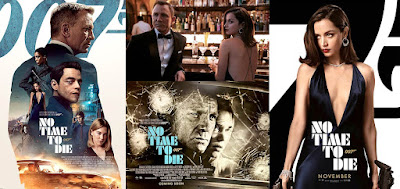
No Time To Die
A Die For A Die
No Time To Die
UK/USA 2021
Directed by Cary Joji Fukunaga
EON Productions
Blu Ray Zone B
Let me once more state for the record that I don’t have anything against Daniel Craig. In fact, I think he’s a great actor. He’s just got the wrong colour hair for James Bond and, also, I just don’t like any of the Craig Bond films. I’d frankly rather watch him in other roles. That being said, my expectations were hopeful for No Time To Die because I was receiving some very mixed, word of mouth reviews from the various friends I have. For instance, my die hard, Bond fanatical friend Chris, who usually has very few bad words to say about the Daniel Craig Bond films, was very disappointed with this one... thinking it one of the all time lows of the series, from what I can make out. Conversely, my cousin Steve said this was one of the very best Bond films and went back to his local cinema in Australia to see it a number of times. So, yeah, I thought this one would at least be interesting if it was dividing people’s opinion so much.
Alas, I have to report back that this latest outing for England’s popular secret agent has a lot in common with the previous Craig films, as far as I’m concerned... in that it’s very boring, drab, dull and any other descriptions which could be best summed up with the modern term... meh! My initial response once the film had concluded was... how can they make a movie which was both worse than Quantum Of Solace (reviewed here) and simultaneously, unbelievably more boring than Octopussy (reviewed here)?
Once again, the film picks up the plot threads from the previous Craig films, allowing them to all be seen as one single arc. We catch up with a now retired Bond living with his girlfriend Madeleine (Léa Seydoux reprising her role from S.P.E.C.T.R.E, reviewed here) but then, of course, Bond manages to find himself back in the thick of the action and attempting to save the world from yet another super villain, this time in the form of Safin (played by Rami Malek).
And... it’s a bit of a yawn, to be honest. The fact that the opening gun barrel sequence has Bond missing his target for the first time ever in the history of the EON Bond films (there’s no red blood washing it out in this version... just a really awkward transition), should have given me a heads up. The pre-credits sequence is certainly plot and character motivated but it forgets to be a big blast of action like the many James Bond films before it. I mean, there’s definitely a little action there but just as it starts to get going it’s already over and we are into a quite dreary opening title animation accompanied by a similarly dreary opening song. Sadly, this is a good guide to how the rest of the film is going to go... it’s a long, slow burn (running two and three quarter hours) with very few action sequences and, for the most part, not enough ooomph in them to really deliver the kind of pace and energy a loyal legion of Bond fans might expect from the franchise. This would perhaps explain why the response to the movie in my timeline on Twitter has been lukewarm at best.
Now, I was pretty careful to pick up absolutely no spoilers for this one before I fired up the Blu Ray but, alas, as I’d revealed to my friend @cultofthecinema on the phone a few days before, I was pretty sure how the movie was going to end (using the same kind of casting information with which I’d predicted, a couple of years before release, a certain event which takes place towards the end of the Star Wars movie The Force Awakens). And, yes, I was dead right on that one. I really don’t want to give away the ending of the film here but, even if I’d had no suspicion before the movie started as to the final trajectory of the story, the writers and director manage to telegraph it so much that it’s pretty much a foregone conclusion by the midway mark. Scenes which would have been better occurring at the end of the movie play out earlier than you might expect and, by some point, I suspect most people in the audience would realise there’s a reason why certain plot points are explored more fully before the final innings, so to speak.
Okay, enough on that. Let me say something positive here. There are two things I did like about the movie. One was the brief but effective scenes where a new character played Ana de Armas shares the one good action scene with her Knives Out co-star Daniel Craig. I could have done with a lot more of her character in the movie, to be honest.
And the other thing was Hans Zimmer’s score. He’s done a wonderful job on this one and managed to deliver a nice score which really gets to the heart of what the John Barry and early David Arnold scores were about. I love Zimmer but I was really surprised he was able to pull something like this off. He also interpolates various themes from the classic Bond film On Her Majesty’s Secret Service (reviewed here) for the score and, although the film doesn’t reference the plot of that movie at all (how could it when the Craig films were supposed to be a total reboot), there are a lot of musical echoes of it... enough to inject a kind of ‘surrogate nostalgia’ into the movie, it has to be said. Probably didn't need that ‘emotional association by proxy’ though. Not that there aren’t a lot of visual references to previous Bond films from the history of the franchise in the movie anyway... bit of a strange kind of homage. Nevertheless, I thought Zimmer did a remarkable job with the music... although now I know why there wasn’t too much action music on the CD soundtrack... you can only score what’s on the screen, I guess.
Okay, my biggest problem with the movie is it’s far too long. And that makes no sense since, not long after a scene where M and Bond are at each others throats and Bond is not welcome to return to active duty, it’s almost immediately followed up by them being all pally again and Bond being recruited for the mission. I can only assume that some kind of sequence of events which would have led to this change of heart was cut from the movie to get the time down. Even so, the film drags so much that, you have to wonder why the producers and director didn’t get the editor to trim another hour out of it.
All in all, then, I didn’t have a good time with No Time To Die. I wish Craig all the best in the world and hope to see him in some more movies soon but, as far as Bond films are concerned, I think I’m more than happy to see the back of him. If the series is to continue, as it implies right at the end with the familiar caption ‘James Bond Will Return’, it will have to be a hard reboot with, I suspect, a much younger actor. But let’s see what happens with the ageing producers before we count any more chickens, would be my final word on that.
Tuesday, 3 November 2015
S.P.E.C.T.R.E
In SPECTRE, gadget
S.P.E.C.T.R.E
2015 UK/USA
Directed by Sam Mendes
UK cinema release print.
Warning: Very slight identity spoilers.
Regular readers of my column and, in particular, my many Bond movie reviews, will know that I really don’t rate the Daniel Craig Bond films all that much. I’ve gone on record in saying that they’re at least better than some of the worst of the Roger Moore era films (my least favourite Bond) but they’re not that far apart from them and they inhabit the lower end of my Bond rankings alongside such terrible Bond movies as Octopussy, Licence To Kill and Die Another Day. That being said, I don’t want you to think I don’t rate Daniel Craig. I think he’s a pretty cool actor, actually... I just think the version of Bond he’s been asked to play - the unsophisticated, everyman’s 007 thug - is not necessarily the right way to go and anyone who's read the original Ian Fleming novels will see a big difference in the character as it's portrayed here. Perhaps, bearing in mind the dubious nature of the character in the first place, a more honest approach but... not necessarily a good role model to have. He is extremely popular however and, I’m sure, this movie will be much loved by fans of this era.
Now S.P.E.C.T.R.E didn’t appear in more than maybe two of Ian Fleming’s later Bond novels. The Bond villain organisation of choice in the majority of the Bond books were the real life organisation known as Smersh (an amalgam of two Russian words meaning “death to spies”). When Doctor No and the early Bond films were made, Smersh was changed to S.P.E.C.T.R.E, I seem to remember, although my memory may be failing me... because the producers didn’t want to offend the Russians. Consequently, when the movie From Russia With Love came out, although Smersh does get a mention (it even gets a mention in the first Flint movie), it’s all about S.P.E.C.T.R.E again and this carried on and was eventually taken up by Fleming in the novels himself, after he based his own novel Thunderball on the script he was developing for the movie with Kevin McClory (again, if memory serves).
So fans of the books always felt kinda cheated when the movies used S.P.E.C.T.R.E as the bad guys... we all knew who the real villains were and the films seemed to be somewhat compromised in their intent before they were even out of the starting block. I remember sitting in a cinema in Llandudno on my summer holiday in 1987 and breathing a sigh of relief when one of the villains in The Living Daylights sent down the “death to spies” message to one of Bond’s colleagues before killing him... Smersh were finally back.
But now, it seems, Smersh have had their day once more and we get the original film version of the organisation not only returning as the title of this latest Bond movie but, also, tying into the storyline from the previous three Daniel Craig films, which are all fully referenced in this movie (along with a few other little nods to Bond over the years). And, of course, with the return of the movie organisation we have the return of one of the main villains of the Bond novels and films... although I think the writers were kind of trying to keep that a surprise. Honestly though, I think pretty much everyone who was interested in this movie, however, figured that out from the word go so... yeah, we have the always excellent Christoph Waltz playing Blofeld.. an exceptional choice of an exceptional actor for an exceptionally Bond fan pleasing role.
We also have some excellent actors and actresses cast alongside him such as Monica Bellucci, Léa Seydoux, Ben Whishaw (continuing as Q), Andrew Scott (Moriarty in the modern TV incarnation of Sherlock), David Bautista, Naomie Harris (continuing as Moneypenny), Jesper Christensen (returning as Mr. White) and Ralph Fiennes (continuing as M). And everyone is excellent in it. They’re all good, every last one of them... but I couldn’t help but think that both the script and the action choreography let them down a bit on this one.
Bellucci, for instance, is totally wasted. She is, and always has been, a phenomenal screen presence but she really is in the movie for a very short time in, I believe, only two scenes (unless you count the time split in one scene as the opening of a third). Waltz is excellent but the dialogue really isn’t up to scratch, I felt. He always delivers it so well and does some really interesting things with his acting but... you need to really give him special lines to work with like Tarantino did on two occasions (to date). And why the writers insist on treating the revelation of Ernst Stavro Blofeld as some kind of reveal is beyond me. Like I said, we all knew this before they’d even started shooting the thing. Andrew Scott is cool but he’s also got an element to his character which is written like it's supposed to be some kind of twist... you will see everything coming, as far as his character goes, pretty much from his first scene in the movie... which is kind of a shame but the storyline even makes it almost impossible for his character’s personal revelation not to be the case as it basically resolves a dramatic problem the writers put in the way of the main protagonists right from the start of the picture. So it’s all a bit of a shame, truth be told.
Now there are some very good things about this particular installment in the Bond franchise. The opening sequence is pretty good... although the lack of ‘racoon eyes’ completely spoils a character reveal... not to mention continuity in all the shots leading up to this, in much the same way that we all thought it was a ridiculous choice to make when Michael Keaton has exactly the same thing happen to him when he pulls his mask off in Batman Returns. Seriously? Movie makers really should start realising that we’re not all completely stupid. You’ll know what I’m talking about it when you see it and if you’re anything like me it’ll pop you right out of the movie. But yeah, other than this and some improbable helicopter shots not matching, the pre-credits sequence is probably one of the strongest things about this movie. A big shout out to David Bautista too, playing one of the most tough and relentless Bond henchmen in the history of the series and, if you’re paying attention, doing it in such a way that the character, alongside another of the main villains, can easily be brought back for another movie if so desired.
Thomas Newman’s score is pretty good in places too... a lot better and more obviously Bondian, I thought, than some of the stuff in the previous movie Skyfall... although during some of the action sequences it does get totally lost in the sound mix, if truth be told. Either way, it’s a lot better than the horrible non-Bond song the producers saw fit to include during the title sequence. I thought the title song for Skyfall was bad enough but this one... well... I guess the writer couldn’t think of anything to rhyme with S.P.E.C.T.R.E and, you know, also forgot to put a strong melody line in it.
Okay... I so I didn’t have high expectations for this movie from the start but I was kind of buoyed up from the strength of the opening sequence. Alas, it didn’t take long before I was looking at my watch trying to work out when the movie would end again, I’m afraid. There were more bad things than good in this movie, I reckon. For instance... the title sequence was really not that great. It didn’t help that it had the aforementioned song playing over it but it did, at least, have a few classically surreal moments that looked like they belonged in a Bond movie credits piece, for sure... but not many, I’d hasten to add.
Another thing is that the action sequences seemed, for the most part, just astonishingly dull for a lot of the movie and, worse, seemed to be getting less interesting as the movie wore on. The editing on them was fine... this is no Quantum of Solace, I’m pleased to say, but I did find myself rather bored through most of these scenes and, the one scene which looked like it would have all the main good guy protagonists storming British intelligence and getting into a big battle, alas, didn’t quite get there. It all seemed just a bit anticlimactic in the end and I really couldn’t get into the spirit of the movie, by the final reel. Add to this a main protagonist who completely relies on his gadgets to get him out of trouble in this one, especially, rather than his own cunning, plus a highly predictable story line and... well... it just wasn’t happening for me, I’m afraid.
Ultimately, this is a big looking Bond film which I’m pretty sure the majority of modern audiences will really get into... however, I don’t think I’m that audience anymore and this really isn’t my Bond. At least they saw fit to resurrect the iconic gun barrel opening shot this time although, bizarrely, they seemed to have forgotten just how to use it to get you into the next scene like the majority of Bond films have easily have managed to do in the history of the franchise. Oh well, I’ll keep my hopes alive that the next movie in the series can breath some life back into the franchise. And as far as S.P.E.C.T.R.E goes... well at least it didn’t have an invisible car in this one.
EON James Bond Movie Reviews on NUTS4R2
Monday, 17 August 2015
The Man From UNCLE
A Few Of My Waverly Things
The Man From UNCLE
2015 USA
Directed by Guy Ritchie
UK cinema release print.
Hmmm... okay, so this is one of those films that make reviewing these things both interesting and, frankly, extremely frustrating. I saw the trailers for this and the tone looked somehow wrong and, well... it certainly is but there’s a lot of good stuff here too.
I used to watch The Man From U.N.C.L.E as a kid on TV, mostly in the many movie incarnations... some of which were just edited versions of compiled episodes and others which were original stories (if memory serves me correctly). It’s been a long time since I saw any of those projected onto a big screen... I think I saw one or two around about the early to late seventies, on screenings at holiday camps etc when I was a kid. I remember the biggest factors in me getting into these things, as it always seemed to be, were the musical scores on these. Although the original The Man From UNCLE theme by Jerry Goldsmith is what most purists will probably cite as the best, I personally prefer the reworkings and scores by other composers such as Gerald Fried and Richard Shores... once the unusual time signature of maestro Jerry’s had been changed to something more usual (which I really don’t mind in this particular instance... not nearly as much as the original composer did) and made more typically jazzier. I used to hum this stuff all the time as a kid.
Now I don’t know much about Guy Ritchie but I saw his excellent Sherlock Holmes film and his not that bad but, not great, sequel to it some years ago. I can see that he’s a great talent and has some nice, possibly even innovative stuff, going on in his films. As such, I was expecting at least a half watchable movie from this and The Man From UNCLE is certainly more than that. However, the film at no time seems like either and extension or a reboot which is faithful in any way, shape or form to the original series or movies... and it really seems to make no attempt to be that, it has to be said.
For me, the movie needed to have at least two things in it besides characters who were like the originals... that was a variation of the original Jerry Goldsmith melody line plus baseline to give it a musical identity and, of course, those signature scene changes which sent the camera fast panning off to the left or right with a jumble of “incomprehensible to the eye” image movement which snapped you into the next location. I thought that the studio would at least retain these things but, alas, it really didn’t and I think this hurts the film tremendously in terms of being an addition to The Man From UNCLE universe.
As far as the characters are concerned, the movie puts too much history into the characters and this means they have been severely changed from their earlier counterparts. Bond author Ian Fleming originally created the Napoleon Solo character for TV before being pulled off of the project due to contractual conflicts with the Bond series of films (again, if my memory serves me correctly). However, the character name, at least, made it into the book of Goldfinger (and the movie version, reviewed here, although in the film he’s just referred to as Solo), so that’s kind of interesting in terms of development times. The character name was used in the book five years before the show aired so I’m not sure if that was a long development time or just a case of Fleming using an old name he liked... he also contributed the character April Dancer, who would later be played by Stefanie Powers in the TV show The Girl From UNCLE.
In this updated version, Solo has somehow become an ex-thief and Ilya Kuryakin is a big gorilla of a Russian who suffers from psychotic episodes. This is a far cry from the original characters and it really puts the final nail in the coffin as far as continuity with the originals goes.
That being said, Henry Cavill and Armie Hammer are both absolutely great playing this movie’s versions of Solo and Kuryakin... the audience just has to accept they are playing different characters. They are ably supported by Alicia Vikander and Elizabeth Debicki playing both ally and villain in this although, it has to be said that Debicki seems a little underused as the main antagonist. One wonders if there was a much larger film, much of which was left on the cutting room floor for this one. Certainly the visual absence of a pay off scene involving Kuryakin and Count Lippi, in a nice reference to Ian Fleming’s Count Lippe character in Thunderball (reviewed here) and the use of montages which promise larger action sequences than were revealed, perhaps, may indicate that this movie has been heavily trimmed... probably by the director I should imagine. All that being said, the film is a joy to watch once you can get over the fact that the only character who is remotely like his original source is Hugh Grant channeling a younger version of Leo G. Carrol’s Mr. Waverly character.
The film is set in the 1960s and that’s certainly good. The director seems to enjoy playing with a kind of hyper real version of the sixties which is not a million miles away from the style employed through various espionage films over the years... just not really The Man From UNCLE franchise. One of the things he does is employ split screen techniques such as those popularised in movies like the original version of The Thomas Crown Affair and he has a great slant on this at the end of the first sequence he does in this manner, where the vertical split from two separate, parallel displayed shots is pulled away revealing that you are actually seeing a single shot which is split by a vertical in the composition already. He does this less successfully later in the movie but the first time he does that here it’s a nice little reveal.
Another interesting thing he does is to take the old horror cliché of having something important happening in the background of a shot which the main characters are unaware of, the audience witnessing what’s going on before the characters realise it. He uses it for comic effect and, certainly, the first time he does this it works quite well. However, I have to say that it becomes something of a signature flourish throughout the film and, by the third time he relies on this technique, I was getting a little tired of it, to be completely truthful.
However, asides from all these little moans, it’s actually a great little 1960s style homage movie with bright colours, nice dialogue, great performances and a very freestyle shooting methodology - Ritchie seems to use every kind of different camera move and trick in the book and it’s really to his credit, and the editor’s, that he manages to make it all work so well without ever once jarring the viewer. There is a certain positive chemistry between all the lead actors and actresses too, which really helps the film, even though these are not the characters you are familiar with from the original show.
Daniel Pemberton’s percussion heavy score is the icing on the cake. Ritchie uses a number of songs, many of them put to surprisingly good use on the soundtrack, but Pemberton’s sixties style spy score is absolutely brilliant and this soundtrack was an instant purchase for me on CD. My one regret, as I stated earlier, was that the powers that be had decided not to use the original theme tune, which would have greatly lifted the movie more into UNCLE territory and I would have really liked to have heard what Pemberton would have come up with for this. I was already a fan of his score for The Awakening (movie reviewed here) and it was a blast to hear him having the opportunity to do something this flamboyant in a modern film score... hopefully he will become a bit more well known in the industry after this because, Goldsmith cues or not, it’s a pretty cool score.
And that’s about all I have to say about The Man From UNCLE: The Guy Ritchie Affair. It’s not the best version of the source material it could have been. In fact, it couldn’t be much further from it even if the director had tried to update it chronologically to modern times. However, it is a great little gem of a movie and if you are not someone going in with any expectations that it needs to live up to the original, then you should have a lot of fun with it. Like the 1960s Modesty Blaise movie, this film is an absolutely appalling adaptation... but it’s a really fun film. Go see it.
Saturday, 14 December 2013
Die Another Day
Frosty Reception
Die Another Day
2002 UK/USA
Directed by Lee Tamahori
EON Blu Ray Region A/B/C
I looked at this again the other week and thought to myself, once more, that it was such a shame that the remarkable Bond actor Pierce Brosnan had to exit the series with such a terrible movie. I am looking back on it now and I’m still stunned as to why half of the decisions on this film were made.
Okay, so lets get started on this mess.
Unlike the previous three Brosnan films, all of which had very strong pre-credits sequences, Die Another Day starts off with what seems to me like an overly dull, couldn’t-care-less series of action sequences, ultimately involving hovercrafts in a jungle setting. It still doesn’t hold my interest and as Bond is caught by his enemies at the end of this sequence (which is a first for the series I think), we go into a truly nasty opening credits sequence which actually functions as part of the narrative (again a first) and tells the story of Bond being tortured for over a year. It’s kinda ugly and, well, kinda unremarkable really. And just to add insult to injury, there’s an opening song by Madonna with truly unhelpful sound dropouts (done deliberately) which is okay, perhaps, as a song in its own right, but truly not really a Bond song. I don’t know what they were thinking when they accepted this as their song on the film but I don’t think the good of the movie came into it. Probably more about dollars and pounds.
This was the 40th anniversary film for the series and there are a lot of references to Bond’s past movie exploits in it, but it all seems to have been put together in a really clumsy manner and it seems more about getting everything in than truly paying homage to the film’s distinguished ancestry. They even throw in the ornithology book that Ian Fleming looked at to get the name of his super spy but, they’re not exactly subtle in doing it.
Everything about this film seems unbelievably over the top and, even the one saving grace of a fine set of actors doing their best with the material they have, does not go nearly far enough towards saving this picture. Even Brosnan himself, still completely in character, has to deliver lines of dialogue which are really just a big long series of polished one-liners. The dialogue and sexual innuendo had been creeping up quite a lot in the last couple of films but they still kept it to manageable and somewhat Bondian levels. Here they over indulge themselves and the consequence is that you can’t take anything anyone says with any degree of seriousness. It’s all just a knowing quip as far as the script goes.
The thing which really helps ruin this film, though, is the over the top science fiction aspect to it. There’s often been an element of sci-fi in Bond but in this one he has an invisible car. I’ll say that again so you can let that meander around in your brain for a while and figure out a reaction...
Bond has an invisible car!
Yeah, I know, I know. It’s all based on stealth technology, I’m sure, but I really don’t think this has a place here and the special effects are such that you really can’t see the thing. Seriously, whether this stuff was in the realms of possibility or not at the time, the inclusion of this kind element just knocks the film’s credibility for six and really doesn’t do it any favours. He’s not Wonder Woman with her invisible jet... he’s James Bond. And, by the way, an invisible jet is easy to get away with when you’re a character existing in a world which allows for both men and Gods. Here it’s all scientified and, basically, just mocks itself.
And, of course, in addition to this... Bond can stop his heart at will.
No seriously. Want me to repeat that one too?
Bond can stop his own heart just by thinking about it.
He uses this technique to create a distraction when he’s trying to escape his own people. But it’s preposterous... and it’s not how it should be. He’s not Derek Flint. Derek Flint was a spoof character and, as such, can live in a world where he is so far advanced he can stop his own heart. James Bond is not that character and it’s yet another blow to the believability of this movie. I really don’t know why the writers and producers thought they could get away with this stuff. I remember coming home from the cinema at the time and thinking, “Wow. I’d almost rather be watching Octopussy than that.” Seriously, it is that bad.
Which is a shame really because there’s a lot of talent both on and off the screen in this one but... they just can’t conquer a preposterous script, I’m afraid. And I really could have done without the terrible joke scene near the end were it appears Bond and Miss Moneypenny are finally “getting it on”. Awful, embarrassing stuff.
Of course, one of the main talents in the crew is composer David Arnold, who really knocked it out of the park with some of the best music in the Bond series in the last two films. Here, he really does try but the music seems a little less stimulating than before and even though he throws the Bond Is Back musical phrase in there and also the famous bass line from On Her Majesty’s Secret Service, the music is mostly a dull affair and this is reflected in the compact disc stand alone listen too, as far as I’m concerned.
And that’s about it, I’m afraid. I really haven’t got a whole lot left to say about this one. Die Another Day is a terrible Bond movie and both Brosnan and his audience deserved much better than this shabby treatment. One to avoid if you want to remember Brosnan as one of the better Bond actors.
EON James Bond Movie Reviews on NUTS4R2
Labels:
007,
Die Another Day,
Halle Berry,
Ian Fleming,
James Bond,
Lee Tamahori,
Pierce Brosnan,
Rosamund Pike,
spy
Sunday, 6 October 2013
GoldenEye
Pierce Creatures
GoldenEye
1995 UK/USA
Directed by Martin Campbell
EON Blu Ray Region A/B/C
Okay then. This one’s a corker.
After the disappointment of the previous film, Licence To Kill, which had Timothy Dalton playing Bond very well in what was essentially a rubbish movie... I found myself in kind of a state of disenchantment with the Bond franchise once again. The gap between the last film and this one was nearly six years and somehow I’d just assumed that everyone involved with the mess of that last movie were just hanging their heads in shame and that it had been the franchise killer. Seriously, I’d just thought that everyone had realised how terrible Licence To Kill was and just finally decided to stop making any more Bond films for fear of accidentally doing the same thing. I’d written it off, just as I’d written off any post McCoy Doctor Who stories way back then too.
Truth be told... although the box office on Licence To Kill was quite poor, there were also various legal issues which were getting in the way of continuing the series. By the time all the wrangling had been sorted out, Timothy Dalton had decided he’d had enough, which was a great loss to the franchise but also helped the series gain legs when the new bit of casting proved equally suitable for the role.
Pierce Brosnan was the guy I had pegged to play Bond in The Living Daylights without even knowing he’d come that close (holds up finger and thumb with small gap between them) to going ahead in the role in that film. This time, at least, when I told people they should have got Pierce Brosnan in on it, they mostly knew who I was talking about. And low and behold, they actually gave the role to Brosnan... who I still, at the time, didn’t even know had been up for the role even.
So this was it then. I’d have to go and see the new Bond movie and just keep my fingers crossed that they’d learnt a few lessons since Licence To Kill.
As it turns out... they had. GoldenEye is one of the top five Bond movies ever committed to celluloid. They get everything just right in this one and it’s truly a film which ushered in a new golden age of Bond... for a little while, at least. If you want to know what my top 5 Bond films are in ascending order it would be as follows: 5. GoldenEye, 4. The Living Daylights, 3. Dr. No, 2. From Russia With Love and 1. On Her Majesty’s Secret Service. If you want to get in to Bond then those are the five to get you “into the groove”, so to speak.
This film brought a lot of cast changes with it. The Bill Tanner character, who actually appears in 6 of the Bond movies to date, was played this time around by Michael Kitchen. Judy Dench makes an amazing M and Samantha Bond was an equally well written Miss Moneypenny. There were also a couple of new characters with Jack Wade (a kind of stand in for the Felix Leiter character since Licence To Kill, as the films didn’t have the guts of bringing the character back with his disabilities like Fleming did in the books after Live And Let Die), played by previous Bond villain Joe Don Baker and Valentin Dmitrovich Zukovsky as played by the lovable Robbie Coltrane. Both reappear again later in the series.
And just in case there were any doubts this was still a Bond movie... we have the return of Desmond Llewellyn carrying on with his usual Q personae... which is all very entertaining.
As if this wasnt enough, we have the likes of Izabella Scorupco as the leading lady, a small part for Tchéky Karyo (who many will know from his role in Luc Besson’s Nikita), the inimitable Alan Cumming, Sean Bean as the bad guy and Famke Janssen as one of the sexiest Bond girls ever to grace a Bond movie... and Bond doesn’t even sleep with this character.
So the point I’m pushing here is you’ve got a cast of absolute professionals doing their thing and, for once, they’ve got a script which, while just a tad creaky now, is still bloody well written and in the hands of these acting geniuses the lines sing off the page.
GoldenEye starts out with an absolute powerhouse of a pre-credits sequence involving extreme bungee jumping, a stealth mission gone wrong, a shootout, a chase and an airplane catch up stunt which takes the biscuit and plays with the bounds of credibility... until you realise that a) it’s physically possible and b) this is proven because the stunt in question seems to have been done for real in the movie. You also have a character in this sequence who is left for dead and returns as the villain for the main body of the movie, which is set nine years after this pre-credits sequence. I think this is the first time that kind of long dead character follow through from the opening has been done in a Bond film.
After this we go straight into an absolutely brilliant Bonder than Bond opening title sequence which, in my opinion, has never been bettered in the movies since this one and it’s backed up by a pretty good ballad too, sung by Tina Turner.
Furthermore, after these two fabulous things, we then go into a post-credit sequence car chase/race between Famke Janssen and Brosnan which is a completely, jaw droppingly, beautiful partnership between some brilliantly designed and well thought out footage which is lovingly married by the editor, who cuts it perfectly. I think this sequence alone is something which should be used as a text book for any budding action directors. It’s a fast sequence which is beautifully crafted and which doesn’t lose the audience... a perfect example of speed, power and wit, presented intelligently.
And the best part of all of this is... the film does not go down hill after this heady series of “opening events”.
GoldenEye is also one of the perfect Bond films because, unlike the next movie in the series, which suffers from this a little, it doesn’t just string big action sequences together without giving the characters and plot time to breathe. It’s a proper Bond film and not just an action fest and this is important, I feel, on a Bond film. It’s a spy movie genre... not a Hollywood hit and run.
And then there’s the music.
Okay, I’ll tell you up front that I really love the GoldenEye score but that it has very many detractors/haters in “film music fan” circles. For some reason a lot of people really disliked it. Personally I was thrilled at the time that Eric Serra, the guy who breathed musical life into such Besson films as Subway, The Big Blue and Nikita, was scoring this movie and he didn’t let me down.
Even from the pre-credits sequence, the music hooks you. It starts very early on by pumping the classic Monty Norman Bond theme, orchestrated as a kind of bass percussion underneath the music... a slow, pounding, relentlessness that “brings the Bond” with every note. This is a device re-used throughout the film but, if this wasn’t enough, you also have the famous three note trumpet motif from Goldfinger (you know the one) reorchestrated for synthesisers and punctuating this opening with a kind of audio echo of Bonds past. It’s truly fantastic and it really angers me when people on various film music message boards say this score has no tune in it... um, people, it has both the Bond theme and quotes from Goldfinger in it right from the outset... get a life.
I loved David Arnold's scores for the next two movies in the series but I think Serra’s score holds it’s own with a lot of the better Bond scores. Put it this way... when this film came out I’d been kinda having a break from listening to movie scores for a year or two. I was more into avant-garde contemporary composers or atonal/serial modernists at the time. GoldenEye reminded me why I’d spent years listening to movie scores and reignited my passion for the art form, which I’d been interested in since about the age of four, but which really took hold of me when I was nine. Similarly, my cousin, who really likes movies but isn’t really into soundtracks all that much, went out and bought this score at the time too because he loved it in the movie so much and I know he really liked the album presentation. So I find negative comments about the score a bit annoying when I think it fits the film like a glove, to be honest. There’s a tank chase sequence which is really ace in the film and I think the score sounds out of kilter with the rest of the movie... but that’s because that sequence was scored by another composer when the producers etc lost faith with Serra’s score. The irony of that is, Serra’s original tank chase music made its way onto the soundtrack album and... well... they were crazy to rescore it. It’s perfect!
Overall, the film is a well rounded action adventure yarn within the spy genre it rises from. It’s a brilliant package which doesn’t forget to appeal to what’s in your heart before it gets back to coaxing up your adrenalin levels.
Alas, the UK blu-ray of this version retains the same BBFC cuts that I thought were going to be reinstated this time around. I’ve bought three DVD prints of this film over the years and they’re all different. The only way to see some quite edgy stuff which reminds you how the writers had tried to put the toughness back into the Bond character (albeit in a slightly misogynistic but not inappropriate way) is to buy the US edition of the movie... which I will be doing again for the stand alone Blue Ray version at some point... which will bring my total count on DVD and Blu Ray (I’m not even going to bring up VHS) to 5 prints. Not good but, hey, what can one do when faced with an overly censorious government.
And that’s that. Brosnan was a great version of Bond and I was deliriously happy that the franchise was back on course again. 1995 was a pretty good year for Bond fans.
EON James Bond Movie Reviews on NUTS4R2
Saturday, 21 September 2013
Licence To Kill
Off Licence
Licence To Kill
1989 UK/USA
Directed by John Glen
EON Blu Ray Region A/B/C
After having my faith restored in the Bond franchise after the trauma of Roger Moore, with Timothy Dalton coming aboard for The Living Daylights, I was ready to see more of Dalton’s excellent portrayal of Fleming’s most famous creation in action. That previous excursion for 007 had been a rare mix - we had a great performance by Dalton as Bond and a great script to work with. Unfortunately, while Dalton is indeed still excellent in his second and final outing as 007 in Licence To Kill, it has to be noted that it’s a really awful movie. Not quite as bad as Octopussy, obviously... but still pretty dreadful.
It's said at the time that the original title of this movie, Licence Revoked, was changed because it was thought an American audience wouldn't understand the word revoked. I don't know if that's the actual reason the title was changed but, title change or not, this movie is interesting in a lot of ways.
For starters, it’s the last film for a lot of the EON Bond personnel. Timothy Dalton, Caroline Bliss, Robert Brown and even regualr director John Glen would end their run on the series with this one. Similarly, it’s the last one where Cubby Broccoli was actually on set, after being taken ill halfway through the shoot on this one. After this, he still produced but took something of a back seat, is my understanding.
But there’s lots of other interesting stuff going on here... especially on the acting front. Pedro Armendáriz Jr, son of Pedro Armendáriz, who took his own life after completing filming on From Russia With Love, has a few little moments in this one and, golly, he really does look like his dad in some respects. I remember doing a double take when I saw this at the cinema for the first time with a “doesn’t he look like” moment, before I even knew he was the son of the actor in question.
More importantly, we have David Hedison returning to the role of Felix Leiter and, up until Jeffrey Wright played the character for a second time in A Quantum Of Solace, he was the only actor to have reprised this role. And he’s still my favourite Felix actor. Interestingly, his previous performance as Felix was in Roger Moore’s opening film Live And Let Die, which is ironic because the sequences in this film directly following the opening credits, with Felix being half eaten by a shark, are pulled directly from the novel of Live and Let Die (both Live And Let Die and For Your Eyes Only also have sequences pulled directly from this novel). Now the thing about Felix, is that this happened to him in what was actually the second novel and his arm was chewed off. So for the rest of the books he had a hook for an arm and was retired from the CIA and working for the famous Pinkerton’s Detective Agency, turning up to assist Bond at incredibly well timed moments. Unfortunately, Hedison didn’t reprise the role a third time and, possibly because of the impact of this sequence, the Felix Leiter character was not brought back until Daniel Craig’s first movie in the series, which was the third version made of Casino Royale.
So... interesting stuff.
You have Robert Davi as Sanchez, the main villain of the piece, and one of his men is played by Grand L. Bush. Of course, these two had already been teamed up together as CIA agents in the original Die Hard movie, which is kind of an interesting thing too (more on Die Hard in this review a little later... although, if you want to read my review of the first Die Hard film, it’s here). The film also has a young Benicio Del Toro in it as another Sanchez henchman and, as if all this wasn’t enough, this film sees pretty much the most scenes and contribution Desmond Llewellyn’s “Q” has had in any of the movies. A shame his parts seem to get bigger in the worst films in the run, but there you go.
Licence To Kill had a lot of pressure on it to perform. Since The Living Daylights had been released, Hollywood had started getting serious about action again. The intervening two years had seen the start of, not only the Die Hard franchise (still going strong to this day) but also the equally successful Lethal Weapon franchise. Bond was perceived as being a bit old fashioned and corny so the producers wanted to make the content of this movie more adult. Which I’m all for in some ways. Bleeding bullet holes, an intelligent plotline, a bit of sex and other grown up malarkey would not harmed the film in any way, I suspect, and possibly brought Bond back to the status the writers and producers had in mind.
Unfortunately, what we have is a film which is just plain nasty. Torture sequences where a man’s head explodes due to deliberately changing the air pressure on him, grinding machines and so on. This is not adult... in some ways it’s quite a childish, knee-jerk response, actually. It’s just got an unpleasant edge which I find hugely questionable for something which is supposed to be a Bond film. Dalton plays the “grown up” Bond very well, just as he had in the previous film, and you certainly can’t miss his excellent performance in the role as it is giant steps above what Moore developed into during his tenure... but just having the perfect casting does not a Bond film make and the tone is just a little too edgy throughout most of the movie for my liking. I think this plays a big part in why I consider this film to be one of the most disappointing entries in the series.
And watching it again, I can identify another element which goes a good way towards undermining this movie which I didn’t necessarily realise when the film was released. And it’s this...
John Barry had scored his last Bond film with The Living Daylights, due exclusively, as far as I can glean, from his bad experiences working with the pop group A-Ha and his failure to negotiate control of the opening Bond song in any of the later Bond projects he was approached for. He simply refused unless he could do what was wanted for the films and, I have to say, when it’s John Barry you’re talking about, you can replace that phrase with “do what was needed for the films”.
In his place the director went with the late, great Michael Kamen, who had already cut his teeth on the very same two action franchises that had lead the Bond producers to try and up their game a little... notably the Die Hard and Lethal Weapon series. And, to be absolutely fair to him, Kamen delivered an absolutely cracking action score to this which fully integrated the John Barryesque arrangement of Monty Norman’s original Bond theme. However...
It’s just not a Bond score. It’s not over the top enough. Barry used to really make you feel the tension and pulled no punches in the fight scenes with trumpets, trombones and whatever else ballsy brass he had up his musical sleeve... and you would really feel it. Kamen, instead, delivers and slightly Bond flavoured Die Hard score... and it just doesn’t really rip into you the way it needs to. Now it’s probably not his fault, he was probably told to score it like this and, certainly, his own stylistic voice is probably something I’m hearing in this too... it just doesn’t feel appropriate or hit you hard enough, is my feel. And while I think Kamen’s score is perfectly fine, even excellent, as a stand alone listen... I really feel that with a John Barry score on it, the movie might have gained a little bit more traction with me... and possibly with it’s target audience too.
As it is, despite some well thought out action scenes, two of the most beautiful Bond women to grace the screen since Thunderball and Timothy Dalton’s beautifully played “hard man’s attitude” version of Bond, the film still manages to fall very flat. It’s not one I’d recommend and I think it says something that, when legal complications stopped the producers from making any more Bond films for six years after this one, I’d just assumed that it was because everybody was as disappointed with it as I was (apparently this did not have strong box office) and realised it was a terrible movie. So I was disheartened with the franchise once again... but things would be getting better once more. Brosnan’s era was just around the corner.
EON James Bond Movie Reviews on NUTS4R2
Tuesday, 3 September 2013
The Living Daylights
Dalton Towers
The Living Daylights
1987 UK
Directed by John Glenn
EON Blu Ray Region A/B/C
Okay, so after losing interest in the Bond movies after Octopussy and not actually bothering to see A View To A Kill at the cinema when it came out, I got interested again when a newspaper proclaimed that Roger Moore would not be in the next film and that the producers were looking around for a new Bond. It was all the guys at school were talking about (asides from whatever video nasty they’d seen that week). I piped up and said that it would be great if they could ever think to get the guy from Remington Steel in as James Bond. He’d be perfect for the part. This comment was met by scorn and derision from most of my peers, hardly any of whom had been watching the show or even knew who Pierce Brosnan was. And why would a little TV actor ever be considered to play a character who was, at the very least, the English equivalent of a full blown super-hero.
I would have been a lot more confident of my suggestion, of course, if I’d known that one day, Brosnan would indeed go on to play the role I thought he was perfect for. Moreover, I would have been extremely surprised, to say the least, if I’d known that the producers were indeed considering him to play Bond in The Living Daylights and had more or less offered him the role. Only the contract of the Remington Steele TV show, expiring just one day too late, prevented Brosnan from playing the role back in 1987, it turns out.
Anyway, as it happens, the press finally announced who would play Bond and it was certainly a surprise. At first I couldn’t place the actor but then I remembered he was Prince Barin. Yeah, that’s right. Timothy Dalton, the guy who had fought Sam J. Jones on the spikey-tippy thing of death in the 1980 version of Flash Gordon would be Bond.
So this was kind of interesting and I took confidence in the fact that Roger Moore wouldn’t be clogging up the next Bond picture and decided I’d go and see this one. I remember seeing it in a cinema in Llandudno on my Summer holidays when it came out, if memory serves. It had an interval with an organ solo in the middle. They still did that in Wales back in the 1980s.
And you know what? The Living Daylights was awesome.
It opens with a quite spectacular action sequence which, for my money, is one of the best pre-credits sequences in Bond history. And no small part of that is due to John Barry’s kick ass scoring, it has to be said. This was Barry’s last film for the franchise which had made him a household name, due to various sticking points about his control over the title songs and the deals behind them, but he didn’t know that at the time and, frankly, the score is way ahead of the stuff he’d been doing recently on the Moore films.
The score aside, though, Timothy Dalton is absolutely wonderful as James Bond.
Now I don’t have a lot of love for his second and final outing as Bond in License To Kill (bleah) but even in that film, he does the role of Bond perfectly (even if the second movie is not much cop). Maybe not straight from the book (none of the best Bonds are) but certainly he upholds the traditional values kick started by Sean Connery and co in Dr. No and it has to be said, he is one of the all-time great Bonds. And this is his all time great Bond movie. The always solid and reliable John Glenn outdoes himself here, producing a film which seems cut from a slightly different cloth to his previous outings. It’s his high point for the series as far as I’m concerned and the pacing and rawness of his framing and editing coupled with the humourous dialogue and near perfect script make for a beautiful Bond film which I’d gladly include in my top 5 Bond movies if I ever had to make a list.
The writing does actually take a few little moments from Fleming’s original short stories from this collection too and, though the script was originally written for Roger Moore and certain quips and gags made it through to the draft used for the final product, Dalton’s delivery is much more acceptable and rugged. He makes the part his own very quickly and you never once stop believing in him in the role. I hate to gush about an actor so much, especially not one who I’ve not seen in that many movies, but Dalton acts his socks off in his two Bond films and really nails the part. It’s a brilliant performance and one that bears many repeat viewings.
Of course, with all this newness to the role, including a new Miss Moneypenny, there’s a lot of the familiar brought back in to compensate. So Barry’s score once again ushers the new Bond in and you also have Desmond Llewellyn’s Q, Robert Brown’s M and, sadly (but perhaps this character did overstay his welcome just a little), Walter Gottel’s last appearance as running character General Gogol.
But none of this detracts or adds to the fact that you have an absolutely brilliant and entertaining movie with a bunch of supporting actors and actresses like Maryam d'Abo, Jeroen Krabbé, Joe Don Baker, John Rhys-Davies and Art Malik... all doing an incredibly good job and pulling together to make this one of the best of the post-Lazenby Bond films. Even a throwaway character used to build confidence in the Bond personae, called Saunders and played by Thomas Wheatley, is given a certain depth to what is actually a very small role. It all works so well and you believe that Bond is fairly angry by this character’s death... enough that you know that handy licence to kill he has will not be waiting too long before getting some serious usage.
The gadgets are back too but they aren’t too overused and Bond’s new Aston Martin is equipped with rockets and such like to help him on his mission. The best addition is an update to the old Goldfinger tyre-slasher gag, but with laser cutters instead. A nice little homage in a film which itself was marking 25 years of Bond on screen.
And, as I said near the start, you have John Barry’s absolutely brilliant score building and releasing tension throughout, including some electronic enhancements which I think is the first time he got back into major orchestrations for synthesisers again on a Bond film since his score for On Her Majesty’s Secret Service. It’s the one part of the score that tends to date the music a little bit but it certainly doesn’t stop it being effective. And since the plot of this film involves a Bond girl who is a cello player, you even get to see Barry in the actual film himself, conducting her in a symphonic concert at the end of the movie. This is all good stuff and adds value to subsequent rewatches.
Not much more to say about this one, to be honest. If you want a jumping on point for Bond, this would easily be one of my top five picks (but still way behind On Her Majesty’s Secret Service). Certainly the director and producers got all the ingredients just right on this one... not once overcooked or presented too raw. A great 007 meal which deserved a much better dessert than what it got in the next film.
EON James Bond Movie Reviews on NUTS4R2
Saturday, 26 January 2013
Goldfinger
Midas, A Hatter
Goldfinger
1964 UK
Directed by Guy Hamilton
EON Blu Ray Region A/B/C
Now it’s interesting because, although this is one of the most popular and beloved movies in the entire EON Bond series, I’ve never really had what you could call a natural affinity with Goldfinger. I do, as a rule, find director Hamilton’s Sean Connery edition Bonds to be a lot less quality than the other Connery films in the sequence, although I believe his first Roger Moore is probably the stand out for that particular actor’s era of Bond.
So for me, Goldfinger is the Bond film that “isn’t as bad as Diamonds Are Forever” but, even though I don’t naturally gravitate towards this one if I want to watch a random Bond film, I have to say that it’s still a lot of fun and a real corker in some respects.
There’s a big difference with the Bond character in this one because, even though he was shown to make the occasional mistake in the previous two movies (no honestly, he was), he did have the reputation of being a bit of an unstoppable hero with almost superhuman attributes by the time of this third installment (always a danger with regularly occurring characters... although they’re often popular just because of these kinds of qualities).
Hamilton, at least, tries to humanise Bond a little more in this one by having him kinda accidentally scraping by as opposed to owning the confrontations he’s in... even while his “laugh along, over the top” elements are still being showcased to the hilt in this one. Even his most successful encounter, for instance, during a fight scene in the pre-credits sequence, has Bond accidentally put himself in harms way by tossing the bad guy directly in the vicinity of Bond’s own shoulder-holstered weapon... all the better to kill him with. It’s a tribute to Connery’s “physical” acting that Bond’s brain can be seen working overtime when he realises his error, to quickly solve the solution with a bit of electric shock treatment involving a bath. That he uses a very similar method to take care of the main henchman of the movie, Oddjob (he of the lethal hat), at the end of the film may, or may not, have been a cynical, deliberate choice.
All the way through the movie, Bond seems to get overtrumped by the story’s main antagonist, except for the two scenes where he takes on Goldfinger at the start - one involves a card game and the other involves a very enjoyable golf game with some quite sparkling dialogue (Goldfinger seems to get all the best lines in this movie). For example, Bond gets himself caught, then he almost gets lasered to death, then he gets shipped out, escapes and sends out a vital message to save the world, only to get himself caught again and the message not reach its recipients. He seems completely powerless for most of the film (he doesn’t even know how to defuse the bomb near the end of the movie when he’s finally got a clear run at it) and the only reason Goldfinger doesn’t get away with his cunning scheme is because Bond, and he possibly doesn’t even realise this himself, has charmed the pants (and knickers) off of Pussy Galore, as played by Honor Blackman... a character who was definitely a lesbian in the book.
There are some interesting things of note in Goldfinger too. The character only referred to as Solo in the film, one of Goldfinger’s gangster “customers”, was based on the character Napoleon Solo in the original novel and Ian Fleming did spend quite some time, before he was pulled off of it, developing the original idea for the TV show The Man From U.N.C.L.E. They obviously kept at least one of Fleming’s contributions in the character name.
Future producer and legal whizz Michael G. Wilson, from what I remember when I saw him talking about Bond at the NFT ten or more years ago, doubled for Oddjob in the shots where Oddjob is driving one of the gangsters to his “pressing engagement”... on his school/college vacation or something, I believe, when filming was taking place for these scenes.
Desmond Llewellyn’s Q character is probably the most significant “changed” character here because this is his second appearance and director Guy Hamilton helped him out with more of a brief for the character... the fact that he’s not exactly fond of Bond because 007 is always going out and breaking his expensive new gadgets is an attitude that Llewellyn really plays out well and would stay with the character for a long time... apart from when it seemed to do a 180 degree turn from time to time, in movies like Octopussy, for example.
Another memorable and noteworthy feature of the film is John Barry’s second Bond score and a wonderful score it is too. I remember going to Barry’s first live concert in many decades (that’d be the one that over-ran for about three hours and left us all stranded in London with no underground at 2am in the morning) and Michael Caine got up on stage and told us about the time he shared a flat with Barry. He was kept awake all night by Barry’s constant plinking away on a piano and the tune he was hearing being worked out was the main theme from Goldfinger... nice story that.
I also remember that producer Saltsman didn’t particularly like the score... although I think I’ve read a lot over the years about Saltzman’s bad call on musical matters (wait until we get to Live And Let Die). Regardless, the score in the film is an absolute classic, full of those gorgeous, wailing brass hits and peppered with metallic percussion shots whenever anything particularly “golden” happens. It’s so influential that, when Barry’s work on the score for The Incredibles was rejected, they got the brilliant composer and musical chameleon Michael Giachinno to write a score very reminiscent of his early Bond scores with some of that movie’s great musical moments relating to specific cues from Goldfinger which must, I believe, have been present on the temp track to the film in it’s early life. Dawn Raid At Fort Knox from the Goldfinger score, for example, has a very prominent “substitute track” in The Incredibles, amongst many others. Presumably, by this point, Barry no longer sounded, or more likely, was no longer willing to sound, like his younger self. Either way, it just goes to show the quality of the music and may help to explain why the original soundtrack album reached number one in the Billboard charts in the USA at the time, and why it stayed in the charts for 70 weeks!
Gert Frobe is, as you would expect, quite excellent in the title role and there are stand out performances from all the cast while Connery smoothly demonstrates Bond’s expertise in a wide area of interests, as is shown in his dinner scene with M in the movie, where he demonstrates his knowledge of wines... although his taste is perhaps called into suspicion a little earlier in the film, where he pointedly equates serving a bottle of champagne unchilled as being similar to listening to The Beatles without earphones. I bet that’s one line of dialogue the writers wished they hadn’t put in on reflection.
Okay... so Goldfinger isn’t one of my personal favourite Bond films, but it is still one of the best. Not a bad one to use as a jumping on point if you’ve never seen a Bond film before, although I’d personally recommend From Russia With Love as a virgin watch if you’ve not seen any of these movies as yet.
EON James Bond Movie Reviews on NUTS4R2
Subscribe to:
Posts (Atom)


