Monday, 18 October 2021

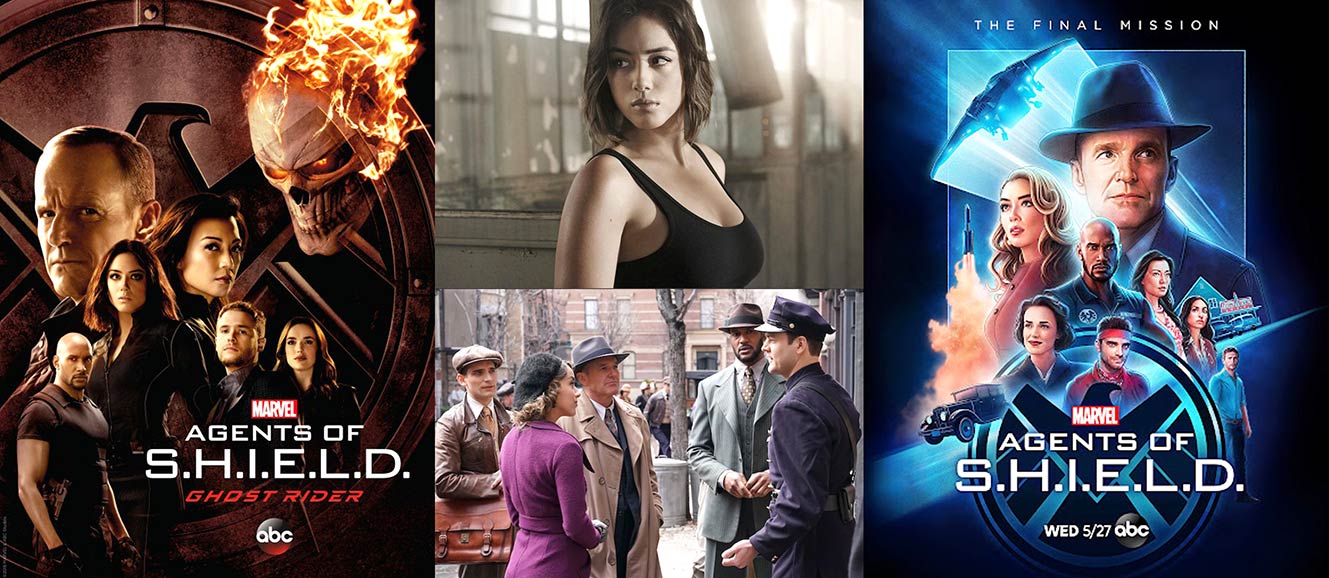
Marvel’s Agents Of S.H.I.E.L.D


S.H.I.E.L.D Of Dreams

Marvel’s Agents Of S.H.I.E.L.D
TV Series Seven Seasons 2013-2020
Marvel


Warning: Big spoilers throughout.

I’ve been holding off writing about Marvel’s Agents Of S.H.I.E.L.D for seven years now*, mainly because when it first started, it was an okay show with not much I felt I could say about it in a seasonal review. So my plan was always to do a small general round up review of the show once it had finally finished and, after a couple of years of resurrections when the show was threatened with cancellation but then managed to stay afloat, which is a hard proposition in today’s television landscape, that point has finally come.

The show’s big pull in the beginning was the ‘return from the dead’ reappearance of Agent Coulson after he was stabbed through the heart by Loki in The Avengers (aka Marvel’s Avengers Assemble, as it’s known over here in the UK). So Clark Gregg was back as Coulson and we got introduced to various members of the S.H.I.E.L.D team as well as an inadvertent newcomer to the group. So we had regulars Ming-Na Wen as ‘tough as nails’ killing machine Melinda May, Chloe Bennet as Daisy ‘Skye’ Johnson (who would become Quake after gaining superpowers a few seasons down the line), Elizabeth Henstridge as super scientist Jemma Simmons, Iain De Caestecker as her co-super scientist Leo Fitz and Brett Dalton as Grant Ward... in the initial line up.

And when it started it was a modest kind of weekly ‘mission impossible’ affair, sometimes linking into cleaning up loose ends from the various Marvel movies and pitting the agents against Hydra and various super powered enemies... sometimes taking The X-Files route to building up the mystery of whoever the villain of the week would be. And there were some intriguing but well telegraphed plot lines and outcomes... and others that you didn’t see coming and kept the programme fresh. Coulson’s seeming immortality and his discovery that he had been brought back to life by Nick Fury through the use of untested alien technology led to its own problems and a long running story arc and then, just as you kind of knew he would, the young heroic, well liked and trusted leading man character of Grant Ward turned out to be a double agent villain working for Hydra at the end of the first season and became, for a few seasons, the teams ultimate arch enemy.

Like the Marvel comics it was inspired by, there are sometimes deaths of characters but Agent Coulson, who dies a few times over the course of the show, was always brought back through one contrivance or another, sometimes with or without the prosthetic, weaponised arm which replaced the one which a fellow team member had to cut off to stop him from being infected by an alien virus (or some such... it was a while ago). That team member was one of a new batch of regulars and semi regulars played by Henry Simmons (as Mack), Natalia Cordova-Buckley as the super-speed powered Yo Yo, Nick Blood as Lance Hunter, Adrianne Palicki as Bobby Morse, Joel Stoffer as mechanical alien being Enoch and Jeff Ward as Deke Shaw, who is the grandson of Simmon’s and Fitz loved up couple from a bleak, future time line. Oh... and in Season 7,  Enver Gjokaj reprising his role as Daniel Sousa from Agent Carter, who hooks up with the gang in the 1950s and stays with them as they try to return to their own time... yeah, give me a minute, and I'll get there.

And there were also some heavy hitting regular guest stars turning up in the show from season to season too, such as Bill Paxton as an enemy double agent, Kyle Machlachlan as Daisy’s super villain father she never knew who rebelled against The Inhumans (if I’m remembering properly) and John Hannah as the scientist who helps Fitz develop the Lifesize Model Decoys (LMDs) who were in the original comics, before the technology gets the better of them and the regular team all spend most of a season imprisoned in a crazy AI universe and embedded into different versions of their characters.

So the thing about Agents Of S.H.I.E.L.D is that, every time you think the show was just about played out, it kept reinventing itself. For instance, Brett Dalton reprised his Grant Ward character a couple of times after he got killed, first as a superpowered evil alien God who took the form of Ward and then, later, as a nice guy iteration of him in the AI mirror world that Fitz’ lady robot traps them all in. So interest was held a number of ways such as, in one season, the introduction of Gabriel Luna as that season’s regular character, Ghost Rider. And then, before you knew what hit you, the finale of one season finds the gang all up in space in the far future, trying to stop an alien race from enslaving what’s left of humanity after a future timeline variant of Daisy has destroyed the Earth. All in a days work.

When they get back to their own time, now as fugitives from S.H.I.E.L.D, they are trying to stop the same timeline re-occurring and, frankly, failing at it a lot of times over. And then the next season would be a search through space trying to locate Fitz and then, when Coulson has died and an evil alien using his body clone has also died, he’s back as a mechanical, sentient alien being rebuilt by Enoch and the gang are all time hopping through various points of Earths history, trying to stop an evil alien race from changing time so S.H.I.E.L.D aren’t there to stop them in the future. That last is basically Series 7 of the show and, yeah, it’s a fantastic finale to a series that, as I said, just kept getting better and better. I loved how the seventh season shows’ opening credits emulated the media of the period that they were in from week to week and I double loved that, when Coulson got vapourised in the 1980s, Deke took his downloaded memories and rebuilt him on a TV set as a ‘Max Headroom’ version of Coulson, while they were waiting to rendezvous with the rest of the team who had accidentally jumped into their future, where Coulson’s body is rebuilt again.

The show is fast paced and has all the Marvel stuff you would expect... the budget allowed for some nice special effects and usually at least one or two battles a week. Not to mention a strong series of plot arcs performed by a bunch of actors who, honestly, really are brilliant at these roles. I don’t know if the same is true on the set but certainly they seem to have some good chemistry together on screen. I like how it managed to retain a certain freshness by around season three where the structure and milieu of any given season was never the same as the one before. I also like that they at least tie up the character line of Agent Sousa from Agent Carter and allow for both his death (he has to die because the history books said he did) and his resurrection as the S.H.I.E.L.D agents manage to fake his death so he can reappear in the future as a member of the regular team. It all sounds silly but it’s all quite well written and I did appreciate this show. If Disney deem to release the seventh series on Blu Ray at some point then I’d probably pick up a box set and rewatch all these through one day. Although, the way they’re going with their stupid Disney Plus channel, that’s looking less likely I suspect.

So there you have it. If you’re a fan of the Marvel Cinematic Universe iteration of the Marvel properties (there are a few, rare MCU character guest appearances too, from time to time) then you’ll probably have a good time with Agents Of S.H.I.E.L.D, especially by the time you hit the fourth season and the changing nature of the programme starts to assert itself. Definitely give this one a go but don’t miss out on Series Seven, which, by the logic of what I’ve been telling you, is the best season yet.

*at time of writing.

Sunday, 17 October 2021

The Night House


The House By
The Symmetry


The Night House
USA/UK 2020
Directed by David Bruckner
Walt Disney


Warning: Some mild spoilers.

The Night House is an interesting film and I almost had a really great time with it. I say almost because, like the plot development of the dream world depicted in certain moments in the film, it’s very much a game of two halves. I’ll get to that in a while but let me tell you some of the plot set up and the good stuff first.

Well, for starters, it’s got one of my favourite modern actresses playing the lead protagonist, Rebecca Hall (from amazing movies like The Awakening, reviewed here and Professor Marston And The Wonder Women, reviewed here) as Beth. And she really is fantastic in this (isn’t she always, even in lesser movies like Iron Man 2). The film starts when she returns to her lake house, after her husband’s funeral. Her husband, who designed and built the house, has shot himself in a boat in the lake with no inclination that he had suicidal tendencies and Beth, a local school teacher, is left to deal with her grief. There are a few other characters in the film such as her best friend Claire, played by Sarah Goldberg... but the majority of the film is just Beth dealing with her grief and then being caught up in weird events when she is regularly awoken by a presence she believes is her dead husband.

And all that stuff is great. There are a few good jump scares to it although, admittedly, when it does try this one too many times too often, such as a shot following Beth dozing off while laying on Claire’s knee (I don’t think it was supposed to be a reference to Éric Rohmer), the scares do start getting more predictable and, therefore, not scary, it has to be said. But the moody atmosphere is kept going throughout and I’m pleased to say, in terms of the supernatural occurrences in the film, the movie delivers the goods and doesn’t cop out when it comes to escalating the degrees and machinations of the antagonistic phenomena.

Also, Rebecca Hall really does carry the movie for a lot of the time. In her interactions with the occasional character that crops up, such as a woman she finds her husband may have had an affair with (it’s more complicated than that), Beth is written as a very sharp, stand offish, confrontational and smart woman and, yeah, that’s tailor made for an intelligent actress like Hall, for sure. And great swathes of the movie are just her on her own with barely any dialogue, so you need someone like her in this kind of movie.

The film is loaded with beautiful shot compositions too. The director uses very clear vertical sections and splits to delineate different areas of the house and even uses a shot I’d seen done in a new movie a few weeks before, where Beth’s head is small in the shot and framed within a rectangle of a grid of windows, as we look in at her from outside the house. It turns out, the symmetry of the compositions and the camera movements around those little vertical splits are very much a part of the story and there is a really neat trick where the director uses the negative shape of a column (think of the old candlestick illusion of the two faces in profile), which looks like a man’s face, to surprise the audience when the face made out of the negative space looks around at Beth. Unfortunately, the director seems so pleased with this shot that he repeats the trick a fair few times after that and it loses its impact very quickly.

The real problem is the bizarre mix of over sharing the various mysteries of the house... it’s ‘backwards’ twin house, some kind of occult rituals, Beth’s back story containing a ‘dead for four minutes’ experience, a book on Caerdroia (a term for a Welsh turf maze which I think is supposed to be a metaphor for the construction of the house itself) and various ghost women running to the lake... and giving the audience too many elements to process without really explaining the relevance of a lot of them. Now I know the ‘secret’ at the heart of the mystery, for example, I am still left scratching my head about the relevance of a lot of the plot elements found in the movie. It feels, by the last reel, vaguely unsatisfying and like the writers just let it all go and spoiled all that good build up. I must confess that, once I’d realised the film was over, I said to myself that I must read the novel this film is obviously based on to find out the real significance of all the occult jigsaw puzzle pieces scattered throughout... only to find out that it’s not even based on a book and is an original screenplay. So, yeah, I really didn’t understand how a lot of these things fit in and I’m not usually that slow on the uptake in most movies.

So, what else can I say about The Night House other than it has a gorgeous score by Ben Lovett which I wish had gotten a proper CD release? If you’re a big Rebecca Hall fan then definitely take a look at this one as she’s always an interesting actress to watch. If you’re a horror fan... I suspect this wasn’t made with you in mind because it’s not going to scare you much, I would think. If you’re not normally a watcher of the genre, then you may get something out of this one and it’s probably a good, light introduction to the supernatural, if you have a hankering to try out something like that. I probably won’t be watching this one again anytime soon and I just wish someone would tap Rebecca Hall to make a proper sequel to The Awakening at some point in the near future, to be honest.

Thursday, 14 October 2021

1974 - La posesión de Altair


The Altair Limits


1974 - La posesión de Altair
Mexico 2016 Directed by Victor Dryere
Cauldron Films Blu Ray Zone A


Warning: Some minor
spoilers here to set the scene.


1974 - La posesión de Altair is a film which was completely off my radar until Cauldron Films, in the US, released a Blu Ray of it recently. In fact, my only reason for buying this release was because it was bundled with the CD soundtrack to the movie and proper CDs are becoming scarce in the phase of music business ignorance we all find ourselves in at present. So I pre-ordered this and finally it’s here and, much to my delight, it’s a great little horror movie lurking within the box.

Well, I say horror but, that’s actually a hard call, to be honest. A couple of decades ago, when I first saw the giallo All The Colours Of The Dark, I was watching it and wondering why the hell people thought it was a giallo when it was obviously a horror movie all the way through until, in the last ten minutes or so, the rug was pulled and it turned out to be a giallo after all. Well, without giving anything away, 1974 - La posesión de Altair has a similar moment, or set of moments, leading up to a similar theme of subverting the genre somewhat but, I think when all is said and done, the use of horror tropes in this one is totally justified and, as far as I’m concerned, it still functions under the genre of horror movie... albeit not the kind I was expecting. Which is also great, of course. I do have one caveat but I’ll get to that in a while.

Okay, so briefly, the film tells the story of a young Mexican couple, Altair (played by Diana Bovio) and Manuel (played by Rolando Breme) after they move into a nice, big, somewhat secluded property. The film is a found footage horror and starts off with black and white interview footage of the aftermath of the events of the film from a TV news broadcast to give foreshadowing, before going into the full colour story proper through the traditional, ‘film everything that happens to us’ route of the found footage movie. Basically, shortly after moving into a new property, Altair starts talking to an ‘angel’, unseen by Manuel and the audience and, not long after, starts acting both withdrawn and crazy. For instance, she has been told by the angel to build two, black painted brick ‘doorways’ in both her bedroom and the basement and, though she doesn’t order the materials, the bricks and black paint arrive in the garage for her the next day. Lots of the usual sound design scares and the old birds flying into the house tropes are involved but also a moment when the new puppy, Carlo, who has been lost for about a week, turns up again as a much older dog. Manuel enlists the aid of his best friend (to document the strange phenomenon) and also Altair’s sister... and they try to get her some help from out of her past and figure things out.

The film doesn’t show a lot of gore (although there is some, such as Altair bleeding from the eyes in a kind of stigmata moment... an image used on the trailer and marketing for the movie) and instead, the majority of the scares come from the camera anticipating what you don’t see (even providing a couple of nice jump scares at times) and the strong ‘sound design’ style soundtrack from composer and sound designer team Enrico Chapela and Uriel Villalobos. In addition to the CD soundtrack of this, there’s a short but sweet extra giving an insight into the ‘score’ (I still maintain ordered noise is music... because it is) and how instruments were disguised and disturbing sounds like babies crying and cats mating were sonically transformed into something less recognisable but equally unsettling. And, as far as I’m concerned, it all works very well.

There are some clues about the nature of Altair’s possession dropped through the narrative and, I have to say, I did get there just 20 minutes or so before certain chilling events take place... but that being said, the film really delivers the scares and explores a cross pollinated concept which I’ve only personally seen done once before so, yeah, I thought this one was brilliant.

There’s also some room, given the found footage nature which would almost eliminate this, for some nice moments of shot composition. For example, when Manuel’s friend Callahan (played by Guillermo Callahan) is filming an intimate conversation between Manuel and Altair, where Manuel’s face is more prominent in terms of facing towards us, Callahan pans the camera around to a mirror mid conversation so we get almost a reverse shot. Which actually perhaps stems from this character’s hastily established love of cinema. Both the main male characters are cineastes with Bergman and Hitchcock’s names being invoked at various times. Also, despite being listed as an anachronism on the IMDB,  Callahan’s penchant for mathematics and his recent trip to Budapest justify, to some extent, his possession of a Rubik’s cube, which was invented that same year but wasn’t actually on the market yet.

My one problem with the film was the found footage nature of a movie being set in 1974. The whole thing is supposed to be shot on Super 8 film (and this is indeed how the director shot the majority of it) but I really don’t think the average man on the street would have been wasting expensive Super 8 film to record everything on. I get it that the character is a stop motion animator working from home and so he has drawers full of the stock but, yeah, you would get through so much more of it that it would cost a small fortune. Back in the 1970s, when my family had an old Super 8 cine camera, I think we only got about six or seven reels shot because, yeah, this stuff was expensive. You certainly wouldn’t have wanted it to go wandering around the house shooting off film as you go.

However, that being said, it does give the film a nice ambience it might not have had, albeit that nothing that happens in the story necessitates the need for a period setting at all (but that’s another story) and, if you can get past the more modern attitude of people filming everything, then it’s all fine. And as it happens, I had an absolute blast with 1974 - La posesión de Altair and would recommend it to all my horror loving friends. I wish it had got a proper cinema release in the UK so I could have experienced the film properly but, who knows, one day we might get the opportunity. One of the better of the found footage movies and now I’m off to listen to the CD.

Wednesday, 13 October 2021

Uncle Tom’s Cabin


Dirty Cotton
Scoundrels


Uncle Tom’s Cabin
aka Onkel Toms Hütte

USA/
West Germany/France/
Italy/Yugoslavia
1977
Directed by Géza von Radványi
and Al Adamson
Severin Blu Ray Zone A


Wow... okay then. First of all, as you’ve probably guessed form the specs up the top, if you didn’t already know, that this movie is one of those bizarre Al Adamson re-purposed films that his company, IIP, used to foist onto the public as new product, following the latest trends and, somehow, managing to be quite successful for the most part. This time it’s the turn of a 1965 West German movie called Onkel Toms Hütte and based, of course, on Harriet Beecher Stowe’s popular and somewhat influential (by the sound of it) novel Uncle Tom’s Cabin.

Now, I don’t really approve of slavery as a thing and I also hate watching a lot of it in movies. I can tolerate stuff like Ben Hur because I know the lead protagonist removes himself from the equation to get his revenge but, as a rule, this trend of slaves working on cotton plantations is not something I can usually stomach and, truth be told, I tend to find these things really boring. Indeed, I only saw Tarantino’s Django Unchained once, when it was released into cinemas, because the whole second half of the movie is just such a tale. Honestly, the first half of that film was electric but when it reached a certain point, my brain kinda switched off. However, this one is part of the massive, 32 movie Al Adamson - The Masterpiece Collection box set from Severin which I’ve slowly been making my way through and, well, I really didn’t want to miss any of the films out.

The re-release of this film in this particular form comes about because of two things... the success of the plantation movie Mandingo, from two years prior and, more importantly, the success earlier in the year of the TV mini series Roots. IIP wanted something to capitalise on the success of that show and so they got hold of this movie but needed to really spice it up for audiences if they were going to make a success out of it.

Now then, the original version of the movie is almost three hours long. Here, Adamson has shot and added in a few scenes which lurk completely on the periphery of the plot in that way only he seems to be able to get away with... containing all the lurid content you will find in this movie totalling for, maybe as much of twenty minutes of it. However, bear in mind that, even with Adamson’s extra sex and torture footage added into the mix, the re-release only plays out for just over an hour and a half. So something in excess of an hour and a half has been excised from the original film’s running time.

Now, the film itself, the original, obviously jumps around a bit now but it basically tells of a nasty cotton farmer/slave trader called Legree (played here by Herbert Lom) and of the slave ‘Uncle’ Tom played by John Kitzmiller who, when he is close to death after one of many horrible crimes upon his people perpetrated by Legree, incites the slaves to run, burn down Legree’s big house and flood the cotton fields as they make their escape. And, from what I can see of it, despite the horrible subject matter, it’s a fairly engaging film and I could take it or leave it. Preferably leave it.

But then there’s Adamson’s scenes including a slave called Napoleon, who ties in with the West German footage only because he has the same name of a barely glimpsed character who jumps off a steamer and is suddenly played by a different actor, Prentiss Mouldon. Adamson regular, the lovely Marilyn Joi, also turns up in a pre-credits rape scene. And there’s some interesting things going on with the film in this version.

For example, sandwiched between the prologue and the opening credits, such as they are, is a load of footage from the film (including, I suspect, some of the excised bits) with screen loads of short, sharp blurb about the importance of Harriet Beecher Stowe’s novel and it kind of makes a bizzare, mini trailer for the film you are about to watch...which I’ve never seen done before.

The other interesting thing about it is just how well Adamson works to blend his footage in with the original film. I mean, don’t get me wrong, once you know it’s extra footage inserted you can tell, for the most part, which are the additional scenes... and I suspect a siege on a monastery near the end of the picture may also be ‘Adamson enhanced’ because, for a minute there, it almost turns into a Western... yarhoooo! However, you can tell that Adamson’s really given it some thought here because he’s obviously studied what Radványi did in his version of the movie. For example, the whole movie, including Adamson’s sections, is based on a very pastel colour scheme which is almost exclusively browns. Everything looks like it’s brown or sepia almost, with no other really strong colours showing up too much. Another thing Adamson does, at least at the start of his scenes, is take a page from Radványi’s book in approaching things from a distance with long shots. Radványi uses a lot of master shots rather than reverting to close ups on his film and, although Adamson doesn’t eschew close ups like the former director, he does give it that kind of look in parts of his scenes to better match up, in visual style at least (certainly not tone), to the original footage. So, yeah, bearing in mind what he did with films like Horror Of The Blood Monsters (reviewed here) and Mean Mother (reviewed here), it’s really a step up for his approach on this one, I think.

All in all, though, I don’t have too much to say about Uncle Tom's Cabin. I’m not even once tempted to try and source the original 170 minute version to watch and I probably won’t ever revisit this version again. It’s not as bad an experience as I thought it would be, for sure but, I didn’t really have a good time with it and wouldn’t recommend it to anyone, in all honesty. Interesting as another experiment in the way you can change films but, ultimately a chore to watch and I’m much more looking forward to the next couple in Severin’s mighty boxed edition. 

Tuesday, 12 October 2021

The Complete Stories Of Doctor Satan


Satan’s Little Helper

The Complete Stories
Of Doctor Satan

Written by Paul Ernst
Fiction House Press
ISBN: 9781947964891


I first learned of the literary character of Doctor Satan at the beginning of the year, due to a tome dedicated to the cover artist who painted three covers featuring the character, The Alluring Art of Margaret Brundage - Queen Of Pulp Pin-Up Art (reviewed here). My mind obviously immediately jumped to a famous cinema serial but, it turns out, this character has nothing to do with the one portrayed in the 1940 theatrical serial Mysterious Doctor Satan. In fact, this predates that character by four or five years.

Doctor Satan was a ‘supervillain’ created by Paul Ernst. He wrote eight fairly short Doctor Satan stories, pitting him against his arch nemesis, the hero of the stories, Ascott Keane. He and his secretary Beatrice Dale manage to, more or less, temporarily defeat Doctor Satan in each story... but the readership of Weird Tales, which is where these stories appeared from August 1935 to August 1936, didn’t think a lot of him and the character didn’t resume his terrorism on the world after those initial eight. The stories included are Doctor Satan, The Man Who Chained The Lightning, Hollywood Horror, The Consuming Flame, Horror Insured, Beyond Death’s Gateway, The Devil’s Double and Mask Of Death.

Now, I have to say, I’m a little bit with the majority of the readership on Weird Tales on this one but, there’s enough interesting features to the stories which made this worth reading. The primary one being the strange and diabolical death traps, a different one in each story, that Doctor Satan uses against his victims to try and inspire huge ‘protection’ payments from others... regardless of the fact that he’s, like Ascott Keane, a rich millionaire playboy and in Satan’s case, doesn’t care about the money... he just likes to bend people to his will and uses the money as his goal. Among the manners of death devised by Satan, are poisonous insects, a spotlight which causes the flesh, muscles and blood of a body to shift their molecular state so that they’re transparent (leaving people looking like living skeletons), a static electricity disintegrator bomb which charges up to the required power to explode according to it storing up enough energy when an automobile hits a certain speed, people who combust from the inside out, a paralysing gas which leaves men dead for a number of hours, a ray which kills people by shrinking them down to the size of a little doll (I wonder if the creators of The Master in Doctor Who had access to these tales?), hypnotic trances designed to make the victim go mad and a device which changes the speed of time flow at whatever it’s pointed at... so that people and objects are slowed down to frozen or, in the case of one, sped up so that his heart shatters.

By far the most spectacular death, though, is used as the opening hook for the very first Doctor Satan story. In it, victims complain of dizziness and headaches for a good number of hours before dying from a fast growing tree sprouting out of the top of their heads. This is quite a spectacular death and I’m surprised that nobody has done this in a film (as far as I know). It turns out that the victims are accidentally inhaling a seed placed in their vicinity which works its way up the nostrils and into the brain, where it quickly grows to a big tree-like plant through the top of their crushed skull. Satan’s deadly skills are a combination of rational science and his studies of the occult, both skills which are also inherent in the main protagonist of the stories, Ascott Keane.

Now Ascott Keane is a quite boring but notable figure. Mostly he’s boring because the stories are so short that no real personality has time to manifest before he’s already tracked down Doctor Satan and is having a ‘final battle’ with him. However, he’s a wealthy individual who pretends to be a shallow millionaire playboy while he secretly helps out those in need with his remarkable crime busting skills. Hmm... sound familiar? I guess he may be partially inspired by Lamont Cranston in The Shadow stories but, either way, this seems like a template for a certain Bruce Wayne, who wouldn’t make it into comics as Batman until that character’s 1939 debut. I would imagine Bob Kane and Bill Finger would have been reading pulps like Weird Tales, The Shadow and Doc Savage at the time. I mention Doc Savage because the fantastical elements of the stories used by Ernst for this character seem pretty inspired by Lester Dent’s iconic hero of bronze. One difference being that these stories are not particularly well written... whereas the Doc Savage novels are little works of art. Another difference being that although the strange components of the mysteries faced by Doc are always explained away by science (excepting the very last of Dent’s stories about the character, Up From Earth’s Centre), the strange devices and devilish plots weaved by Doctor Satan rarely stand up to scientific explanation and are almost always sugar coated with supernatural, occult icing on the cake. Which makes them both less credible and, feeling like a bit of a cheat if I’m honest. However, without those elements we wouldn’t have a story where Doctor Satan and Ascott Keane fight in spirit form in the astral plane, as their bodies are both sent into death for a period of time as they explore this other world.

I can’t find much in the way of information about Doctor Satan but I do have some issues with the order of the stories. Weird Tales often chose to not publish stories in a chronological order (as I found out when I read the Conan stories in the order in which they appeared in the magazine) and there are some dead giveaways here. For the majority of the stories, Doctor Satan has two thuggish assistants working with him called, Girse and Bostiff. Bostiff is interesting because he is quite muscle bound but has no legs, resembling one of the lead characters in Tod Browning’s Freaks... so how the writer can quite casually use this guy to manhandle victims for Doctor Satan is puzzling at best. He never uses a wheelchair, just uses his arms as legs while simultaneously seizing people and lifting heavy objects somehow. This makes no sense to me. He seems a somewhat inefficient kind of ‘right hand man’ to have around, at the best of times...

Anyway, regardless of this, Girse is killed by Ascott Keane in a trap meant for himself in the fourth story, The Consuming Flame. Which is fine but, in the fifth story, Horror Insured, Girse is back in it like nothing had even happened. What’s more, he is killed by Keane again at the end of this one. I’m guessing Horror Insured was, perhaps, originally rejected and so Ernst maybe wrote another story featuring the death of Girse, The Consuming Flame. And then, I suspect, the editor of Weird Tales decided to run his original ‘death or Girse’ story a month or two later. Which makes for a glaring continuity error.

Similarly, Bostiff meets his death at the hands of Keane, wielding the occult powers of the Blue Mist of Death in The Devil’s Double. However, in the next and final tale, Mask Of Death, he seems to be up and about again with no mention of how he’s back from the dead. So I’m assuming the publication dates were flipped for these two stories and they were not printed in the order the writer intended.

And that’s all I’ve got to say about The Complete Stories Of Doctor Satan. It’s a nice enough idea of a character and has some really cool, strange concepts written into its DNA which make the stories worth reading, even though they could have been a lot better written to capitalise on the strength of the sometimes ‘totally out there’ fantastical elements. Not one I’d recommend to many people unless you have read other pulps and these are no comparison to the Doc Savage novels, it has to be said. Still, happy to have had the opportunity to read them and, well, they’ve pointed me in the direction of something else I need to read... if I can lay my hands on another ‘out-of-print’ copy.

Monday, 11 October 2021

Agent Carter


Get Carter


Agent Carter
Original Airdates:
Season 1 - January to February 2015 (8 episodes)
Season 2 - January to March 2016 (10 episodes)
Marvel Blu Ray Zone B


Warning: Some spoilers. 

 Following on from the popular Agent Carter One Shot short movie included as an extra on the Iron Man 3 Blu Ray and DVD, Hayley Atwell reprises the role which she first played initially as Steve Rogers’ love interest in Captain America - The First Avenger and some of the other Marvel Cinematic Universe films depicting her at different ages in different times. This show is set in 1946 and I came to it via a very cheap Blu Ray set from my local cash converters. Well, I can tell you that I was so impressed with the first episode that I ordered a Blu Ray set of the second season straight after watching it so that, by the time I’d finished the first series, I could go straight onto the second.

Initially we see a version of Peggy Carter who is still mourning the loss of Captain America as she is handed all the menial ‘women’s jobs’ in the intelligence agency for which she works, the Strategic Scientific Reserve (SSR). However, as you would expect, she starts doing things her own way and getting a jump on the case in hand, without the knowledge of her superiors and co-workers, subsequently making herself a target in the process. Here, she works to clear the name of Howard Stark, as played once more by Dominic Cooper from the role of Tony Stark’s dad in Captain America - The First Avenger and is assisted throughout the majority of her investigations by Stark’s butler Jarvis (played wonderfully well by James D'Arcy) while trying to throw her newish, possible romantic interest, fellow agent Daniel DeSousa (played by Enver Gjokaj) off the scent of what would be her perceived collusion with an enemy. All this after an arsenal of Stark’s weapons is raided and unleashed into the wrong hands by an unknown party.

The casting is wonderful and everyone does a good job here. Hayley is pitch perfect and, honestly, takes to the action just as well as she does to everything else about the show. She had me when her character uses a leather jacket and thick gloves to scale an electrified fence in seconds during the first episode. And it’s the kind of thing you expect from Marvel when they get things right... and as you know, Marvel really have a good track record with getting their stuff together properly (with just the odd glitch here and there on the way).

As you would expect, there are also lots of little throwaway references to all things Marvel and it has a lot of ties to other concepts in the MCU too. Such as, in the second series, when they are trying to shut down a dark matter rift, they use a new invention called the Gamma Cannon, which is obviously a forerunner of the technology that gave us The Incredible Hulk in the cinematic version of that character’s creation. Or the main villain in the second season being Whitney Frost, who long time fans of Marvel will know debuted in the comics back in 1969 as the character Madame Masque. Another example of the wonderful referencing cementing the various MCU structuring would be one of the main villainesses of both series, the lethal Dottie Underwood. She is one of the ‘Black Widows’ trained by the Russians from a young age to be a ruthless killing machine (and has Peggy and her colleagues in her sights). Alas, that character is left at a loose end at the end of the second series (I’ll get to that in a minute) as is another character which would eventually herald in the Winter Soldier programme. It’s good to get another look at Sgt Fury’s Howling Commandos in action again too although, of course, in the cinematic version of the Howling Commandos of the 1940s, Nick Fury isn’t their sergeant at all.

And, it’s a fast paced show with some absolutely beautiful period sets, costumes and cinematography... indeed, vintage stockings were used over the camera lenses as they were back in the day because they couldn’t afford to shoot with the same special lenses they used in the first Captain America film. There are some nice nods to the obvious, such as Hopper’s Nighthawks inspiring a certain aesthetic to a lot of the show and sometimes the not so obvious, such as a wonderful, dream musical sequence in the second series. This latter is a really nice attempt at doing one of those big budget, abstract set piece musical numbers and it’s a real blast, although I think in terms of this specific variant it’s possibly just a shade too early, by maybe a couple of years,  in terms of that particular style being used given the show’s 1946 setting, perhaps?

Now, the slight downside is that the writers obviously didn’t know the show was going to be cancelled. So some of the characters like Dottie Underwood are deliberately left to bring back into the action in a later series and, although the second series does have a proper resolution to things (Peggy gets the guy!), they couldn’t resist leaving things on a cliffhanger to set up the next show. So, in the last minute, a main regular character is shot dead by an unknown hand. I guess that one may never get resolved now, although Agent Sousa goes on to appear in the time-travelling episodes comprising the seventh series of Agents Of SHIELD. And, yeah, we already know what Peggy’s future holds in store for her from the MCU films... and we also know what her re-written past will probably look like, given Steve Roger’s return trip to the 1940s to be with her and live his life out with her in Avengers Endgame (which also features James D'Arcy as the original version of Jarvis). It’s resolution enough although, it has to be said, the obvious resolution the show would be working towards would be Peggy Carter getting together with Howard Stark to set up SHIELD. It’s a shame that we didn’t get to see this before it was cancelled but, then again, with the current MCU status... you never know, we might get fed more information about those events in time. My understanding is that one of the reasons the show was cancelled is similar to the reason the Emmy award winning Tales Of The Gold Monkey (reviewed here) was prematurely stopped... aka, not enough ratings to justify the extra expense of making a historical period show, alas.

Meanwhile though, as they say in the comics, we are left with two seasons of an absolutely splendid TV show which dovetails nicely into the current MCU and is a real joy to watch. Agent Carter is something you’re really going to want to take a look at if you want to see the flesh on the bones of the character whose life, death and then life again was referred to throughout Phase 1 to 3 of the MCU films and possibly, for all I know, coming again in Phase 4 (surely the new Doctor Strange movie, given its probable plot, could slip a few more things into the mix?). Marvel fans are definitely going to want to familiarise themselves with this show.

Sunday, 10 October 2021

The Mummy's Curse


I’ll Have
Ananka One


The Mummy's Curse
USA 1944 Directed by Leslie Goodwins
Universal Blu Ray Zone B


The Mummy’s Curse used to be one of my favourite films of the Mummy franchise but, I dunno, it seems like less the movie I remember nowadays. I’m going to go right ahead and get the whole ‘series continuity’ elephants in the room out of the way first because, frankly, there are some big ones here... in keeping with the continuity crimes of the previous films in the series. This one was directed by Leslie Goodwins, the guy who directed the Mexican Spitfire pictures with Lupe Velez, in the very same year as the previous entry, The Mummy’s Ghost (reviewed here) and, frankly, I’m surprised that the writers here managed to build on those continuity problems even more. So let’s get to it...

If you remember the last film, Kharis and the woman hosting the soul of Princess Ananka sunk down into the swamp in New England. Now the swamp is being drained to make way for building work and Kharis is already up and about, with the help of yet another egyptian High Priest (plus his murderous assistant), who is trying to help Kharis find Ananka. However, absolutely nobody can answer the big, obvious question here? Why the heck the swamp has suddenly moved geographically to... New Orleans. Yes, that’s right, sink in a swamp in Massachusetts and rise in The Big NO. Nobody refers to the location of the last film in any way, shape or form and are acting as though the last picture took place in this latest locale.

Not only that. I’ve already said the films tend to jump anywhere between 3 to 30 odd years between sequels, right? Well this one is set a whapping 25 years after the last one but, guess what folks? Yeah, that’s right, 25 years have passed but characters are still getting drafted into the war because it’s still 1944. What the heck? I just read that somebody had worked out the time shifts between the films based on when the first one is set and, by rights, the action here should be taking place in the year 1997 but... no, ‘tis still 1944. Gosh knows what would have happened if Kharis had turned up in The Devils Brew (released as House Of Frankenstein, reviewed here) as originally planned.

Furthermore, when the decidedly confused and amnesia ridden Princess Ananka does come out from under the earth, well... she went down as actress Ramsay Ames but now she’s being played by Virginia Christine. Both lovely ladies but, really? It was shot the same year, couldn’t they get the same lady back for the next one? I’m speculating here but Virginia Christine has gone on record that she feared for her life in the scenes where the bandaged Lon Chaney Jr, playing the role for his third and last time, carried her around because he spent most of the production drunk. So maybe there was... I dunno... some tension between him and Ames in the previous shoot. I’m just speculating here but... well, it would be interesting to know if somebody has the information.

Okay, continuity aside, it’s not a bad picture but, considering it’s short, one hour and some seconds running time, it’s exceptionally slow. It takes maybe a half hour before Kharis even lumbers into the picture properly and it doesn’t help that we get a lengthy recap of the back story of the character (again using footage from both the Boris Karloff and Tom Tyler movies) to keep things from getting pacey.

Still, asides from the incredibly dull first half an hour, there are still some entertaining and also notable things about the film. Entertaining such as in lines of dialogue which brought a smile to my face like... “Come, the hours do not linger.” instead of just telling someone to hurry up. Or the discovery of... “freshly murdered men.” Oh, well... glad they were still fresh then, I guess.

The real big thing for me is the fact that we have an undead, reanimated corpse of a character, Princess Ananka, pushing up through the earth she is buried in with her hand, followed by the rest of the body. Many people think this was first done by George A Romero in his 1968 zombie classic Night Of The Living Dead. However, I can think of at least two other times prior to this that I’ve seen it done before that film. One would be the 1966 Hammer Horror The Plague Of The Zombies (which I can’t help think influenced Romero just a little) and the other time would be in this one. After all, Mummies are pretty much just Egyptian zombies and so, shot in 1944, I think this may well be the first film in which this was done. If anybody knows of an earlier example of this phenomenon then please let me know in the comments section below.

When Ananka walks around trancelike for a bit, she is caked in dust and earth and so she walks through a stream to wash herself out, so to speak. When she surfaces she looks a normal colour again and, wow, those streams in New Orleans must really be something. Not only does it get her clean, it gets her make up done and her hair styled too. Hair salon owners all over the world need to jump in a plane and wrest the secrets of the magical beautician super powers from the New Orleans swampland.

Other than that, there are a few more nice things. The shadows used to show the first murder as silhouettes against a wall is effective but an overwrought scene where Kharis keeps trying to grab Ananka but people, unaware of his presence keep leading her or driving her away from his clutches by accident just as his hand comes up to get her, actually does kind of play as a comedy almost and I wonder if this was deliberately supposed to register like this due to Goodwins’ other directorial assignments.

The music in this one is by genre composer Paul Sawtell (no, thanks all the same IMDB but he’s not, as you say, uncredited... thanks for playing though) and I think this is the first one of these he’s done (although he’d scored a lot of other pictures prior to this in the five years he’d already been working). It gives the film a somewhat different atmosphere than the others although, I did notice that an earlier piece of music from the Universal monster movies by either Hans J. Salter or Frank Skinner has either been tracked or rewritten for at least one of the scenes towards the end of the picture. And, frankly, it really needed that piece slotting in because, much as I like Sawtell and his future collaborations with Bert Shefter, this one really doesn’t help speed up the picture any and it could have done with some bolder scoring with a few more ‘musical stings’ in  my opinion.

And that’s it... more or less... for The Mummy franchise. There would be one more in the series after The Mummy's Curse but it wouldn’t be Kharis reappearing, it would be a parody of the character for... well, you’ll see in a future review. Keep your eyes open on this blog because we were almost into the era of... the comedy/horror movies.

Thursday, 7 October 2021

Mean Mother


Patch Adamson

Mean Mother
Directed by Al Adamson
& León Klimovsky
USA 1973
Severin Blu Ray Zone A


In a pre-credits scene, a pimp and his associates pay a visit to one of the girls who he has hooked on drugs, setting up for the audience just how bad this minor character is. Then he goes to a rooftop (of course it’s going to be a rooftop... it’s an Al Adamson movie) to buy some drugs off of a Vietnam war soldier called Beauregard Jones, played by Dobie Gray (credited as Clifton Jones). They try to cheat him so he takes out the pimp, his two henchmen plus the two corrupt policemen in the pimp’s pay before grabbing a plane back to the Vietnam war. He’s the... Mean Mother of the film’s title (although he doesn't seem to be wanting to procreate with anybody's mum in the movie so... it might be a bit of a duff title) and the opening credits include shots of Jones from the pre-creds sequence and shots of soldiers (which is a part of the plot which plays out within 5 to 10 minutes of the movie) and is genuinely one of the worst title sequences of any Al Adamson film I've seen to date.

If it could be called an Al Adamson film, that is.

Because what we have here, once again, is a patchwork movie put together by the half cut remains of a Spanish crime movie from two years prior, Run for Your Life (directed by León Klimovsky) with a load of new footage by Adamson (billed as Albert Victor) featuring a ‘parallel plot’ so that he could repackage and sell the movie to the youth of America as one of the growing trend of popular blaxploitation movies. And... it has to be said, it’s not very good. Not absolutely terrible but... yeah, not too far away from terrible either, although parts of it are entertaining, at the very least.

So the Spanish part of the movie has the main protagonist Joe, played by Dennis Safren, with Luciana Paluzzi, the gal from Thunderball (reviewed here) as his love interest. The story follows Joe, who runs from a court martial in Vietnam and goes to Rome, getting mixed up in smuggling and working for a criminal network. At some point it turns into a kind of secret agent movie when Joe is asked to help a Russian ballerina to defect from Spain (where she’s somehow working at the Royal Festival Hall?) and move her to London (wait, what?) but that's also about a valuable jewel she is in possession of and, to be honest, I suspect the great leaps in logic and garbled story line must be because of the bits of the film which got excised for this new, cross pollinated movie (I hope).

Meanwhile, Joe’s ‘mean mother’ of a friend Beauregard also leaves Vietnam and goes to Spain, where he gets mixed up with a girl who stole forged money plates from the mob and who leaves him high and dry, blaming him. With ‘the syndicate’ on his tail, he quickly flies over to Rome to connect up with Joe so they can get away from things with the finances from Joe’s new defecting ballerina job, which doesn’t go without its problems. Beauregard’s main love interest is played by Marilyn Joi, who has used a number of different names in various films and who has been in a lot of Adamson’s movies from this time. She’s always interesting to watch on screen so at least her performance was entertaining, to be sure.

In order to try and sell the idea that these two completely different in tone story elements are somehow part of the same film, Adamson manages to get Dennis Safren over for the new footage with Dobie Grey for two scenes. One is near the start where, even though he is on screen with no other characters other than Safren, Beauregard manages to hook up with Joe in Vietnam where they both decide to go their separate ways (to Rome and Spain). Similarly, there is a scene towards the end of the movie in Rome where the two also hook up. Alas, for Joe’s two scenes in the new footage, the actor seems to have a lot heavier hair and the style he used for the earlier film is not apparent (maybe he was also in the middle of shooting something else at the time)... so he will have really short hair in two scenes sandwiching a scene where it’s much fuller in a couple of places in the movie. Just in case you really were having trouble figuring out which parts of the films belonged to which shoot. Which, trust me, you won’t have any trouble with any way because one’s a Eurocrime movie and the other is a blaxploitation thriller so, yeah... and if you really are having trouble then another clue could be that the soundtracks for each movie are totally different too. Roberto Pregadio provides the Run For Your Life scenes with something appropriate to what’s going on there while Vic Caesar’s funky, wah wah guitar score for our ‘mean mother’ of a character does exactly what you’d expect from that kind of film. So, yeah... these two films don’t splice together seamlessly, for sure.

But, it’s not a chore to get through either and although the separate ending for Joe’s character doesn’t really carry the emotional weight I suspect it’s supposed to... what with half the movie being cut away... Beauregard and Marilyn Joi’s character have an okay ending. Although, their ending includes a car chase through a stretch of desert and I was having real emotional trauma that I was going to have to end up watching that damned Al Adamson car roll again at some point. Fortunately this doesn’t happen this time... that footage is not reused yet again and this is possibly why I was more on board with the ending more than any other factor, it has to be said. Would I recommend Mean Mother to anyone... no. It’s not something I would even highlight to fans of the genres involved (even the Run For Your Life part of the film is somewhat clunky) but I am at least glad I got to see it in the context of my watch through of the huge Al Adamson - The Masterpiece Collection box set from Severin. Also, this disc in the series has a pretty nice interview extra with Marilyn Joi where she talks about her time as a burlesque dancer and then meeting Adamson and going to work in the movies (and how she got some of those parts)... which is a really cool bonus feature. Now if I can just get through the next, similar patch up job of a film on the same disc in the box... I will be happier.

Wednesday, 6 October 2021

Godzilla VS Hedorah


Hedorah Skelter

Godzilla VS Hedorah
aka Gojira tai Hedora
aka Godzilla VS The Smog Monster

Japan 1971
Directed by Yoshimitsu Banno
Toho/Criterion Collection
Blu Ray Zone B


"Promising new director" Yoshimitsu Banno (who in a roundabout way is responsible for the current American cycle of Godzilla movies) only directed this one entry into the Godzilla series. After seeing this one, the producer promptly banned Banno from ever working on another Godzilla movie again. However, rewatching it in a beautiful transfer in the Criterion Collection’s boxed (booked?) edition of The Showa Era series of Godzilla films only confirms, once again, what I always knew about the movie which, frankly, is my favourite of all the films to feature The Big G. Godzilla VS Hedorah is, frankly, the Citizen Kane of Godzilla movies as far as I’m concerned. It’s a little unique and only has two wrong notes in the whole film.

Although Godzilla is still the upright, slightly comical defender of the human race here, the tone of the film is much darker than many of the others and, coupled with an irresistible soundtrack and a mixture of different narrative styles, it’s easily the most entertaining one in my book.

There’s a brief prologue which ponders the ‘origin’ of Hedorah (who has apparently arrived from space) as a parasitic creature living in the sea. However, immediately it starts it pushes the message of the movie, as the sludge and toxic waste which we dump in the oceans and our air gives the creature strength to grow and transform into a larger, even more dangerous creature. And it’s a welcome return, in some ways, to the first movie of the series, in that it pushes a more serious social message about mankind’s stupidity as part of its main message. Indeed, one could almost go on to say that the film is a little too preachy as the message is hardly a sub plot and trumpeted on throughout its entire length.

We then go straight into the psychedelic title sequence with an absolutely fantastic, rocking pop song that is performed by the singer over the main credits in front of a multicoloured series of wax projection lamp slide displays (common to movie party scenes in the 1960s) a little like the way Sheena Easton appeared on the opening credits of For Your Eyes Only (reviewed here). And, yes, of course the song is all about man’s terrible pollution of the planet and, thankfully, it re-occurs a few times in the film so my toes can keep tapping along as I take in the beautful images. I love the rocking title sequence so much and then the director pulls the rug and we’re left with an old clock with no hands, floating in the sludge of the river in an industrial area as a huge downer and darkening of the mood.

This is one of only a handful of Godzilla movies which highlight a child as the main human protagonist (possibly Toho were reeling from the competition with ‘The Other Big G’, Gamera, seen by this point as a defender of children everywhere) but, considering the bleak nature of this movie, where the threat of Hedorah is not downplayed and almost pushes the movie into horror territory, it’s unusual to have a kid as the human viewpoint. But the story doesn’t spare the kid any of the dark... as he promptly sees his scientist father disfigured on half of his face with acid burns when he encounters Hedorah under the sea (think Harvey Dent and you’ll have some idea of what I’m talking about here).

Anyway, despite a wonderful psychedelic disco scene (where the singer performs some of the title song again... yay!) and a scene where the youth of Japan have a big love-in rock festival on Mount Fuji while the tired old ‘old people’ hide in the bushes and watch them with disdain (hmm... think some kind of point is being made here), the film is quite relentless in its darkness. The main gist of the rest of the story being... Hedorah kills a lot of people in the various forms he can mutate into at the drop of a hat (such a a rocket propelled flying saucer of himself or a more Cthulhu-like creature that can shoot laser beams out of its big, red, dead and staring eyes), with mostly just his natural polluting ways (often just flying by them so his noxious fumes reduce people’s bodies to skeletons) and Godzilla tries to stop him. The Big G gets seriously beaten up a number of times (honestly, he loses every fight until the last one quite badly and gets pretty injured throughout) before he utilises a failure of a human invention, built to try and stop Hedorah... and helps it work properly with his radiation breath. This is then converted into anti-Hedorah lightning via these massive electrodes invented by the young whippersnapper’s disfigured father. So, yeah, this is a rare film in which Godzilla actually really needs the aid of humanity to help him protect them from the evil monster. So that’s also an interesting twist.

But there’s so much going on that this simplistic story becomes a feast for the kaiju friendly senses. The director uses a kind of multi-media mish mash of narrative forms to tell the story... such as a number of really interesting and sometimes quite surreal animated sequences, the text and voice-over narration of young kids’ essays on pollution to push a point on screen and the intrusion into the narrative of various newscasters reporting on what’s going on. Indeed, one animated sequence where two women wearing anti-Hedorah gas masks are dissolved has a wonderful transition as the fusion of their dissolved faces becomes the shaded area on a map which demonstrates what the newscaster is relating. I can’t help but think that Frank Miller must have been at least a little familiar with Godzilla Vs Hedorah when he wrote the classic DC mini series The Dark Knight Returns, which uses a similar juxtaposition of ‘newsreel reports’ to invade the narrative and shape it.

Other things of note are the fact that the young protagonist plays with Godzilla and Hedorah action figures... and a selection of wonderfully powerful visual moments such as a yowling kitten being left unscathed but very dirty in the wake of one of Hedorah’s attacks... plus various shots of the actors viewed through the opposite side of an aquarium with the fish floating around in front of their faces. There’s even a black and white scene setting up the kids on Mount Fuji, which pushes the gloominess until they get the guitars out and the scene explodes into colour (a short burst of optimism which suddenly turns tone in another polluting attack from the movie’s antagonist).

There’s also the villain to talk about. If you look at a still of him he looks quite comical but, I dunno, he has an interesting and very threatening presence in the movie. The way he reacts to things with his eye movements actually gives us a kind of window into his alien thought processes on some kind of primitive level and, honestly, the scene where he marches into the industry centre of Tokyo and just stands over a big, industrial chimney belching fumes so he can loudly inhale them while getting stronger, looking like some kind of monstrous Cthulhu junkie deadened by the high of the fumes, is totally unsettling.

The fights are interesting in this one too in that... well, for a start, they’re almost totally unscored. The music which is used in this film is amazing as composer Riichirô Manabe fills it with weird instrumentation and sinister, creepy themes (except for one, I’ll get to it in a moment). And the choreography of the fights themselves are a little like a Sergio Leone spaghetti western. They’re all about squaring off and out-staring the other, less about punching each other out and more about the gravitas of the inevitable conflict. Which is just as well in a way, for Godzilla, because he gets really damaged almost every time he trades blows with the smog monster. There’s also more anti-pollution messages pushed in these encounters and more than once The Big G is left in the dust, coughing toxic fumes while Hedorah runs rings around him or fires globules of disfiguring acid at our giant hero. Indeed, he looks a little like Stallone at the end of Rocky in terms of being none too good for wear from his various, harrowing encounters. So, yeah, it’s less like a regular Godzilla movie in many ways.

The only two noticeably ‘out of tone’ elements also involve music to some degree. Firstly, while Hedorah’s personal musical landscape is quite minimalistic and horror-like, Godzilla has a bizarrely comical theme lumbering onto the soundtrack every time he turns up. It completely wrecks the sombre mood built by the surrounding themes. Secondly, there’s a moment at the end of the film where Godzilla flies, set to triumphant but equally comical music, where he uses his fiery breath to propel himself backwards through the air in controlled flight to catch the ‘spawn of Hedorah’. In a lot of the Godzilla films made just before or after this one, it would have been fine but, here, it’s housed within a film which really doesn’t fit with this kind of inventively comical addition and, strangely (considering the tone wasn’t upheld for the movies that came after), its the first and last time the character flies in this fashion in one of the actual movies.

And there you have it. Godzilla VS Hedorah is, for me, the absolute best Godzilla film ever committed to celluloid. If you’ve never seen a Godzilla film before and want to be hooked by the series then this one is definitely a contender to jump start your obsession. I am loving the new Criterion transfer of this and it certainly won’t be the last time I watch this slice of kaiju genius, for sure. Absolutely incredible. It’s a shame the sequel to this one was scrapped. 

Tuesday, 5 October 2021

The Bodies Beneath


Flipping Celluloid

The Bodies Beneath
by William Fowler and Vic Pratt
Strange Attractor Press
ISBN: 9781907222726


The Bodies Beneath, a curious tome by William Fowler and Vic Pratt, was something of a blind buy for me. One of those books you come across as an interesting looking Amazon recommendation when you’re searching for something else and, to be fair, it certainly turned out to be a better, more informative purchase than the book I set out to order (I’m keeping the review of the other tome I bought to myself because it was so dire). That being said, however, I think it’s fair to say that I found the book fairly interesting rather than out and out saying I enjoyed it. Not that this reaction  to the book should in any way negate the value of the tome in question, by any stretch.

The book is subtitled... or at least marketed with the tagline... The Flipside of British Film and Television and this is because the two writers, William Fowler and Vic Pratt, are the two minds behind the BFI’s Flipside screenings of recent, not too long gone days and also the spin off DVD/Blu Ray Flipside label where a wealth of truly interesting treasure has found a modern audience. So, whatever I personally think of the writing in this one, they certainly have proven themselves to be valuable members of the film community in this country (and globally, as it happens) and have done some valuable work for the cause of the moving image.

Their modus operandi here... or at least their justification for both a title parodying an old Andy Milligan movie and a binding rationale for the contents of the book... is that they are unearthing long lost gems of British cinema, TV and short works which have mostly long been hidden (debatable) or inaccessible to the degree that they have vanished almost without trace from contemporary memory.

What this really means is that the writers do dredge up some interesting works along the way as they each write separate reviews of vanished (and not so vanished) gems from the past and combine a few reviews apiece into each, thematically binding chapter. Those chapters being The Tunnel Of Love, Out Of Towners, Kid’s Stuff, True Stories, The War Room, Music And Movement, Fantastic Fictions and Tales Of Terror. Although, it has to be said, I found some of the linking themes unconvincing in some cases and there are many works described here that, of course, would easily cross over into other chapters.

What surprised me is that, amongst the truly obscure stuff such as the Cornish dance documentary Oss Oss Wee Oss, the sadly lost Cricket Match On A Fishing Smack During A Heavy Sea or the depiction of Anthony Newley’s big budget self destructive, not so cleverly disguised fictional autobiographical feature Can Heironynous Merkin Ever Forget Mercy Humppe And Find true happiness?... there’s also quite a few things that are both not forgotten by anyone and quite often easily available with your Amazon click finger. For example, there’s a whole section on Danger Man in the Tunnel Of Love chapter, which is a chapter dealing with sexuality. To be fair, it brings in Patrick McGoohan’s reasons for turning down playing James Bond (he was sought out for the role and offered it before Connery) and how he didn’t allow the frivolous sexuality of those kinds of characters on his shows but... yeah, obscure it isn’t. And, I’m sorry, the writers may think that nobody these days know about Arthur Lucan when one of them is detailing the interesting events which lead to the movie Old Mother Riley Meets The Vampire, where Lucan (Old Mother Riley) co-starred with Bela Lugosi... but I think he’s dead wrong about that. In fact, as I type this, I know that there’s a DVD box set downstairs of Old Mother Riley films ripe for borrowing and exploration if I ever get the time (I was privileged to see Arthur Lucan’s surviving stand in doing the Old Mother Riley act at a seaside theatre once, as a teenager).

There’s some interesting stuff too, of course, which would no doubt still be fairly obscure such as Secret Rites and Legends Of The Witches, if it had not been for the phenomenal efforts of the two writers to get such films resurrected on Blu Ray in recent years (you can read my review of these two gems right here) and also ‘banned by Government from transmission TV’ films like The War Game are certainly things I may keep on my radar for viewing at some point. But there are also a lot of errors in even some of the 'not so obscure' stuff. For instance, on a section about the first of the two live action TinTin films, TinTin and the Golden Fleece... the writers appear to be too young to remember, or even know of, the hugely popular, much loved cartoon show which was later replaced by something quite different and modern... a TV phenomenon which really has vanished and has since become a holy grail object for people of a certain age (not to mention the unreleased 1947 stop motion movie of The Crab With The Golden Claws... which also gets no mention here and is arguably a lot rarer).

I think the thing which rubbed me up the wrong way a little is that one of the writers... and I won’t say which one... seems to be more interested in delivering clever puns and somewhat condescending commentaries about the subject he’s purportedly attempting to lionise (somewhat) rather than giving clear and concise facts and opinions, which is more the territory of the other writer, it seemed to me. Certainly, while I love spending time with people talking about films over a nice whisky and coke, one of these guys would just have had me clamming up whereas, the other person comes across as way more friendly and willing to learn, I think. Of course, the personae coming across in the text is not always a significant overlap into the real life version of a human being so, yeah, I’ll reserve judgement for now.

So, yes, it’s a rag tag gallery of non-sequiter review choices where easily available stuff, such as Colin Baker’s portrayal of The Doctor in the Doctor Who season where the stories were bound together by the overall Trial Of A Time Lord arc, rubs shoulders with Vincent Price’s six episode Cooking Price-Wise series or the much loved movie Electric Dreams but, like I said, I can’t actually say I enjoyed The Bodies Beneath and I am glad to be finished with it, to tell the truth. Having said that, if you are interested in finding out about some relatively obscure gems midst the various dishes on offer here... and if you’re reading this blog with any regularity then you possibly are of that ilk... then I would certainly recommend this one as being something worth picking up for your book shelf because, yeah, a few of the things in here are such that you probably won’t find them referenced anywhere else, I suspect. Not much more to say about this one though... a fascinating and possibly ‘useful in the future’ tome which is worth retaining for when certain titles ‘come up’, so to speak.

Monday, 4 October 2021

The Mandalorian Series 2


Bounty Lines

The Mandalorian Series 2
2020 USA Created by Jon Favreau
Eight episodes.


Warning: Loads of big spoilers.

Well... I’ve been holding off from writing this review for a week or so* because... Series 2 of The Mandalorian was okay. And that’s all. And that’s pretty much the problem here. When I was a kid and later a teenager, Star Wars was a hallmark for something really special (even the two not so good movies, Attack Of The Clones and Revenge Of The Sith). If there was a new piece of the franchise coming then it was something to be looked forward to. It was something to set your sights on to get you through the year. And then George Lucas sold it to Disney. For, I’m sure, the best of intentions actually but, well, here we are.

The Disney treadmill got under way with a good start on The Force Awakens but then managed to turn out the somewhat ‘out of synch in terms of continuity’ Rogue One and the disastrous The Last Jedi (which looked really great but completely managed to screw the franchise up completely). When we got to the Star Wars film which did capture a lot of the things which made the originals special without being too ‘in awe’ of the lineage, Solo, the film under performed at the box office... something I personally believe was solely to do with stepped up bad timing and the lack of studio recognition as to how badly people thought previous release was (The Last Jedi). The last movie, The Rise Of Skywalker was pretty good but it spent most of it’s time trying to take away the bad taste of The Last Jedi to the point where it just seemed to jump the shark a little and swerve in a bit of the wrong direction.

And then there’s The Mandalorian. The first season followed it’s old TV western formula and managed to have some really good episodes, tempered with some less than stellar ones. Series Two is, I have to say, more consistent in its tone but, alas, somewhat straddles the line between great and terrible and seems, I dunno, just a little bland and mediocre. It’s a nice thing to watch and that’s no bad thing... but it’s not a great thing to watch, I’m sad to say.

The two main highlights which actually got me bothering to tune into this thing again were the return of two key characters from the main film franchise... Bobba Fett and Luke Skywalker. Alas, although Bobba Fett was played by the actor Temuera Morrison, the person who played Bobba’s father Jango Fett in the aforementioned Attack Of The Clones, he doesn’t make too much of an impact here. Granted, he elevates a couple of the episodes with his presence but ultimately, doesn’t serve much purpose other than to draw the audience interest from the original movies and to have a post credits sequence at the end of the last episode where he sets up a new Bobba Fett TV show.

His sudden reappearance from the dead is never really explained (I think it might have been already explained in some cartoons) and, due to some fast thinking from the writers in terms of the way the story goes in the last episode, he never gets to meet Luke Skywalker so Luke can kick his backside for what he did to Han Solo in The Empire Strikes Back. I’m guessing that would have taken too long out of an episode to write in and so, yeah, they don’t even try to cater for that confrontation.

And as for Luke Skywalker... well. I’ve got a lot of respect for Mark Hamill but this is the worst return of the jedi I could have imagined. They keep his black hood up when he’s lightsabering to death a new squad of battle droids which, frankly, look like they’ve been cribbed from Hammerstein wearing his old war head from The A.B.C Warriors strip in 2000AD comic. Presumably this is to give the effects team less CGI because, when he does reveal his face, they’ve used that technique which is sometimes successful and sometimes not, of making people look like they did decades ago. Alas, here it just looked as fake as the CGI generated Grand Moff Tarkin and Princess Leia from Rogue One. Also, despite ‘The Child’ being an obvious Force user, Luke just seemed somewhat out of place in the world of The Mandalorian, truth be told. At least that’s how it felt to me.

Pedro Pascal and his semi-regular companions were all on top form again but even special guest appearances such as Rosario Dawson and Katee Sackhoff, two very fine actresses, didn’t really distract from the ‘lack of special’. It was a nice and somewhat entertaining show, for sure but... yeah, it feels like Star Wars has really lost its magic since the Disney deal and I do believe that they are going to disprove the old adage “nothing succeeds like excess” next year with a whole host of Star Wars TV shows and another movie which, I suspect, will dilute the brand down even more. I’m trying to stay positive here because Star Wars has been in my life since I was nine years old, when I first saw the original movie in cinemas at the tail end of 1977 but, yeah, it feels like its almost becoming a chore to watch, in some ways. And now that The Child, aka Grogu, looks like he’s departed the series for good (possibly to be slaughtered by Kylo Wren in a decade or so after the setting of this show), it seems to me that the powers that control the current version of the Star Wars universe may be pushing their luck a bit if they are thinking of continuing this for a third season. I guess we’ll see what happens but, believe me, I am sorry I couldn’t be more positive about this latest show. But it just feels like more counterfeit Star Wars to me.

*At time of writing, last year sometime. Sorry, if I could get more excited about it I’d have got it up sooner.

Sunday, 3 October 2021

Incident In A Ghostland


Hell, Dolly

Incident In A Ghostland
France/Canada 2018
Directed by Pascal Laugier
Arrow Blu Ray Zone 2


Warning: Big spoilers in this one...
sorry, I want to talk about certain stuff.


Pascal Laugier, who made the very interesting thriller Martyrs (reviewed here and don’t bother with the US remake, is my understanding) wrote and directed Incident In A Ghostland which was, if memory serves, pushed heavily at FrightFest a few years ago. I missed it for some reason (probably it was either on at an inconvenient time or clashing with something else) but I’ve since bought the CD soundtrack and so I wanted to see how the visuals of the film fit in with the music.

Well... I’d have to say that, while the title implies that this is some kind of horror movie, the truth of the matter is it’s a kind of home invasion thriller instead. Now, to be fair, I’ve ever really got much enjoyment from home invasion or other, close cousin movies where one group of people are terrorised by another group of people. They just tend to feel somehow mean spirited to me. This one is made more tolerable by being shot really nicely with some great compositions and colour palettes. Nothing particularly obvious comes to mind to demonstrate any overt stylistic flourishes from the director, at least on this first watch but, trust me, the mise en scène is easy on the eye and will captivate your ocular candy needs right from the outset.

Now, I’m not sure what a Ghostland is but, maybe it’s slang for a specific type of derelict landscape because, frankly, there’s nothing supernatural in this movie here, people. Instead we have a somewhat obvious series of events which somehow fail to fully captivate, despite the great shot design and the really strong acting turns from the five ladies who make up the three main characters of this picture... Crystal Reed, Mylène Farmer, Anastasia Phillips, Emilia Jones and Taylor Hickson. Truth is, the film just fails to surprise and disappoints on that kind of level so much so that, despite some solid work from all involved, the film telegraphs all its so called ‘twists’ before the first 25 minutes or so are done.

The set up sequence lasts just over 20 minutes and, in that time, it manages to let the cat out the bag quite a bit. For instance, when one of the two sisters who are the main protagonists tells their mother that they’d found a book containing fake interviews made up about the other sister, it kind of sets one on a watch out for anything in later scenes in the movie which may be similar illusions of the character. So, yeah, when after the first 20 mins we jump several years into the future to see the successful career of one of the two girls who has achieved her dream and become an extremely successful horror writer, it didn’t take me long into this similarly extended sequence to realise that the whole thing could well be just an elaborate construction of her mind and that no time had passed at all. There are some visual indicators which kind of clue you in on a somewhat subconscious level in this second sequence and so, when the moment came and I found out that a lot of what I’d been watching was, indeed, a lie... I was already kind of expecting it and it kinda stole the thunder of the moment, to be honest.

Given that the two sisters are being terrorised by two people who like to treat them as childrens’ dolls, it almost then gets giallo-like in its potential solutions because, frankly, after a while anything could be an alternative reality and there was even a few points where I thought this movie was going to go down the same route as The Twilight Zone episode Five Characters In Search Of An Exit and everyone would realise they were just dolls at the end of the narrative. I’m marginally happy that Laugier chose not to go that way but I was effectively distracted enough that I kind of gave up caring about who survived this thriller and who didn’t. Which is a shame.

The music to the movie itself is fine. An effective score provided by... well, Todd Bryanton if you believe the IMDB or Georges Boukoff, Anthony D’Amario and Ed Rig if you believe the soundtrack album... is a mixture of both simple piano melodies and the modern, atonal sounds associated with contemporary Hollywood horror movies. It’s about the only element of the film which approaches the tradition of the horror genre and, ironically, the best thing about it. I’m listening to it as I type these words, in fact.

This lack of supernatural shenanigans or non-human monsters seems somewhat ironic when the movie opens with a pointed reference to the great H. P. Lovecraft and even, at one point, has one of the characters meeting the man himself in a sequence (which, as you’ll probably guess, is also a construct). And, to be fair, the film could have easily changed things to fit into the artificial label of ‘horror movie’ but, instead, decided to take a more direct route to its pleasures. Something which may or may not have been a good call, we’ll never know.

Like Martyrs, Laugier seems to have a penchant for battering around the lead characters and, in this, the ladies faces are pretty disfigured by the two main antagonists. Indeed, I believe one of the younger actresses, Taylor Hickson, also sued the film company for a heavy facial injury when she throws herself through a ‘glass’ window... which I’m guessing doesn’t make for a fun time on set. These films seem to be a bit of a gruelling experience to shoot for the actresses taking part in them, by the looks of it.

And that’s about all I’ve got to say about Incident In A Ghostland, I’m afraid. This one is far inferior to this director’s previous movie in terms of gripping atmosphere and it doesn’t have that film’s pseudo-religious mystery element thrown in to the equation either. Not a terrible film by any means but not one I’d recommend to a friend, to be honest. I think this director does some interesting stuff though so maybe he’ll pull a masterpiece out of his pocket next time. I’ll be keeping my fingers crossed for that, methinks.