Friday, 17 December 2021

Deathcember


Christmas
Advent-ures


Deathcember
Germany 2019
Directed by Various Artists
Shout! Factory


Warning: Yeah, some spoilerage.

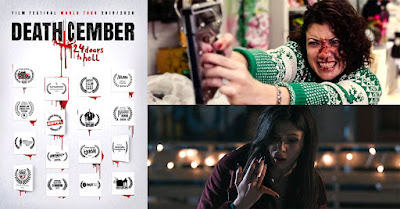
A fairly quick shout out for a 2019 Christmas movie called Deathcember. It’s basically a bit like The ABCs Of Death movies in that it’s a collection of short films based around Christmas death (and sometimes horror) by a variety of international directors, some of them quite famous such as Ruggero Deodato, Andreas Marschall, Lucky McKee and Pollyanna McIntosh. The film is advertised as being 24 films but there are actually 26 short movies in this one, as there are also two additional movies mid and post end credits.

The film starts off with the camera swooping over a computer generated snowscape which finds a cemetery with borders that are shaped like the Star of David. The camera wanders around from various gravestones on which credits for the movie are found before moving up and out of the cemetery to take in the film’s title and then going into a cabin. Inside the cabin, which includes an upside down Christmas Tree (the anti-Christmas?) the camera starts moving around a room and then it will stop on an object. The outline of an advent calendar door will then appear around that section of the screen before opening and allowing the camera to swoop inside the door to access each segment.

As you would expect from this kind of portmanteau movie, it’s a hit and miss affair but, I’d have to say on this one that most of the segments are at least interesting and it’s never a dull affair. I’d say more hit than miss but, at the same time, don’t expect too many of them to really knock your socks off. There are some nice ideas though, such as a greedy, advent calendar chocolate binging child finding himself suddenly turned to chocolate and inside an advent calendar himself, as his sister then eats him. There were some definite highlights for me too...

All Sales Fatal by Michael Varrati was a nice one of an unsatisfied customer trying to return her Christmas purchase because she’s changed her mind but the store won’t refund her without a receipt. Anger wells up and she and the sales guy get suddenly involved in a brutal fight to the death before the, admittedly obvious, punchline moment of that particular story. X-Mas On Fire by Florian Frerichs is not such a great idea but it is quite entertaining, depicting a heist gone wrong. It also has a nice few moments of Reservoir Dogs parody in it. Bob Pipe’s door, The Hunchback of Burg Hayn is a black and white silent movie and nicely captures the style, albeit with a big dollop of humour, of a 1920s Hollywood production. Andreas Marschall’s door Pig is probably going to be big with the strange modern brand of feminists. When a man is marked up with a big P on his jacket, mimicking Fritz Lang’s movie M, a brutal retribution is visited on a guy by a group of vengeful women. However, when he is unmasked and one of them exclaims to the others that it’s the wrong guy... the brutality continues under the guise of “There are no wrong ones.”

There were some wrong ones for me though and, one of the segments, a spectacular looking science fiction piece called 3rd December 2389AD, mainly failed for me because I just didn’t understand what the heck was going on in it at all. But that’s probably more to do with me than the quality of the actual film. Probably my three favourites in this collection were Crappy Christmas (terrible title) by Juergen Kling, December The 19th by Milan Todorovic and Five Deaths In Blood Red by Ama Lea.

Crappy Christmas is an animated short in the style of a claymation movie. It includes what is certainly the most inventive death of the film (and of most movies, I suspect) which I will only describe as the ‘viagra catapult cock through the head’ death, involving a Bishop... and I’ll leave that there but, yeah, you need to see it. December The Nineteenth is a short tale about two girls about to embark on a lesbian relationship, who have their first date, as it were, by going ice skating together at night. However, the first time skater is so bad at it that she ends up causing the other to first break one finger before she accidentally slices off the fingers of her other hand with her skates, eventually ending up with her ice skate accidentally embedded in the other girl’s face before meeting her own accidental death. It’s stylish and funny. Five Deaths In Blood Red is exactly as it sounds, a mini giallo parody and it really captures the style of the early to mid-1970s gialli by the likes of Sergio Martino in its too short running time. There is some nice music in this segment too by Eduardo Daniel Victoria, which hovers between slightly out of kilter, 1970s US slasher mode but also some lovely giallo homages in its make-up which really help push the comparison.

And that’s me pretty much done on Deathcember. I think  the notes I took while watching this one were longer than the review this time but looking at them, there’s not much else I’d want to elabourate on, I think. The movie is exactly what you’d expect from these kind of ‘film collective’ movies and it doesn’t scrimp on the violence/goriness and even adds some very occasional nudity. It’s not fantastic but it’s certainly entertaining enough to ensure that the nearly two and a half hour running time breezes by and it continues to hold the interest. Definitely not a bad film to watch if you want something both violent and funny to check out over the Christmas period.

Thursday, 16 December 2021

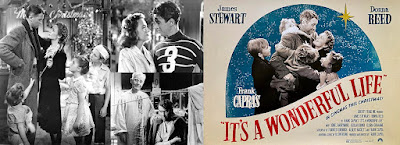
It's A Wonderful Life


Mary Christmas

It's A Wonderful Life
USA 1946 Directed by Frank Capra
Liberty Films/Paramount
Blu Ray Zone B


Warning: Small spoilers... like the ending.

Well, I’m not even sure how to start a review of what is, frankly, one of the best known and most loved films in the history of cinema (and rightly so). I mean, is there much I can say that hasn’t been said about It's A Wonderful Life a million times by others before me in a much more interesting and eloquent way than I? Well, possibly not but I do have the odd observation to add and some of the stories behind the production can never be repeated enough, I think.

The film, the first directed by the very successful Frank Capra to be shot at RKO studios under his own co-partnered company Liberty Films (after a string of hits directing for other producers), is most definitely the greatest Christmas movie ever made, even though the plot of the movie is not actually dependent on it being Christmas at all and, indeed, much of the film is not set during Christmas.
The basic plot, which I’ll explain very quickly, involves the great James Stewart as George Bailey. The film has a very dark prologue and a very brave one, after a load of despairing voices heard over establishing shots of the film’s sole setting, Bedford Falls, are heard praying to God to help out George in his hour of need. The audio of one of his young daughters crying out “Please God, something’s the matter with daddy!” within the first minute or so is all it takes nowadays to start the tear ducts flowing and turn me into a blubbery mess for the remainder of the film’s quite lengthy (for it’s time) 130 minute running time.

We then get that incredibly brave shot of just a static image of stars lighting up whenever one of them ‘speaks’... representing God and his chief angel, talking... which lasts almost two minutes (turn the sound off and you’ll see why that’s incredibly brave... but the dialogue is riveting and saves it). Another angel, Clarence (AS2, Angel Second Class, who hasn’t won his wings yet), played by Henry Travers, is assigned with the task of helping out George Bailey and then he (and the audience) are shown stories from George’s life from when he was a kid and rescued his little brother (losing the hearing in his left ear for his trouble) and right up until the events to which Clarence is needed to act as his Guardian Angel (which doesn’t come until an astonishing hour and 40 minutes into the substantial running time).

After an absolutely brilliant movie up until this point, George considers taking his own life by jumping off a bridge into an icy river so his family and the Bailey Buildings And Loan Company, which he has been trying to hold together for all these years and which is in big trouble, can benefit from the life insurance policy that he has in his pocket. Okay, there’s all kinds of things wrong with that but, assuming the death is taken as accidental, then that policy would be no good anyway, surely, because it would go and get all soggy and unreadable in the river after the deed is done? Well, despite this, Clarence jumps in the river instead so George can rescue him and get an introduction. He then acts as a kind of ‘Ghost of Christmas That Could Have Been’ when he introduces a scenario where George Bailey was never born and how bad things in the world would be if this common man, trapped in the town of Bedford Falls all his life without being able to travel the world as he intended, hadn’t touched so many lives.

The final straw is when he sees his wife Mary, played by Donna Reed, shunning him, having grown up an old maid who runs the library (now the Pottersville Library after the films chief villain Mr. Potter, played by Lionel Barrymore). This is hardly a ‘Mary Christmas’. He prays to God to live again and then things get fixed, ending with a, perhaps uncomfortable, resolution where the sudden procurement of individual financial wealth is lionised within the ending of the movie.

Rounding out the cast of amazing actors in the film are Thomas Mitchell as Uncle Billy, Ward Bond as Bert the cop, Frank Faylen as Ernie the cab driver (husband of Carol Hughes, who played Dale Arden in the third Flash Gordon serial, reviewed here) and the amazing Gloria Grahame as Violet, the local, um... local bad gal (check out the brilliant, recent movie Film Stars Don’t Die In Liverpool for an account of the last year or so of her life... reviewed by me here). Alongside too many actors to name and they’re all good in this, every single one of them.

And the script is absolutely pitch perfect and manages to flesh out a lot of those supporting characters very quickly and with small sketches so that you believe in every one of them and can fill in their back story, to a degree, with the little shorthand, throwaway dialogue worked into the screenplay.
It had a lot of development in the script stages too, with the original short story on which it’s based distributed as Christmas cards to a small number of people, written by Philip Van Doren Stern, re-crafted as an absolute epic movie...

Some of the various versions of some of those alternate scripts have left little clues to their intent in the final product. For instance, Uncle Billy was originally a larger role and much use was apparently made of his affinity with animals and his curiously large assortment of pets. Indeed in at least one scene you’ll see his pet Raven on the loose and in the scene where tragedy has struck and he’s left crying at his desk by an infuriated and desperate George Bailey, you’ll see mice, various birds and, at the end of the shot, a squirrel which jumps onto the desk to try and comfort him... which must all have been a hangover from one of the previous versions of the screenplay.

Other variations are not obviously present in any shape or form in the final product... for example, there’s no evidence in this that there was once an ending where George Bailey had to fight the corrupt Government doppelgänger of himself and kill him to end the alternate reality. Yeah. that would have been a much different film.

Something I noticed this time around, in a truly gorgeous Blu Ray restoration job from Paramount (please people, don’t ever purchase or watch the silly colourised version... that is an object of evil put on the Earth as an ultimate crime against filmanity) was that the villain of the piece, Mr. Potter, has a little, ornate, precious metal skull on the desk in his office. Oh, and those set dressings are worth looking at... you’ll see a lot of things in the details. Such as a whole raft of pre-production publicity stills of the cast used as photographs in the little office space George has created for himself in his and Mary’s home.

Another thing of note... apart from a grown up Alfalfa from The Little Rascals having a bit of a moment in the film’s early scenes with the dance hall/swimming pool... would be that Donna Reed actually managed to knock out the window of the old house that Mary and George would make their home by herself with her first shot (which is pretty amazing considering the distance). Also, the big crash just after drunk Uncle Billy exits screen right was a sound guy accidentally dropping some equipment leading to James Stewart’s laugh and Thomas Mitchell’s off-screen ad lib of “I’m alright... I’m all-right!” earned the perpetrator a $10 bonus from the director for improving the film.

And a big thing which may well ruin the movie for you if you let it... the film was shot on big sets at RKO in June. A blazing summer and, indeed, in the middle of a heatwave which was so hot Capra sent the cast home to recuperate one day. However, it looks just like Winter and the effects team created, for the first time ever, a special snow compound, earning a Class III Scientific or Technical Award from the Academy of Motion Picture Arts and Sciences for their efforts. Indeed, it’s more or less the same way snow in films is done today and is much better than the dyed cornflakes or asbestos used prior to this.

Dimitri Tiomkin’s score is special too (what survives of it in the finished film, there were a lot of additional needle drops here) and, since I don’t know for sure which bits were his and which bits were borrowed, I won’t say too much about it. But it does more than just illustrate the scenes, providing immediate foreshadowing to the next scene, for instance, when George hears the news his father has had a stroke and you suddenly hear the Funeral March woven into the score. Great cinematography too, considering the number of cinematographers who worked on it and how consistent it looks. Capra has some wonderful shot set ups. For example, the washing line which Clarence and George use to dry their clothes on after the bridge jump scene forms a diagonal which is used to compartmentalise the actors within the shot.

One last thing... I mentioned about the brave static shot at the start of the movie, pulled off with just winking lights and great audio... well another extremely unusual moment for a 1940s movie (possibly the first time this was done, I’m hearing) is when James Stewart first enters the picture as the adult version of George Bailey. When his face is clearly visible and turns to the camera, Capra freezes the frame for a good long while as the various angels talk about Bailey’s face. Again, it’s kinda bold for the time to just stop the picture like this (I bet Godard loved this film, I need to find out) and, once again, the brilliant dialogue and voice acting covers up the sudden lack of flow and doesn’t really pop you out of the picture. Another wonderful moment in a film full of them.

And that’s as much as I’ll say on It’s A Wonderful Life for just a short review but I’d urge you to both read up on it in various books and, above all, watch this movie because it’s amazing. As is the new Blu Ray transfer which also includes a nice featurette about the restoration process, another one on various ‘secrets’ (I never realised how many matte painting plates were used to help flesh out the backdrops in the film) and a rare piece of ‘home movie’ footage of the final wrap up picnic with the cast and crew. So yeah, a wonderful film made better and preserved with modern restoration techniques. I’ve never seen it looking so good (even at the cinema, over the years). This is one for the ages and, despite it’s failure on its original release (helping seal the fate of Capra’s short lived Liberty Films), its reputation has grown over the years and it’s now recognised, as it should be, as one of the pinnacles of the art of American cinema. Not much comes close to this one, for sure.

Wednesday, 15 December 2021

My 2100th Blog Post - Al Adamson The Masterpiece Collection


My 2100th Post

Al Adamson -
The Masterpiece Collection
Review Index

Blu Ray Boxed Edition
Severin Films


Wow, that last 100 posts sailed by quick. That’s what you get from saving on time by not having to commute to the office in a pandemic. Talking of which, I saved not only in time last year but in cash too due to not having to shell out for various different bus line tickets. So, if you’ve been following my blog for the past year, you’ll know I diverted and invested that cash into something worthwhile, aka I shelled out for the wonderful Blu Ray box set put out by Severin in the US, Al Adamson - The Masterpiece Collection... boasting 32 films plus assorted other extras. I reviewed the stunning documentary film Blood And Flesh - The Reel Life And Ghastly Death of Al Adamson last July and then, starting from this March, I began to methodically work my way through the contents in the order the films are threaded in the box... and reviewed each and every one of them. So I thought, why not do an index to my reviews of the titles in this for my 2100th Blog Post? Then, any of my readers who have enjoyed the Adamson reviews I’ve put up here can find them all easily in one place.

Well, it seemed like a good idea and so here it is, with the contents of each disc including the various extras listed (some of which I haven’t got around to watching yet but I’ve seen all the presented films). Most of these discs also include trailers or TV spots, which I’ve not bothered to reiterate in this listing. Please note that two of the reviews listed in this overview of the set were from different sources. I’d already written a review of Dracula VS Frankenstein for a separate release and so didn’t really need to rewrite it (although I obviously did revisit the film itself, on Severin’s beautiful new transfer) and I also reviewed the Vinegar Syndrome edition of Dr. Dracula because it had the whole film on it (plus the original, superior version of the movie)... click on the title of each full movie listed to take you to my review of it.

Disc One
Blood And Flesh - The Reel Life And Ghastly Death Of Al Adamson
Outtakes, The Cowboy Life Of Denver Dixon,
Russ Tamblyn’s Melted TV, Manson and Screaming Angels,
The Prophetic Screenplay Makes Gary Kent Testify,
Beyond The Earth Promo Reel


The Female Bunch
The Bunch Speaks Out, Extended Scenes


Disc Two
Psycho-A-Go-Go
Blood Of Ghastly Horror
The Fiend With The Electronic Brain

Archived Audio Commentary with Producer/Distributor Samuel M Sherman,
Alternate title sequence as Man With The Synthetic Brain


Disc Three
Half Way To Hell

Five Bloody Graves
Outside Of Tucson Interview with actor/screenwriter Robert Dix,
Partial Archival Audio Commentary with Producer/Distributor Samuel M Sherman,
Alternate Five Bloody Days To Tombstone Title Sequence


Disc Four
Blood Of Dracula’s Castle
Partial Audio Commentary with expert Brian Albright,
Audio Interview excerpt with Alex D’Arcy


Horror Of The Blood Monsters
Partial Archival Audio Commentary with Producer/Distributor Samuel M Sherman,
Alternate Space Mission Of The Lost Planet Title Sequence


Disc Five
The Fakers
Alternate Smashing The Crime Syndicate Titles

Hell’s Bloody Devils
Archival Audio Commentary with Producer/Distributor Samuel M Sherman,
Sam Sherman interviews actor John Gabriel


Disc Six
Dracula Vs Frankenstein (my old Cheezy Flicks edition review)
Archival Audio Commentary with Producer/Distributor Samuel M Sherman,
Zandor And Friends,
Feed Your Head! Lose Your Head!,
Monster Protest Home Movie Footage,
Sam Sherman interviews Forry Ackerman, Outtakes


Brain Of Blood
Partial Archival Audio Commentary with Producer/Distributor Samuel M Sherman,
Memories Of Blood


Disc Seven
Satan’s Sadists
Archival Audio Commentary with Producer/Distributor Samuel M Sherman, Outtakes

Angels’ Wild Women


Disc Eight
The Naughty Stewardesses
Archival Audio Commentary with Producer/Distributor Samuel M Sherman,
Fly Girls - The Stewardess as Lifestyle Icon in the Golden Age of Exploitation Film


Blazing Stewardesses
Archival Audio Commentary with Producer/Distributor Samuel M Sherman,
Alternate The Great Truck Robbery Title Sequence,
Bedroom Stewardesses Adamson Footage


Disc Nine
Girls For Rent
Archival Audio Commentary with Producer/Distributor Samuel M Sherman,
Alternate I Spit On Your Corpse Title Sequence


Jessi’s Girls

Nurses For Sale


Disc Ten
Black Heat
Partial Archival Audio Commentary with Producer/Distributor Samuel M Sherman,
Alternate Girls Hotel Title Sequence, Alternate The Murder Gang Title Sequence


The Dynamite Brothers


Disc Eleven
Mean Mother
Partial Archival Audio Commentary with Producer/Distributor Samuel M Sherman,
The Joy Of Marilyn Joi


Uncle Tom’s Cabin


Disc Twelve
Black Samurai

Death Dimension


Disc Thirteen
Sunset Cove
Sunset Toolbox

Cinderella 2000
Partial Archival Audio Commentary with Producer/Distributor Samuel M Sherman

Nurse Sherri
Dr. Dracula Adamson scenes

BONUS REVIEW: Vinegar Syndrome’s release of Lucifer’s Women/Dr. Dracula 


Disc Fourteen
Carnival Magic
A Boon To Science, Audio Commentary by Producer Elvin Feltner, Outtakes

Lost
The Happy Hobo - Rushes For Promo from unproduced Adamson kid’s film.

And there you have it. I must say, I had a really good time with most of this boxed set and even the truly terrible movies contributed to me rediscovering my passion for film. I hope you had a good time reading about them (if you clicked on any of the links) as I did writing about them.

Tuesday, 14 December 2021

Lost


Dog Days

Lost
USA 1982
Directed by Al Adamson
Severin Blu Ray Zone A


Although it’s not the last footage he shot for a potential movie, Lost is the last film that Al Adamson directed that got any kind of commercial release and it’s one of those films which seems to have been missing in action for some time. Indeed, the 16mm 1.37:1 print which Severin have scanned in and preserved for this, the final stop in their brilliant Blu Ray boxed set, Al Adamson - The Masterpiece Collection, isn’t in the best shape when compared to some of the other, much older films in this collection.

The film carries on in the direction that Adamson found himself going at this point in his life, with a pleasant and heartwarming (at least in its intention) family film, much like the far superior Carnival Magic was (reviewed here) but, for my money, this just wasn’t as engaging a film as that one.

The film stars the main male protagonist of that previous film... sorry, I meant the main male ‘human’ protagonist of that film, Don Stewart as Jeff Morrison, a new husband from a family who has just been divorced. Playing his new wife is none other than Sandra Dee as Penny Morrison (yes, that Sandra Dee, the once teen star immortalised in a song from Grease decades after her time in the spotlight) and the film is about both them and the real main protagonists of the picture, her eleven year old daughter Buddy (played by Sheila Newhouse) and their dog Skipper (played by Skipper The Dog).

The family have just moved to the mountainous wilderness of Utah to start a farm in a beat up old shack to make a fresh start for themselves. And it goes through several clichés you would expect from that set up... Buddy is not getting on well with her ‘new father’ and missing her divorced dad, the whole ‘town folks having a hard time trying to start a farm’ situation but being befriended by the locals, the kid being teased at school and, the old classic, helping out on the neighbouring farm and rescuing the horses during a fire.

And then, around half way through the film, Buddy runs off with Skipper and gets lost in the mountains for three days while her family worry about her and join various search parties to try and rescue her. More clichés, of course, such as being washed away in a river, reuniting with her dog, catching her own fish, nearly being killed by a cougar but escaping in a similarly perilous river and ultimately befriending an old man in the wilderness, who is a guest appearance by the one and only Jack Elam.

Of course, all is well in the end but the film is just a whole lot more clumsier than I would expect from even Adamson, with some choppy editing which I suspect is as much to do with not getting coverage on the shots and scenes as it is to do with anything else. He and his cinematographer do try though and there are some interesting shots within the smaller aspect ratio which are well done, such as where they use the cross sections of big window frames from outside the cabin to frame the face of one of the actors in one square while another actor stands way behind and to the left, taking up the length of two squared off window sections, thus pushing the depth of the shot. So, yeah, there’s nice stuff in it but it mostly just felt sloppily done, I have to say.

The acting was all pretty good though. Probably the best one in it was Skipper The Dog although, you do get that common thing happening in canine starring movies where the dog is looking off shot to their owner, waiting for a visual cue as to what they have to do next in the scene (this seems to happen with humans in porn movies a lot too, from what I can remember). In fact, there’s one annoying moment when Buddy and Skipper are on their lonesome on a mountain where, if you check out the bottom left corner of the shot, you can see the shadow of the dog’s owner moving around from off frame.

The music is a bit too syrupy and generic for my liking and, truth be told, it kinda works against the images in some ways. I couldn’t find a composer's credit so I’m guessing the producers used needle drops from a music library for this one, like a fair few of Adamson’s past films. It’s not something which stays with you in any way and I certainly couldn’t find a uniting theme or connection to any of the pieces used throughout the course of the movie.

And I’m not sure I’ve got too much more to say about Lost other than I’m wondering if it’s a somehow cursed film because this was the last released feature film for Al Adamson, Sandra Dee, Ken Curtis, William Kerwin and Sheila Newhouse (as the eleven year old Buddy, it was also her first screen role and she did quite well so I don’t know why nobody used her again). It’s not a film I would really recommend to anybody but it is a milestone for me because this means I’ve finally watched the huge boxed set of Adamson’s films that Severin put out (and sold out of fairly quickly) last year. Tomorrow, I hope to put up one final review which will serve as both an overview of the box contents plus an index link to my reviews for all the other films to be found in this Severin edition (for anyone who wants to read through them all).

Monday, 13 December 2021

Infinite


The
Regeneration
Game


Infinite
Paramount USA  2021
Directed by Antoine Fuqua


Warning: Plot spoilers, I guess.

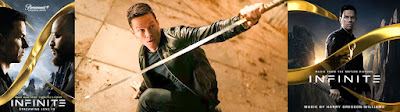
Infinite is a new science fiction action adventure based on a relatively new novel, The Reincarnationist Papers, by D. Eric Maikranz. Now, this information surprised me because the story is very much a riff in the vein of a Philip K. Dick kind of concept and yes, it’s yet another of these recent sci-fi movies which feels like it's exploring concepts from 1950s science fiction, it seems to me. However, it’s a nice enough concept but... it’s kind of wasted the way it’s been presented here.

The Infinite of the title is the name a certain, smallish underground section of the population give to themselves. They are basically people who, from adolescence, can now recall all their past lives leading up to this point... so they don’t have to learn new skills and are pretty much experienced at everything they’ve tried their hand at for thousands of years. When they die, their soul is just reborn into another body and so on. However, the Infinites are split into two warring factions. There are the Believers... the good guys of the film who want to use their special skills to benefit mankind... and the Nihilists, the bad guys of the story who want to destroy the world so they don’t have to keep coming back in new bodies.

To this end, many years ago, the main villain Bathhurst, played by Chiwetel Ejiofor (who nearly always makes a good villain but he seems to have some truly terrible lines here... much like all his costars in this), invented an egg of destruction which, when activated, will wipe out all life on the planet. In a blistering car chase action sequence at the start of the movie we see a character, one of three Believers who die in the opening sequence, steal the destructive egg and we are told later that he has ‘hidden’ it somewhere. Why Bathhurst can’t make another one is not really made clear but, anyway, it’s up to the Nihilists to find the egg so they can destroy humanity and the Believers to find the egg to keep it hidden or, preferably, destroy it. However, nobody knows where the main action hero at the start of the movie hid it before his death.

Enter Marky Mark Wahlburg. That character has now been reborn into his character, Evan. However, he doesn’t know he’s an Infinite because of him being treated as a schizophrenic throughout his life (and the tin plate in his head doesn’t help either). However, when both factions of Infinites realise it’s him, the Believers nab him from under the noses of the Nihilists and start trying to ‘jog his memory’ about the heroic action man he really is and, more importantly, where he hid the egg.

And that’s the main set up and I won’t say much about the plot. All the actors including those just mentioned and the likes of Sophie Cookson, Dylan O’ Brien, Toby Jones, Liz Carr, Jóhannes Haukur Jóhannesson and Jason Mantzoukas... are all pretty good. However, the dialogue they are asked to deliver in the film is, generally, not. Take the aforementioned Ejiofor, for example. We’ve seen him play a villain in numerous films and he’s always so threatening and not someone to be trifled with. Here, however, nothing much he’s saying is worth listening too and that goes for pretty much all of the other characters in this. The only redeeming moment in his character is the fact that, with the beard and black costume choices he has, he does tend to come off as a kind of knock of Roger Delgado as The Master (from the Jon Pertwee era of Doctor Who), so I was at least able to enjoy his performance on that level.

Another huge problem is the opening of the movie. It starts off with this truly brilliant action sequence (rendered less effective by some rubbish rap song over a lot of it) but... it’s the best set piece in the movie. It’s too strong and makes all the other action sequences in the film which follow look bad in comparison. And I’m sorry but, Marky Mark riding his bike off a really high cliff in Scotland and managing to land it on the wing of a plane which has already been in the air for two minutes really doesn’t help things. This film is definitely going for the action stakes but, as far as I’m concerned at any rate, it really fails to deliver for a lot of the time. Don’t get me wrong, the film is entertaining enough and the kicks, punches, slices and explosions are fine... they just aren’t enough to save it and, coupled with the script... yeah, I was a bit underwhelmed by the whole thing. And I still can’t figure out why a secret society would advertise their whereabouts to the enemy by flying around in aircraft with a big Möbius strip logo on the side.

What I wasn’t underwhelmed with was the action score provided by the great Harry Gregson-Williams. This was, frankly, the only reason I bothered to see the movie, it has to be said, as I'd already bought a copy of the limited edition CD release from La La Land records and I wanted to hear how it played in the movie before listening to it as a stand alone. And how it plays in the movie is... mixed way too low when it could have been way better highlighted against all the bangs and pops of the drab action sequences. But I know the CD will get a fair few spins so, at least there’s that. Thanks to the company for allowing La La Land to put this one out.

And... not much more to say about this one. The film has some nice concepts such as an electronic acupuncture machine to help stimulate memory and a gun that fires bullets which capture the souls of Infinites so they can’t resurrect again, stored in a computer chip instead but... the execution seems lousy on this one, for some reason. Things just don’t seem to be either pumped up enough or gritty enough to be consistently watchable and, yeah, well I won’t be watching Infinite again anyway, I would say. If you like sci-fi action movies then it’s not absolutely terrible and it’s not too dull a diversion of an evening. Just don’t go in expecting an epic.

Sunday, 12 December 2021

Buck Rogers In The 25th Century


Cool As Buck

Buck Rogers In
The 25th Century

USA 1979 Directed by Daniel Haller

Buck Rogers In
The 25th Century

Airdates:
Sept 1979 - March 1980 Season 1
January - April 1981 Season 2
Blu Ray Zone B


I can't remember if it was Shanklin, Scarborough or somewhere like Eastbourne when I first became aware of a book sitting on a store bookshelf... but it would have been something like May or June and I was on holiday with my parents. I spied the paperback copies of Buck Rogers In The 25th Century and Buck Rogers 2 - That Man On Beta (apparently based on an unfilmed screenplay) on the shelf and I pestered my dad to buy me the first one. I was already on board with Buck Rogers because of the fantastic 1930s serial starring Buster Crabbe (reviewed by me here). But, it was expensive... I think it might have been 75p or even maybe 95p. An expensive, luxury item. So he said no. Even so, I knew I would be on holiday in the general area over the next few days and so I took note that the book shop stayed open late on a Thursday night, when it usually shut at 5pm.

Anyway, sometime the next day, my dad and I were trying to remember the name of a specific Gene Kelly musical where three army buddies are reunited a year or two after the war to find they had nothing in common. We just couldn’t think of it but then I had a brainwave. “It’s Always Fair Weather!” I shouted gleefully. “No.” said my dad. “I’m pretty sure it’s not that. “I’m sure it is.” I said... “What do you want to bet?” He said our usual bet of something like either 5 pence or a million pounds. I said, “Tell you what... If I’m right... you buy me that Buck Rogers book from that bookshop! It will give me something to read on the train.” It was Thursday... the day before we took off for home. He said fine because he had two things he was almost certain of... a) The name of that film surely wasn’t that and b) the bookshop shut at 5pm and we wouldn’t be able to get near it until 6pm. So he agreed and, somewhere, we found a store where we could look the information up in a book (no internet in those days, remember).  And yes, I was completely right, the film we’d been trying to remember was It’s Always Fair Weather and so he conceded he’d take me around to the bookshop later, knowing in his mind that it would have already closed. Imagine his surprise (he never lived it down) when he found the bookshop was still open and he had to buy me the novel, which I read from cover to cover very quickly... so much so that I was able to convince him to buy me the sequel a few weeks later.

Now, I think there must have been a lag on the UK cinema release date because it’s listed as July 1979 but I would have been on holiday early June in those days and so it maybe came a little later to cinemas just outside of London (Enfield Town is nowadays considered part of London, in fact). So I remember waiting a few months and seeing the film and loving it. Then, later, a TV show which, somehow never seemed to live up to the film and which got pretty bad in its second season. So it was an absolute pleasure catching up to these again on Blu Ray.

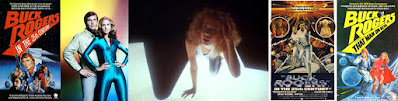
The film was originally made as the first of a series of TV movies but Universal decided it was looking so good that they decided to do it properly, as a theatrical version. And that version is also available on the current Blu Ray and it's like chalk and cheese to the later, pilot version recut of mostly the same material. It’s also not quite as dark as the version of the story in the novel, which was written from an earlier draft of the script. That being said, it was still fairly adult in tone, starting off with an almost James Bond title sequence with an actual title song (the TV show opening theme was an instrumental of this) and Buck (played by Gil Gerard) laying on the titles with scantily clad, super sexed-up versions of co-stars Erin Gray (playing Wilma Deering) and Pamela Hensley (playing Princess Ardala, who I first saw in the Doc Savage movie, reviewed here) crawling over his unconscious body in a suggestive manner. Indeed, the film is definitely more adult in tone, even though the first season of the show was extremely sexualised in its plot concerns (with some great costumes to match).

I remember someone once told me that if I looked at Gil Gerard in a fight in any episode of the TV show, he hardly ever (I think it happens just once) throws a punch... instead, every time the character gets into a fight, he just kicks people a lot. It looks quite ridiculous and feels way too theatrical but, in the original movie version, he does indeed throw the odd punch or two... which is nice. There are also some very adult lines in the theatrical cut of the movie, such as Buck turning down Wilma’s sexual advances with the line “I’m 500 years old and have to go easy on re-entry.”

The film also starred Henry Silva as Kane (aka Killer Kane), Tim O’Connor as Dr. Huer, Felix Silla as android Twiki (voiced by none other than Bugs Bunny man Mel Blanc), Eric Server as Dr. Theopolis and Dr. No himself, Joseph Wiseman as Ardala’s father. Wiseman was dropped completely from the TV show and, asides from the pilot film which was, as I said, a retooled version of the theatrical release... with the title sequence replaced by something far tamer, lots of adult lines removed or redubbed, the death of a character called Tigerman (amongst others) deleted and a few scenes of Buck’s new 25th century apartment added in... Michael Ansara took over as Kane, replacing Henry Silva.

And it’s a fun film. I absolutely loved it as a kid and I quite enjoyed it now, it has to be said. The TV show is more adventures on future Earth - Buck was frozen in the near future of 1987 for 500 years in a space shuttle, as opposed to the dirigible he was cryogenically frozen in for the serial - with Buck helping out his ‘high up’ friends and completing missions for them... for the first season, at least.

And there are some great guest stars in the first series too... such as Tamara Dobson (that’s Cleopatra Jones to you), a young (on the brink of success) Jamie Lee Curtis, Frank Gorshin, Jack Palance, Gary Coleman (Watchoo talking ‘bout Willis?), Leigh McCloskey (from Dario Argento’s Inferno) and even the tragic playmate Dorothy Stratton. Probably my favourite guest star was an early episode with an appearance by an ageing Buster Crabbe, the original Buck Rogers, starring as a character named somewhat after the other famous science fiction hero he played, ‘Brigadier’ Gordon.

The show has a lot of good, ‘of its time’ writing and action and Pamela Hensley returns every now and again to start invasions, strange conspiracies and cosmic wars... all because Buck refuses to be her boyfriend. In this way, she’s almost a carbon copy of the role Marta DuBois played in the TV show Tales Of The Gold Monkey (reviewed here)... or vice versa, come to think of it.

It was a fun show but Gerard didn’t get on well with the producers and was trouble on the set, apparently, for taking it all too seriously (well that’s kinda what you want, isn’t it?). When the second season began, there was a complete change. Most of the characters and actors who played them were replaced with new ones. Dr. Huer, Dr. Theopolis, Ardala and Kane are all gone. Instead we have new regulars Hawk (an alien bird man played by Thom Christopher), Dr. Goodfellow (played by Wilfrid Hyde-White), a second robot called Crichton (voiced by Jeff David) and Jay Garner as Admiral Asimov, who is indeed name checked as being an ancestor of popular science fiction writer Isaac Asimov (his famous three laws of robotics are quoted often in the second season). And with Mel Blanc being ill for the first handful of episodes, Twiki’s voice was changed to some kind of high pitched thing, before dropping back to Mel Blanc with no explanation whatsoever. Future Hollywood star Dennis Haysbert also turns up as a semi-regular bridge crew member in the second season.

Not only that, the show was no longer taking place on Earth but on a starship called Searcher, as Buck and the crew would basically ‘seek out new life and new civilisations’ around the galaxy, which made it another Star Trek/Battlestar Galactica clone and something far from the concept of the original Buck Rogers created by Philip Nowlan in the original novel and subsequent comic strip adventures in the earlier half of the 20th century.

There was an actors strike that year which held up production and, after that and considering their troubled relationship with the lead actor (apparently), Universal pulled the plug after only 11 episodes of Season 2. By then, though, there were less good episodes than bad, it has to be said.

That being said, the bad episodes are still quite fun looking back at them now, even though the designs and costumes took a big quality drop in the second season. The original starfighters in the movie and first season (and rarely seen in the second), which were reject concepts from the aforementioned Battlestar Galactica, were absolutely beautiful. And the costumes were... well... they definitely didn’t hide a lot of the various actors and actresses from episode to episode. Even the wise ass robot Twiki, who was picking up the old 20th Century lingo from Buck, was a well designed thing which you can see was probably influenced by Star Wars to some extent but, only in that you can trace the lineage of both him and the more famous C3PO right back to Brigitte Helm’s robotrix in Fritz Lang’s Metropolis (reviewed here). In comparison, the second season looks like nobody had any money to shoot proper special effects let alone put money into the sets... with the exception being the wonderful looking bird craft belonging to Hawk.

And that’s me done for a good long while, I think, with Buck Rogers In The 25th Century... not forgetting a quick shout out to Stu Phillips who composed the score to the movie (and several other interesting composers on the show)... not to mention Kip Lennon on vocals on the original, amazing vocal version of the Buck Rogers theme tune. I’m not sure I’d recommend this to everyone, for sure... however, if you liked the show in the 1970s, you might have some fun still with it now. It’s not for everyone these days but I’m glad I saw these again and, you never know, I might revisit again in another decade, if I’m still around myself.

Friday, 10 December 2021

Adrienne


Concerning
Unbelievable
Truths


Adrienne
USA 2021
Directed by Andy Ostroy
HBO


I never really react much when favourite film stars or composers die. I see people on Twitter proclaiming their grief and always wonder why the heck the person is so vocal and shook up about it, considering he or she’s never likely to have even met or corresponded with that person. Maybe I’m demonstrating what psychiatrists call an ‘absence of appropriate affect’ but, yeah, I never really understood it.

Except once.

I remember going on to the internet one day in 2006 on my lunch hour at the office and reading that Adrienne Shelley had been found dead in her flat, a suspected suicide. That one really hit me and I remember tearing up and trying to figure out why the heck I was reacting that way? I’d never met her and she was as distant to me as another planet in the heavens but, yeah, she was an actress I really empathised with, it turns out. I’d only seen her in three things... two films by my favourite living director Hal Hartley, called The Unbelievable Truth and Trust and also a random TV episode of a show called Early Edition. They were the first two feature length films by Hal and were also Adrienne’s first two films ever. I’d never seen a single episode of Early Edition, before or since but, I remember seeing a trailer for the show and, upon seeing Adrienne was in it, I made a point of watching it. So, yeah, something obviously clicked and I was also looking forward to a new film she’d apparently written and directed (and appeared in) called Waitress at the time. I felt grief over her passing for, I dunno, some inexplicable reason, being that it was for someone who I never knew but even more so when it was later discovered she’d been murdered (it was originally a suspected suicide but, when you see this beautiful documentary, you’ll see how ridiculous it was that anyone could ever believe it).

The actress had everything about to really come together for her. She didn’t know it yet but, a few days or so after her untimely death at the age of 40, leaving behind her loving husband and daughter, Waitress was accepted into the Sundance festival. It went on to become a hit movie and was then adapted into a very long running, successful stage musical... but she was not around to experience her success.

This documentary, Adrienne, is certainly about her life but, perhaps somewhat more so, it’s about the husband Andy Ostroy and their daughter Sophie, who were left behind and how they dealt with it. How they are continuing to deal with it. It’s directed by Mr. Ostroy and there’s much less of the ‘talking to the stars’ aspect than you might think of in this kind of movie. I mean, sure, there are various interview moments from the likes of Robert John Burke, Hal Hartley, Cheryl Hines, Kerri Russell, Nathan Fillion, Paul Rudd and various friends and family... and it all paints a wonderful picture of Adrienne. However, this documentary is also, I dunno, it’s plays as something like an exorcism of bad spirits or at least an acknowledgement of the struggle of the surviving family members.

It’s structure and focus, which then allows us to slip into a continuing look at Shelley’s personal story, is of Andy and Sophie. Andy also remembered the many difficult but heart tugging conversations he had with his daughter, who was just three when her mummy left them, and the two have reconstructed the conversations as voices in some lovely, very moving little line drawing animated sections which punctuate the movie at regular intervals. I have to say... maybe it’s more to do with me getting old but I started tearing up a little from about two minutes into the film and didn’t really let up until after it had finished.

This first two minutes or so show a Halloween party that Shelley was at (or had thrown) the night before her untimely death at the age of 40 and she looks so happy with her daughter and where she was in her life that, when you think of it, it was preposterous that the police could, for even one minute, believe this was a suicide. And so the film also starts to highlight Andy’s story of getting the police to investigate the case seriously and getting an arrest and confession very quickly (as it turns out, yeah I remember at the time it was a quick turn around on the media), due to a smart cop who spotted a feint trace of construction dust and a tell tale footprint in Shelley’s bath tub, where the killer had staged the murder to look like a suicide.

While this piece highlights the good work of The Adrienne Shelly Foundation, set up by Andy to help women filmmakers get projects made, the film builds to a moment when the killer agrees to Andy’s request to meet with him in jail, where he is about 15 years into a 25 year sentence. That’s an interesting interview and I’m not a hundred percent sure of what to make of it... so I’m not going to judge that sequence because I don’t have any real understanding of how both parties are dealing with their actions, emotions and consequences at that time but, yeah, it maybe brings a certain amount of closure to the audience, if not to the people caught up in the events.

At the end of the day, Adrienne is an absolutely wonderful tribute to one of the unsung, or at least underseen, geniuses of the art of cinema (writing, acting and directing) and, also, for me personally, as I’ve been putting off watching Waitress for the first time for years because I’m still upset about Shelley’s death... it’s a wake up call to get it out of the ‘to watch’ pile on the other side of the room where I type this. Also to explore a fair few other things she either co-starred in, wrote or directed... which I had no idea she was even involved with. So that’s something else I have to squeeze into the next couple of years, if I can find these films. Needless to say, I think Andy Ostroy has made a bold and beautiful film here and I would recommend it to anyone. I hope this one gets a Blu Ray release at some point because I’d like a proper physical edition on the shelf.

Thursday, 9 December 2021

Bird Box


Don’t look now...
or ever


Bird Box
USA 2018
Directed by Susanne Bier


Warning: Light spoilers.

I’ve been hearing about Bird Box for some time and Twitter was full of it when it was released back in 2018. I was reluctant to see it as it didn’t have a cinema release and I was hesitant to watch stuff for free before the coronavirus pandemic (the more things don’t get released in a proper, distanced cinema venue though... and the less they are released as a proper Blu Ray, then my reluctance to bother paying for a different venue increases... cinema equals big experience and shop window, Blu Ray equals the actual product you can hold in your hand... don’t try and fob people off with this digital “from the ether” rubbish, it’s not the real thing, end of story). And then, of course, there was the Bird Box challenge, which consisted of people trying to travel or drive long distances while blindfolded, causing a fair few accidents in the process is my understanding and prompting a certain distancing to this behaviour from the evil studio involved in the production of the film. Personally, when it comes to blindfolds, I’d rather take the Nine And A Half Weeks challenge myself but, hey, to each their own.

Other than that, though, I knew absolutely nothing about Bird Box other than it starred Sandra Bullock, who seems to me to be a fine actress. I’ve not read the source novel (although I think I will need to now because certain elements of the film seem to have been left deliberately ambiguous and maybe they weren’t so much in the book?) so I can’t tell you how close it is to that but, I can say it’s a fine film.

It starts off very strongly too, with Bullock’s character Mallory telling two five year old children they are going on a long, perilous journey where they will not take their blindfolds off and if they do, she will hurt them. This is a grim set up and, indeed, the premise of the film is quite a downer, as we see the small family making their way to a boat to go down the river to a possible sanctuary. We then flash back to five years before, at the start of the events which lead to this, where we have the single but pregnant Mallory and her sister going to hospital to check up on her incoming sprog. They ignore the news that, in various countries, there have been devastating mass suicides among the people for the last half a day. Then, as they leave the hospital, it starts where they are and there is pandemonium. Mallory’s sister kills herself after they crash their car but Mallory manages to get to relative safety in a house with some people, including the two male leads for the film, the less than likeable Douglas, played by John Malkovich... and Bullock’s potential romantic interest Tom, played by Trevante Rhodes.

The problem is... there are things out there. Things you can’t really see but, if you happen to glance in the direction of one (often indicated as an invisible presence by leaves swirling about and the words of long dead loved ones calling out to a person to look at them) you will either kill yourself or, in the case of a select few humans (usually the already mentally unbalanced ones), you will align yourself with whatever is doing this and try to compel, by force, any other humans to look and die. And it’s these rogue human elements which do the most harm in this movie, as they’re less easy to spot or control and, since a survivor is likely to be blindfolded when out in the wild, it makes them easy prey as opposed to these human sympathisers who can see what’s going on. All the survivors have as an extra help is the birds in a box or cage, as the title suggests. Birds go frantic whenever one of these creatures is near although, to be fair, not so much is made of this in the movie version, at least, to warrant this as the title of the work, in my opinion.

And it’s really not a bad little sci-fi horror film. It’s not that scary, truth be told and, it is a little predictable but it has a nice structure which flashes back and forth between the journey Mallory is now on with the two kids and the various incidents along the way which happened over the five years which get her to that point. And there is some nice foreshadowing to the audience of events which have happened but we have not been shown yet, in the form of things like a child’s toy suddenly making it clear that not both of these kids are Mallory’s (which we’d kinda figured out but it’s made implicit which one isn’t hers before we are shown the how and why in a flashback scene).

And it’s a nice, entertaining slice of post apocalyptic movie making done right... I’d put it up there with the classics of the genre and far surpassing films which almost but, didn’t quite, get a similar premise right... such as The Happening. Also, it does what a lot of these kind of films do, something which a lot of zombie apocalypse films especially seem to pride themselves on doing (or rather not doing) in that it leaves the antagonist manifestation or whatever the heck that’s doing this completely unexplained. You never have a sense of what or why on this thing and that really helps serve the story because it a) doesn’t get dulled down with having to overly explain it all and b) makes for more drama as the humans can try and work their way around the mystery.

So, yeah, all in all I’d say Bird Box is a pretty good movie and I’d certainly recommend it for fans of post apocalyptic science fiction and, to an extent, fans of certain kinds of horror films too. I’ve now had to purchase an expensive and hard to get (in the UK) but brand new and unused Blu Ray on demand for my dad because, frankly, he loves Sandra Bullock movies and that would be the only way he’d get to see this (shame on certain companies for not making it in a more accessible format like this in the first place). But yeah, good little movie, a shame about the way in which it’s been released (which is becoming the new normal and it really shouldn’t be allowed to be).

Wednesday, 8 December 2021

She Wolf Of London


Werewolf By Gaslight

She Wolf Of London
aka The Curse Of The Allenbys
USA 1946 Directed by Jean Yarbrough
Universal Blu Ray Zone B


Warning: Huge spoilers from the outset.

Okay, so this film has highlighted to me a bizarre and interesting thing about the way the Internet works, or doesn’t work, for no good reason that I can figure out. Here’s the thing... when I climbed onto my Macbook for the cast list on the IMDB and typed in She Wolf Of London, I had absolutely no problem finding this film, all well and good. However, prior to this, when I typed it into the IMDB app on my iPhone, well, it’s a different story. You type that title in and you will not have a chance of finding this film (at time of writing in the UK). I found it by knowing one of the actors and retracing it to the year but, on my iPhone IMDB app, the film is only locatable if you type in the title The Curse Of The Allenbys.

So, the internet version of IMDB tells me that this is what the film is known as in the UK. Well, I could certainly understand if the original title was replaced because... big spoiler here... there’s actually no werewolf in this movie. So the title implying a wonderful female lycanthrope is just hogwash and will, I’m sure, be as much as a disappointment to most audiences as it was to me when I first saw it decades ago. That being said, I have to tell you, I’ve been living in the UK for 53 years now and this is the first time I’ve ever heard of The Curse Of The Allenbys as a title. All my previous DVD versions of the film included in various sets, from the US or the UK, have always carried the title She Wolf Of London. So I don’t know what’s going on with the regional versions of the IMDB app but, someone really should address this issue and sort it out.

Now then, I mentioned I was disappointed with the film on my prior viewings and, I’d have to say that the same holds true now. Don’t get me wrong, there are a few points of interest and some nice things happening and I’ll get to all those in a minute but, really this is a not too clever, watchable but unimpressive film. And, like I said, there is no actual monster in this one and it certainly isn’t a horror story. This film would best be described as a ‘gaslighting’ thriller so... yeah... why it’s always marketed as part of the Universal Classic Horror movies and bundled in with their various werewolf films is anybody’s guess. I’m thinking there were less werewolf movies so they needed to add a film to trick the customers into thinking they are getting value for money at the price point. That’s my best guess at that one, anyway.

The film stars June Lockhart, future star of the TV show Lost In Space, as young Phyllis Allenby, sole heir to her parents sizeable country estate in London, living with her Aunt (who is really the housekeeper her father nearly married but she doesn’t necessarily know that), played by Sara Haden and her Aunt’s daughter played by Jan Wiley. Allenby is about to marry her sweetheart Barry, played by Don Porter but she suddenly calls things off when locals are either mutilated or murdered by an unknown ‘beast woman’. She fears it’s herself doing it because of the famous (and non-existent except as a silly legend) Allenby Curse, which says members of the family will... well it’s all a bit obscure but, basically, she thinks she must be turning into a werewolf and feeding off the locals in her sleep.

Meanwhile we have a local police detective played wonderfully by Lloyd Corrigan on the case, answering to his boss played by the one and only Dennis Hoey. Of course, fans of the Basil Rathbone/Nigel Bruce Sherlock Holmes film series will know Hoey as the much put upon Inspector Lestrade who was a regular in the series and, honestly, his role here really isn’t any different from that.

And there are some good things about the film including some nicely done compositions. For example, bearing in mind it’s shot in the standard 1.33:1 aspect ratio of the time, the director manages to still split the screen into thirds in one shot, using vertical lines made up from the environment to show all the main action of this particular moment in the middle sliver of a space. Nicely done. Later on, towards the end of the film when the ‘Aunt’ brings Phyllis her drugged milk in order to murder her, the director uses very oblique Dutch angles from shot to shot at odds with each other to accent the Aunt’s sinister intentions. So yeah, some very nice stuff but... it’s just not a great story.

Even the first time I saw it I was suspecting the Aunt of gaslighting Phyliss and committing the local murders herself (leaving the blood on the hands and clothes of the drugged Allenby at night, after she does so) within the first ten minutes and that was before I even suspected there was going to be no werewolf in the film. In fact, that’s the only thing which stops most audiences from seeing through the trick straight away, I suspect. The fact that the film is (whether the IMDB believes this or not) called She Wolf Of London, implying the presence of a supernatural creature... re-enforced by the fact that Phyliss is seen reading a book called Lycanthropy - The Werewolf Legacy at one point.

And not much more to say. Sara Haden’s performance is outstanding, especially when she lets her ‘crazy’ show before her accidental demise at the end of the movie and... so is Corrigan, as the bumbling detective. June Lockhart is okay, I guess but, she’s playing such a weak and shilly shally whiner of a character that I have absolutely no sympathy at all for this person, so obviously born with a silver spoon in her mouth that, by the end, I really wish the aunt had ‘done her in’, in the parlance of the film, because she’s just so irritating.

So, yeah, that’s me done with She Wolf Of London and it’s kind of doubtful that I’ll ever bother revisiting it again now this review is written. Not really worthy of being included in the classic Universal Horror canon, especially since it’s really only a modern marketing designation, I suspect. Nice performances, nicely made... a bit of a duff movie, in all honesty.


Tuesday, 7 December 2021

Godzilla VS Mechagodzilla


Missile-Toe Monster

Godzilla VS Mechagodzilla
aka Gojira tai Mekagojira
aka Godzilla VS The Bionic Monster
Japan 1974
Directed by Jun Fukuda
Criterion Blu Ray Zone B


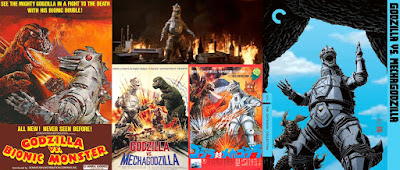
Well this one’s a bit if a fun romp. It’s nonsense with a capital G* but Godzilla VS Mechagodzilla, the penultimate film of the Showa Era Godzilla movies highlighted in Criterion’s recent Blu Ray set, is actually one of the better entries from this period. It also looks like it had a better budget than what the Godzilla films had deteriorated to in the last few outings and there’s very little recycled footage (apart from one major piece which I’ll get to in a minute... but it doesn’t last very long).

Okay, so the plot consists of two groups of main protagonists linked by one of each group being the brother of the other. One lot, including a good guy professor, is working on a piece of flat metal found in a cave. His conclusion is that the metal is ‘space titanium’ and so there must be some evil aliens up to no good somewhere (he’s not wrong... astonishingly). Meanwhile, a mini statue of local Okinawan monster deity King Caesar is found in another cavern... except the evil aliens are also after that. Why? Because it’s a key piece in enabling a gazillions of years old prophecy about a big monster arriving to destroy the world and then, when the sun sets in the West, two monsters teaming up to defeat it.

This prophecy is reenforced early in the film when a young girl doing her ritualistic ceremony at the House Of Azumi temple, where King Caesar is supposed to be the symbolic guardian, collapses momentarily when she has a vision of a big monster attacking the city. Now, this vision is the bit of recycled footage I mentioned a couple of paragraphs ago, since the monster in the dream seems to be King Ghidorah footage from another film. This is the only time, though, that Ghidorah is seen in this picture because the giant monster which comes in later is something else... so, yeah... this vision makes absolutely no sense and we could really have done without the visual heads up. Thanks a bunch, kaiju writers.

And from hereon in it's all shenanigans afoot. Godzilla surfaces and starts acting like a villain trying to destroy the city. So suddenly he’s a bad guy except... no he’s not. Isn’t it strange that Godzilla’s pal Anguirus is trying to fight Godzilla, getting defeated in a gory combat which sees Anguirus defeated and in retreat? However, it’s not before he knocks a bit of scale off of Godzilla to show a gleaming surface underneath. Then, when another Godzilla joins the fray, at the request of Anguirus, he also gets bashed up pretty badly but... not before he reveals to the world that he was being framed by tearing the outer skin off of the other Godzilla, to the point where it changes into its true self... Mechagodzilla! The Big G does manage to break Mecha-G’s head and the aliens bring it back to their secret base for repairs. Godzilla then finds a big thunderstorm on an island and, in a first since his affinity with electricity was first established 20 years earlier in Gojira (reviewed here), Godzilla charges himself up with the lightning bolts from the storm.

Meanwhile, a gunman has been trying to get the King Caeser statue from an archaeology gal and her friend, the professor’s nephew. When the gunman gets shot in the face for his trouble, half of said face goes through a shimmery transformation to reveal that he’s some kind of space ape. He is defeated by one of the secret Interpol agents who had been acting... just sinisterly enough... to make the audience think that they were the bad guys in this.

While all this stuff is happening, the aliens kidnap the professor and force him to fix Mechagodzilla’s head. It’s at this point I have to ask again, why? Since they invented and built the thing themselves... why would it be that the ‘aliens from Black Hole Planet No 3’ would need an Earth scientist to help them fix their creation. I have no idea what’s going on here anymore. However, as you can imagine, the whole thing leads to a big fight between Mechagodzilla... who has finger rockets, destructive laser vision and who can shoot missiles from his metallic toes... and Godzilla, helped by the long dormant King Caeser, who is revived in a ritual by the lady who had the vision earlier in the film.

Things get bloody in the later combat too, with Godzilla leaking some big jets of red, arterial spray from his neck courtesy of his mechanical counterpart (a monster inspired by Mechani-Kong from King Kong Escapes, reviewed here). Plus there's a nasty moment where Mecha-G shoots multiple hypodermic syringes into Godzilla for... well, for no apparent reason. However, things get resolved when, in a first for the series, The Big G somehow uses his electrical charge to turn himself into a giant electromagnet, to bring Mechagodzilla towards him just before, with King Caesar’s aid, he rips off the robotic antagonist’s head.

There’s a big escape and destroy sequence cross cut with this fight, which also makes use of arterial spray. When the professor and the Interpol man helping him use the professor’s ‘special pipe’ with magical properties of being able to shut down electrical currents to help themselves escape (now days we’d call it something which shuts down things with an EMF pulse) and when the leader of the aliens gets shot, we get black blood spraying out of his neck before he, too, turns into an actor in a bad ape face mask... with extra little sticky out bits jutting out to presumably denote his alien leader status.

And that’s about it. There’s not a great deal of inventive shot design going on in this one and in some of the effects shots, the wires are clearly visible (especially so when watching this in a high definition format). This film also features the very last score that the great Japanese composer Masaru Satô did for a Godzilla film although, I have to say, it’s not one of his best. He does, however, manage to invoke the piece of leitmotif established for Godzilla by composer Akira Ifukube in this in a couple of places by, literally, playing just the first, long held note and then ignoring the other notes because the musical phrase is so well known by this point that you kind of fill in the rest of it in your head. Ifukube himself would actually return for the next and final film in the Showa Era Godzilla film series, a direct sequel to this one.

Godzilla VS Mechagodzilla is a fun if full-on nonsensical film which, in all honesty, utilises a much better looking design for the film’s titular antagonist than the one revealed in this year’s Godzilla VS Kong movie (reviewed here). It’s pacey, action packed and the only real downside is that the director seems to have really discovered the way hand held photography can be used to lend a certain chaotic dynamic to a shot... to the point where it was actually making me feel a little nauseous in one sequence. However, like I said, one of the better of the later Showa Era films and, of course, the Mechagodzilla would also turn up in many films to come. And rightly so... flying, mechanical kaiju are always a welcome addition to any film, in my book.

*So that would be Gnonsense then.

Monday, 6 December 2021

Doctor Who Flux - The Vanquishers


Split Infinity

Doctor Who Flux
Chapter Six - The Vanquishers

Airdate: 5th December 2021
BBC 1


Warning: More spoilers.

Wow... saved the universe again then.

The final part of Doctor Who Flux, The Vanquishers was, well, it was a bit anti-climactic really. Once again Jodie Whittaker as The Doctor, companioned with her regular ‘besties’ Yaz (Mandip Gill) and Dan (John Bishop) defend the Universe from the evil swarm. Teamed up with Professor Jericho, Bel, Vinder, The Dog Man, Kate Lethbridge-Stewart and Diane from previous episodes. And absolutely nothing is revealed about what the heck any of it is really about by the conclusion of the show.

The novelty aspect this week is The Doctor somehow fragmented and split into three splinters of herself to work with her companions in various time zones simultaneously to defeat the big bad guys The Swarm... and all the other monsters such as Sontarans, Cybermen and Daleks. As usual, the scriptwriters attempt to blind the audience with scientific jargon rather than explain the dynamics of both this transformation and the ultimate defeat of the Flux... and The Swarm. Well, okay, I kind of understood the clichéd old matter VS anti-matter tactic but, yeah, it seemed such a basic idea that one wonders why pretty much anyone in the rest of the universe hadn’t thought of it first.

So... acting was all very good and the old “contact” exclamation to establish a mental link, this time with two Doctors of the same incarnation, was a nice little Easter egg for long term fans who remember stories like The Three Doctors I guess (review coming to this blog in 2022, fingers crossed). They even threw in a character death to try to keep up the audience interest but, nah, it was an okayish episode I guess but that tactic didn’t really do much for me and it was telegraphed so early... and with a character who’s only been in the two previous episodes... that it felt a bit flat, to be honest.

The real kicker on this is the fact that, asides from The Doctor being aggressively warned by the essence of time manifesting as herself towards the end... we get no clue as to what this has all been about in terms of her past and her links to division. Indeed, the dog man even, it turns out, was once her loyal friend in the days she has no memory of... but if he ever talks about it, an implant put in his blood by The Division will let out a poison and he’d be dead within three seconds, so he can’t tell her anything. Vinder and Bel’s baby was an equal wash out... it’s possibly nobody special at all, unless they decide to bring these two characters back in one of the three specials next year.

So all we have left is a tearful Doctor, who is once again travelling the universe, this time with Yaz and Dan as her constant companions... and the Timelord pocket watch which holds all the memories which she’s lost. But, rather than open it and get full disclosure of her past lives, she instead buries it in the heart of the TARDIS with instructions for her to never be allowed to get a hold of it.

It’s interesting because the special effects were all fine (as much as they could be in a show which has a long standing history of having special effects which aren’t always that fine) and the episode was really going for a kind of epic look to it. However, for all the whiz bang glitz and light shows, it felt perhaps the least epic of any of the installments which made up this six part mini series and, certainly, not really something worthy of what some of the more interesting episodes this year have been teasingly building too. At least, that’s what I thought.

And so once again I am left with nothing much more to say about this one. Sorry it’s such a short review, again... but Doctor Who Flux - The Vanquishers really didn’t do much for me and, since the whole serial was so wedded to the underlying story arc, it kinda takes the other episodes down in flames with it too. I mean, it’s kinda okay but, yeah, maybe I’m expecting more from Doctor Who these days. I think we could really do with a return to form, to be honest. Not exactly my favourite episode or season and, well, I still think the writing needs to be less lazy on the science and, just a bit better than this. I love Jodie as The Doctor but, once again, I wouldn’t recommend this year’s series as being in any way special. But, you know, it’s just in a slump. That can change... I’ll be watching on New Year’s Day, for sure.

Sunday, 5 December 2021

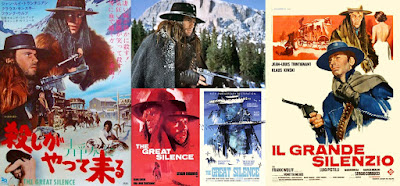
The Great Silence


Silence Still Golden

The Great Silence
aka The Big Silence
aka Ill Grande Silenzio
Italy/France 1968 Directed by Sergio Corbucci
Eureka Masters Of Cinema Blu Ray Zone B


Warning: Spoilers because, of course, you can’t
discuss a great work of cinema like The Great Silence
without talking about the amazing ending of the movie.


“They call him silence because wherever
he goes the silence of death follows.”
Vonetta McGee, Ill Grande Silenzio


The Great Silence is one of those films which will always be in my top two or three all time favourite Italian Westerns. I already talked about it a little in my 2013 look at some of the most powerful endings in cinema history, End Game (which you can read here if you so desire)... but I thought it was time to do a ‘clean review’ with the advent of the Eureka Masters Of Cinema label’s brand new restoration Blu Ray release because, well, the film has never looked better. Perhaps it’s even a little too good looking but... I’ll discuss that comment in a minute.

Now, mainly I suspect because of the films powerful and cynical ending, the film was not shown in some countries, such as the US and here in the UK, for a couple of decades. Banned maybe too strong a word for it in retrospect but, it was certainly stifled at birth as far as English speaking countries go... even though the majority of the actors in this one are lip synching (kind of) in English and the original English dub was made and thankfully still exists (which is probably the best choice to watch this on, given it's the language being spoken on set, which was also an unusual thing for an Italian western... where everybody usually just spoke their native language from whichever country they were born). So my first experience of this remarkable movie was when director Alex Cox showed it on his weekly film series Moviedrome in 1990, under the title The Big Silence... which I believe was the first ever screening in this country.

The plot is simple. A bunch of outlaws who are not really bad, just in unfortunate circumstances created by the officials in the town of Snow Hill and its environs, are being hunted by ruthless Bounty Killers and being shot dead for the reward, whether they give themselves up or not. One of these, Loco (as he is known on the English dub), played by the great Klaus Kinski, is doing a lot of damage to their poor, outlaw community who are hiding in the mountains. A new Sheriff, played by Frank Wolff, is sent to Snow Hill to pave a way for an amnesty for the outlaws. Something not wanted by Loco and the town’s banker Pollicut (who pretty much runs the place), played by Luigi Pistillo. But the so called outlaws have hired the great, law abiding assassin/hero Silence, played by Jean-Louis Trintignant, to help rid them of some of the bounty killers. And then, when Loco lawfully but unjustly kills the ‘outlaw’ husband of a local lady, played by Vonetta McGee, she herself hires Silence to put an end to Loco but, as anyone who’s seen this knows, things don’t play out as they would in a more formulaic spaghetti western, for sure.

Silence has his own reason to hate Pistilli’s character, as he slit his throat as a young lad to stop him from telling of the ‘murder for bounty money’ killing he took part of when murdering Silence’s parents in front of him. I don’t know how slitting the boys throat kept him from talking, since it’s clear Silence can still read and write but, yeah, this is perhaps the real reason he’s called Silence at any rate, in contradiction to that wonderful quote from Vonetta McGee’s character, which I put at the top of this review. Well, that and the fact that Trintignant couldn’t speak English. 

Another thing about the character is that he carries an automatic weapon, a German Mauser (a 7.63mm Mauser C96 ‘Broomhandle’ version) in this, which is not a common thing for characters in Spaghetti Western cinema and which most people assume is an anachronism, although these pistols were actually first manufactured two years before the setting of the film... so this overlap with ‘the old West’ is actually distinctive but quite valid. I seem to remember Corbucci’s next Western, Il Mercenario, also has a main protagonist carrying an automatic pistol.

The film is beautifully shot with Corbucci and his cinematographer doing some nice things with the camera. In one shot, for instance, he uses the vertical slats of a prison cell to shoot through to delineate the space on screen and highlight characters in two rectangles... before moving in to highlight just one character, changing the focus as he does so, so that the bars blur out and disappear. It’s almost shot entirely in the snow too (and a lot of shaving foam, by all accounts)... which is unusual for a Western, to have it in a snowbound setting (although it’s not the only one). The director, who was responsible for a fair few good westerns originally wanted to shoot his classic Western Django in the snow but was turned down by the producers (hence, they ended up with a film shot in the mud, a bit like the last 20 minutes or so of Kurosawa’s Seven Samurai). However, Django was successful enough so that, by the time he got to making this movie, he was allowed his snow. And the print and transfer has never looked better but, as I intimated earlier, I’m not sure if the transfer it totally correct. The reason I say this is that in all versions of the film I’ve seen before, including screenings at cinemas, there were a few shots here and there at the start of the movie where a kind of Moiré pattern covered the entire shot. Some people have said this was caused by light reflecting on the lens but I don’t see how a simple light reflection could produce that kind of look. I don’t know what caused it and it seemed totally a non-sequitur to the visual continuity of the movie but it was strong enough that I always believed it was a patterned filter put over the camera for certain shots (don’t ask me why). In this new transfer, that patterning is almost entirely absent other than in part of a shot where it’s quickly glimpsed so... yeah... is this from a better source or has this been removed in the transfer process after the fact? The answer is... I don’t know but if anyone does, then please message me via the comments section at the bottom of this blog.

Asides from the wonderful cinematography, there are three other great strengths inherent in The Great Silence. The first one I should mention is that the performances by the wonderful cast are all excellent. Trintignant’s Silence is a powerful, silent figure and McGee is wonderful as the wronged spouse who falls in love with him, after hiring him to kill Loco. Kinski is absolutely wonderful when he’s playing a villain anyway (as he often did). The weasel face contradicted by the big, blue puppy dog eyes are the perfect look for a villainous presence on screen but the film is full of little acting details which go the extra mile, such as when Kinski licks his lead pencil before totting his kills up in his notebook. The supporting cast of Luigi Pistilli and Frank Wolff are wonderful too, with Wolff playing somewhat against type to play the likeable, truly honourable sheriff character (something you couldn’t say about a lot of sheriffs in Italian Westerns for sure). It struck me for the first time while I was revisiting this film again, when they shared a scene or two together, that Pistilli and Wolff both went on to kill themselves in real life (Wolff just three years after making this movie and Pistilli in 1996).

Asides from the acting, another big strength of the movie is the late, great Ennio Morricone’s amazing and sparsely spotted score. There’s not a huge amount of it (indeed, the 35 minutes that have been released on CD in the past is pretty much the entire score, from what I can make out) but it’s got a wonderfully elegiacal tone and is full of addictive melodies. This means it’s one of those movies to which I am constantly tapping my toes in time as I watch it, which is no bad thing.

Lastly, of course, there’s that ending. Big spoiler for this and don’t read this if you’ve not seen it and want to... you need to go in blind...

At the end of the film, Loco and his gang of evil bounty killers shoot Silence’s hands up, parodying Silence’s trademark move of shooting off the bad guy’s thumbs so they can’t use a gun against him. They then shoot him dead, then shoot dead his new girlfriend who hired him... and then massacre the roomful of innocent ‘outlaws’, men and women, who they have tied up to the bar in the saloon... “all in accordance with the law” as Loco remarks... and he and his group of truly evil bad guys ride off into the snow to commit evil deeds elsewhere. It’s a powerful ending and one which will surprise most first time watchers. Especially since the dialogue is peppered with foreshadowing throughout the film, highlighting the more expected ending of Loco getting his just and bloody desserts at the hands of the film’s main heroic protagonist, Silence.

The new Eureka Masters Of Cinema is definitely one to get for any fans of the movie. Transfer aside it’s loaded with amazing extras... some of which are legacy from other companies’ releases over the last 20 or so years and others which are brand new (to me at least). Everyone who has one of the previous releases will remember, for sure, the silent alternate ending scene, with the preposterous return of Wolff’s character (somehow alive after being dropped and sucked under a frozen lake) and the armour gauntlet reveal of the lead character... where Loco is indeed killed and the good guys have a happy ending. This release does this one... or two... better in that, in addition to Alex Cox’s commentary on the alternate ending, the non-commentary version of this actually now has the sound restored. So you can hear the original Italian dialogue (subtitled in English) for this silly scene. Not only that, but they’ve unearthed another alternate ending, which they call the ‘ambiguous’ ending and, honestly, it’s like a cut down version of the original ending where, by the ommission of most of it, Silence is wounded and everyone remains alive but so do the bad guys, who decide to just leave everyone alone and get out of there... or that’s what it seems like. I’ve no idea what we’re supposed to make of that version, to be honest.

But there’s more, including various behind the scenes featurettes, archival documentaries and also some new talks, including a wonderful fifteen minutes by Alex Cox himself. And, although I haven’t had a chance to explore these yet, there are three commentary tracks on here, including a recording of a live commentary that Alex Cox gave at a screening earlier this year (which I most certainly do need to listen to, for sure).

And that’s me done on The Great Silence. One of the all time greatest Westerns ever made (if you watch it with the proper, original ending) and an absolute joy from start to finish. Everyone who is interested in Western cinema should give this one a watch and I would recommend this one to pretty much everyone. And don’t snooze on the new Ltd Edition Blu Ray from Eureka Masters Of Cinema, which also has reversible artwork, a nice slipcase, a set of miniature, reproduction lobby cards and a double sided poster. A wonderful purchase and the most definitive release this film has ever had, I would say.